While Xiaomi is likely working to launch the Xiaomi 15 series of smartphones in China in October, its sub-brand Redmi is reportedly developing the Redmi K80 lineup, which could become official in November. To recall, the Redmi K70 and K70 Pro, which debuted last year, came equipped with a 5,000mAh battery and 120W fast charging support. Recent reports suggested that the Redmi K80 and K80 Pro may pack a 5,500mAh battery. However, a new leak suggests that the K80 series will have an even larger battery.
Redmi K80 series battery size tipped
Tipster Smart Pikachu claims that the Redmi K80 series, which originally planned to have a 5,500mAh battery, will now feature a larger battery capacity, likely starting with a 6. This indicates that the K80 and K80 Pro may house a 6,000mAh battery. Furthermore, the leaker revealed that the camera module of the Redmi K80 series will feature a streamlined design, positioned at the upper-left corner.
As per a previous leak, the Pro model will have a glass back and a metal frame. Expected features include a flat OLED panel with 2K resolution and a 120Hz refresh rate, a 50-megapixel telephoto camera with 3x optical zoom, and support for 120W rapid charging. Being a Pro variant, the device is expected to feature the latest Snapdragon 8 Gen 4 chipset. For security, it may feature an ultrasonic in-screen fingerprint sensor.
The Redmi K80, on the other hand, may house a 2K OLED panel with a 120Hz refresh rate and a Snapdragon 8 Gen 3 chipset. There is a possibility that the K80 and K80 Pro may get rebranded as the Poco F7 and F7 Pro in markets outside of China in 2025.
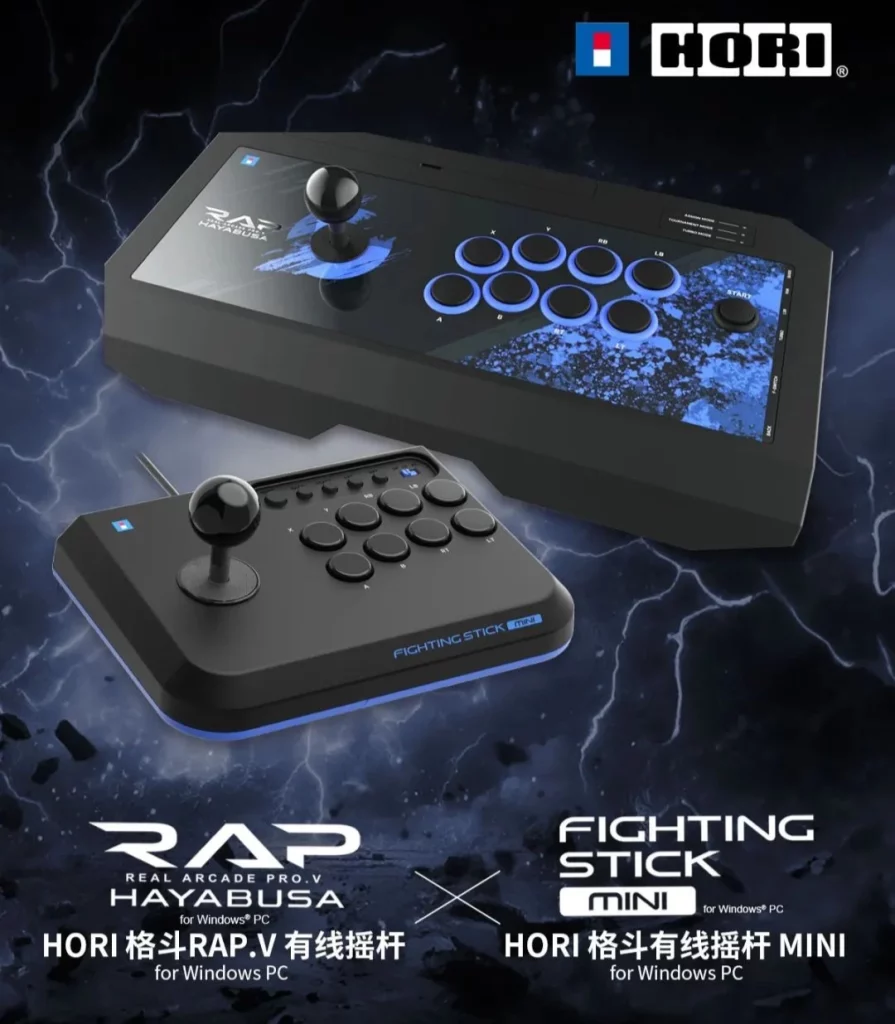
HORI has unveiled the Mini Fighting Joystick, a wired controller specifically designed for Windows PC gamers. Priced at 298 yuan (around $44 USD), the compact joystick boasts a size of 21 x 15 x 8.7 cm and weighs approximately 500g.
The Joystick uses a wired cable connection with a 2.5m cable length.
The Mini Fighting Joystick features analog controls that offer familiar and responsive control during fighting games. The low-resistance, concave thumbstick ensures smooth and precise inputs for those crucial in-game moments. Built with durability in mind, the controller can withstand the rigors of competitive gaming.
For a lag-free connection, the Mini Fighting Joystick utilizes a wired connection with a cable length of 2.5 meters. Compatibility extends beyond Windows 10/11 PCs – the controller also works with PlayStation 5 and 4 consoles, making it a versatile option for fighting game enthusiasts. The XInput mode ensures the joystick functions seamlessly with a wide range of PC games.
Despite earlier reports of production cuts, Tesla’s Shanghai Gigafactory is currently running at full capacity, according to a visit by Beijing News Shell Finance on July 15th. The factory’s Model Y production line is churning out a new car roughly every 30 seconds.
Tesla’s final assembly workshop uses a vertically-stacked, dual-line configuration
This news comes after concerns arose earlier this year about reduced production at the Shanghai plant. Reuters reported in May that Tesla planned to cut production by at least 20% between March and June 2024. Tesla China remained silent on the issue, and new car registration and export volumes did show a decline compared to the same period in 2023.
However, with the third quarter underway, Tesla appears to be ramping up production to meet its year-end targets. CEO Elon Musk has previously stated that the company expects to surpass last year’s car sales figures, and achieving this goal hinges on the Shanghai factory operating at full speed.
The report also highlights the factory’s impressive level of automation. Tesla’s final assembly workshop utilizes a vertically stacked, dual-line configuration, with vertical elevators transporting doors, bodies, and other components, saving nearly 100 meters of production line space. Additionally, the four workshops are interconnected, allowing for efficient movement of manufactured parts within the facility.
This high degree of automation translates to a staggering 95% fully automated production across the factory, with the welding workshop nearing 100% automation.
Beyond car production, Tesla is also making progress on its Shanghai Energy Storage Super Factory project. According to Tesla Vice President Tao Lin, the project remains on track for completion in 2025. This facility will focus on manufacturing Tesla’s flagship energy storage product, the Megapack.
Reports have claimed that Xiaomi will be the first brand to launch Snapdragon 8 Gen 4-powered smartphones this year. While Qualcomm is expected to announce the Snapdragon 8 Gen 4 in October, Xiaomi is said to launch the Xiaomi 15 and 15 Pro equipped with the new chip in the same month. At present, the rumor mill is leaking key details about the Xiaomi 15 series in bits and pieces. The latest leak, courtesy of reliable tipster Digital Chat Station, sheds light on the 15 series’ camera island deisgn and color options.
Xiaomi 15 series design leak (rumored)
According to the tipster, the entire Xiaomi 15 series will adopt a new design, eliminating the decorative studs on the camera module. Previously, the Xiaomi 14 and 14 Pro had a square-shaped camera module positioned in the upper-left corner, surrounded by a metal bezel with a Parisian hobnail texture, characterized by small, raised dots. The latest leak indicates that while the Xiaomi 15 series will retain the square camera module in the upper-left corner, it will likely not include the decorative studs.
The leak further suggests that the Xiaomi 15 and 15 Pro will come in standard colours like black, white, green, and bright silver, along with some special editions. Additionally, the series will be relatively thin and lightweight.
According to previous reports, the Xiaomi 15 will remain a compact flagship phone with a flat display, while the 15 Pro will be a larger device with a quad-curved screen. Both phones will have Xiaomi’s Dragon Crystal Glass protection for the screen. The series is expected to offer an IP69-rated dust and water resistance.
The standard model may come with a 4,800mAh or 4,9000mAh battery, as well as 100W fast charging and 50W wireless charging support. On the other hand, the Pro model may house a 5,400mAh battery with 120W fast charging and 80W wireless charging. A recent report claimed that the 15 Pro’s OmniVision OV50K 50-megapixel primary snapper will support a variable aperture of f/1.4-f/2.5. Apart from a 50-megapixel ultrawide lens, it may feature a 50-megapixel Sony IMX8-series periscope telephoto camera with 5x optical zoom.
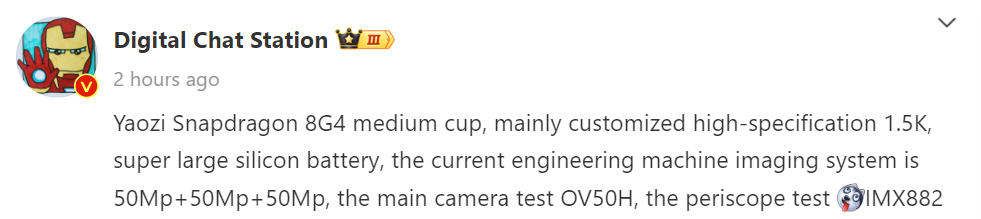
Honor has recently launched the Honor Magic V3 series of foldable phones, the MagicPad 2 tablet, and the Honor MagicBook Art 14 notebook in China. The brand is now reportedly working on the Magic 7 series of flagship phones. Today, tipster Digital Chat Station released a Weibo post to leak what appears to be the key specifications of the standard variant of the Magic 7.
Honor Magic 7 key specifications (rumored)
As per the leak, the Honor Magic 7 will feature a 1.5K resolution display and a large silicon battery. Three 50-megapixel cameras are reportedly present on the back of the current engineering prototype of the device.
He added that the device is being tested with an OmniVision OV50H primary camera and a Sony IMX882 periscope telephoto camera. The forthcoming Snapdragon 8 Gen 4 chipset will power the device.
Qualcomm is expected to announce the Snapdragon 8 Gen 4 chipset in October of this year. Many upcoming flagships, such as the Xiaomi 15 series, the iQOO 12, the OnePlus 13, the Realme GT 7 Pro, and so on are expected to feature the Snapdragon 8 Gen 4 SoC.
A recent leak revealed that one of the Magic 7 series phones will have an OLED panel supplied by Tandem, a Snapdragon 8 Gen 4 chipset, a 6,000mAh+ battery, and a 50-megapixel (OV50K, main) + 50-megapixel (OV50H) + 200-megapixel (Samsung HP3, telephoto) triple camera unit. These specs may belong to the Magic 7 Pro or Magic 7 Ultimate.
The Magic 6 series of smartphones was announced in January of this year. Hence, it is likely that the Magic 7 lineup may break cover in January 2025.
Amazon is introducing new bundles for cloud gaming, featuring a Fire TV Stick 4K or 4K Max paired with an Xbox Controller and a free month of Xbox Game Pass Ultimate.
This follows Microsoft’s partnership with Amazon to bring Xbox Cloud Gaming to Fire TV Sticks in over 25 countries starting July 2024. Xbox Game Pass Ultimate members can play games on the 2023 Fire TV Stick 4K Max and Fire TV Stick 4K using a Bluetooth-enabled wireless controller.
The Xbox app, available from the Amazon App Store, requires a Microsoft account, a compatible Fire TV Stick, and a reliable internet connection. This partnership provides a cost-effective alternative to a standalone Xbox streaming device or a dedicated gaming console, making gaming more accessible and convenient, especially for those without a console.
This setup allows you to play Xbox games without the need for a bulky console. Choose your preferred Fire TV Stick model and an Xbox Controller in your favorite color.
Pricing & availability
Amazon Prime members can get the best deals, with prices starting at$68.90 for the Fire TV Stick 4K bundle and $78.90 for the 4K Max bundle. Non-Prime members will find prices slightly higher.
In related news, Xbox is hosting a sweepstakes to win a limited-edition Deadpool wireless controller in celebration of the upcoming movie “Deadpool & Wolverine.” This unique controller features a design with a butt on the back. To enter, follow Xbox on X (formerly Twitter) and repost their official announcement by August 11th, 2024. The grand prize includes the controller and a custom Deadpool-themed Xbox Series X console with foam replicas of Deadpool’s katanas.
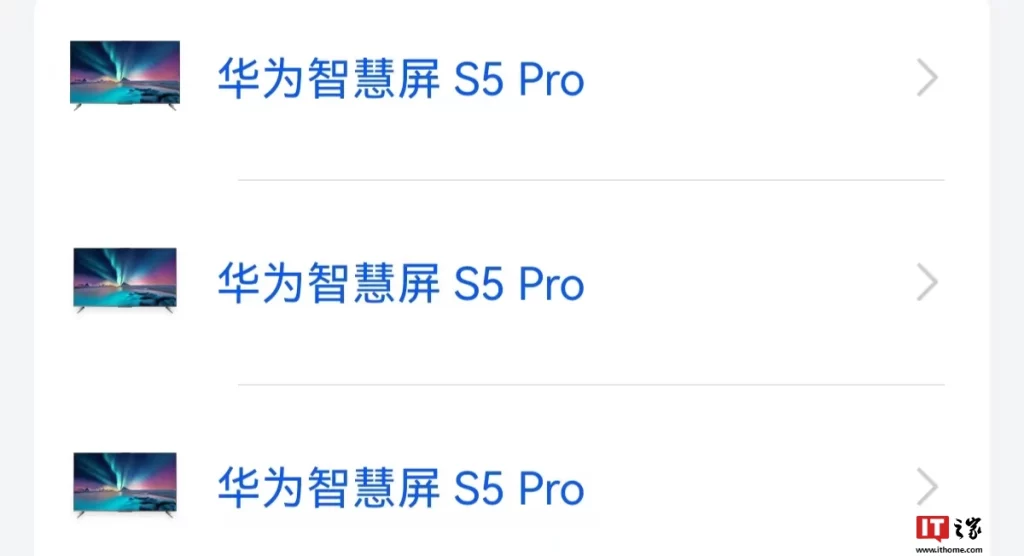
Tech enthusiasts received a glimpse of the upcoming Huawei Smart Screen S5 Pro on July 18th, as it appeared in the Huawei Smart Life App. The app currently allows users to bind the S5 Pro to their account, but detailed information about the device remains unavailable.
Huawei still has to release specific info like screen resolution, panel tech etc.
The size selection within the app hints at three different variants of the S5 Pro. However, specifics like screen resolution, panel technology, and processing power are yet to be revealed by Huawei.
Meanwhile, tech blogger Uncle of Kanshan has shed some light on the potential configurations and pricing for each S5 Pro version. While official confirmation is still pending, the launch date is expected to be around July 26th.
This news comes alongside announcements of other new Huawei products, including the Sound Joy2 Portable Speaker, Sound X 4 Speaker, Smart Screen S3 Pro Rhino Remote Control Kit, Huawei Routing BE 7, and Huawei FreeBuds 6i Wireless Headphones.
With the S5 Pro now appearing in the Smart Life App and rumors swirling, it seems like the company is gearing up for a product launch later this month. Stay tuned for further updates on the official specifications, pricing, and availability of the Huawei Smart Screen S5 Pro.
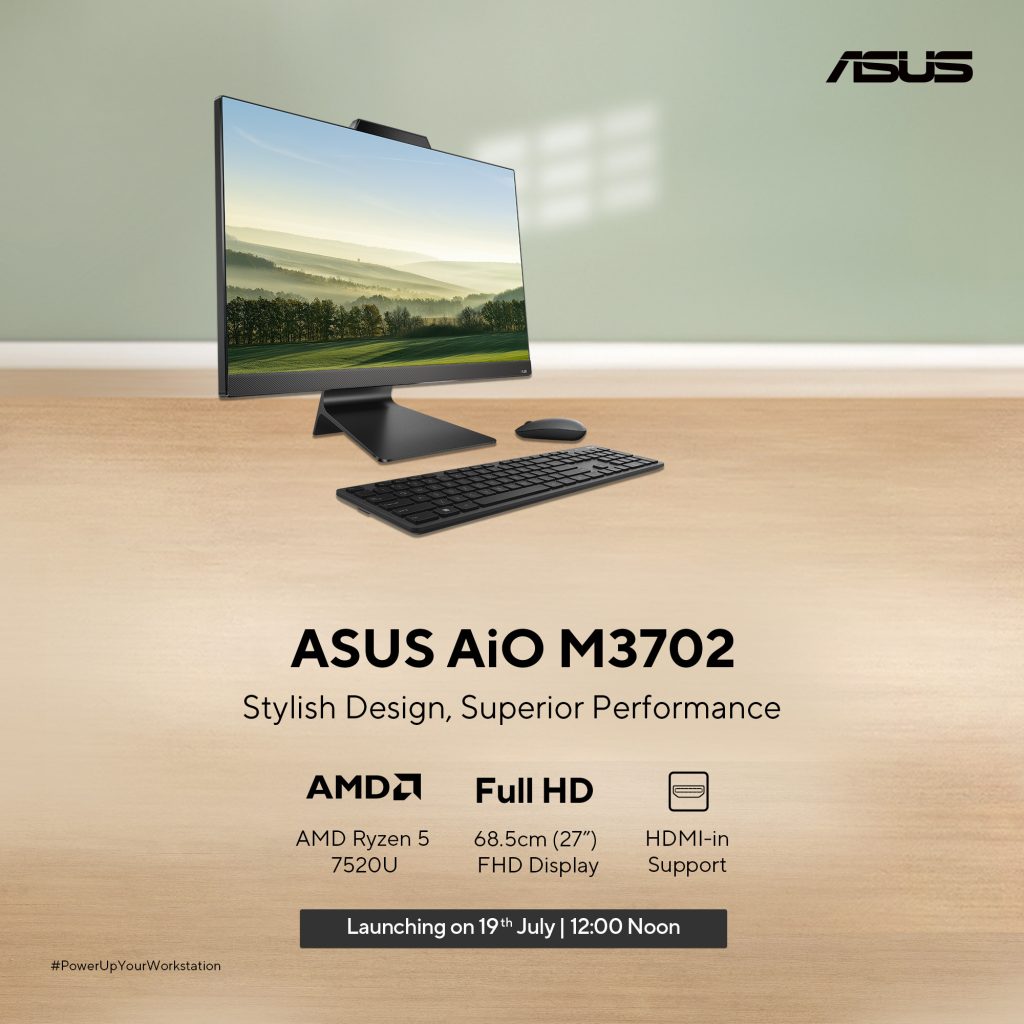
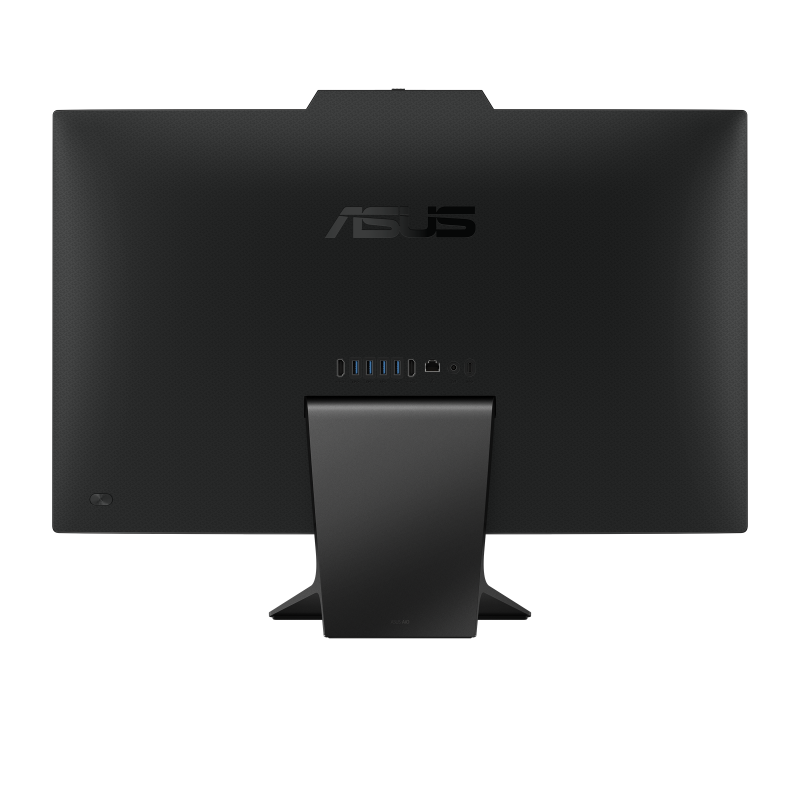
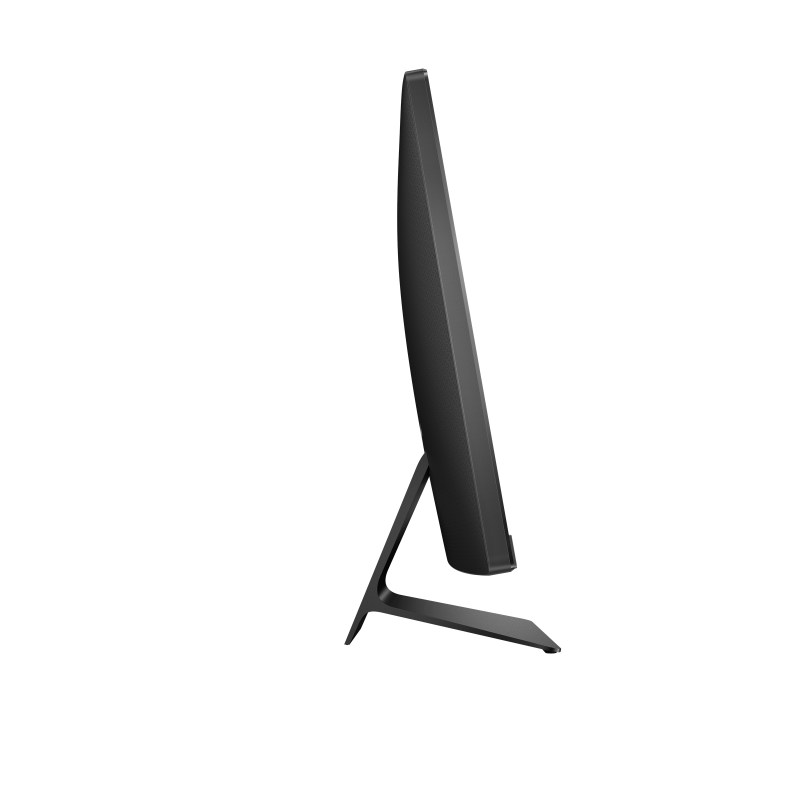
ASUS India is launching the M3702, an all-in-one PC designed for home and office use on July 19. This new machine will feature an AMD Ryzen mobile processor with an integrated GPU.
ASUS M3702 AIO PC specs:
The M3702 boasts a 27-inch Full HD anti-glare display with wide viewing angles and a 91% screen-to-body ratio. The display offers full coverage of the sRGB color gamut and comes with TÜV Rheinland certification ensuring reduced eye strain. For audio, it has built-in speakers with Dolby Atmos and built-in mics with two-way AI-powered noise cancelation.
The PC packs an AMD Ryzen 5 7520U mobile processor, with four Zen 2-based cores and 8 threads, offering a maximum clock speed of 4.1GHz. The processor has an integrated AMD Radeon 610M GPU based on the RDNA2 architecture and can handle some light gaming. The AIO comes with up to 1TB NVMe PCIe 3.0 SSD storage and 16GB LPDDR5 RAM. Windows 11 keeps you updated.
The connectivity ports include a 2-in-1 card reader for SD and MMC cards, a DC-in port, an RJ45 Gigabit Ethernet port, an HDMI out 1.4 port, an HDMI in 1.4 port, three USB 3.2 Gen 1 Type-A ports, one USB 2.0 Type-A port, and one USB 3.2 Gen 1 Type-C port. The PC also has a built-in camera with a privacy shutter.
Pricing & availability
The M3702’s Indian pricing and availability will be unveiled on July 17. This all-in-one PC is already available to purchase in multiple markets outside of India.
In related news, ASUS has introduced the ProArt 13 2024, a convertible laptop designed for creative professionals. It features an AMD Ryzen AI 9 HX 370 processor, RDNA 3.5 architecture graphics, and a powerful NPU. The laptop boasts a 2.8K OLED touchscreen with 100% P3 color gamut, 550 nits peak brightness, and stylus support. It is thin and light at 15.8mm and 1.38kg, with advanced cooling and a 73Wh battery.
Xiaomi has unveiled the MIJIA Faucet Water Purifier 2 in China. The new product comes with a long-lasting and washable filter element. Xiaomi says the filter can be used for up to six months before changing it. The release of the MIJIA Faucet Water Purifier 2 is coming a few months after the product appeared on a crowdfunding campaign.
The Xiaomi MIJIA Faucet Water Purifier 2 has an integrated structure and snap-on rotating assembly and disassembly. It can be directly hung on an existing faucet and deployed in different scenarios. The product supports a 5-layer composite filtration system that includes a high-density stainless steel filter, diatom mud ceramic filter element, and coconut shell activated carbon. It also comes with high-density non-woven fabric. The model, according to Xiaomi, effectively removes mud, rust, colloids, residual chlorine, insect eggs, and organic pollutants in the water.
The design of the faucet water purifier makes it possible to easily determine the condition of the filter element. The filter element is visible and can be easily cleaned. It can be repeatedly polished and scrubbed with sandpaper or scouring pad to retain its effectiveness. There are four filter cartridges in the package. This implies that you can theoretically use the device for up to two years without the need to buy a new filter cartridge. It is noted however that the cartridges are not compatible with the first-generation filter cartridges.
The flow rate of the Xiaomi MIJIA Faucet Water Purifier 2 is up to 3.4 liters/ minute. There are three water use modes available namely purified water, raw water, and shower water. It has a tuning knob that enables the user to switch between the modes. The MIJIA Faucet Water Purifier 2 is offered at an introductory price of 119 yuan ($16). The product will be available from July 19 in China. There are no global availability details yet for the MIJIA Faucet Water Purifier 2.
OpenAI continues its push to make advanced AI technology more accessible with the release of GPT-4o mini. This new model, touted as “the most powerful and cost-effective small model at present,” aims to expand the capabilities of OpenAI’s chatbots for a wider user base.
The GPT-4o is a more cost-effective version for users
Beyond its affordability, GPT-4o mini signifies a step towards OpenAI’s vision of “multimodal” AI. This future envisions a single tool capable of generating various media formats, including text, image, audio, and video. GPT-4o mini lays the groundwork by offering a foundation that can be integrated with these additional functionalities in the future.
OpenAI positions GPT-4o mini as a cost-effective solution, potentially making advanced AI features more accessible to developers and businesses. The rollout strategy further emphasizes this goal. Free users of ChatGPT will gain immediate access to GPT-4o mini, while Plus and Team users can utilize it starting today. Enterprise users will have access next week, suggesting a tiered system with basic functionality available for free and more advanced features reserved for paid subscriptions.
It’s important to remember that GPT-4o mini is derived from the recently released GPT-4o, OpenAI’s current powerhouse model. The “o” in the name signifies its “omnidirectional” capabilities, encompassing advancements in audio, video, and text functionalities across 50 languages, along with improved speed and quality.
The launch of GPT-4o mini underscores OpenAI’s commitment to democratizing access to its powerful AI models. This move has the potential to pave the way for a more versatile and user-friendly future of artificial intelligence.
Ninkear A16 Pro Laptop is an AI-powered gaming laptop, designed to cater to both hardcore gamers and professionals seeking high-speed performance, all wrapped in a sleek, modern design. With its revolutionary specs and an exclusive limited-time offer, the Ninkear A16 Pro is set to redefine your computing experience.
Exclusive Limited-Time Deal
In an exciting limited-time deal, the Ninkear A16 Pro is available at a discounted price of $826.44, down from its original price of $847.66. Use the discount code 8O9MF9QF Geekbuying.com to get this offer.
As part of this exclusive promotion, you will also receive a free mouse and keyboard stickers, enhancing the overall value of this incredible package. However, stocks are limited, so act fast to secure this deal.
At the heart of the Ninkear A16 Pro lies the AMD Ryzen 7 8845HS processor, boasting 8 cores and 16 threads, with a base frequency of 3.8 GHz that can turbo boost up to an impressive 5.10 GHz. This cutting-edge processor ensures you can seamlessly switch between intensive tasks like gaming, streaming, and professional work without breaking a sweat. The 16MB cache further enhances performance, making multitasking a breeze.
High-Speed RAM and Massive Storage
Equipped with 32GB of high-bandwidth DDR5 RAM, the Ninkear A16 Pro can handle multiple applications and browser tabs simultaneously, ensuring a smooth and responsive experience. The 1TB PCIe NVMe M.2 SSD provides lightning-fast boot-up times and data transfer speeds, so you can spend more time doing what you love and less time waiting.
Picture-Perfect Display
Immerse yourself in stunning visuals with the 16-inch 120Hz display, featuring a 2.5K (2560 x 1600) resolution and 350 nits brightness. The 16:10 aspect ratio and sRGB 100% color gamut ensure vibrant, true-to-life colors that make every game and video look spectacular. Whether you’re gaming or working on creative projects, the Ninkear A16 Pro delivers an unparalleled viewing experience.
Backlit Keyboard with Number Pad
The Ninkear A16 Pro’s backlit keyboard is designed for comfort and convenience, especially in low-light environments. The illuminated keys are soft and easy on the eyes, and the inclusion of a number pad (activated by Fn+F9) adds an extra layer of functionality for those who need it.
Stay Connected Anywhere
Whether you’re gaming at home or on the go, the Ninkear A16 Pro has you covered with fast and stable Wi-Fi 6 connectivity. Additionally, the Gigabit Ethernet port ensures you can stay connected in gaming cafes or other locations where a wired connection is preferred.
Personalized Performance Modes
With the FN+Q shortcut, you can switch between three personalized modes to optimize your laptop’s performance for different tasks. The 35W office mode is perfect for light tasks like watching videos and office work, the 45W balanced mode handles design and creativity applications effortlessly, and the 55W strong performance mode unleashes the laptop’s full potential for gaming, providing an immersive and victorious experience.
Massive Battery Life
The Ninkear A16 Pro is equipped with an 80.08Wh high-capacity lithium-ion battery that offers up to 10 hours of usage on a single charge. The GaN PD100W Type-C charger ensures you can quickly recharge your laptop in just one hour, providing all-day power and productivity.
Operating System: Windows 11 Home
The Ninkear A16 Pro comes pre-installed with Windows 11 Home, featuring a beautiful and consistent new design, improved performance, and a host of new features. With better window layout options and enhanced gaming capabilities, Windows 11 ensures that you get the most out of your Ninkear A16 Pro.
The Ninkear A16 Pro Laptop is more than just a gaming device; it’s a versatile powerhouse that caters to a wide range of needs. From its high-speed AMD Ryzen 7 processor and massive RAM to its stunning 2.5K display and long-lasting battery, every aspect of this laptop is designed to deliver top-tier performance.
And with the current discount offer and free gifts, you can upgrade your gaming setup without breaking the bank.
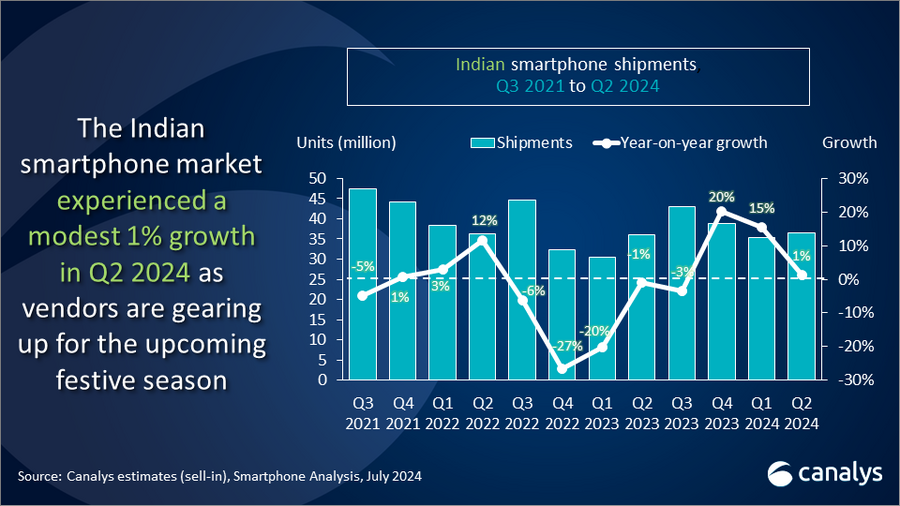
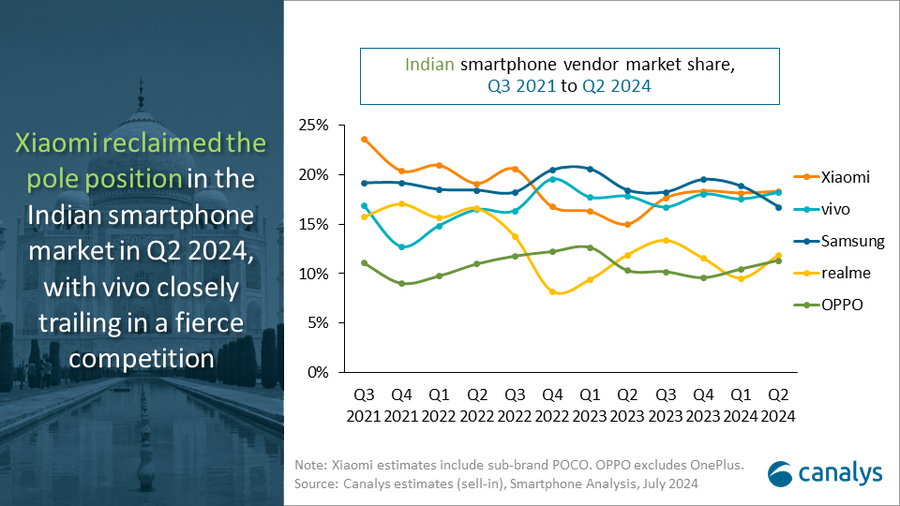
The Indian smartphone market witnessed sluggish growth of just 1% in the second quarter of 2024 (Q2), according to market research firm Canalys. This slowdown can be attributed to several factors, including national elections held during the period, subdued seasonal demand, and extreme weather conditions in some parts of the country. Despite the overall stagnation, there were some key shifts in manufacturer rankings.
Consumers Eye Upgrades with 5G on Horizon, Boost Expected for Festive Season
Xiaomi, after relinquishing the top spot for six quarters, made a comeback in Q2. They captured an 18% market share by shipping 6.7 million units, solidifying their position as the leading smartphone brand in India. This resurgence can likely be attributed to their continued focus on offering compelling 5G smartphones in the mass market. Xiaomi is also targeting the flagship and upper midrange market with the launch of the Xiaomi 14 series, Xiaomi 14 Civi.
Vivo came in a close second with 6.7 million units shipped, leveraging their strategy of affordable 5G and feature-rich mid-range models. Samsung maintained a strong presence, securing third place with 6.1 million units shipped. Rounding out the top five were Realme and Oppo (excluding OnePlus) with 4.3 million and 4.2 million units shipped, respectively.
In Q1 2024, India’s smartphone market grew by 15% year-on-year, with shipments reaching 35.3 million units, driven by an improved inventory situation and successful promotional strategies. Samsung led with a 19% market share, followed by Xiaomi and Vivo, while other brands like Apple, Motorola, and Infinix also achieved significant growth.
Looking ahead, Canalys predicts a mid-single-digit growth in smartphone shipments during the upcoming holiday season, fueled by a potential upgrade wave. Their research suggests 44% of Indian consumers plan to buy a new phone within the next year, with many seeking the latest features like 5G.
However, Canalys analyst Sanyam Chaurasia warns of challenges in the Indian market. Frequent discounts during festivals set unrealistic price expectations for consumers, hurting brand value and profitability. Additionally, slow migration from feature phones and a growing second-hand market create obstacles for manufacturers.
Google’s next-generation Pixel smartphones, smartwatch, and TWS earphones are expected to be unveiled next month. Leaks and rumours have revealed plenty of information about the devices. The Pixel Watch 3 is expected to come in two variants. In the latest development, the upcoming smartwatch’s pricing has been leaked for the European market courtesy of Dealabs. And it’s not looking good compared to last year’s Pixel 2 as well as Google’s competitors.
Google Pixel Watch 3 pricing surfaces
The Pixel Watch 3 is rumoured to come in 41mm and 45mm sizes. The former will be called standard whereas the latter could be dubbed XL. Both of them are expected to be offered in WiFi and 4G LTE versions.
The Pixel Watch 3 41mm with WiFi connectivity will reportedly be priced €399 (~$435) whereas the 4G LTE version will cost €499 (~$546). The Pixel Watch 3 45mm (XL) model with WiFi connectivity is said to be available for €449 (~$491) while the 4G LTE variant will carry a price tag of €549 (~$601). There’s a price difference of €50 if you compare the prices of the WiFi and LTE versions of both models.
The report also reveals that the Pixel Watch 3 41 and 45mm models will come in Obsidian, Porcelain, and Hazel colors. The former will also be offered in an additional Pink shade.
As per the aforementioned leaked pricing, the Pixel Watch 3 WiFi and LTE versions will be expensive by €50 and €100 respectively compared to the Watch 2’s same models. This makes the upcoming offering more expensive than the recently launched Galaxy Watch 7 WiFi model which is priced at €319.
It’s worth noting that the Pixel Watch 3’s pricing will vary depending on the market region. The EU prices don’t necessarily reflect US pricing but a price hike could be likely.
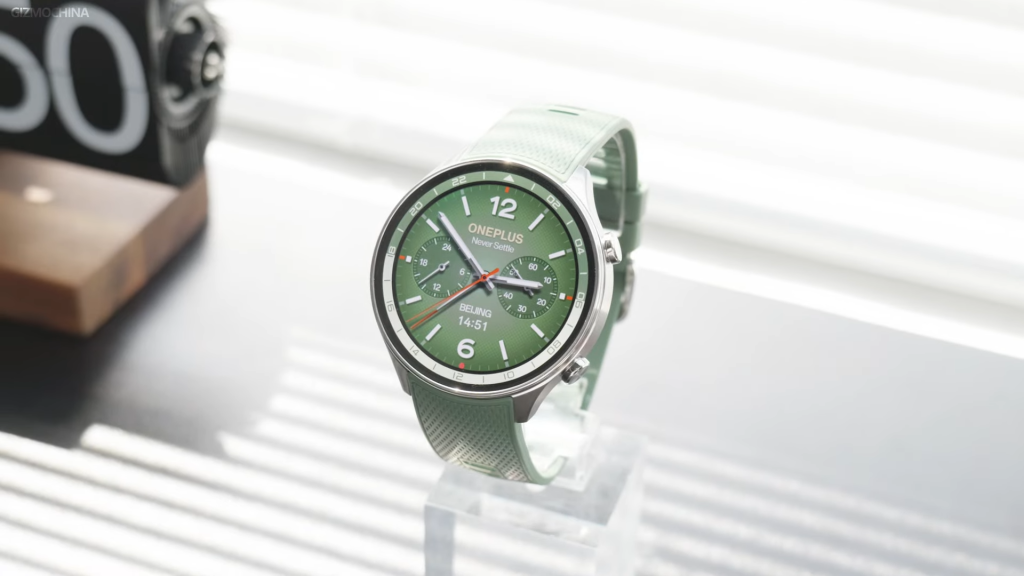
OnePlus has recently launched the OnePlus Watch 2R, a new smartwatch with a focus on lighter weight and a more affordable price tag compared to its predecessor, the OnePlus Watch 2. While they share many similarities, there are a few key differences to consider. Let’s break down the specs and features of both watches to help you decide which one is right for you.
The most significant difference between the two watches lies in their design and build materials. The OnePlus Watch 2 boasts a premium stainless steel body, giving it a more robust and luxurious feel. It weighs 80g with the strap, making it slightly heavier than the Watch 2R. In contrast, the Watch 2R opts for a lightweight aluminum body, weighing in at 59g with the strap. This makes it a more comfortable choice for all-day wear, especially for those with active lifestyles.
Both watches feature a 1.43-inch AMOLED display with a resolution of 466 x 466 pixels. The Watch 2R offers a maximum brightness of 1000 nits in High Brightness Mode, making it easier to view under direct sunlight. The Watch 2 has a default maximum brightness of 600 nits, which is still sufficient for most situations. Both watches utilize scratch-resistant glass for protection, with the Watch 2 sporting a more premium 2.5D sapphire crystal. The Watch 2R uses a 2D glass screen, which may be slightly more susceptible to scratches.
Both smartwatches offer 5ATM + IP68 water and dust resistance, making them suitable for swimming and other outdoor activities.
2. Software and Performance
Both the OnePlus Watch 2R and Watch 2 pack the same punch when it comes to software and performance. They utilize a unique dual-OS architecture, featuring Wear OS by Google powered by the Snapdragon W5 chip, alongside a proprietary OS based on RTOS. This allows for a smooth and responsive user experience with access to the vast app ecosystem of Wear OS and the power-saving benefits of the RTOS.
They both come with 32GB of storage, letting you download music from services like YouTube Music and Spotify for offline playback. Additionally, both support Health Connect by Android, allowing you to manage your health data from various apps in a centralized location.
3. Health and Fitness Features
The OnePlus Watch 2R and Watch 2 are well-equipped for fitness enthusiasts. They boast over 100 workout modes with automatic workout detection, making it easy to track your activities. Built-in dual-band GPS ensures accurate activity tracking, with additional data provided for specific exercises like running, badminton, tennis, and skiing.
Both watches offer heart rate, blood oxygen saturation monitoring, and stress detection. This data can be easily accessed and analyzed through the OnePlus O Health app.
4. Battery Life
The battery life is another area where the two watches are quite similar. They both pack a 500mAh battery and promise up to 100 hours of use in smart mode. In power saver mode, both watches can stretch to an impressive 12 days on a single charge. Additionally, both support fast charging, with the Watch 2 boasting VOOC charging that provides a full day’s worth of power in just 10 minutes.
5. Price and Availability
The OnePlus Watch 2R comes in at a more affordable price point of Rs. 17,999 ($215) in India, making it a good option for budget-conscious buyers who prioritize weight and comfort. The OnePlus Watch 2 carries a premium price tag of Rs. 24,999 ($298), reflecting its use of a more luxurious stainless steel body and a potentially more durable sapphire glass screen.
Please Note: When you buy something using the links in our articles, we may earn a small commission at no cost to you.
6. Conclusion
The choice between the OnePlus Watch 2R and Watch 2 boils down to your priorities. If you prioritize a lightweight and comfortable design at a more affordable price, the Watch 2R is the clear winner. However, if you value a more premium build with potentially better scratch resistance and are willing to pay extra for it, the Watch 2 might be a better fit.
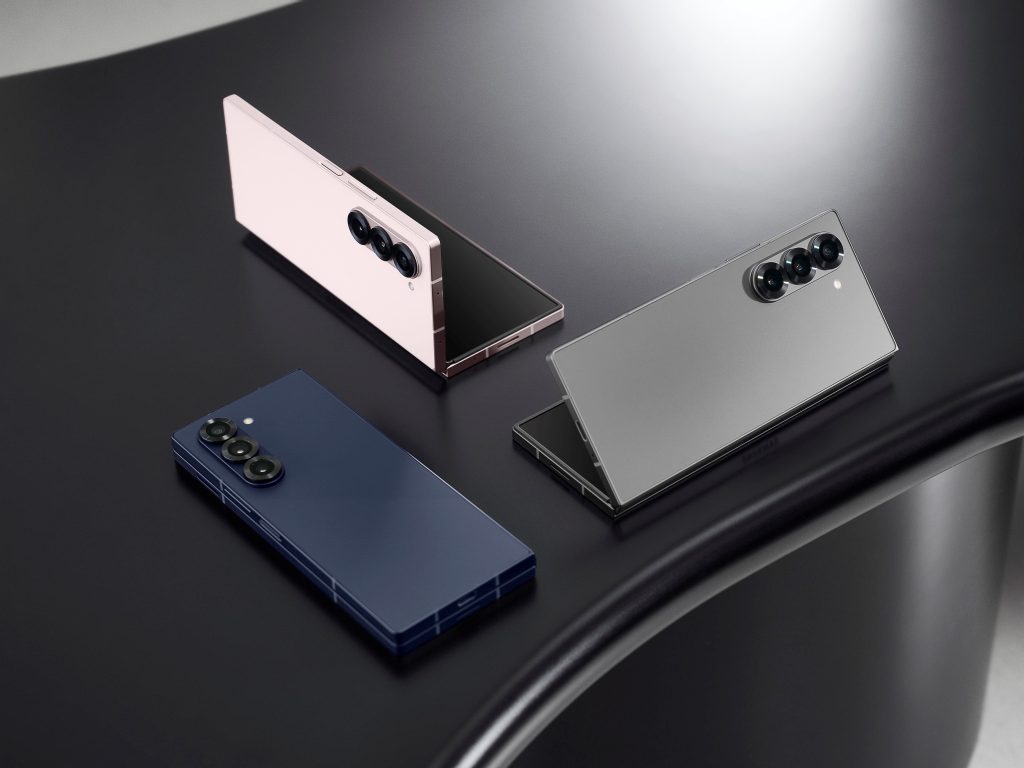
Samsung, the pioneer of mainstream foldable smartphones, is clearly facing challenges in maintaining its lead in this domain. The recently released Galaxy Z Fold 6, for example, offers little more than an incremental upgrade.
Meanwhile, Chinese manufacturers have been consistently innovating their foldable, be it in terms of features or physical design. The recently launched Honor Magic V3 for instance, has a slim form factor measuring just 9.2mm when folded, making it the thinnest foldable currently available. In comparison, the Z Fold 6 is 12.1mm thick, which is 2.9mm thicker than Honor’s device.
But Samsung appears determined to reclaim its dominance in this market. According to a report from Naver, Samsung is working on a foldable phone that will be only 7mm thick when closed.
If the company manages to pull this off, it would be an incredibly thin foldable that will easily beat the Honor Magic V3 in terms of thickness. But it’s easier said than done. To achieve such a slim dimension, the company will need to make some heavy trade-offs, such as sacrificing S Pen support and reducing battery capacity.
This isn’t the first time we’ve heard about a slim foldable device from Samsung. There are reports of a Galaxy Z Fold 6 Slim in development. It’s unclear if the rumored device with a 7mm thickness is the same as this model or a separate iteration.
Beyond just physical dimensions, the report suggests that Samsung is also looking into unique features to set its foldables apart from traditional smartphones. However, specific details about these features are currently unavailable.
As the foldable smartphone market grows more competitive, Samsung’s ability to innovate and deliver compelling devices will be crucial in maintaining its leadership in this emerging category. We eagerly await to see what the company has in store for us.
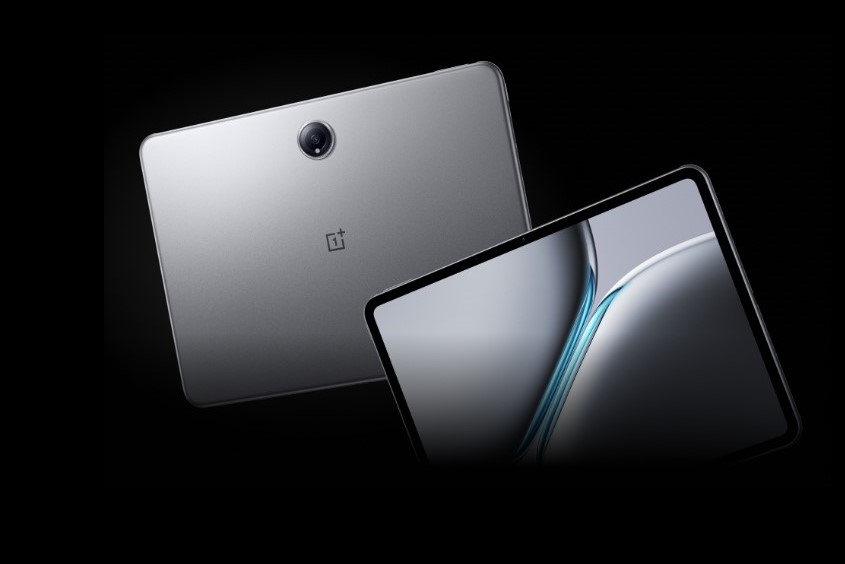
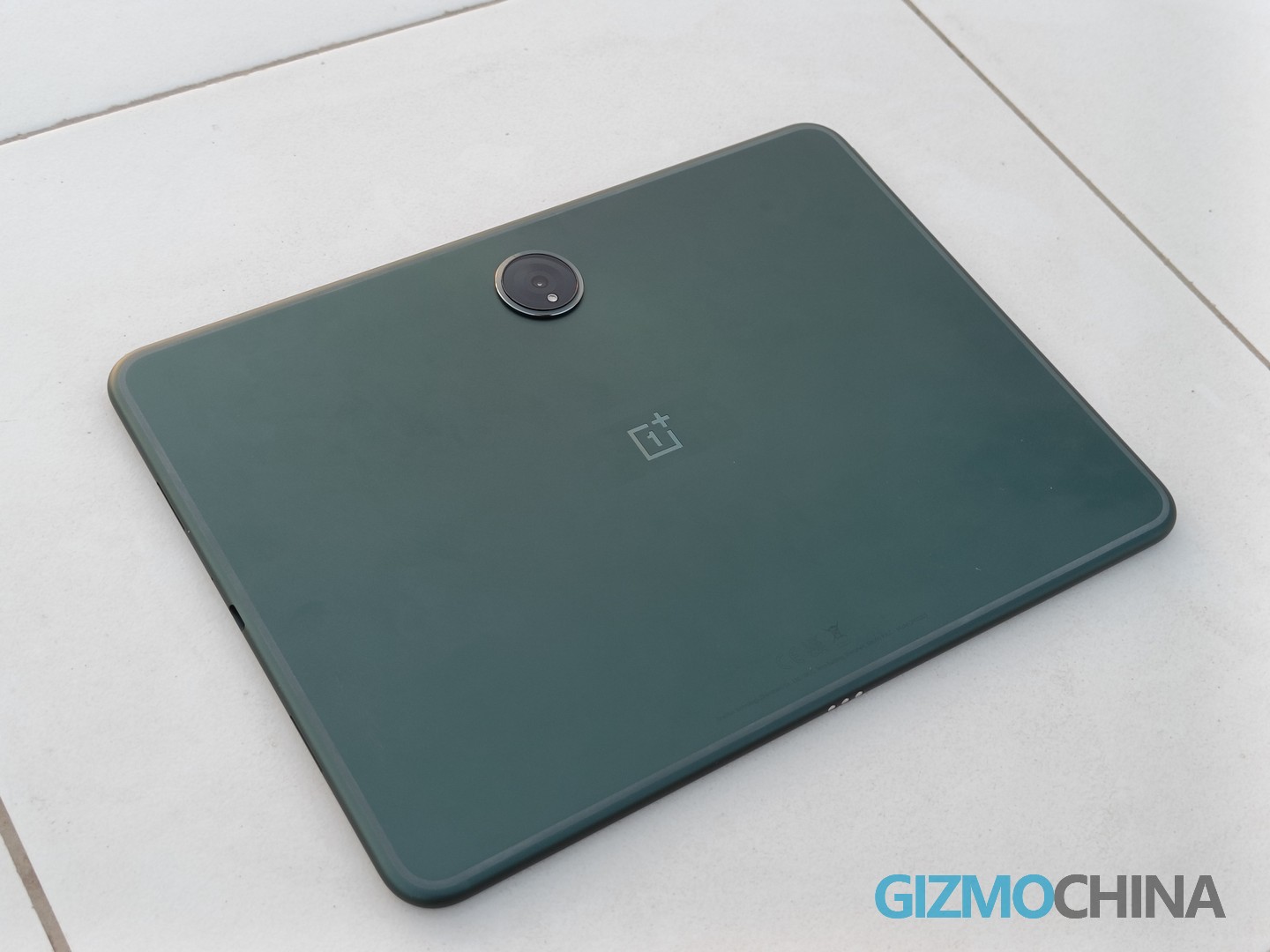
OnePlus finally unveiled its next gen tablet earlier this week. The OnePlus Pad 2 arrives as the direct successor of the original OnePlus Pad. But is it actually a worthy successor? How do the two compare in terms of specs, pricing, and other aspects? Let’s check it out.
The new OnePlus Pad 2 launched with a taller 12.1-inch IPS LCD panel that offers a resolution of 3,000 x 2,120 pixels, a 144Hz refresh rate, HDR10+, Dolby Vision, and up to 900 nits of peak brightness. This is taller than the 11.61-inch IPS LCD screen on the original OnePlus Pad. You still get Dolby Vision, HDR10+, and a 144Hz refresh rate. But, its peak brightness maxes out at 500 nits.
2. Flagship chip upgrade
The Chinese company had announced the OnePlus Pad with the MediaTek Dimensity 9000 SoC. This is a high end chip that offers capable performance. However, the successor to this tablet takes performance to the next level. OnePlus Pad 2 is equipped with the Qualcomm Snapdragon 8 Gen 3. This is the same processor that powers ultra premium phones like the Samsung Galaxy S24 Ultra.
3. 6 Speakers over 4
There are plenty of similarities between the two generations of tablets, but OnePlus did bring some changes in the audio setup. The OnePlus Pad 2 is equipped with six speakers that support Dolby Atmos for a more immersive listening experience. To recall, the first tablet from the brand only offered a quad speaker setup, but these also supports Dolby Atmos. You can even check out our review of this model.
4. What’s remained the same?
Apart from a few aspects, OnePlus didn’t bring any massive changes in the Pad 2 overall. But that’s not necessarily a bad thing entirely. You still get the metal unibody that employs aluminum for the rear and the frame. This adds premium feel to the tablet. The battery is still a massive 9510mAh cell, which supports a respectable 67W wired fast charging. Another area that remained untouched is the camera system. The front still houses an 8-megapixel selfie shooter, while the rear has a 13-megapixel camera.
5. Pricing & Verdict
Back in 2023, the first OnePlus Pad dropped with a starting price tag of ₹37,999, $479, €499 in India, the US, and Europe, respectively. With all these upgrades, there has been a slight hike in price with the OnePlus Pad 2. The tablet now starts from ₹42,999 in India. Meanwhile, its US, EU, and UK market pricing starts at $550/€550/£500. Unlike the unique Halo Green color option on the original Pad, the Pad 2 only arrives in a rather plain Nimbus Gray color option.
So if you’re looking for a new tablet right now, the OnePlus Pad is the more affordable option. However, the OnePlus Pad 2 seems like a better offering, if you can stretch your budget a bit. The second iteration aims to improved on its predecessor and is a better deal for the specs and features that you’re getting.
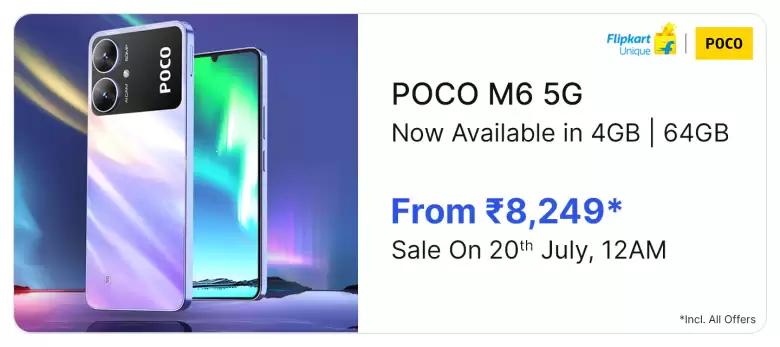
The POCO M6 5G debuted in India last year. It was announced in three RAM and storage configurations – 4GB + 128GB, 6GB + 128GB, and 8GB + 256GB. Earlier this year, the brand also introduced an Airtel Locked version of the device priced cheaper than the regular version. It seems that POCO is not done yet with the smartphone as its new variant has just been announced. The latest offering is now the base model. Read on to know the details.
POCO M6 5G gets a new variant
As per the Flipkart banner, the POCO M6 5G’s new variant packs the same 4GB RAM but it is not coupled with 64GB internal storage which is a downgrade from the previous 128GB. However, with this, the device also costs Rs 8,249 now. The latest model will be the fourth in the list. The banner reveals that the M6 5G 4GB + 64GB will be available for purchase from July 20, 12 am onwards. It is offered in Orion Blue, Polaris Green, and Galactic Black colors.
Apart from the RAM and storage, the rest of the core specifications of the POCO M6 5G remain the same. It features a 6.4-inch display bearing an HD+ resolution and a 90Hz refresh rate. The phone is powered by a Dimensity 6100+ processor. It is backed by a 5,000mAh battery unit with support for 18W fast charging.
The POCO M6 5G has a dual-toned look as the rectangular camera island is in Black color. It houses a 50MP main camera paired with an AI lens. There is a 5MP selfie snapper. The power button doubles up as a fingerprint scanner. Software-wise, it is eligible to receive two OS updates and three security patches.
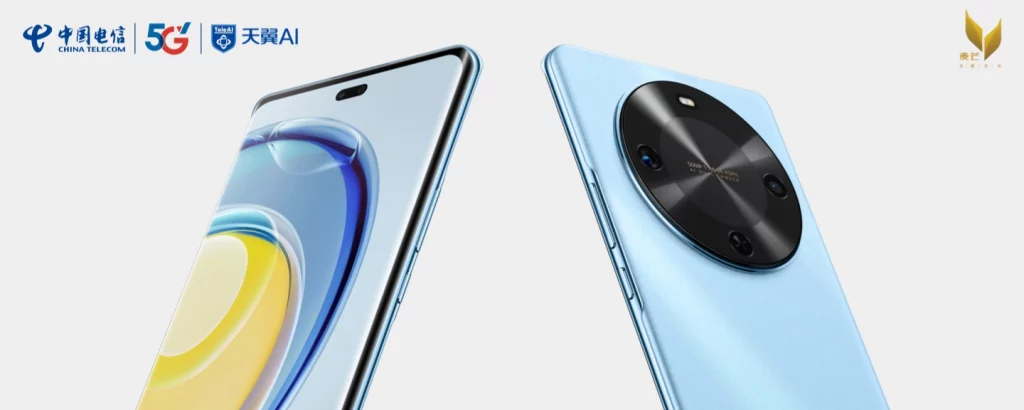
Tianyi Telecom Terminal Co., Ltd., a subsidiary of China Telecom, launched the Maimang 30 smartphone today. The Maimang 30, succeeding the Maimang 20, positions itself as a mid-range contender featuring a large display, sleek design, and integrated AI capabilities.
Maimang 30 Specifications:
The Maimang 30 features a 6.78-inch 1.5K curved display with a centered pill-shaped punch-hole cutout for the front-facing camera. The display offers a resolution of 2700 x 1224 pixels and utilizes 2160Hz high-frequency PWM dimming for smoother visuals and potentially reduced eye strain. The touch sampling rate of 300Hz promises a responsive user experience, and the display is claimed to support wet-hand touch for added convenience.
Under the hood, the Maimang 30 is powered by the Qualcomm Snapdragon 695 processor. While not a top-of-the-line chipset, it should provide sufficient performance for everyday tasks and light gaming. The phone comes pre-installed with Tianyi Cloud Disk, a cloud storage solution offered by China Telecom.
The phone boasts a built-in AI Star model, which offers functionalities like AI voice assistant, screen recognition, document scanning, and one-click access to specific features.
The Maimang 30 features a triple-camera system on the back. The main sensor is a 50-megapixel unit with an f1.8 aperture. It’s accompanied by a 2-megapixel depth sensor and an 8-megapixel front-facing camera for selfies and video calls.
The phone packs a 6100mAh battery, which China Telecom claims to be the largest among phones under 8mm thin. The phone itself measures approximately 7.98mm thick and weighs around 189g, making it a relatively lightweight option despite the large battery. The Maimang 30 also supports 40W fast charging for quicker power replenishment.
Availability and Pricing
The Maimang 30 comes in two storage options: 8GB RAM with 256GB storage and 12GB RAM with 256GB storage. Both variants are available in three color options – Obsidian Black, Crystal Blue, and Snowy White. The prices are set at 1999 yuan ($275) for the 8GB+256GB version and 2199 yuan ($302) for the 12GB+256GB variant.
Pre-orders for the phone kick off today, July 18th, at 3:30 PM CST, with official sales starting at midnight on July 25th.
Oppo is apparently planning on launching a new A series smartphone in India. The upcoming device could be dubbed the Oppo A3x, which will likely be a mid range smartphone model. However, prior to its official release, the specs and design of the Oppo A3x were leaked.
Oppo A3x Design & Specs
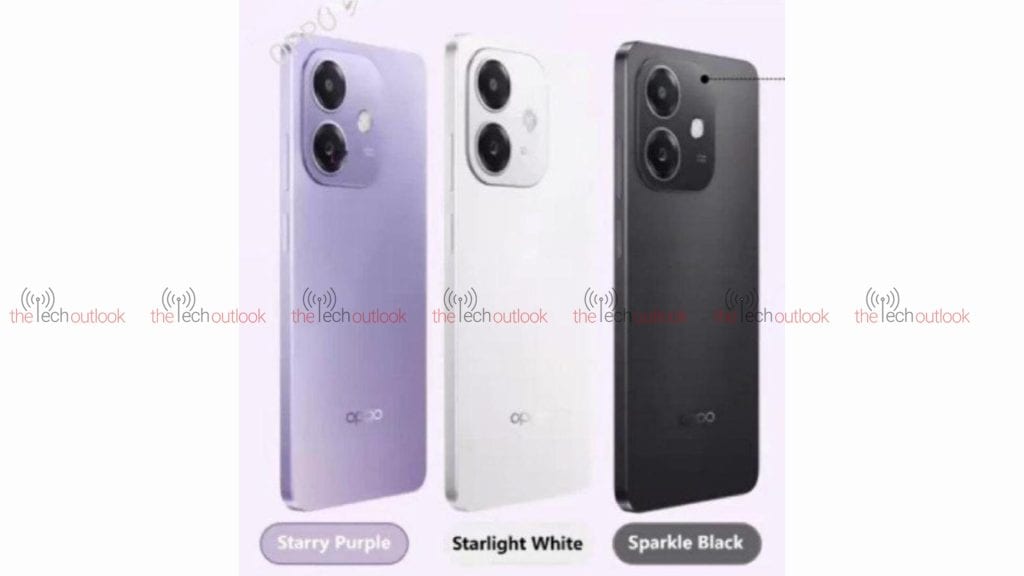
The design and the specs leak were shared by an industry source to TheTechOutlook. The report also shared leaked promo image posters showcasing the Oppo A3x’s design. Looking at the picture, we can see a dual camera setup on the rear and a flat rear panel. The poster image also highlights military grade shock resistant design and multi liquid resistance (IP54 rating). Meanwhile, the front will apparently sport a bright display (1000 nits peak) with a smooth 120Hz refresh rate. There is also a punch hole cutout for the selfie camera.
The screen has a flat panel with rounded corners and noticeable bezels, while the volume rockers and power button are on the right frame and the SIM tray is on the left. Color options of the new Oppo A3x were also leaked, confirming Purple, Sparkle Black, and Starlight White variants. The rear has an 8-megapixel camera with a flicker brightness detection sensor and the front houses a 5-megapixel selfie shooter.
Oppo A3x with Purple, Starlight White, and Sparkle Black
The Oppo A3x is rumored to run on the Android 14 OS based ColorOS 14 custom skin out of the box. Under the hood, it may be equipped with the Dimensity 6300 SoC, which is paired with either 4GB + 64GB or 4GB + 128GB storage options. A large 5,100mAh battery pack powers this device, which can support 45W wired fast charging. This is all packed in a slim 7.68mm body. The source added that the Oppo A59 will be discontinued following the launch of the Oppo A3x.
Just after the article went up, Nothing confirmed that the Phone 2a Plus will launch in India on July 31st. However, the company hasn’t shared any other details yet.
Original Story Continues…
After launching the Phone 2a in March, Nothing recently introduced a new smartphone under its sub-brand CMF with a unique modular back design. Just when it seemed like the company was finished releasing phones for the year—with the Phone 3 confirmed for a 2025 launch—rumors of another device, the Phona 2a Plus, have started to surface now.
The speculation ignited after Nothing posted an image of the Pokemon Mega Aerodactyl on social media, followed by a standalone “+” sign.
For those unfamiliar, the company uses Pokemon creatures as codenames for its devices, and the Phone 2a was internally referred to as Aerodactyl. So the mention of Mega Aerodactly followed by a plus sign naturally leads us to believe an upcoming “Plus” model within the A-series lineup, if not specifically a Phone 2a Plus.
Adding weight to the rumors, Indian telco operator Jio has listed a device named Nothing Phone 2a Plus in its database. While this doesn’t confirm the existence of the device, it certainly suggests that something is in the works.
Details about the Nothing Phone 2a Plus are scarce at the moment. It’s unclear how the Plus model will differentiate itself from the standard Phone 2a.
The latter already offers a solid mid-range package with a 6.7-inch AMOLED display with 120Hz refresh rate, a MediaTek Dimensity 7200 Pro chipset, and a capable dual camera system.
If the Plus variant sees the light of the day, it might feature improvements in the camera system, processor, or battery life. However, until Nothing provides official confirmation or more concrete leaks emerge, these details remain speculative.
For now, it’s advisable to approach these rumors with caution. While the evidence does point towards a possible Nothing Phone 2a Plus, there’s still a chance that the company might have other plans.
We use cookies on our website to give you the most relevant experience by remembering your preferences and repeat visits. By clicking “Accept”, you consent to the use of ALL the cookies.
This website uses cookies to improve your experience while you navigate through the website. Out of these, the cookies that are categorized as necessary are stored on your browser as they are essential for the working of basic functionalities of the website. We also use third-party cookies that help us analyze and understand how you use this website. These cookies will be stored in your browser only with your consent. You also have the option to opt-out of these cookies. But opting out of some of these cookies may affect your browsing experience.
Necessary cookies are absolutely essential for the website to function properly. This category only includes cookies that ensures basic functionalities and security features of the website. These cookies do not store any personal information.
Any cookies that may not be particularly necessary for the website to function and is used specifically to collect user personal data via analytics, ads, other embedded contents are termed as non-necessary cookies. It is mandatory to procure user consent prior to running these cookies on your website.















![OnePlus Watch 2R with Wear OS 4 by Google,Snapdragon W5 Chipset,Upto 100hrs battery life,1.43’’ AMOLED Display,100+ Sports Mode,Dual Frequency GPS,5 ATM,IP68 & BT Calling [Gunmetal Gray]](https://www.gizmochina.com/wp-content/plugins/aawp/public/image.php?url=YUhSMGNITTZMeTl0TG0xbFpHbGhMV0Z0WVhwdmJpNWpiMjB2YVcxaFoyVnpMMGt2TkRGb2MxSjJhV05PTUV3dVgxTk1NVFl3WHk1cWNHYz18MTc4OTgyNTI2Mw=)

![OnePlus Pad 2 (12.1 Inch)LCD Display,8GB RAM, 128GB Storage,Snapdragon 8 Gen 3,144Hz Refresh Rate,Dolby Vision & Atmos,Open Canvas,AI features,6 speakers,Wi-Fi with Cellular Data Sharing [Nimbus Gray]](https://www.gizmochina.com/wp-content/plugins/aawp/public/image.php?url=YUhSMGNITTZMeTl0TG0xbFpHbGhMV0Z0WVhwdmJpNWpiMjB2YVcxaFoyVnpMMGt2TkRFMGEydHdjV1JIY2t3dVgxTk1NVFl3WHk1cWNHYz18MTc4OTgyNTI2Mw=)