
Add GIZMOCHINA on Google:
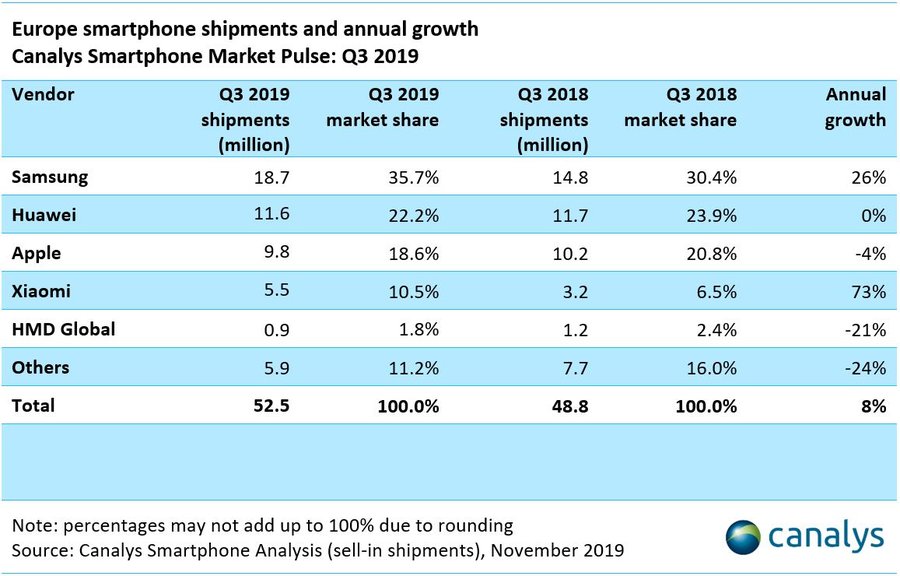
The latest Canalys report lends an overview of smartphone sales and the overall market share of global manufacturers in Europe. According to the report, Europe has recorded maximum sales volume in the third quarter of 2019, with shipments growing at an average rate of 8% year-on-year. It is interesting to note that Huawei comes in second place, right after Samsung, despite its failure to attain Google’s Google Mobile Service (GMS) certification.
Ever since the US trade ban, Huawei has been unable to get a GMS license for its Mate 30 series, hampering sales in the global market. Despite the supposed handicap, Huawei’s smartphone sales volume has rebounded by nearly 36.5% to 11.6 million units since the second quarter of 2019. Huawei sold 11.7 million units back in Q3 2018, and the difference is negligible.
According to the Canalys report, the surge came in primarily from Eastern and Central Europe, which recorded 26% growth as compared to the same period last year. Sales in Western Europe, however, declined by 17%. Samsung made the best possible use of this opportunity. While the difference in sales volume between the South Korean and Chinese tech giants were 3.1 million units in Q3 2018, the gap widened to 7.1 million units during the same period this year. Samsung recorded an annual growth of 26%, increasing its total market share to 35.7%.
Apple came in third recording a sales decline of 4% from Q3 2018, with a total of 9.8 million units. Xiaomi takes the fourth spot with significant growth of 73% year-on-year, with 5.5 million units being sold in Q3 2019, increasing its market share to 10.5%. Xiaomi’s growth is the direct result of the company’s aggressive expansion strategy in the region since last year. HMD Global takes fifth place by selling nearly 900k units, recording a market share of 1.8%. HMD’s sales declined by 21% since Q3 2018 when it sold 1.2 million units, recording a market share of 2.4%.
Canalys analyst Mo Jia explains that the situation in Europe is vastly different from the United States of America where the highest sales volume comes from network carriers. In Europe, however, the sales volume is evenly split between operators and open channels, i.e. showrooms that sell unlocked devices at full price. This is what makes Europe a lucrative business destination for Chinese smartphone manufacturers since the profit margins are higher on mid to high-end devices.
With the fragmented implementation of the 5G spectrum in 2020, numerous OEMs are expected to partner with network providers within Europe in a bid to sell their devices. The European market is expected to witness an invasion of mid to high-range smartphones in 2020.
UP NEXT: Huawei M-Pencil Stylus Showcased for the MatePad Pro
(source)



Comments