
Add GIZMOCHINA as Preferred Source on Google
We are now closer than ever to achieving 3nm chips in smartphones, but it is easy to forget that a vast majority of the electronics industry still relies on legacy processes owing to their low costs. Because of this, a lot of electronics continue using the planar 28nm process – a fabrication process that was last seen at the beginning of the last decade. And it is this industry that Samsung is aiming at with its newly announced 17nm process node.
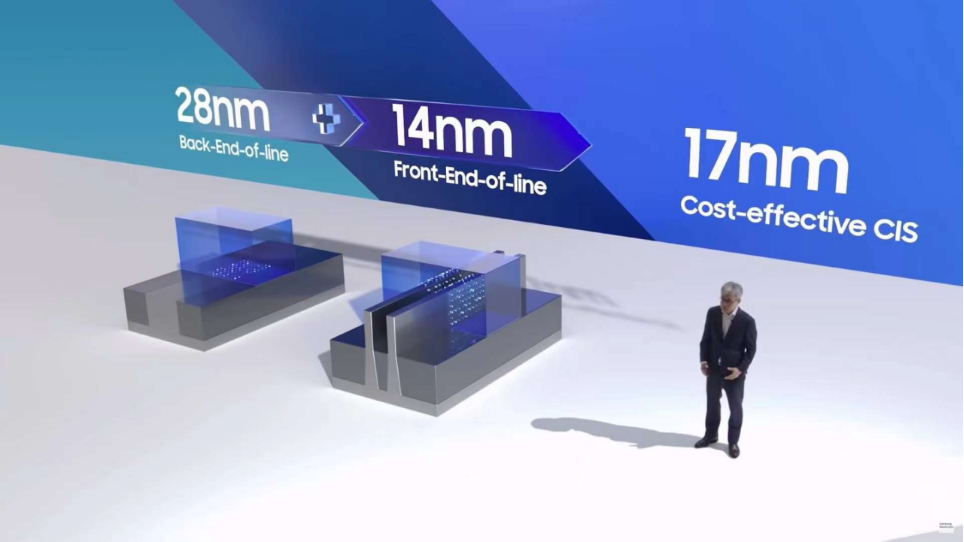
Samsung Foundry Forum 2021 was held yesterday where it was announced that Samsung will be launching the 3nm GAA process in the first half of 2022 along with the commercial production of 2nm GAA process chips in 2025. Along with this, the company also announced the launch of a new 17LPV process – the 17nm Low Power Value process (via: IT Home).
It is basically an advanced version of the 28nm process with the difference being that it combines the 28nm BEOL (Back-End-Of-Line) and the 14nm FEOL (Back-End-Of-Line) process. This can bring significant cost reduction for customers while also improving energy efficiency by leaps and bounds.
Compared to the traditional 28nm process, the new 17LPV process chip has a 43% reduced area, 39% improved performance, and 49% better power efficiency.
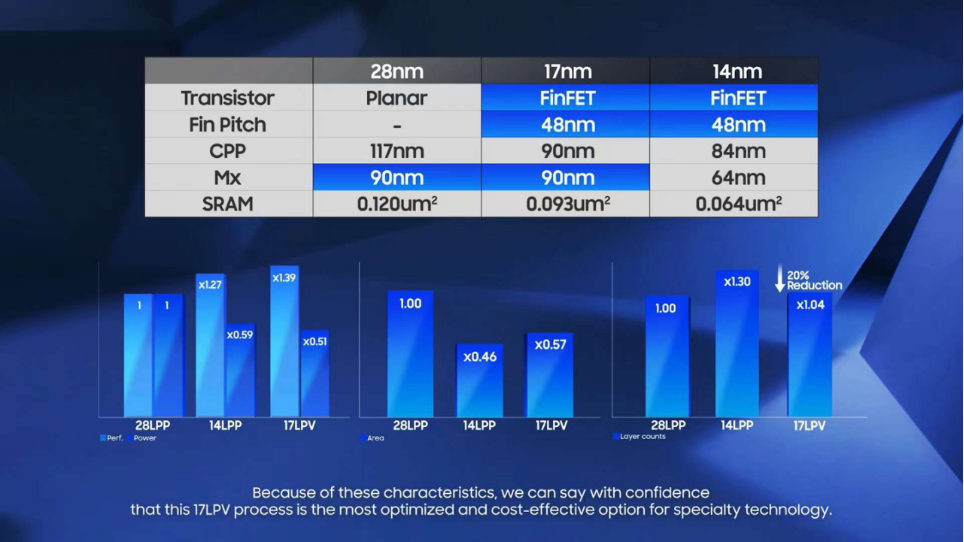
The mass production time of this process hasn’t been announced yet but Samsung says that the first application for 17LPV will be in camera image signal processors, as part of Samsung’s CMOS Image Sensor portfolio.
In addition, Samsung is also integrating the 17LPV process into its high-voltage products for DDIC/display drivers that require back-end high-voltage support combined with improved logic.
RELATED:
- The Galaxy Z Flip3 propels Samsung’s latest foldable sales to over 1 million units in Korea
- Samsung India eyes 65% growth in high-end consumer electronics
- Samsung Electronics indicates 28% growth in operating profit in Q3 2021
- Samsung now rolling out One UI 4.0 with Android 12 beta in India
- Samsung postpones its next-gen 3nm chip production until next year




Comments