
Add GIZMOCHINA as Preferred Source on Google
ASML (Advanced Semiconductor Materials Lithography) is a Dutch corporation that designs and manufactures lithography machines for the semiconductor industry. The lithography machines are one of the most important equipment in chip building.
Access to ASML’s cutting-edge lithography technology is one of the reasons behind TSMC‘s massive success as a contract chip manufacturer that works with most of the big giants in the industry such as NVIDIA and Qualcomm.
The high-NA lithography technology is expected to reduce the transistor size by 66%
Now the latest news is that ASML is going to ship its most advanced lithography machine worth US$ 380 million (~2.753 billion yuan) to TSMC this year. ASML Chief Financial Officer Roger Dassen revealed in a recent conference call that the company’s two largest customers, TSMC and Intel, will obtain its high numerical aperture (high-NA) extreme ultraviolet (EUV) lithography technology within 2024.
Reportedly, ASML has already delivered the world’s first commercial high-NA EUV lithography machine to Intel, starting with the first unit delivered to a factory in Oregon in late December. The exact time when TSMC will get the latest and most advanced tool from ASML is unclear at this point.
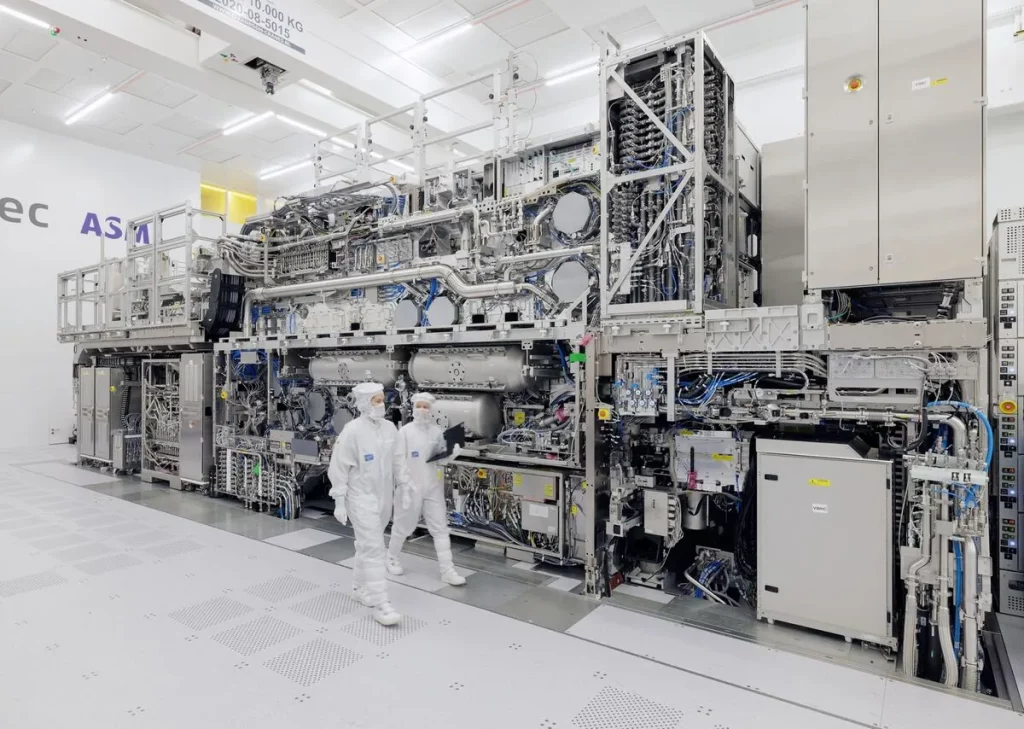
The high-NA lithography technology is expected to reduce the transistor size by 66%. So, it could enable chip manufacturers to fit more of them in a same-sized piece of silicon. Obviously, there is much more than just the transistor count (such as power efficiency) when it comes to sustained performance. But the power efficiency also improves with the reduction of the size.
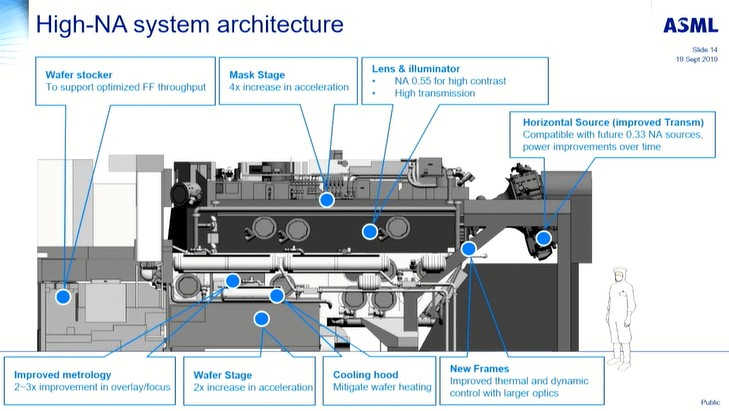
Reportedly, the high-NA EUV system achieves a numerical aperture of 0.55. Compared with the previous EUV systems equipped with a 0.33 numerical aperture lens, the accuracy will be improved and will enable more sophisticated patterning on the silicon.
The machine is also 30% larger than the predecessors which are already so large that they require three Boeing 747s to carry them.
Speaking of TSMC, the development of the 2nm nodes is reportedly progressing smoothly. The company has plans to start the development of N3X and N2 process in Q2 2025. Mass production of N2P and A16 will begin in Q2 2026. Its 2nm process will use Gate-all-around FETs (GAAFET).
TSMC expects its 2nm process could bring 10% to 15% performance improvement along with 25% to 30% lower power consumption.
(Source)



Comments