
Add GIZMOCHINA on Google:
Today Samsung unveiled its latest foundry innovations and also outlined its vision for the AI era, during an event held at the company’s Device Solutions America headquarters in San Jose, California.
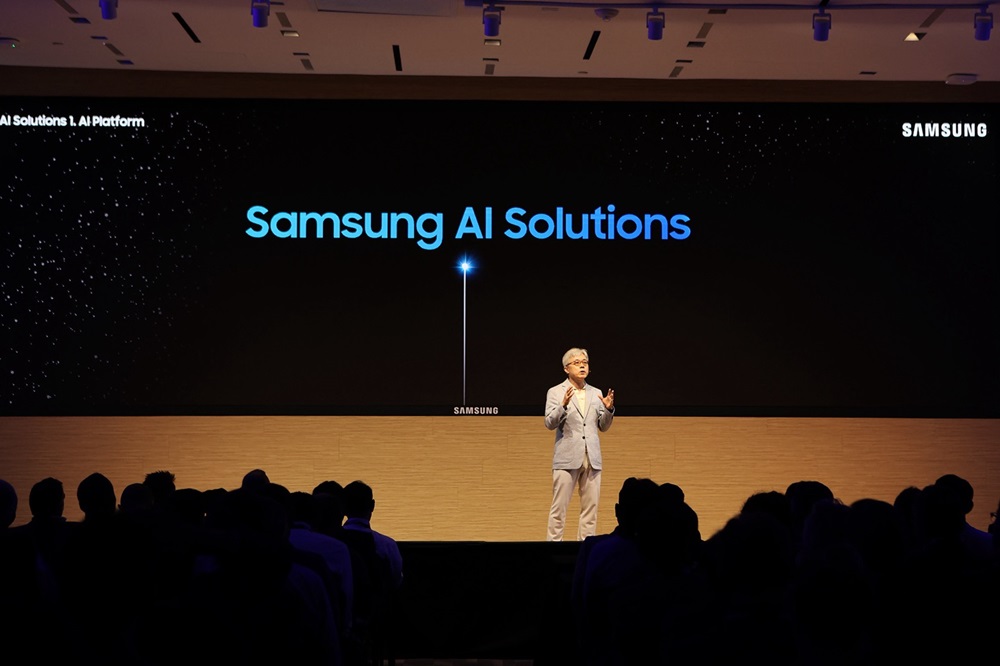
To contribute to the AI race the company has been working on its future process nodes and has reportedly made some progress. The development includes three new process nodes – SF2Z, SF1.4, and SF4U. As you can probably guess from the names these are the company’s most advanced 2nm, 1.4nm, and 4nm process nodes so far. They will reportedly integrate these three nodes into the Samsung AI Solutions platform.
Alongside the GAA process, which according to the company is suitable for AI accelerators, the company also has plans to introduce integrated, co-packaged optics (CPO) technology for high-speed, low-power data processing, said Dr. Siyoung Choi, President and Head of Foundry Business at Samsung Electronics.
The company’s latest 2nm process – SF2Z
The company’s latest 2nm process, SF2Z, incorporates optimized backside power delivery network (BSPDN) technology. According to the announcement, the new process places power rails on the backside of the wafer to eliminate bottlenecks between the power and signal lines.
With the help of the BSPDN technology, SFZ2 offers enhanced performance as compared to SE2, the first generation 2nm process node. Additionally, SFZ2 also significantly reduces voltage drop (IR drop), enhancing the performance of HPC designs. The company noted that the mass production of the SFZ2 process node will start in 2027.
A new 4nm and another 1.4nm node
“SF4U, on the other hand, is a high-value 4nm variant that offers PPA improvements by incorporating optical shrink”, noted the company. The mass production is scheduled for 2025.
Notably there is also a 1.4nm node (called the SF1.4) under development, on which the company is making progress “smoothly”. The smallest of the three is also scheduled for mass production by 2027.




Comments