Vivo recently unveiled the Vivo V40 SE, Vivo V40 Lite, and Vivo V40 in the European market. To recall, the brand unveiled the Vivo V30 series of smartphones in various markets, including Europe, earlier this year. The Vivo V30 Pro arrived as the first-ever V-series phone with a ZEISS co-engineered imaging system. This time around, the standard V40 features the ZEISS professional mobile imaging experience. Here is a look at how the V40 stacks up against the V30.
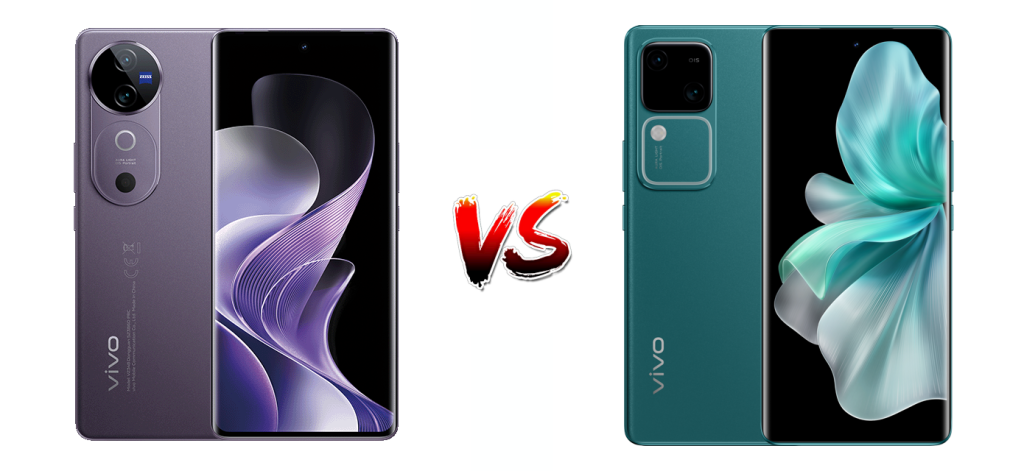
From the front, the Vivo V40 and V30 have an identical look, as both phones are equipped with a curved-edge AMOLED panel with a centrally aligned punch-hole. The V30’s back panel has a rectangular camera module that houses three cameras and a square-shaped Aura LED flash. On the other hand, the V40 has a large pill-shaped module, which houses three cameras and a ring LED flash.
The V40 measures 164.16 x 74.93 x 7.58 mm and weighs 190 grams , while the V30 is slightly lighter at 186 grams with dimensions of 164.36 x 75.1 x 7.45mm. Both phones feature a glass back cover. The V30 comes in three shades: Peacock Green, Andaman Blue, and Classic Black. While the V30 is an IP64-rated device, the V40 offers superior IP68-rated dust and water resistance. The V40 comes in two options: Stellar Silver and Nebula Purple.
The AMOLED display of both devices is 6.78 inches with a resolution of 2800 × 1260 pixels. However, the V40 boasts a higher local peak brightness of 4500 nits compared to the V30’s 2800 nits, enhancing visibility in bright environments. Both models support a 120 Hz refresh rate and have an in-screen fingerprint sensor.
2. Vivo V40 vs Vivo V30: Performance
Both devices are powered by the Snapdragon 7 Gen 3 chipset. The V40 offers two RAM options, 8 GB and 12 GB, both of which utilize LPDDR4X technology, with UFS 2.2 for 256 GB of internal storage. In contrast, the V30 provides similar RAM options but comes with fixed ROM capacities of 128 GB and 256 GB, also using UFS 2.2.
A notable upgrade in the V40 is its 5,500 mAh battery compared to the V30’s 5,000 mAh battery. Both models support 80W fast charging.
3. Vivo V40 vs. Vivo V30: Cameras and Other Features
Both phones feature a 50-megapixel front camera with autofocus. On the rear, they share an OIS-assisted 50-megapixel main camera and a 50-megapixel ultrawide camera. The V30 also features a 2-megapixel macro camera on the back, whereas a flicker sensor in the V40 has replaced it.
On the connectivity front, the Vivo V40 supports a broader range of 5G bands (n1/n2/n3/n5/n7/n8/n20/n26/n28/n38/n40/n41/n66/n75/n77/n78) compared to the V30 (n1/n3/n5/n8/n28/n77/n78). Both phones support dual nano SIMs with 5G dual standby and have similar connectivity options, including Bluetooth 5.4 and dual-band Wi-Fi. Lastly, the V40 supports NFC, which is absent in the V30.
Vivo V40 vs. Vivo V30: Final thoughts
The V40 offers minor upgrades compared to its predecessor, the V30. While it offers a brighter display, a larger battery, broader 5G band support, NFC functionality, and better durability, these enhancements may not be significant enough for all users. Both phones share the same processor and similar camera configurations, making the V30 a potentially viable option for those who prioritize a lighter design and are content with its existing features.
We use cookies on our website to give you the most relevant experience by remembering your preferences and repeat visits. By clicking “Accept”, you consent to the use of ALL the cookies.
This website uses cookies to improve your experience while you navigate through the website. Out of these, the cookies that are categorized as necessary are stored on your browser as they are essential for the working of basic functionalities of the website. We also use third-party cookies that help us analyze and understand how you use this website. These cookies will be stored in your browser only with your consent. You also have the option to opt-out of these cookies. But opting out of some of these cookies may affect your browsing experience.
Necessary cookies are absolutely essential for the website to function properly. This category only includes cookies that ensures basic functionalities and security features of the website. These cookies do not store any personal information.
Any cookies that may not be particularly necessary for the website to function and is used specifically to collect user personal data via analytics, ads, other embedded contents are termed as non-necessary cookies. It is mandatory to procure user consent prior to running these cookies on your website.





Comments