
Add GIZMOCHINA as Preferred Source on Google
Samsung is reportedly gearing up to take mobile gaming to the next level with the Galaxy S25 series, rumored to introduce frame interpolation technology for smoother 120fps gameplay. According to tipster Jukanlosreve, the flagship lineup could incorporate Qualcomm’s AFME 2.0 (Adreno Frame Motion Engine), allowing games to scale from 60fps to a fluid 120fps. This technology could make the Galaxy S25 series a standout choice for gamers when it debuts in 2025.
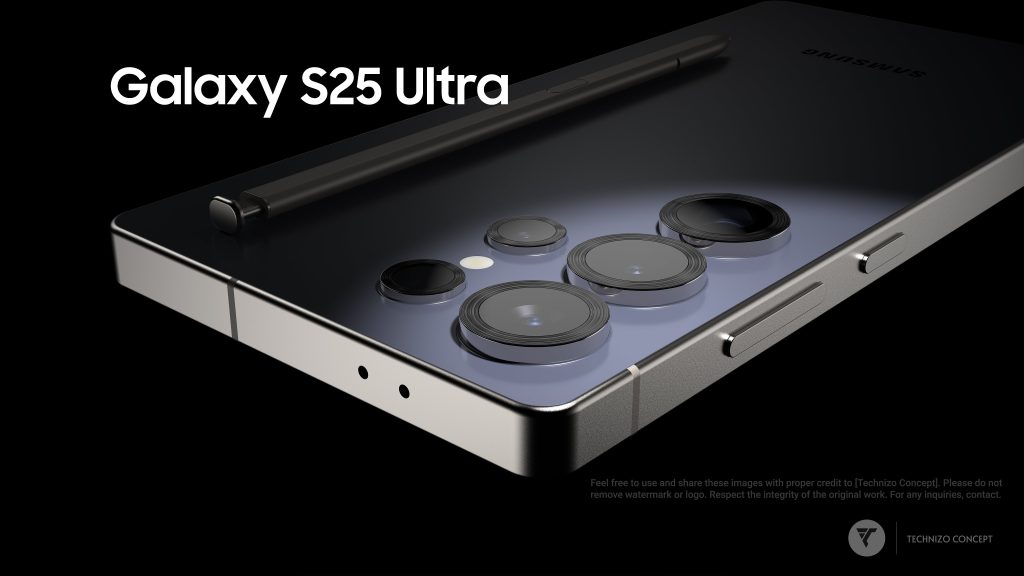
Galaxy S25 series to debut Qualcomm AFME 2.0 technology
Qualcomm’s AFME 2.0 technology is not new, having been introduced in 2021 and refined during last year’s Snapdragon Summit. However, its application in the Galaxy S25 series would be groundbreaking for Samsung’s flagship lineup. Unlike iQOO’s approach, which relies on a dedicated chip for frame interpolation, Qualcomm’s AFME 2.0 handles the entire process directly on the GPU without external chips or CPU intervention.
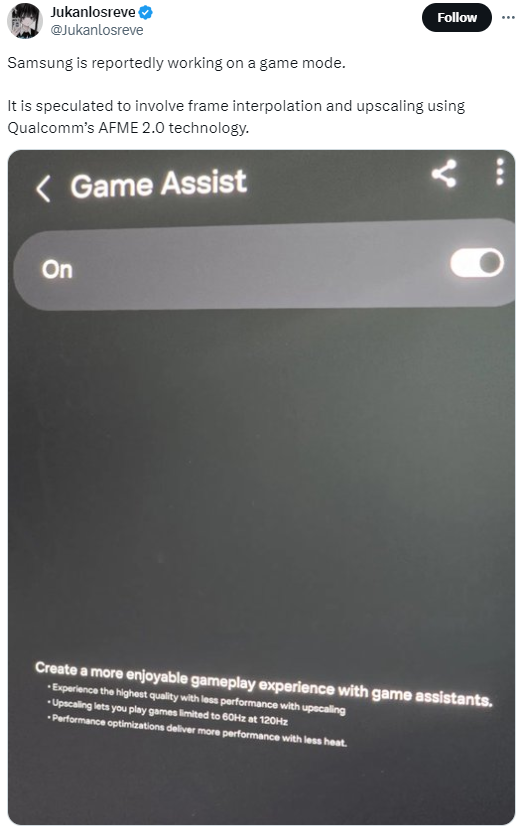
This approach is expected to optimize power consumption and reduce the strain on the device, allowing the Galaxy S25 to maintain smoother gameplay while managing battery life and thermal performance. In contrast, interpolation technologies on PCs focus purely on visual fidelity, while mobile implementations aim to strike a balance between performance and efficiency.
While the latest rumor suggests that all Galaxy S25 models might adopt the Snapdragon 8 Elite chipset, which enables AFME 2.0, there’s still speculation about chipset distribution across the lineup. The S25 Ultra could exclusively feature the Snapdragon chip (and this gaming tech), while the base and Plus models might stick with Exynos 2500 or Dimensity 9400 processors. This segmentation could impact how widely Samsung’s gaming enhancements are experienced across the series.
Other expectations from the Galaxy S25 series
Reports suggest an increase in RAM capacity without a price hike, which could further enhance multitasking and gaming performance. If true, these changes would position the S25 series as a balanced mix of power, efficiency, and affordability.
Samsung’s implementation of frame interpolation could also spark comparisons with iQOO’s dual-chip solution, which has proven effective in enhancing gameplay. How Qualcomm’s GPU-centric approach measures up will be an exciting development to test.
(Source)




Comments