
Add GIZMOCHINA as Preferred Source on Google
Microsoft recently introduced the “Majorana 1” quantum processor, generating significant interest in the tech industry. The company claims that this new chip, powered by a “topological qubit,” marks meaningful progress toward scalable and practical quantum computing. According to Microsoft, Majorana 1 could enable the development of a single chip with a million qubits—something that has long been considered a distant goal.
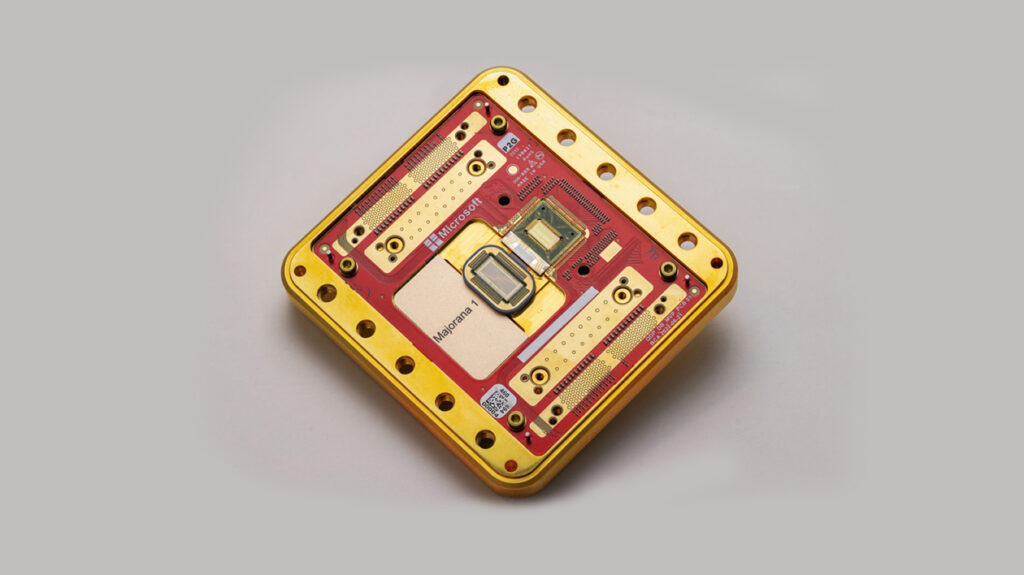
This development is particularly intriguing because Majorana 1 uses a new material called a “topoconductor” to create a special state of matter that supports topological qubits. These qubits, based on Majorana particles, are expected to be more stable and resistant to environmental disturbances—a major challenge in existing quantum computing designs. If these claims hold up, improved stability could make it easier to scale up qubit numbers and achieve fault tolerance, a critical requirement for real-world quantum applications.
However, while the announcement is promising, it is important to keep expectations in check. The current prototype of Majorana 1 contains only eight qubits—far fewer than quantum processors developed by IBM and Google, which already use hundreds or even thousands of qubits with other technologies. While Microsoft’s vision of a million-qubit chip is ambitious, this is still an early-stage development rather than a finished product.
Bringing a prototype to practical application is a complex and time-consuming process. Microsoft’s claims will require thorough validation, and the performance of Majorana 1 will need to be demonstrated through concrete benchmarks and real-world tests. The history of quantum computing includes instances of overpromised advancements that did not pan out, making it essential to approach such announcements with a degree of caution and focus on verifiable results.
That being said, if Microsoft’s approach proves successful, it could have a significant impact. The stability and error correction advantages of topological qubits could help address long-standing scalability issues in quantum computing. Microsoft’s roadmap, which includes a “tetron” architecture and gradual scaling strategies, outlines a structured approach to achieving error detection and, eventually, fault-tolerant quantum computing.
For more daily updates, please visit our News Section.
Tech enthusiast? Get the latest news first! Follow our Telegram channel and subscribe to our free newsletter for your daily tech fix!
(Source)




Comments