Add GIZMOCHINA as Preferred Source on Google
Choosing between the Samsung Galaxy S24 FE and Google Pixel 9a isn’t as straightforward as it seems. Both phones cater to slightly different audiences, even though they share some common ground. Whether you’re after top-tier performance, camera prowess, or battery endurance, both have strengths and compromises. Here’s how they stack up.
1. Design and Build Quality
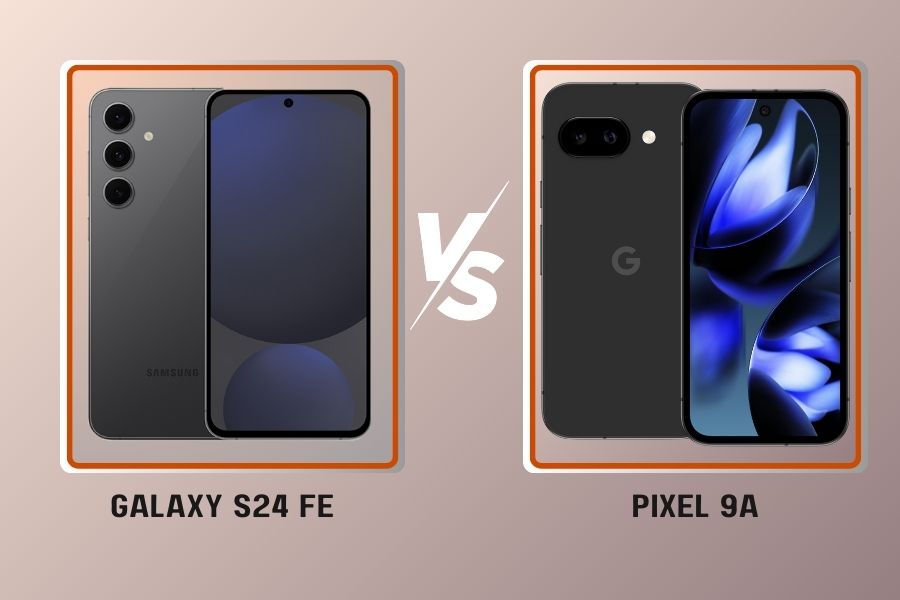
At first glance, the Galaxy S24 FE looks and feels more premium, thanks to its Gorilla Glass Victus+ on both front and back, sandwiched between an aluminum frame. It’s also heavier at 213g, making it feel more solid.
The Pixel 9a, on the other hand, takes a more practical approach, using a plastic back with an aluminum frame. While it keeps the weight down to 186g, it doesn’t feel as high-end in hand.
Both phones come with IP68 water and dust resistance, so neither has an advantage in durability. However, Gorilla Glass Victus+ on the S24 FE is more resistant to scratches compared to Gorilla Glass 3 on the Pixel 9a, which feels like a downgrade for Google’s mid-range device.
2. Display
Samsung has always been known for its displays, and the 6.7-inch Dynamic AMOLED 2X panel on the S24 FE lives up to that reputation. It boasts a 120Hz refresh rate, HDR10+ support, and 1900 nits of peak brightness.
The Pixel 9a counters with a 6.3-inch P-OLED display. It also offers a 120Hz refresh rate but stands out with a higher peak brightness of 2700 nits, which could make it more visible outdoors. However, Samsung’s AMOLED panel may deliver deeper blacks and better contrast.
3. Performance
Under the hood, Samsung uses the Exynos 2400e (4nm) chipset, a slightly toned-down version of the regular Exynos 2400 found in the S24 series. Google, on the other hand, equips the Pixel 9a with its custom Tensor G4 (4nm) chipset.
Raw performance-wise, the Exynos 2400e is expected to be slightly more powerful than the Tensor G4, especially in GPU-heavy tasks. However, Google’s chipset is designed more for AI and computational photography rather than gaming or raw processing power.
If you’re someone who values overall smoothness, the S24 FE might have the edge. But if you care about on-device AI features and smart optimizations, the Pixel 9a could be more appealing.
4. Software and Updates
Both phones offer seven years of major Android upgrades, ensuring long-term support. However, Pixel phones get Android updates on day one, while Samsung devices typically receive updates a few weeks later.
Google’s software experience is cleaner and more AI-focused, with features like Circle to Search, Best Take, and Live Translate built directly into the OS. Samsung, on the other hand, adds more customization and productivity tools with One UI 6.1, including Samsung DeX for a desktop-like experience.
If you prefer a simple, no-frills Android experience, the Pixel 9a is the better choice. But if you like customization and extra features, the S24 FE is the way to go.
5. Cameras
The Galaxy S24 FE’s triple-camera setup includes a 50MP main sensor, an 8MP telephoto lens with 3x optical zoom, and a 12MP ultrawide sensor. In contrast, the Pixel 9a sticks to a dual-camera setup with a 48MP main sensor and a 13MP ultrawide lens.
Samsung’s telephoto camera gives it a clear edge for zoom shots, while the Pixel 9a’s camera may shine in terms of processing power and Google’s computational photography tricks like Best Take and Ultra HDR.
For video, the S24 FE goes up to 8K at 30fps, while the Pixel 9a maxes out at 4K at 60fps. On the selfie front, the Galaxy S24 FE offers a 10MP camera, while the Pixel 9a has a higher-resolution 13MP ultrawide front camera.
6. Battery and Charging
Battery life may be a deciding factor for some. The Pixel 9a packs a larger 5100mAh battery, compared to the 4700mAh cell in the Galaxy S24 FE.
Samsung’s 25W wired charging is slightly faster than Google’s 23W, but the S24 FE also supports 15W wireless charging and reverse wireless charging, which the Pixel 9a lacks.
7. Which One Should You Buy?
It’s all up to you to choose between the Galaxy S24 FE and the Pixel 9a. But suppose you’re after a more premium design, a versatile camera system with a telephoto lens, a sharper display, and bonus features like Samsung DeX and reverse wireless charging. In that case, the Galaxy S24 FE is the way to go.
On the other hand, the Pixel 9a is the better pick if you prefer a clean, stock Android experience with day-one updates, smarter AI and computational photography, longer battery life, and a lighter, more compact build.
For more daily updates, please visit our News Section.
Stay ahead in tech! Join our Telegram community and sign up for our daily newsletter of top stories! 💡