Add GIZMOCHINA as Preferred Source on Google
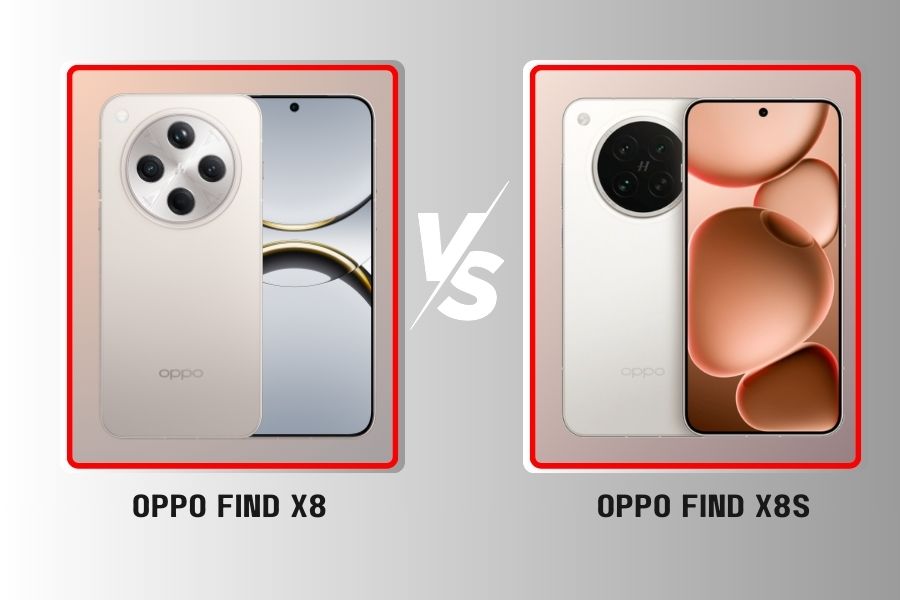
Oppo recently launched the Find X8s smartphone in China, but it’s not entirely a new device. It’s nearly identical to the already-available Find X8.
On paper, both devices are flagships in name and specs, with eerily similar designs. But look a little closer, and you’ll spot some subtle, intentional differences—some meaningful, others more nuanced—that set them apart.
Here’s a breakdown of what sets the Oppo Find X8s apart from the Find X8, and why Oppo seems to think there’s room for both.
1. Design and Build: Shrink to Fit
The first noticeable difference is size. The Find X8s is comparatively smaller and lighter. It measures 150.6 x 71.8 x 7.7 mm and weighs 179 grams, while the X8 stretches to 157.4 x 74.3 x 7.9 mm and weighs 193 grams.
This difference alone makes it clear what Oppo’s trying to do with the X8s. It’s a slightly more compact premium phone without cutting too deep into the high-end spec list.
The phones share the same design language. Both feature glass panels with aluminum frames, but there’s a subtle distinction in protection. The X8 uses Gorilla Glass 7i on both the front and back, while the X8s opts for the more premium and tougher Gorilla Glass Victus.
They share IP68 and IP69 ratings for dust and water resistance, including protection against high-pressure jets and immersion.
The X8 comes in more subdued tones like Star Grey and Space Black, while the X8s adds softer hues to the lineup, such as White and Pink.
| Preview | Product | |
|---|---|---|

|
Oppo Find X8 5G (Star Grey, 256 GB) (12 GB RAM) | Check Price on Amazon |
Please Note: When you buy something using the links in our articles, we may earn a small commission at no cost to you.
2. Smaller Screen, Similar Quality
Display-wise, both phones feature AMOLED panels with 1 billion colors, 120Hz refresh rates, Dolby Vision, and HDR10+ support.
The X8 has a 6.59-inch panel with a 1256 x 2760 resolution, while the X8s trims that down to 6.32 inches and 1216 x 2640. That makes the X8s a better fit for smaller hands, or for anyone who just prefers a phone that doesn’t feel like a mini tablet.
And don’t worry. The smaller size of the X8s doesn’t mean compromises on battery or camera performance. More on that in a bit.
Back to the screen, both have a pixel density of around 460 ppi. But for media consumption, the X8’s slightly larger screen and higher brightness may offer a more impactful experience.
3. Dimensity 9400 vs Plus
Here’s where things get interesting. The Find X8 runs on the MediaTek Dimensity 9400, while the X8s sports a Dimensity 9400+. These are essentially the same chip, with the “+” variant offering a slightly overclocked Cortex-X925 core (3.73 GHz vs. 3.63 GHz). The rest of the configuration remains identical: three Cortex-X4 cores at 3.3 GHz, four Cortex-A720 cores at 2.4 GHz, and an Immortalis-G925 GPU.
In practice, that small boost in clock speed probably won’t make a noticeable difference. The “+” might deliver slightly better performance or benchmark scores, but in real-world usage, it’s likely negligible. Still, Oppo wants the Find X8s to feel like the newer, more premium choice—even if the difference is marginal.
There’s nothing separating these phones in terms of RAM or storage. Both come in variants with 12GB or 16GB of LPDDR5X RAM and storage options ranging from 256GB to 1TB, all using UFS 4.0. There’s no microSD slot on either model, which is par for the course at this price point.
4. Mostly Similar Cameras
The camera hardware also remains largely similar, with just one key difference. Both phones pack a 50 MP main sensor with OIS and a 50 MP ultrawide with a 120° field of view. But Find X8’s 73mm periscope telephoto lens offers 3x optical zoom with a larger sensor (1/1.95″), while the Find X8s opts for an 85mm telephoto at 3.5x.
The periscope module on the X8 is physically larger, with a bigger sensor (1/1.95″ vs. 1/2.75″) and larger pixels (0.64µm vs. 0.61µm). It may offer better low-light zoom shots and more natural background compression in portraits. The X8s’ telephoto lens has slightly more reach but is likely to underperform in dimmer environments.
There’s one more tweak. The Find X8 includes laser autofocus in addition to phase detection, which is absent on the X8s. This might matter for close-up subjects or fast motion, but again, the real-world impact will vary.
The front-facing camera setup is also similar. Both use a 32 MP sensor with autofocus and support for 4K video at 60fps. They also offer 10-bit video, HDR, Dolby Vision, and high-frame-rate recording up to 240fps at 1080p.
This parity in camera features means most users won’t notice a difference unless comparing them side by side.
5. Battery and Charging
Despite being the smaller model, the Find X8s has a bigger 5700 mAh battery compared to the 5630 mAh cell on the X8. Both support 80W wired and 50W wireless charging.
For the global model, Oppo ships the Find X8 with a USB 3.0 port (globally). Whereas, the Find X8s is unlikely to get a release outside of China.
6. Software and Extras
Both phones run ColorOS 15 on top of Android 15, with a promise of five years of major updates. Everything else—Wi-Fi 7, Bluetooth 5.4, dual SIM support, full satellite positioning, and Circle to Search integration—is consistent across both devices.
7. The Verdict
On paper, the Oppo Find X8s and Find X8 are remarkably close. The X8s is a slightly more compact and lighter iteration, with a newer chip and a revised telephoto lens. But the X8 retains a few functional advantages, like a bigger display, USB 3.0, and a more capable zoom camera.
The X8s isn’t a watered-down version, nor is it a straightforward upgrade. Instead, it’s Oppo diversifying its lineup just enough to cater to different ergonomic preferences.