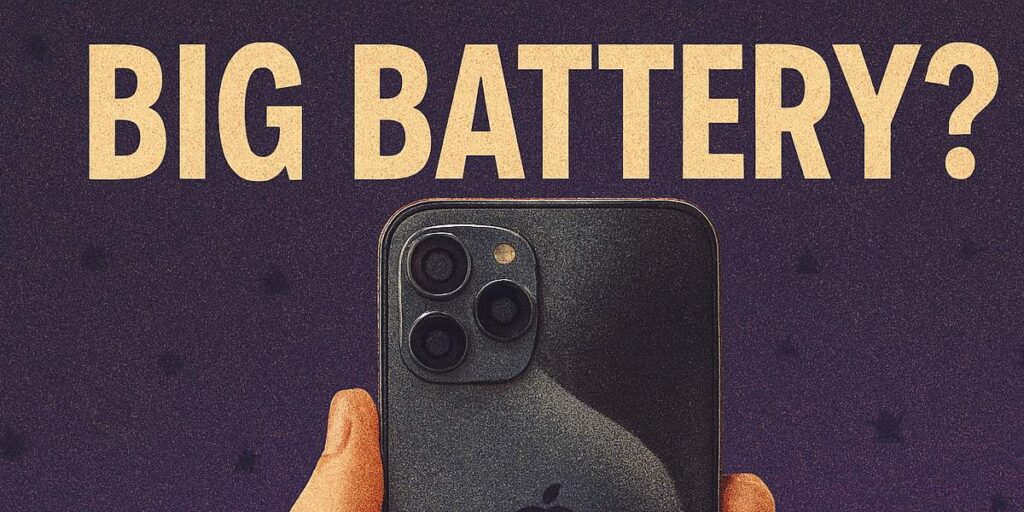
What if you had the chance to upgrade a feature on your favorite iPhone or Android phone? At the top of my list would be cramming in bigger batteries. Especially for Apple and Samsung devices, which are still playing it safe when they really don’t have to.
It’s 2025, and you can buy a phone in just about every configuration imaginable. Foldable displays, AI-powered cameras, custom silicon, and dynamic refresh rate panels are common now. But somehow, the two biggest players in the smartphone game are still lagging behind in battery upgrades.
Their flagship devices ship with battery capacities that don’t even come close to what you’ll find in many Android alternatives. And sure, they’ll point to efficiency gains or software optimization. But at the end of the day, a bigger battery is a bigger battery. And with today’s advancements in compact component design, there’s really no excuse.
Here’s why we think Apple and Samsung should start taking big batteries seriously.
Apple’s iPhone 15 Pro Max packs a 4,441mAh battery. Samsung’s Galaxy S25 Ultra offers a slightly larger 5,000mAh cell. These numbers haven’t changed significantly over the past three years, even as smartphone power demands have increased with features like 4K video recording, on-device AI processing, and ultra-bright 120Hz displays.
And that shows in real-world endurance. According to DXOMARK’s battery ratings, iPhone 15 Pro Max sits in 44th position, while Galaxy S24 Ultra ranks in 63rd position in global battery rating.
It could be because of the design. Both companies prize a thin, premium aesthetic. Apple, especially, sees tight tolerances and clean chassis lines as central to its brand identity. That philosophy leaves little room for thermal headroom or larger cells. Even when iPhones gained weight with titanium and larger camera modules, the extra space went to optics, not battery.
Samsung, while marginally more flexible, still caps its flagships at 5,000mAh—a limit reached by many Android phones as early as 2020.
There’s also a conservative approach to new materials. Neither Apple nor Samsung has embraced silicon-carbon batteries. These batteries, which replace graphite with silicon in the anode, offer:
Up to 20% higher energy density
Better thermal performance
Faster charging without increased degradation
More cycles before capacity loss
Chinese brands are already deploying them. For instance, the Nubia RedMagic 10 Pro has a battery capacity of 7,050 mAh while retaining the same thickness as its predecessor. Apple and Samsung, meanwhile, are still using variations of the same chemistry introduced over a decade ago.
3. Big Batteries Aren’t the Burden They Used to Be
To be honest, users are used to carrying thicker and heavier phones now. Take the recent flagships. iPhone 16 Pro Max is 8.3mm thick and weighs 227g. Galaxy S25 Ultra measures and weighs 8.6mm and weighs 232g, respectively
So a few millimeters of extra thickness in 2025 isn’t a deal-breaker. But even so, brands don’t necessarily need to bulk up their phones, thanks to silicon-carbon batteries. These allow manufacturers to keep a slim profile while packing in more mAh within the same form factor. As a result, compact phones are making a comeback in 2025, and for good reason.
4. Efficiency Has Hit Diminishing Returns
Apple and Samsung have leaned heavily on efficiency gains. Apple’s A17 Pro chip is built on TSMC’s 3nm node. Samsung uses the Snapdragon 8 Gen 3 for Galaxy, arguably the most efficient flagship chip Qualcomm has ever made. Both companies also implement dynamic refresh rate scaling (LTPO), RAM management, and app background restrictions.
But we’re reaching a plateau. Shrinking nodes no longer yield the 30% efficiency gains they once did. And with on-device AI, like Samsung’s Galaxy AI and Apple’s rumored Siri 2.0, set to increase background processing, power savings may be offset by new demands.
In other words, software and silicon efficiency aren’t enough anymore. Bigger batteries are the obvious next step.
5. Also, fast Charging Isn’t a Substitute
You can’t talk about batteries without mentioning fast charging, as they go hand in hand. Not that Apple or Samsung are leading the pack here. Their charging speeds are still underwhelming.
But to be honest, fast charging doesn’t really solve battery anxiety. It just makes it slightly less painful. Unfortunately, both Apple and Samsung lag behind even mid-range competitors in this area.
Silicon-carbon batteries, meanwhile, support faster charging with significantly less degradation. It directly addresses the concerns that have supposedly kept Apple from increasing charging wattages. Yet neither company seems eager to adopt these new chemtries.
6. Why This Matters More Than Ever
In 2025, our phones do more than ever. 24/7 notifications, 4K video recording and editing, video calling, and constant location tracking for wearables, and Find My networks.
Apple and Samsung expect their users to rely on these devices all day, yet the power infrastructure hasn’t kept pace. Power users are either buying battery cases, carrying 10,000mAh power banks, or switching to Chinese OEMs that actually prioritize longevity.
So it’s not just about specs for these foreign brands, it’s about relevancy now.
7. A Logical, Overdue Shift
Adopting bigger batteries doesn’t require sacrificing quality or user experience. It’s about aligning with modern usage patterns, embracing available technology, and doing what users have been asking for.
Apple and Samsung could start small: integrate 5,500mAh batteries in their ultra models, or trial silicon-carbon in a foldable where battery life is most constrained. Even a modest upgrade would send a message that they are improving on this domain as well
We use cookies on our website to give you the most relevant experience by remembering your preferences and repeat visits. By clicking “Accept”, you consent to the use of ALL the cookies.
This website uses cookies to improve your experience while you navigate through the website. Out of these, the cookies that are categorized as necessary are stored on your browser as they are essential for the working of basic functionalities of the website. We also use third-party cookies that help us analyze and understand how you use this website. These cookies will be stored in your browser only with your consent. You also have the option to opt-out of these cookies. But opting out of some of these cookies may affect your browsing experience.
Necessary cookies are absolutely essential for the website to function properly. This category only includes cookies that ensures basic functionalities and security features of the website. These cookies do not store any personal information.
Any cookies that may not be particularly necessary for the website to function and is used specifically to collect user personal data via analytics, ads, other embedded contents are termed as non-necessary cookies. It is mandatory to procure user consent prior to running these cookies on your website.