
Add GIZMOCHINA as Preferred Source on Google
Qualcomm and MediaTek have largely owned the chipset shares for most of the Android devices. And they still do. But the plot is a little different this year.
Xiaomi recently made headlines with its self-developed XRING O1 chip. Now Lenovo appears to be following suit with its own in-house silicon, reportedly bound for its upcoming Yoga Pad Pro 14.5 tablet.
The chip is currently known as SS1101, and it has just made its way to the Geekbench benchmarking site, revealing its performance scores and architecture details.

Lenovo’s first custom chip shows up in tests
According to the benchmark listing, the Lenovo SS1101 is a 10-core SoC (yes, deca-core) built around a mix of Cortex-X3, Cortex-A715, and Cortex-A510 cores. It includes two Cortex-X3 cores clocked at 3.29GHz, three Cortex-A715 cores at 2.83GHz, another two A715s at 1.9GHz, and three Cortex-A510 efficiency cores running at 1.71GHz. On the graphics side, it’s paired with an Immortalis-G720 GPU.
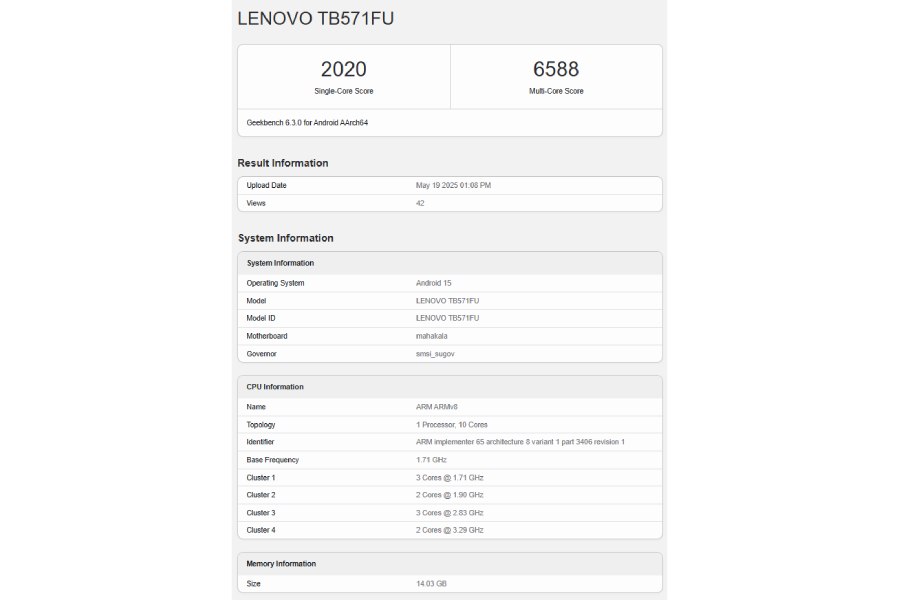
From that configuration alone, it’s clear this isn’t a midrange chip. And the Geekbench results back that up. The SS1101 scored 2020 in single-core and 6588 in multi-core tests—figures that put it well within flagship territory. The test device also seems to have 16GB of RAM.
So far, Lenovo hasn’t made any official statement about the SS1101 or its plans for custom silicon. But if the previous leak is accurate, the Yoga Pad Pro 14.5 could be the testbed for the company’s first custom chip effort.
This is not the first time a tech brand has tried to take more control over its hardware stack, and this surely will not be the last. What’s great in this is that brands will have granular control over not just the chip but also software updates for it.
Don’t miss a thing! Join our Telegram community for instant updates and grab our free daily newsletter for the best tech stories!
For more daily updates, please visit our News Section.




Comments