
Add GIZMOCHINA as Preferred Source on Google
Samsung’s Exynos 2500 is the company’s most powerful mobile chipset that recently debuted with the Galaxy Z Flip 7. It features a 10-core CPU that we don’t see often on mobile chips, paired with a powerful Xclipse 950 GPU, brings serious performance upgrades. The NPU has also received considerable improvements.
The Exynos 2500 brings nice upgrades that are too good to ignore, but how does it stack up against the Snapdragon 8 Elite, the most popular choice among flagship devices? We’ll review benchmark scores and delve into key differences to find out who has the edge.
Let’s begin with the spec sheet:
| Exynos 2500 | Snapdragon 8 Elite | |
|---|---|---|
| Announced | June 2025 | October 2024 |
| Process node | 3nm | 3nm |
| Manufacturer | Samsung | TSMC |
| CPU | 1 x 3.3 GHz — Cortex-X925 2 x 2.74 GHz — Cortex-A725 5 x 2.36 GHz — Cortex-A725 2 x 1.8 GHz — Cortex-A520 | 2 x 4.32GHz — Oryon 6 x 3.53GHz — Oryon |
| GPU | Samsung Xclipse 950 GPU Ray tracing support | Adreno 830 GPU Ray tacing support Snapdragon Elite Gaming features |
| NPU | Yes 59 TOPS | Qualcomm Hexagon NPU |
| Memory | LPDDR5x, up to 4.2GHz | LPDDR5x, up to 5.3GHz |
| Storage | UFS 4.0 | UFS 4.0 |
| Camera | Up to 320MP single camera Up to 8K/60fps video recording | Spectra triple 18-bit AI ISPs Up to 320MP single camera Limitless real-time semantic segmentation Up to 8K/30fps video recording |
| Connectivity | Download speed: 12.1Gbps (peak) Upload speed: 3.67Gbps (peak) Wi-Fi 7 Bluetooth v5.4 Satellite messaging support | Download speed: 10Gbps (peak) Upload speed: 3.5Gbps (peak) Wi-Fi 7 Bluetooth v6.0 Ultra Wideband (UWB) support |
Exynos 2500 vs Snapdragon 8 Elite: Benchmark scores
Note: The tests were conducted on the Samsung Galaxy Z Flip 7 (Exynos 2500) and Samsung Galaxy S25 Ultra (Snapdragon 8 Elite).
AnTuTu comparison
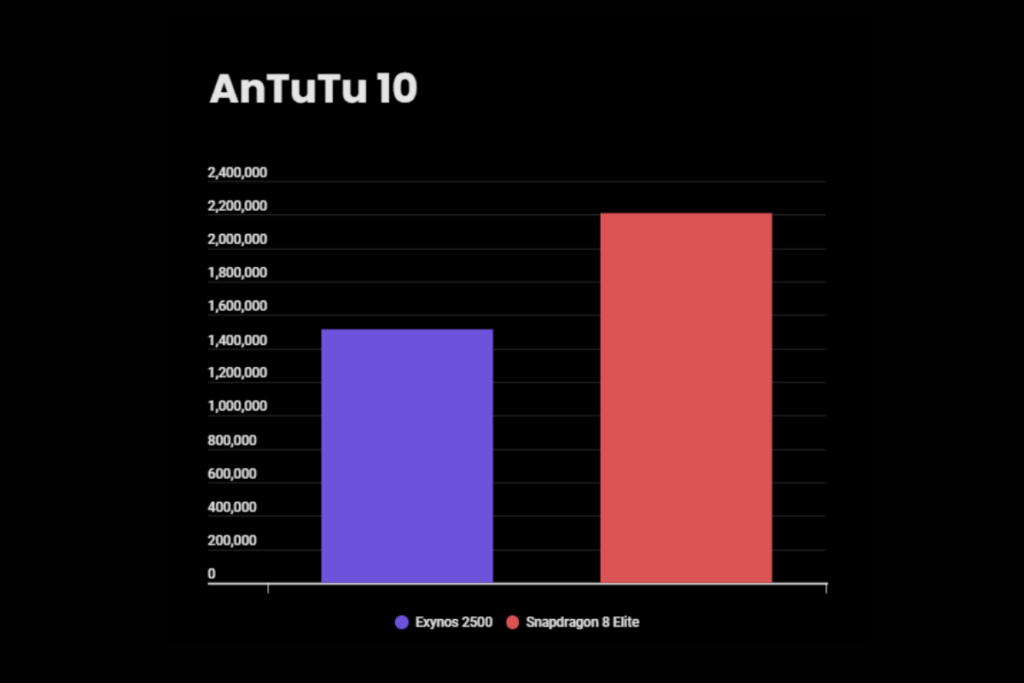
On AnTuTu, the Snapdragon 8 Elite delivers a massive performance lead over the Exynos 2500, scoring over 2.2 million points compared to Exynos’s 1.5 million. The biggest gap shows up in the GPU department, where the 8 Elite pulls ahead by more than 59%, indicating significantly better graphics and gaming performance. The CPU score also favors Snapdragon by around 51%, suggesting faster processing power in demanding workloads.
Even in memory and UX scores, the Snapdragon chip maintains its edge, though the difference is less dramatic. Overall, the benchmark shows strong gains for the Snapdragon 8 Elite.
| Exynos 2500 | Snapdragon 8 Elite | |
|---|---|---|
| AnTuTu score | 1,514,821 | 2,209,476 |
| CPU | 379,468 | 574,518 |
| GPU | 529,420 | 842,351 |
| Memory | 360,718 | 437,621 |
| UX | 245,215 | 354,986 |
Geekbench comparison
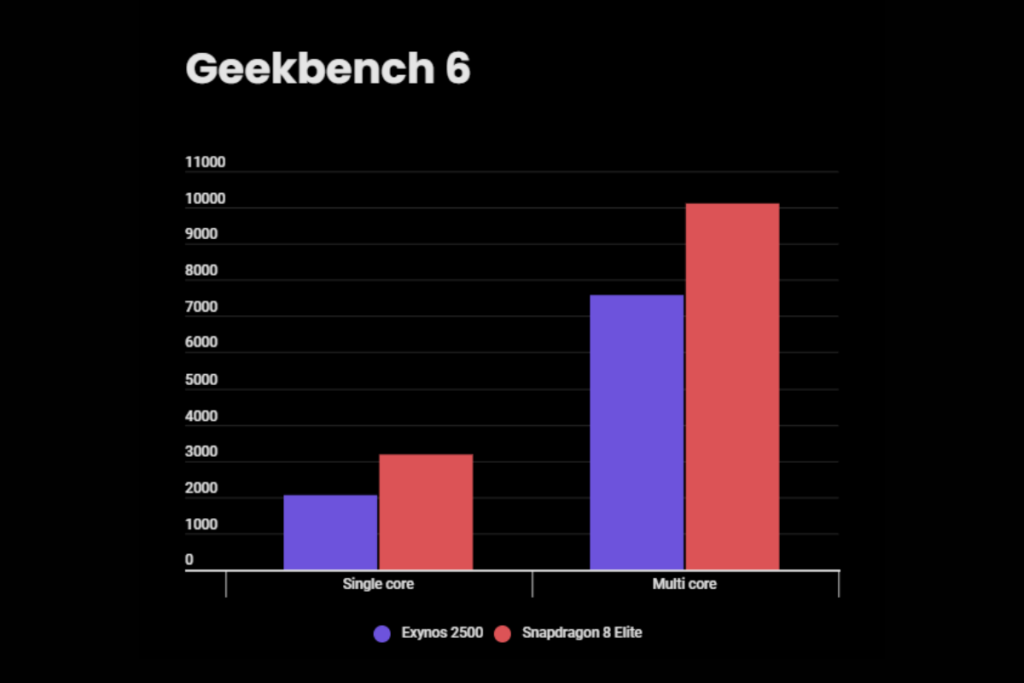
The Geekbench scores further highlight the performance gap between the Snapdragon 8 Elite and the Exynos 2500. In single-core tests, the Snapdragon hits 3,179 points, beating Exynos’s 2,058 by over 54% — a major advantage for tasks that rely on raw speed and responsiveness. The multi-core score paints a similar picture, with the 8 Elite reaching 10,114 compared to the Exynos’s 7,583, marking a 33% lead.
| Exynos 2500 | Snapdragon 8 Elite | |
| Single core | 2,058 | 3,179 |
| Multi core | 7,583 | 10,114 |
The Snapdragon 8 Elite greatly outperforms the Exynos 2500 on various benchmarks, but that doesn’t show the complete picture. So, let’s look at the real-world differences to understand things better.
Exynos 2500 vs Snapdragon 8 Elite: Key differences that matter
Manufacturing
While both chips utilize 3nm process nodes, the Exynos 2500 has been manufactured by Samsung, and the Snapdragon 8 Elite is manufactured by TSMC. Both use advanced, cutting-edge manufacturing facilities; however, TSMC chips generally exhibit better power efficiency.
CPU
The two flagship chipsets differ significantly in terms of the CPU. The Exynos 2500, for instance, has a 10-core CPU, while the Snapdragon 8 Elite has an 8-core CPU. Furthermore, the Exynos chip has ARM-based CPU cores (1 x Cortex-X925, 7 x Cortex-A715, and 2 x Cortex-A520), whereas the Snapdragon chip uses custom Oryon cores.
For comparison, the Oryon cores in the Snapdragon 8 Elite are more powerful and power-efficient, and they also run at a higher speed, giving them a performance edge over the Exynos 2500’s cores.
GPU
The Exynos 2500 has an Xclipse 950 GPU with more pipelines and higher FLOPS. Despite that, it gets crushed by the Adreno 830 GPU inside the Snapdragon 8 Elite. That’s because the Snapdragon chip has a higher memory bandwidth and GPU frequency. On top of this, Qualcomm’s optimizations help Adreno GPUs make better utilization of hardware resources. This not only improves performance but also helps the chip achieve sustained gaming performance without any significant drop.
AI & NPU
The Exynos chip has a powerful NPU that can run up to 59 trillion operations per second (TOPS). The on-device AI performance is 39% better than its predecessor. The Qualcomm chip, on the other hand, is equipped with a Hexagon NPU that delivers 45% higher AI performance and 45% better performance per watt compared to its predecessor.
Camera
The Exynos 2500 supports up to 320MP camera resolution and up to 8K/60fps video recording. While not going into detail, Samsung states that there’s a new ISP capable of capturing vivid images and videos in high resolution. It also features several on-device generative AI capabilities, including removing unnecessary objects and expanding the background.
On the other hand, the Snapdragon 8 Elite features an 18-bit Spectra triple ISP with a maximum resolution of 320MP and up to 8K/30fps video recording. The chip supports multi-frame noise reduction (MFNR) and zero shutter lag (ZSL) at up to 108MP single camera or 48+48+48MP triple cameras. Qualcomm has equipped the chip with a host of features, including real-time semantic segmentation, Truepic photo capture, Video super resolution, and Bokeh Engine.
Connectivity
The Exynos chip offers higher speeds on a 5G connection, with download speeds of up to 12.1Gbps and upload speeds of up to 3.67Gbps, while the Snapdragon 8 Elite peaks at 10Gbps (download) and 3.5Gbps (upload). It also supports satellite messaging. Wi-Fi 7 is present on both chipsets, though.
The Snapdragon chip isn’t without its own perks. It supports the newer Bluetooth 6.0 standard with LE Audio (versus older Bluetooth 5.4 on the Exynos chip). Additionally, it integrates premium audio features such as aptX Lossless and XPAN for spatial audio, and adds ultra-wideband (UWB) support for precise device finding.
Exynos 2500 vs Snapdragon 8 Elite: Conclusion
Samsung has come a long way with the Exynos 2500. It’s a serious step forward, offering a powerful 10-core CPU, beefed-up AI capabilities, and impressive connectivity upgrades. But when placed head-to-head with the Snapdragon 8 Elite, it still lags behind in raw performance.
On both AnTuTu and Geekbench, the Snapdragon chip delivers a commanding lead — especially in GPU and single-core CPU performance — which translates to better gaming, smoother multitasking, and snappier everyday use. Qualcomm’s custom Oryon cores, superior GPU optimizations, and more power-efficient 3nm node from TSMC all give it an edge where it counts.
That said, the Exynos 2500 isn’t without wins. It offers faster 5G speeds, powerful AI compute, and impressive camera support. It’s clearly no longer the weak link in Samsung’s lineup — but if ultimate performance and efficiency are your top priorities, the Snapdragon 8 Elite still takes the crown.




Comments