Add GIZMOCHINA as Preferred Source on Google
Battery innovation doesn’t always get the spotlight, but maybe it should. After all, it’s one of the few things that truly defines the day-to-day user experience. Over the years, smartphone processors got faster, displays turned fluid and vibrant, and cameras reached near-DSLR quality. But battery life? Mostly stagnant. Until now. A quiet revolution is unfolding in battery chemistry, and it’s called silicon-carbon.
1. The Limits of Lithium-Ion
Modern smartphones, laptops, and EVs have relied on lithium-ion batteries for decades. The technology is built around a graphite anode, a safe, stable material with one critical downside: it’s maxed out.
Graphite holds lithium ions well, but its theoretical capacity (372mAh/g) is a hard ceiling. Over the past few years, we’ve only seen incremental gains, maybe 3-5% per generation. That’s not enough when users want thinner devices and longer runtimes.
2. Silicon-Carbon Steps In
Silicon changes the game. It can absorb nearly 10 times more lithium than graphite, theoretically enabling 4,200mAh/g. But the catch is brutal: silicon expands 300-400% when charged. That’s a recipe for cracked electrodes, broken internal structure, and batteries that degrade in months. No one wants a swollen phone after six months.
That’s where the silicon-carbon (Si/C) composite comes in, a hybrid solution that mixes small amounts of nano-silicon into a conductive carbon matrix. The carbon scaffold gives structure and stability. The silicon delivers a bump in capacity. Instead of 100% silicon, most Si/C anodes use 5-15% silicon, enough to boost energy density by 10-20% without the destructive swelling.
3. How It Actually Works
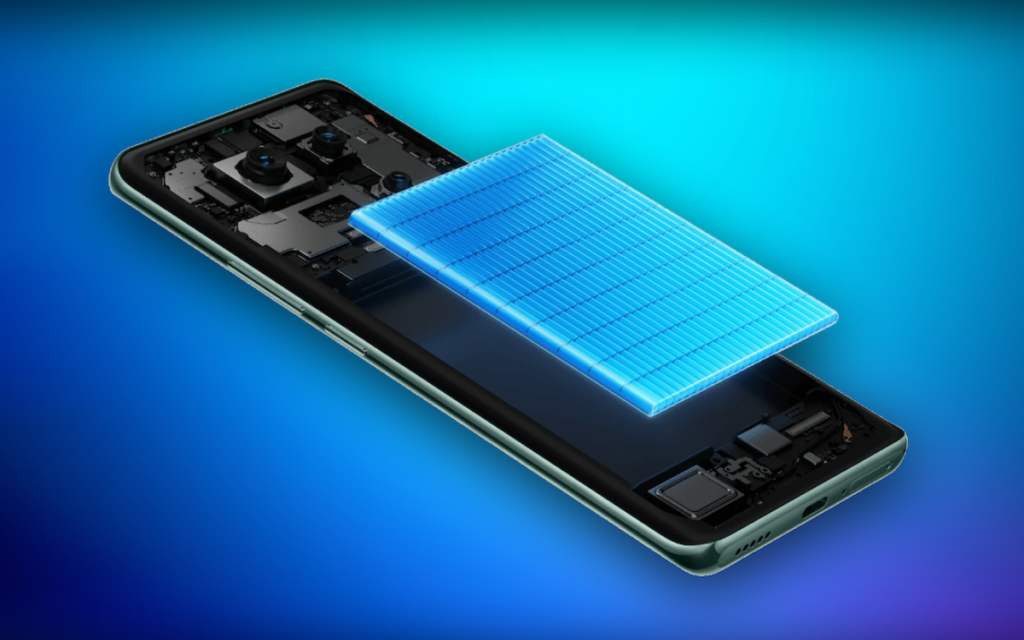
In traditional lithium-ion batteries, lithium ions move between the cathode and anode during charge and discharge cycles. Silicon-carbon (Si/C) batteries follow the same process, but the anode’s improved structure stores more ions within the same volume. That means a 5,000mAh battery can now deliver 5,500 or even 6,000mAh, without any increase in physical size.
Alternatively, you can shrink the battery to make the phone slimmer without compromising on battery life.
It’s not just about size. Silicon-carbon batteries also charge faster, perform better in the cold, and retain more usable power at lower voltages. In one case, Honor’s tests showed 240% more remaining capacity at 3.5V compared to standard Li-ion batteries. That translates to more screen-on time near the end of a battery cycle.
4. Why You’re Seeing It Now
Honor was the first to introduce a Si/C battery in a smartphone back in 2023. Since then, brands like Xiaomi, OnePlus, Vivo, Oppo, and even Huawei’s budget lineup have adopted the technology. And then came the foldables, which saw the most dramatic gains. Devices like the Honor Magic V2 and Vivo X Fold 3 Pro began offering all-day battery life in sub-10mm bodies, something that felt out of reach just a few years ago.
By 2025, mainstream flagships such as the OnePlus 13 and Xiaomi 15 Ultra packed 6,000mAh silicon-carbon batteries without any increase in thickness. Huawei surprised the market with a $170 phone housing a massive 6,620mAh Si/C cell, while Honor’s Power series managed to squeeze in 8,000mAh into a body under 8mm.
The trend has only accelerated. Xiaomi’s Mix Flip 2 ships with a 5,165mAh battery, the Honor Magic V5 includes a 6,100mAh unit, and the Vivo X Fold 5 packs in 6,000mAh, all while pushing foldable thickness to record lows. Thanks to silicon-carbon tech, the old trade-off between slimness and battery life is finally being rewritten.
5. So Why Aren’t Apple and Samsung Onboard?
In short: caution. Apple and Samsung prioritize long-term reliability, and early Si/C cells degrade slightly faster than traditional Li-ion. There’s also logistical overhead: large single-cell batteries over 20Wh are tricky to ship globally. Most Si/C phones today are China-first or split into dual-cell configurations to dodge regulation headaches.
That’s changing, though. Samsung is reportedly testing the tech for the Galaxy S26. Apple, meanwhile, is likely waiting until Si/C batteries hit its benchmark of 80% capacity after 500 cycles. Once that happens, you can bet they’ll rebrand it as a breakthrough.
6. The Road Ahead
Silicon-carbon isn’t the final form. Solid-state and sodium-ion batteries are coming, but they’re not ready yet. Right now, Si/C is the best blend of innovation and practicality. It supercharges lithium-ion without rewriting the rulebook. In a world of foldables, ultra-thin phones, and AI-powered features that drain batteries fast, this tech couldn’t have come at a better time.
For users, it means this: slimmer phones, longer battery life, and a lot less anxiety about hitting 10% by dinner. It’s not magic. It’s chemistry, refined. And it’s already changing what smartphones can be.
For more daily updates, please visit our News Section.
Stay ahead in tech! Join our Telegram community and sign up for our daily newsletter of top stories! 💡