
Add GIZMOCHINA as Preferred Source on Google
The Exynos 2400 is a powerful chipset, featuring a high-performance 10-core CPU and Xclipse 940 GPU for advanced visual rendering. Announced last year, this Samsung-made chipset already powers many Galaxy phones, including the Galaxy S24 series, Galaxy S24 FE, and Galaxy Z Flip 7 FE.
The Snapdragon 8 Elite, on the other hand, is Qualcomm’s flagship powerhouse, rocking a robust 8-core Oryon CPU and a powerful Adreno 830 GPU. It’s the most popular choice for premium smartphones. So, how do these two high-performance chips stack up against each other? Let’s break down the benchmark scores and look at real-world differences to find out.
Let’s begin with the spec sheet:
| Exynos 2400 | Snapdragon 8 Elite | |
|---|---|---|
| Announced | January 2024 | October 2024 |
| Manufacturing | Samsung (4nm) | TSMC (3nm) |
| CPU | 1x 3.21 GHz — Cortex-X4 2x 2.9 GHz — Cortex-A720 3x 2.6 GHz — Cortex-A720 4x 1.95 GHz — Cortex-A520 | 2 x 4.32GHz — Oryon 6 x 3.53GHz — Oryon |
| GPU | Samsung Xclipse 940 Ray tracing support | Adreno 830 Ray tacing support Snapdragon Elite Gaming features |
| NPU | Yes | Qualcomm Hexagon NPU |
| Memory | LPDDR5X, up to 4.2GHz | LPDDR5x, up to 5.3GHz |
| Storage | UFS 4.0 | UFS 4.0 |
| Camera | Up to 320MP single camera Real-time semantic segmentation Up to 8K video recording | Up to 320MP single camera Limitless real-time semantic segmentation Up to 8K video recording |
| Connectivity | Download speed: 12.1Gbps (peak) Upload speed: 3.67Gbps (peak) Wi-Fi 6 Bluetooth 5.3 | Download speed: 10Gbps (peak) Upload speed: 3.5Gbps (peak) Wi-Fi 7 (peak speed: 5.8Gbps) Bluetooth 6.0 |
Exynos 2400 vs Snapdragon 8 Elite: Benchmark score
Note: The tests were conducted on the Galaxy S24+ (Exynos 2400) and Galaxy S25 Ultra (Snapdragon 8 Elite).
AnTuTu benchmark
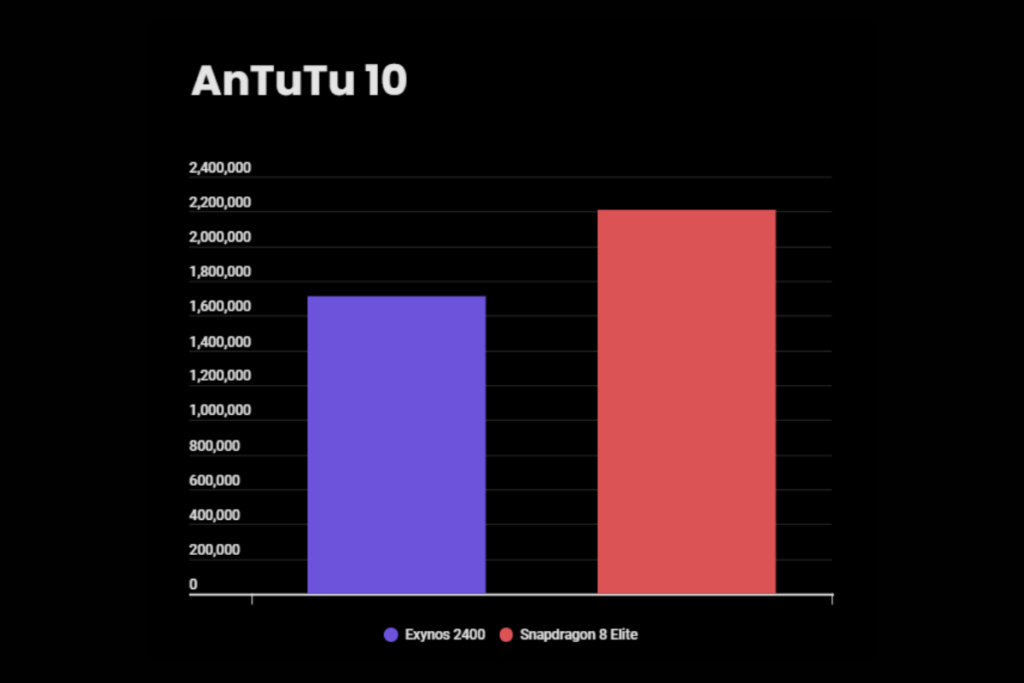
The Snapdragon 8 Elite shows a clear advantage over the Exynos 2400 in AnTuTu, posting a total score of 2,209,476 compared to 1,712,489 — a gap of about 29% overall performance.
Looking deeper, Qualcomm’s chip leads in every category. The CPU score is about 42% higher (574,518 vs 405,345), meaning faster performance in demanding workloads and multitasking. The GPU score tells an even bigger story, with the Snapdragon at 842,351 versus the Exynos’s 662,563 — a 27% boost that translates directly into smoother gaming and stronger graphical rendering.
Memory (437,621 vs 350,139) and UX (354,986 vs 294,442) also favor the Snapdragon 8 Elite, reflecting quicker app loads, better responsiveness, and a more fluid user experience. Overall, while the Exynos 2400 shows big improvements over its predecessors, the Snapdragon 8 Elite sits firmly ahead in raw benchmark performance.
| Exynos 2400 | Snapdragon 8 Elite | |
|---|---|---|
| AnTuTu score | 1,712,489 | 2,209,476 |
| CPU | 405,345 | 574,518 |
| GPU | 662,563 | 842,351 |
| Memory | 350,139 | 437,621 |
| UX | 294,442 | 354,986 |
Geekbench benchmark
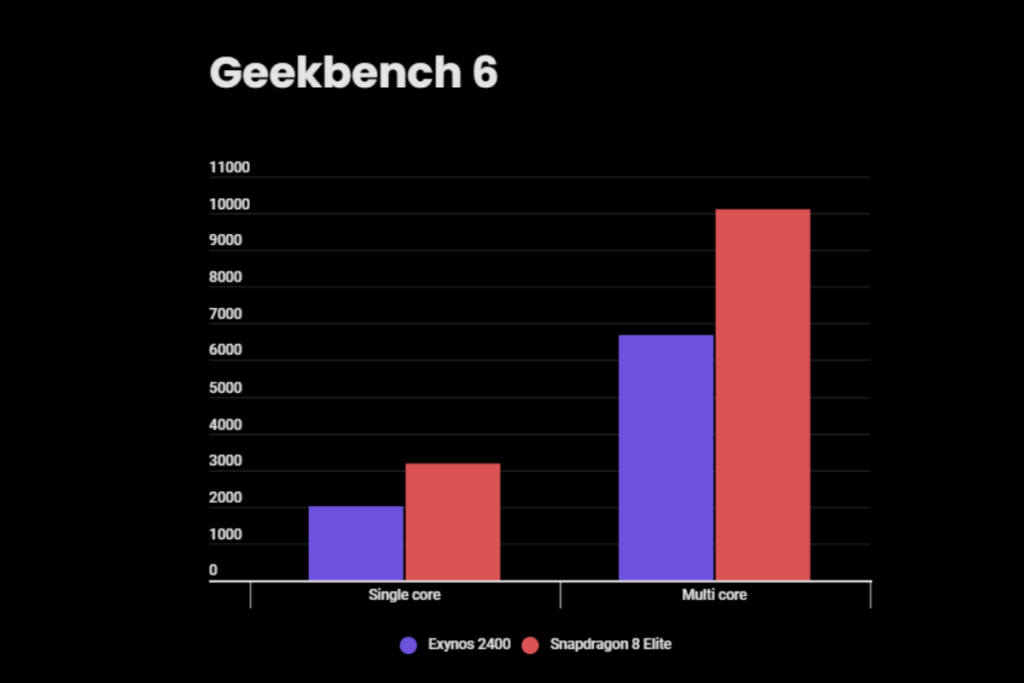
On Geekbench, the performance gap between the two chips becomes even more apparent. The Snapdragon 8 Elite scores 3,179 in single-core and 10,114 in multi-core, while the Exynos 2400 reaches 2,016 and 6,683, respectively.
That gives Qualcomm a huge 57% advantage in single-core performance, which directly impacts everyday responsiveness, app launch, and UI fluidity. In multi-core performance, the gap is slightly smaller but still significant, with the Snapdragon leading by about 51%. This means it handles multitasking, heavy workloads, and demanding apps much more efficiently.
| Exynos 2400 | Snapdragon 8 Elite | |
| Single core | 2,016 | 3,179 |
| Multi core | 6,683 | 10,114 |
While the benchmarks clearly show the Snapdragon 8 Elite leading in performance, they don’t tell the whole story. Other important factors like camera features, connectivity, and more matter too (more on that below).
Exynos 2400 vs Snapdragon 8 Elite: Key differences
Performance
Manufacturing:
The Exynos 2400 is built using Samsung’s 4nm process, while the Snapdragon 8 Elite uses TSMC’s advanced 3nm process. The latter is more power-efficient and offers better performance.
CPU:
The Exynos 2400 features a 10-core CPU that we don’t see often in smartphone chips. It includes one Cortex-X4 prime core, five Cortex-A720 performance cores, and four Cortex-A520 power efficiency cores.
On the other hand, the Snapdragon 8 Elite features two fewer CPU cores, but the eight Oryon cores easily outperform the Exynos 2400 chip. The higher CPU speed provides an additional performance boost to the Snapdragon chip.
GPU:
The Exynos 2400 features an Xclipse 940 GPU built on the AMD RDNA 3 architecture, promising significantly better performance. It supports second-generation ray tracing for a more realistic and immersive gaming experience.
The Snapdragon 8 Elite is equipped with an Adreno 830 GPU, which is 40% faster and 40% more efficient than its predecessor. It also supports hardware-accelerated ray tracing and comes with a full suite of Snapdragon Elite Gaming Features, which includes Snapdragon Game Super Resolution 2.0, Adreno Frame Motion Engine 2.0, and Qualcomm Adaptive Performance Engine 4.0.
On the plus side, the Exynos 2400 features more pipelines and higher floating-point operations per second (FLOPS). The Snapdragon chip benefits from higher peak speed and shading units.
NPU:
Both chipsets feature powerful NPUs that are a major upgrade over previous generations. These NPUs enable advanced on-device AI features, which enhance the camera, boost gaming performance, improve voice processing, and allow for the creation of personalized content, among other benefits.
Camera
Both chips support up to 320MP camera and 8K recording, but they bring notable differences. The Exynos 2400 can shoot with up to four cameras at the same time and leverages noise reduction to improve low-light scenes. Additionally, it supports real-time semantic segmentation, which is also available on the Snapdragon chip.
The Snapdragon 8 Elite has an AI ISP that closely works with the NPU to improve how images and videos are captured and processed in real-time. The AI also works with auto-focus, auto-exposure, and noise reduction. The chip enables simultaneous recording from three cameras (up to 48MP) at 30 FPS or a single 108MP camera at 30 FPS, with noise reduction and zero shutter lag.
Besides great hardware, the Snapdragon chip also offers many useful camera features, including Truepic photo capture, Video super resolution, Computational HDR with staggered imaged sensors, and the Bokeh Engine (version 2).
Connectivity
The Exynos 2400 chipset delivers higher peak download speeds (12.1Gbps vs. 10Gbps) and upload speeds (3.67Gbps vs. 3.5Gbps) on a 5G network. Over a Wi-Fi 7 connection, the Snapdragon chip achieves a peak speed of 5.8Gbps.
On the plus side, the Snapdragon 8 Elite supports the newer Wi-Fi 7 standard (vs. Wi-Fi 6 on the Exynos 2400) and advanced Bluetooth connectivity (v6.0 vs v5.3). Additionally, the Snapdragon chip offers a range of features to enhance connection stability, performance, and power efficiency.
Exynos 2400 vs Snapdragon 8 Elite: Conclusion
The Exynos 2400 is undoubtedly a major step forward for Samsung, with solid performance gains, impressive AI and camera capabilities, and excellent 5G speeds. It’s a competitive Exynos chip from Samsung, and a worthy choice for many flagship devices.
But when it comes to overall performance, the Snapdragon 8 Elite still holds the upper hand. Whether it’s benchmark scores, CPU architecture, GPU muscle, or real-world responsiveness, Qualcomm’s flagship chip consistently pulls ahead. Add to that its cutting-edge 3nm process, faster and more efficient GPU, advanced AI ISP, and superior connectivity options, and the gap becomes even more apparent.
So, while the Exynos 2400 delivers respectable power and solid features across the board, the Snapdragon 8 Elite remains the top-tier choice for users who demand the absolute best performance and innovation from their smartphones.




Comments