
Add GIZMOCHINA on Google:
Google’s in-house Tensor chips from the beginning have faced criticism for not offering solid performance. While they are excellent for everyday tasks, the performance gap is pretty significant when compared with the latest flagships from Qualcomm and MediaTek.
The latest Tensor G5, despite Google claiming a “major performance boost,” couldn’t get anywhere near the Snapdragon 8 Elite’s benchmark figures. The story remained unchanged when compared against Snapdragon 8 Gen 3 — again, a big performance gap in Snapdragon’s favor. Now, we’re interested in finding out if the Tensor G5 can match or outperform a nearly three-year-old Snapdragon 8 Gen 2.
Let’s get straight to the benchmark numbers.
Tensor G5 vs Snapdragon 8 Gen 2: Benchmark score
AnTuTu comparison
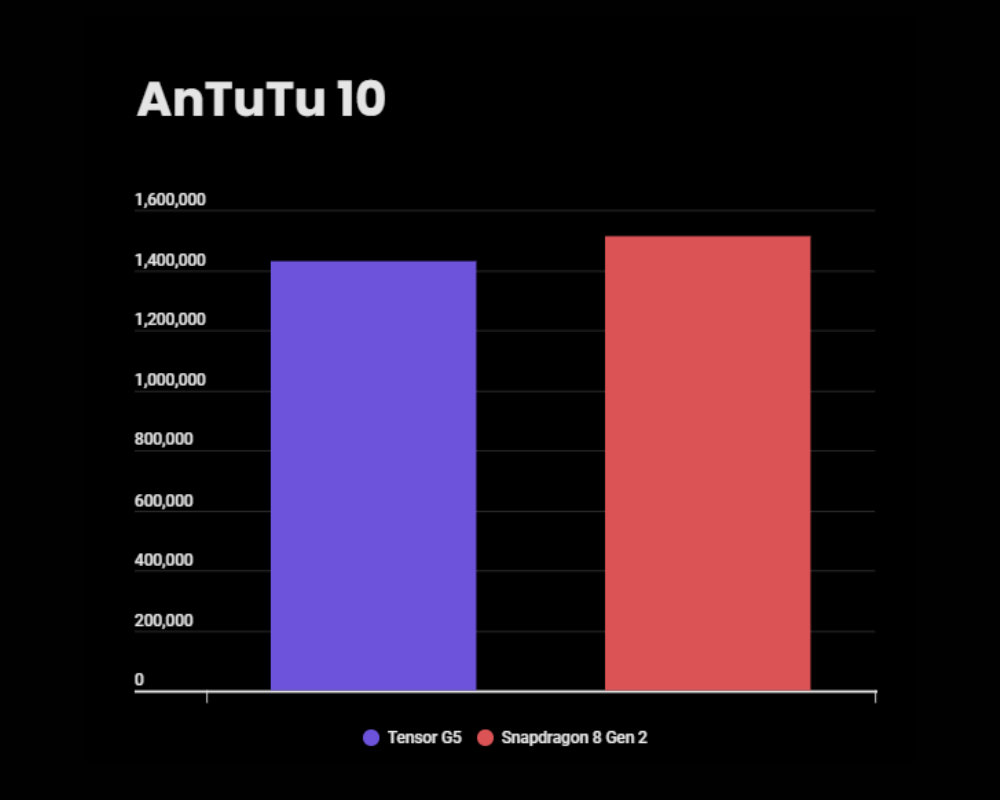
The Snapdragon 8 Gen 2 still holds a slight edge in overall AnTuTu with a score of 1,512,682, compared to the Tensor G5’s 1,429,557. But the story gets more interesting when you look at the breakdown.
The Tensor G5 pulls ahead in the CPU department, scoring 483,989 vs 373,687 — a 29% lead that shows Google’s new custom cores are much stronger for raw processing. On the other hand, the Snapdragon 8 Gen 2 still holds a higher GPU score, with 599,957 vs 416,313 — a massive 44% advantage. That means Qualcomm’s older chips are still superior to the latest Tensor G5 for graphics-intensive workloads, such as gaming and 3D rendering.
Memory and UX scores are closer, with Tensor G5 slightly ahead in memory (293,467 vs 273,714) and Snapdragon 8 Gen 2 leading in UX (265,325 vs 235,788). So, according to AnTuTu scores, both chips should feel smooth for day-to-day use, but Snapdragon’s stronger GPU still gives it the gaming edge.
| Tensor G5 | Snapdragon 8 Gen 2 | |
|---|---|---|
| AnTuTu score | 1,429,557 | 1,512,682 |
| CPU | 483,989 | 373,687 |
| GPU | 416,313 | 599,957 |
| Memory | 293,467 | 273,714 |
| UX | 235,788 | 265,325 |
Geekbench (CPU) comparison
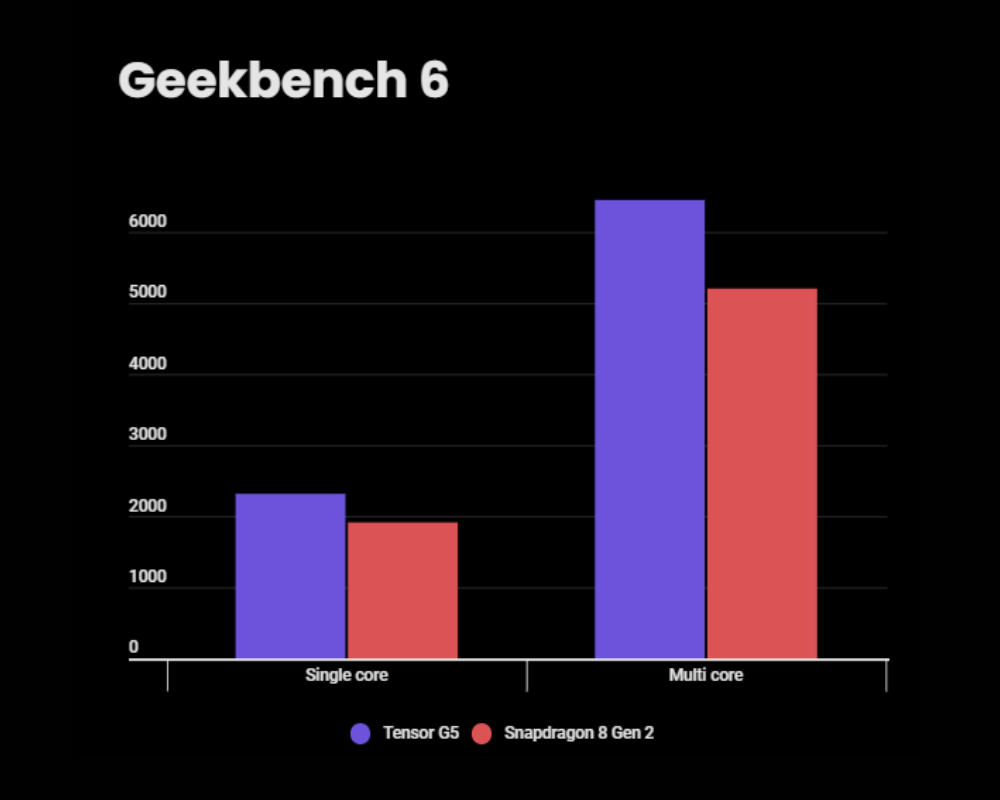
Google claims a 30% faster average CPU uplift for the Tensor G5 compared to last year’s G4, and this improvement is also reflected in benchmarks. On AnTuTu, Tensor G5 scored higher in CPU, and Geekbench also paints a similar picture.
In single-core performance, the Tensor G5 scores 2,316 vs 1,912, giving it a 21% lead. This means the latest Tensor should feel noticeably snappier in everyday tasks, such as app launches, UI responsiveness, and web browsing.
The gap widens even further in multi-core performance, with the G5 reaching 6,452 vs 5,204 — about a 24% advantage. This should result in better handling of multitasking, heavier apps, and background processes.
| Tensor G5 | Snapdragon 8 Gen 2 | |
| Single core | 2,316 | 1,912 |
| Multi core | 6,452 | 5,204 |
Overall, while the Snapdragon 8 Gen 2 still has the edge in GPU and gaming (as seen on AnTuTu), both benchmarks (AnTuTu and Geekbench) show stronger CPU performance for the Tensor G5. So, except for gaming and other graphics-intensive tasks, the new Tensor should feel snappier and more responsive.
Tensor G5 vs Snapdragon 8 Gen 2: Spec sheet
| Tensor G5 | Snapdragon 8 Gen 2 | |
|---|---|---|
| Announced | August 2025 | November 2022 |
| Process node | 3nm (TSMC) | 4nm (TSMC) |
| CPU | 1x 3.78 GHz — Cortex-X4 5x 3.05 GHz — Cortex-A725 2x 2.25 GHz — Cortex-A520 | 1 x 3.2 GHz — Cortex-X3 2 x 2.8 GHz — Cortex-A715 2 x 2.8 GHz — Cortex-A710 3 x 2.0 GHz — Cortex-A510 |
| GPU | PowerVR DXT-48-1536 GPU No ray tracing support | Adreno 740 GPU Ray tracing support Snapdragon Elite Gaming features |
| NPU | New Google Edge TPU | Qualcomm Hexagon NPU |
| Memory Storage | LPDDR5X Zoned UFS 4.0 (512GB+) | LPDDR5X, up to 4.2GHz UFS 4.0 |
| Connectivity | Samsung Exynos 5400 5G modem Wi-Fi 7, Wi-Fi 6E Bluetooth 6.0 | Snapdragon X70 5G modem Download: 10Gbps (peak) Upload: 3.5Gbps (peak) Wi-Fi 7 (peak speed: 5.8Gbps) Bluetooth 5.3 |
The spec sheet clearly shows why the Tensor G5 has a higher CPU score than the 8 Gen 2 on benchmarks. It uses newer CPU cores, which are more performance-friendly and power-efficient. Plus, they also run at a higher speed. Additionally, TSMC’s 3nm advanced manufacturing technology further enables the Tensor G5 to achieve better CPU performance and efficiency.
As for the GPU, the Tensor G5 features PowerVR DXT-48-1536, whereas the 8 Gen 2 comes with Adreno 740, which supports ray tracing and a full suite of Snapdragon Elite Gaming features. For on-device AI capabilities, the G5 has a new Google Edge TPU, which is likely more capable than the Qualcomm Hexagon NPU on the 8 Gen 2. Another notable difference is the newer Bluetooth v6.0 standard on the Tensor chip, whereas the 8 Gen 2 has Bluetooth 5.3.
Tensor G5 phones:
Snapdragon 8 Gen 2 phones


Comments