
Add GIZMOCHINA as Preferred Source on Google
Picture this: a computer sitting in a lab, essentially “thinking up” brand new forms of life from scratch. That’s exactly what just happened at Stanford and the Arc Institute, where researchers used artificial intelligence to design viruses that can actually kill bacteria. And yes, these AI-created viruses work in real life.
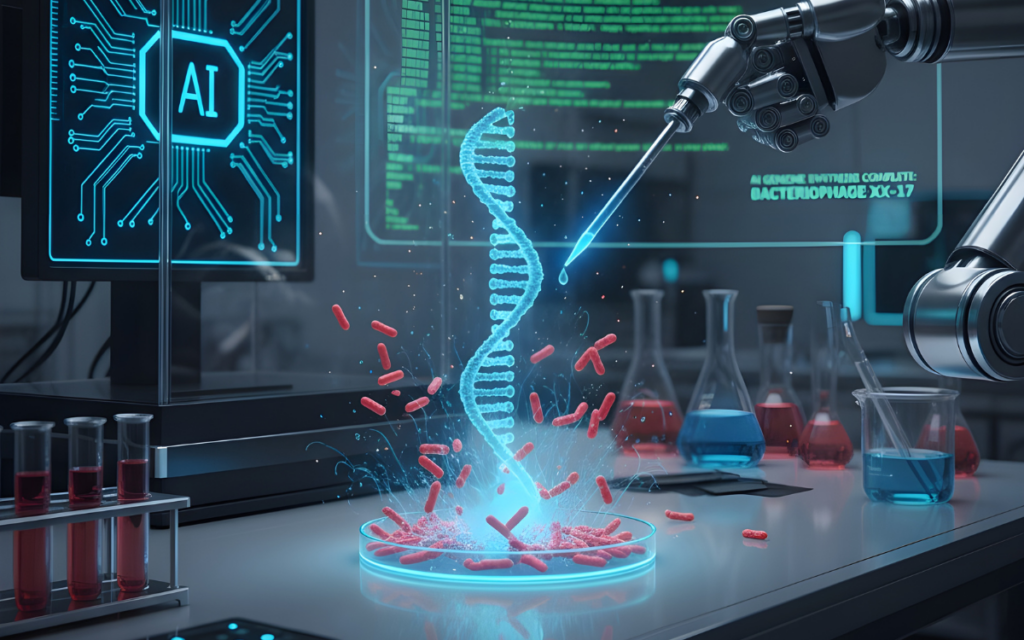
Here’s how wild this is, it’s the first time anyone has used AI to dream up an entire viral genome from nothing. No copying nature’s homework, no tweaking existing designs. Pure digital creativity turned into living biology.
The AI system, called Evo, works kind of like ChatGPT, except instead of being trained on books and articles, it learned from 2 million different virus genomes. When researchers asked it to design new versions of a simple virus called phiX174, Evo created 302 completely original genetic blueprints. The kicker? Sixteen of them actually came to life in the lab and successfully infected E. coli bacteria.
“This was like watching digital code become biology,” said Brian Hie, who runs the lab. You can practically hear the excitement, and maybe a little nervousness, in his voice.
The potential upside is huge. We’re talking about supercharged treatments for antibiotic-resistant infections, which kill hundreds of thousands of people every year. Imagine having an AI design custom viruses to hunt down specific bacteria that antibiotics can’t touch anymore. Or think about gene therapy, using these designer viruses as tiny delivery trucks to fix genetic diseases.
But here’s where things get uncomfortable. J. Craig Venter, basically the godfather of synthetic biology, didn’t sugarcoat his concerns. He called this “a faster version of trial and error” and warned that the same technology could potentially be misused to create much nastier viruses than simple bacteria killers.
Right now, Evo only knows about viruses that don’t harm humans. But the underlying technology? That could theoretically be retrained on more dangerous stuff. It’s like having a recipe generator that currently only knows how to make cookies, but could learn to make dynamite if someone fed it the wrong cookbook.
We’re still years away from AI creating entire synthetic cells, those would need millions of genetic letters instead of the thousands in these simple viruses. But companies like Ginkgo Bioworks are already working on fully automated systems that could go from AI design to living organism without human hands touching the process.
It’s honestly breathtaking and unsettling at the same time. We might be witnessing the moment when life itself becomes programmable, when the line between digital code and biological reality finally disappears. The question isn’t whether this technology will change everything, it’s whether we’re ready for what comes next.
In related AI news, Huawei has recently unveiled its powerful Atlas 950 and 960 SuperPoDs in a direct challenge to Nvidia, while Tencent has introduced a groundbreaking 3D AI tool that is available completely free.
For more daily updates, please visit our News Section.
Stay ahead in tech! Join our Telegram community and sign up for our daily newsletter of top stories! 💡
(Via)




Comments