Add GIZMOCHINA as Preferred Source on Google
Redmi Pad 2 Pro and Samsung Galaxy Tab S9 FE target users seeking large-screen Android tablets at reasonable prices, but they approach it differently. Xiaomi focuses on raw hardware upgrades like a bigger battery and higher refresh display, while Samsung leans on software polish, stylus features, and long-term updates. This comparison is important because buyers must decide whether hardware power or ecosystem support offers more long-term value.
1. Design and Build
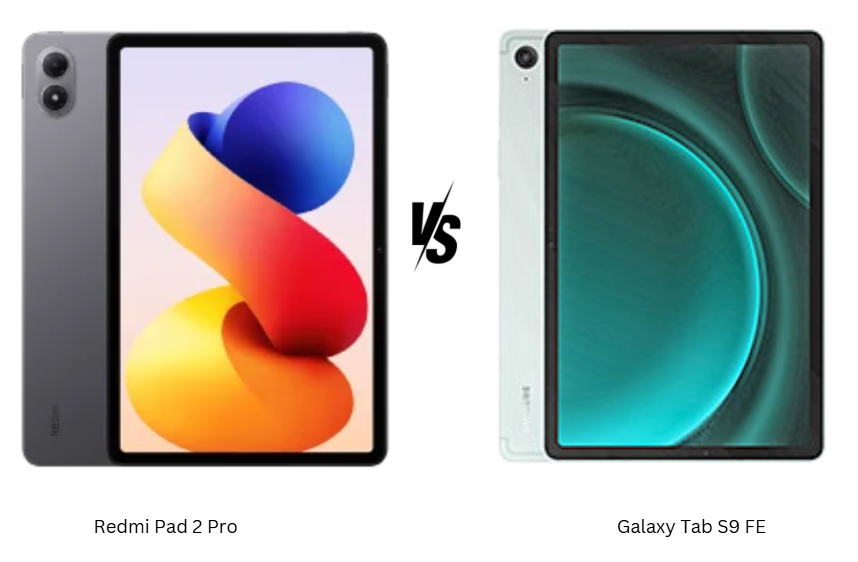
Both tablets embrace premium aluminum builds, giving them a solid feel in hand. The Redmi Pad 2 Pro adds optional matte glass protection that reduces glare and fingerprints, making it practical for long-term use. Its larger footprint makes it less portable but ideal for those who prefer a big canvas. The Galaxy Tab S9 FE, on the other hand, is thinner and lighter, which greatly enhances portability and comfort during prolonged use. Slimmer bezels also give it a sleeker, more modern look.
Where durability is concerned, the Galaxy Tab S9 FE takes the lead with IP68 dust and water resistance, making it better equipped for outdoor or rugged usage. The Redmi Pad 2 Pro offers Mohs level 6 scratch resistance, which improves display toughness but lacks waterproofing.
Verdict: The Galaxy Tab S9 FE wins on durability and portability, while the Redmi Pad 2 Pro offers a sturdier but bulkier option with stronger scratch resistance.
| Preview | Product | |
|---|---|---|

|
Samsung Galaxy Tab S9 FE 27.69 cm (10.9 inch) Display, RAM 6 GB, ROM 128 GB Expandable, S Pen… | Check Price on Amazon |
Please Note: When you buy something using the links in our articles, we may earn a small commission at no cost to you.
| Preview | Product | |
|---|---|---|

|
Redmi Pad 2 Pro | Check Price on Amazon |
Please Note: When you buy something using the links in our articles, we may earn a small commission at no cost to you.
2. Display
The Redmi Pad 2 Pro boasts a 12.1-inch IPS LCD with a 120Hz refresh rate, Dolby Vision, 1B color support, and higher brightness. This makes it excellent for streaming HDR content, gaming, or creative tasks such as digital sketching. It’s optional, matte glass further improves readability in bright conditions. The Galaxy Tab S9 FE comes with a smaller 10.9-inch panel at 90Hz, which feels less fluid. While its pixel density is comparable, the lack of HDR support makes it less appealing for premium content viewing.
Both tablets include stylus support, but Redmi’s larger canvas and smoother refresh rate make it more versatile for artists and note-takers.
Verdict: The Redmi Pad 2 Pro clearly outshines the Galaxy Tab S9 FE in display quality, brightness, and refresh rate, offering a better experience for media and creative work.
3. Performance
Powered by the Snapdragon 7s Gen 4 and Adreno 810 GPU, the Redmi Pad 2 Pro delivers stronger performance across multitasking, app handling, and gaming. It handles demanding workloads with greater efficiency and stability compared to the Exynos 1380 in the Galaxy Tab S9 FE, which is competent but less optimized for heavy use.
RAM and storage options are similar, with both supporting microSD expansion. However, Redmi’s UFS 2.2 storage ensures decent read and write speeds for day-to-day performance. Gaming and creative apps benefit more from the Snapdragon chipset, while the Exynos chip suits light to moderate productivity tasks.
Verdict: The Redmi Pad 2 Pro provides better raw performance, particularly for gaming and heavy apps, while the Tab S9 FE works better for general productivity but lags in power.
4. Software and Ecosystem
Samsung’s One UI offers a polished experience with strong ecosystem integration, including seamless pairing with Galaxy phones, watches, and laptops. Features like Samsung DeX give the Tab S9 FE a desktop-like interface, greatly enhancing productivity for professionals and students. With four years of OS upgrades promised, it offers excellent longevity.
The Redmi Pad 2 Pro runs on Android 15 with HyperOS 2, giving it a modern interface and smoother animations. However, Xiaomi’s software support is less predictable, especially for tablets. It focuses more on a clean, streamlined Android experience rather than deep integration with other devices.
Verdict: The Galaxy Tab S9 FE stands out for its ecosystem and long-term support, making it better for users invested in Samsung’s devices. The Redmi Pad 2 Pro offers a fresher OS but with uncertain update longevity.
5. Battery and Charging
The Redmi Pad 2 Pro packs a massive 12,000 mAh battery, ensuring extended usage for streaming, browsing, or gaming. It supports 33W fast charging, which is respectable for such a large cell, and even provides 27W reverse wired charging to power other devices. This makes it a reliable companion for long work or travel days.
The Galaxy Tab S9 FE, while slimmer, houses a smaller 8,000 mAh battery. Its advantage lies in faster 45W charging, which refuels it quicker, though endurance will not match Redmi’s extended battery life.
Verdict: The Redmi Pad 2 Pro is the better choice for endurance, while the Galaxy Tab S9 FE wins for quicker charging but shorter overall battery life.
6. Camera and Audio
Both tablets feature 8MP rear cameras, but the Galaxy Tab S9 FE supports 4K recording, while the Redmi Pad 2 Pro is limited to 1080p. For video calls, Samsung offers a 12MP ultrawide front camera, ensuring sharper and wider angles, compared to Redmi’s basic 8MP sensor.
Audio is another differentiator: the Redmi Pad 2 Pro comes with a quad-speaker setup tuned with Dolby Atmos and Hi-Res certification, along with a 3.5mm headphone jack. Samsung’s dual speakers tuned by AKG sound clear but don’t match Redmi’s loudness and immersion, and it lacks a headphone jack.
Verdict: The Tab S9 FE is stronger in camera quality for calls and recordings, while the Redmi Pad 2 Pro dominates in audio experience with quad speakers and Hi-Res support.
7. Productivity and Accessories
Both tablets support stylus input, though Samsung’s S Pen is more refined with lower latency and deeper integration across apps. Samsung also provides optional keyboard covers that pair well with DeX mode, turning the tablet into a laptop replacement. The Redmi Pad 2 Pro supports a magnetic stylus but lacks advanced ecosystem-level features.
In terms of ports, the Redmi includes a 3.5mm headphone jack and OTG support, which can be convenient for traditional users. Samsung offers a side fingerprint scanner for added security, but lacks the headphone jack. External display support is also more robust on Samsung through DeX.
Verdict: The Galaxy Tab S9 FE is better for professional productivity thanks to DeX and S Pen optimization, while the Redmi Pad 2 Pro provides better port versatility but limited accessory integration.
8. Connectivity
The Galaxy Tab S9 FE supports both Wi-Fi 6 and cellular models with GPS, making it more versatile for users who need connectivity on the go. Bluetooth 5.3 ensures stable pairing with accessories. Redmi’s Pad 2 Pro also supports Wi-Fi 6 and a newer Bluetooth 5.4 standard, which gives it an edge in short-range connections, but it lacks GPS and cellular options.
Peripheral compatibility is similar, though Samsung’s presence in enterprise environments makes it a stronger choice for professionals who need constant connectivity. Redmi, however, works well as a Wi-Fi-only device for media and learning.
Verdict: The Galaxy Tab S9 FE wins for broader connectivity with optional SIM support and GPS, while the Redmi Pad 2 Pro is limited to Wi-Fi but offers slightly newer Bluetooth.
9. Pricing and Value
The Redmi Pad 2 Pro launches at around $300, offering a larger display, stronger performance, and a huge battery at a lower cost. It delivers exceptional value for entertainment, casual productivity, and creative users who want maximum hardware for their money.
The Galaxy Tab S9 FE costs around $350, reflecting its Samsung ecosystem features, IP68 protection, and longer software support. While more expensive, it holds better resale value and appeals to users who prioritize durability and updates.
Verdict: The Redmi Pad 2 Pro is more cost-effective for hardware and multimedia value, while the Galaxy Tab S9 FE justifies its price with durability, software longevity, and ecosystem perks.
Disclaimer:
Prices are approximate and may vary based on country, region, and applicable taxes
Specs Comparison
| Feature | Redmi Pad 2 Pro | Samsung Galaxy Tab S9 FE |
|---|---|---|
| Build & Design | Aluminum frame & back, optional matte glass, scratch resistance (Mohs 6) | Aluminum build, IP68 dust/water resistant |
| Dimensions / Weight | Larger and heavier | Slimmer and lighter |
| Display | 12.1″ IPS LCD, 120Hz, 1B colors, Dolby Vision, 1600×2560, matte glass (optional) | 10.9″ IPS LCD, 90Hz, 1440×2304, no HDR |
| OS / UI | Android 15, HyperOS 2 | Android 13, One UI 6, 4 OS upgrades promised |
| Processor / GPU | Snapdragon 7s Gen 4 (4 nm), Adreno 810 | Exynos 1380 (5 nm), Mali-G68 MP5 |
| RAM & Storage | 128GB 6GB / 256GB 8GB, UFS 2.2, microSD slot | 128GB 6GB / 128GB 8GB / 256GB 8GB, microSD slot |
| Rear Camera | 8 MP, 1080p@30fps | 8 MP, 4K@30fps / 1080p@30fps |
| Front Camera | 8 MP, 1080p@30fps | 12 MP ultrawide |
| Audio | Quad speakers, Dolby Atmos, Hi-Res audio, 3.5mm jack | Stereo speakers (AKG tuned), no headphone jack |
| Battery | 12,000 mAh, 33W charging, 27W reverse wired | 8,000 mAh, 45W charging |
| Connectivity | Wi-Fi 6, Bluetooth 5.4, no GPS or cellular | Wi-Fi 6, Bluetooth 5.3, optional SIM + GPS |
| Sensors | Accelerometer, gyro, compass, proximity (accessories only) | Fingerprint (side), accelerometer, gyro, compass, proximity |
| Stylus Support | Yes (magnetic, supported) | Yes (S Pen included, low latency) |
| Special Features | Circle to Search, reverse wired charging | Circle to Search, Samsung DeX |
| Price (approx.) | $300 | $350 |
| Launch Date | September 2025 | October 2023 |
10. Conclusion
Redmi Pad 2 Pro is ideal for users seeking a large display, stronger performance, immersive audio, and massive battery life at a budget-friendly price. It suits students, entertainment lovers, and creative hobbyists who value hardware over ecosystem.
The Galaxy Tab S9 FE, meanwhile, is better tailored for professionals and productivity-driven users. With IP68 durability, longer software updates, DeX support, and a refined S Pen experience, it fits seamlessly into Samsung’s ecosystem for work and study.
Final Verdict: Choose the Redmi Pad 2 Pro if media consumption, performance, and battery life are top priorities at a lower cost. Go for the Galaxy Tab S9 FE if durability, productivity tools, and long-term updates matter more.
Read More:
- Redmi Pad 2 Pro vs Redmi Pad Pro: Key Differences and Buyer’s Guide
- Xiaomi 15T vs 14T: Should You Upgrade in 2025?
- iPhone 17 vs Galaxy S25 FE: Which 2025 Smartphone Should You Buy?