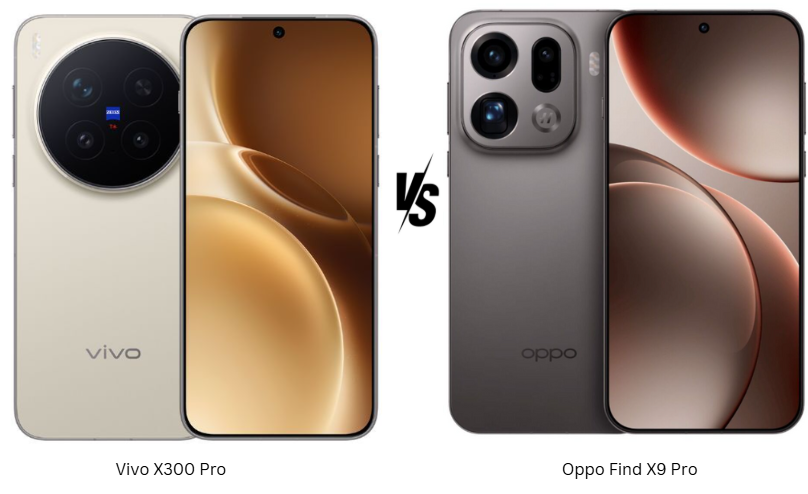
Two $800 flagships, one tough choice: Vivo X300 Pro and Oppo Find X9 Pro are going head-to-head in one of the hottest smartphone comparisons of 2025. Both promise top-tier performance, stunning displays, and pro-level cameras. But which one actually gives you more for your money?
Both Vivo X300 Pro and Oppo Find X9 Pro embrace a premium aesthetic with a sleek glass-aluminum construction and IP68/IP69 water resistance. The X300 Pro leans toward a minimalist, professional look with a flatter back, while the Find X9 Pro delivers a slightly more sculpted, curved rear panel for a smoother hand feel. Both phones are nearly identical in size, but the Oppo’s slightly curved edges make it more comfortable to hold during long usage. The inclusion of eSIM and dual-SIM flexibility on both enhances their global appeal. Overall, the Find X9 Pro edges ahead in ergonomics, while Vivo maintains a cleaner and more classic finish.
Display Quality:
Both devices offer LTPO AMOLED panels with adaptive 120Hz refresh rates and impressive HDR support. The Vivo X300 Pro shines with a record-breaking peak brightness of 4500 nits, ideal for outdoor use and HDR content. Meanwhile, the Oppo Find X9 Pro’s 3600-nit peak still delivers vibrant colors and punchy contrast, but doesn’t quite match Vivo’s sheer brightness power. Both displays are sharp and fluid, though Vivo’s ultra-high brightness and slightly higher pixel density give it a marginal edge for media consumption and gaming.
Verdict:
Both phones offer flagship-grade design and displays, but the Oppo takes a slight lead in ergonomics and grip, while Vivo wins on raw display performance. For users prioritizing sleek feel and comfort, Oppo is a solid pick, but those seeking the most visually immersive screen will likely prefer Vivo.
2. Specifications
Performance:
Both phones are powered by the same Mediatek Dimensity 9500 chip, paired with fast UFS 4.1 storage and up to 16GB RAM. Day-to-day performance and multitasking are virtually identical, with both delivering exceptional speed in apps, gaming, and productivity tasks. However, the Oppo offers a slight edge with software longevity; it promises up to 5 major Android updates compared to Vivo’s 4. This gives Oppo a longer lifecycle, appealing to users who keep their phones for several years.
Battery and Charging:
The Find X9 Pro comes with a larger 7500 mAh battery, while the Vivo X300 Pro offers a still-impressive 6510 mAh cell. In real-world terms, Oppo can deliver slightly longer endurance, especially during intensive use like video streaming or navigation. Charging speeds are close: Vivo supports 90W wired and 40W wireless, whereas Oppo matches with 80W wired and leads with 50W wireless. The difference isn’t drastic, but Oppo’s larger battery and stronger wireless charging give it an upper hand for power users.
Verdict:
Performance is evenly matched, but Oppo’s extended software support and larger battery make it more future-proof. Vivo offers a great balance but slightly lags in wireless charging power and longevity.
3. Camera
Main and Secondary Lenses:
Both phones bring serious camera hardware with 50 MP main and ultrawide lenses and a 200 MP telephoto lens. Vivo’s periscope telephoto has a slightly longer optical zoom (3.7x vs. Oppo’s 3x), making it better for distant subjects. Oppo, however, has the advantage of a wider aperture on the telephoto, improving low-light performance. Additionally, Oppo integrates Hasselblad Color Calibration, producing warmer, more natural tones, while Vivo collaborates with Zeiss for crisper, detail-rich output. Videographers may appreciate Vivo’s 8K capability, whereas Oppo’s 4K Dolby Vision recording remains excellent.
Selfie Camera:
Both devices feature a 50 MP selfie camera capable of 4K recording, ensuring flagship-level clarity. Vivo’s autofocus and HDR tuning tend to deliver sharper, more balanced selfies, while Oppo prioritizes dynamic range and color accuracy. In challenging lighting conditions, Oppo maintains skin tone fidelity, while Vivo’s sharper output is great for content creators.
Verdict:
Camera quality is neck to neck, with each excelling in different areas. Oppo leans into natural tones and strong low-light performance, while Vivo emphasizes sharpness and zoom flexibility. Content creators who love vibrant, detailed shots may prefer Vivo, while photography purists may gravitate toward Oppo’s Hasselblad tuning.
4. Pricing
Both devices are priced at approximately $800, putting them in direct competition within the upper flagship tier. At this price point, users expect premium performance, robust cameras, and excellent displays, all of which both phones deliver.
Since both are priced similarly, the decision ultimately comes down to priorities. Oppo offers longer software support and better battery endurance, giving more value over time. Vivo counters with a brighter display and stronger zoom capabilities.
Disclaimer: Prices are approximate and may vary based on country, region, and applicable taxes.
5. Conclusion
The Find X9 Pro brings satellite connectivity in its top variant, faster wireless charging, and extended software support, features aimed at long-term users and tech enthusiasts. The Vivo X300 Pro impresses with its record-breaking brightness, Zeiss-powered camera system, and robust videography tools, including 8K recording and 3D LUT import, catering to creators.
Verdict:
Both phones represent the pinnacle of flagship competition in 2025. Oppo stands out as the more rounded, future-ready choice with better endurance and software longevity. Vivo, on the other hand, offers the most visually striking display and a camera system tuned for sharp, vibrant output.
For power users and content creators, Vivo might be more enticing; for balanced, long-lasting daily use, Oppo is the smarter pick.
We use cookies on our website to give you the most relevant experience by remembering your preferences and repeat visits. By clicking “Accept”, you consent to the use of ALL the cookies.
This website uses cookies to improve your experience while you navigate through the website. Out of these, the cookies that are categorized as necessary are stored on your browser as they are essential for the working of basic functionalities of the website. We also use third-party cookies that help us analyze and understand how you use this website. These cookies will be stored in your browser only with your consent. You also have the option to opt-out of these cookies. But opting out of some of these cookies may affect your browsing experience.
Necessary cookies are absolutely essential for the website to function properly. This category only includes cookies that ensures basic functionalities and security features of the website. These cookies do not store any personal information.
Any cookies that may not be particularly necessary for the website to function and is used specifically to collect user personal data via analytics, ads, other embedded contents are termed as non-necessary cookies. It is mandatory to procure user consent prior to running these cookies on your website.







Comments