
Add GIZMOCHINA on Google:
Flagship phones aren’t just about power anymore; they’re about what kind of experience you want. The Vivo X300 Pro brings top specs and big battery power at a lower price, while the Samsung Galaxy S25 Ultra focuses on premium design, long-term updates, and extra smart features. This comparison matters because both phones are strong in very different ways, making the choice less about performance and more about personal priorities.
1. Design and Display
Build and Feel:
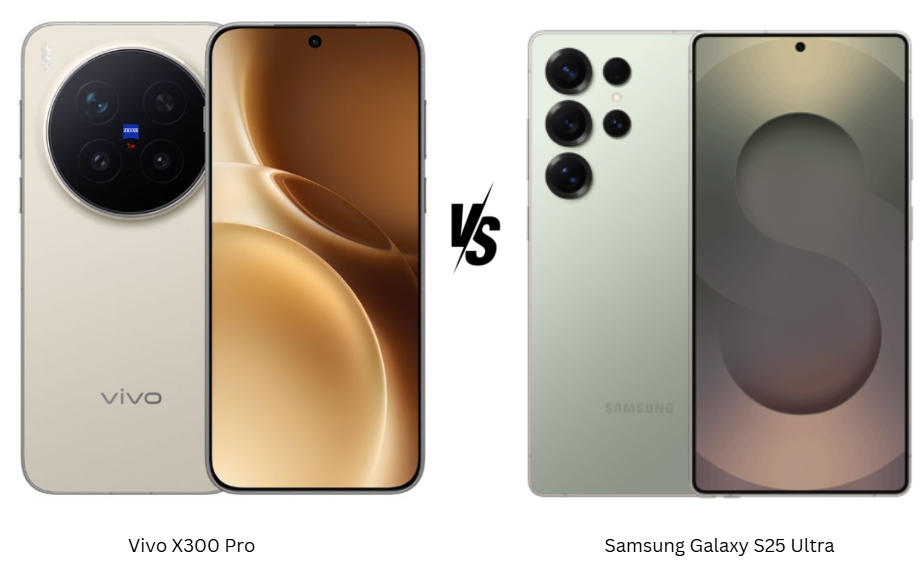
Vivo X300 Pro comes with a sleek aluminum alloy frame, glass back, and an impressive IP68/IP69 rating, making it resistant to both dust and high-pressure water jets. This ruggedness adds a practical edge, especially for users who want durability without compromising on aesthetics. Its slightly curved design and glass finish give it a premium in-hand feel.
On the other hand, Samsung Galaxy S25 Ultra features a titanium frame and the latest Corning Gorilla Armor 2 protection. The titanium frame provides superior rigidity and scratch resistance compared to aluminum, enhancing the phone’s lifespan. Additionally, the presence of an integrated stylus gives the S25 Ultra a functional edge, especially for power users who value productivity tools.
While both phones feel premium, the Galaxy S25 Ultra’s build quality leans more toward ultra-flagship craftsmanship with its titanium body and Gorilla Armor, making it more resilient in everyday use. Vivo’s stronger water resistance may appeal more to adventure seekers, while Samsung’s premium materials offer lasting elegance.
Display Quality:
The X300 Pro boasts a 6.78-inch LTPO AMOLED panel with a 120Hz refresh rate, Dolby Vision, HDR Vivid, and an impressive 4500 nits peak brightness. This makes it excellent for outdoor visibility and HDR content. Its color calibration and high PWM dimming ensure reduced eye strain and vibrant, true-to-life visuals.
The S25 Ultra ups the ante with a slightly larger Dynamic LTPO AMOLED 2X display, QHD+ resolution, and Gorilla Armor protection with DX anti-reflective coating. While its peak brightness is lower on paper, its advanced panel tech and coating deliver exceptional sunlight readability and color accuracy. Samsung’s AMOLED panels are known for their balanced contrast and deep blacks, giving it a slight advantage for content consumption and productivity.
Vivo impresses with sheer brightness, but Samsung’s refinement in clarity, reflectivity reduction, and stylus integration gives the display a more polished, flagship-level experience.
Verdict:
Both displays are stunning, but Samsung edges ahead in sophistication and practicality. Vivo delivers raw brightness and excellent visuals, making it a strong choice for media enthusiasts. Samsung’s titanium build, superior glass protection, and stylus make it more versatile for professionals and power users who value both design and utility.
2. Specifications
Performance:
The X300 Pro is powered by the Mediatek Dimensity 9500, offering an impressive octa-core setup and Arm G1-Ultra GPU. It’s a powerhouse for gaming, multitasking, and high-end photography. The chipset is optimized for AI performance and sustained efficiency, making it an excellent choice for users who prioritize speed without excessive heat.
Meanwhile, the S25 Ultra is driven by the Qualcomm Snapdragon 8 Elite with Oryon cores and the Adreno 830 GPU. This combination delivers next-level performance, particularly in graphics-intensive applications, 4K video editing, and multitasking. Samsung also provides seven major Android upgrades, a big plus for long-term use.
While both devices offer flagship-level performance, Samsung’s chipset is more mature and optimized for both raw power and long-term support, giving it a slight edge for users who keep their phones for several years.
Battery and Charging:
The X300 Pro carries a massive 6510 mAh battery with 90W wired charging and 40W wireless charging. Its large capacity ensures extended screen time, making it ideal for gaming, streaming, or travel. Fast charging ensures minimal downtime, which is a major plus for heavy users.
The S25 Ultra uses a 5000 mAh battery with 45W wired and 15W wireless charging. While its capacity is smaller, Samsung compensates with optimization, efficient AMOLED power management, and PD 3.0 fast charging. However, Vivo clearly holds the upper hand in charging speeds and battery size, catering to users who prefer all-day endurance and quick top-ups.
Verdict:
Vivo leads in battery capacity and charging speed, making it more suitable for power-hungry tasks and extended use. Samsung offers a well-optimized battery with reliable charging speeds, but Vivo’s larger cell gives it a noticeable endurance advantage for intensive use.
3. Camera
Main and Secondary Lenses:
The X300 Pro packs an impressive camera setup with a 50 MP main lens, a 200 MP periscope telephoto with macro capabilities, and a 50 MP ultrawide lens, supported by Zeiss optics and advanced video features like Dolby Vision HDR and 8K recording. Its periscope lens allows for sharp zoom and macro versatility, making it a strong option for mobile photography enthusiasts.
The S25 Ultra counters with a 200 MP main sensor, multiple telephoto lenses (including a 50 MP periscope with 5x optical zoom), and a 50 MP ultrawide. Samsung’s camera software excels in processing, ensuring consistently balanced shots and superior low-light performance. Its color science and stabilization are industry-leading, making it more reliable for professional content creation.
While Vivo’s Zeiss tuning delivers a cinematic and artistic edge, Samsung’s versatility and post-processing accuracy give it a more balanced and dependable output in most lighting conditions.
Selfie Camera:
Vivo offers a 50 MP selfie camera with 4K recording at up to 60fps, delivering sharp and vibrant selfies ideal for vloggers or frequent video callers. Its autofocus ensures clear portraits and cinematic depth effects.
Samsung opts for a 12 MP sensor with dual pixel PDAF and HDR10+ support. Although lower in resolution, its selfie camera produces consistently natural skin tones, better HDR handling, and excellent video stabilization. For most users, this translates to more reliable everyday selfies and video calls.
Verdict:
Samsung’s camera system is more refined overall, excelling in consistency and software optimization. Vivo’s camera is more experimental and creative, appealing to users who love manual controls and cinematic output. Samsung wins on versatility and reliability, while Vivo stands out for its artistic Zeiss-enhanced imaging.
4. Pricing
Vivo offers the X300 Pro at approximately $800, making it a more budget-friendly flagship with top-tier features like a large battery, advanced camera setup, and ultra-bright display. It brings several premium specifications at a lower cost, offering excellent value for money.
Samsung positions the S25 Ultra at around $1300, targeting users who want a polished ultra-premium experience. The extra cost reflects its titanium build, stylus integration, extended software support, and refined performance. It’s designed for those who want a long-lasting, future-proof device.
Verdict
For users seeking flagship performance at a lower cost, Vivo is the clear winner. Samsung, however, justifies its higher price with superior build, refined display, unmatched software support, and ecosystem integration. It’s less about being cheaper or expensive, and more about the kind of experience each device offers.
5. Conclusion
The X300 Pro stands out with its massive battery, ultra-bright display, and creative camera setup, making it a powerhouse for entertainment, photography, and day-long use. Its appeal lies in raw performance and value, ideal for users who prioritize specs and endurance over ecosystem features.
The S25 Ultra offers a more polished, feature-rich experience with its titanium build, stylus support, and top-tier performance. Unique additions like Ultra Wideband, DeX support, and extended software updates make it a true productivity and longevity-focused flagship.
Verdict:
Both phones excel in their own spaces. Vivo delivers unbeatable value and endurance, making it perfect for enthusiasts and power users on a budget. Samsung dominates in refinement, ecosystem strength, and long-term usability, making it the better choice for professionals and loyal flagship buyers.
Read More:


Comments