Add GIZMOCHINA as Preferred Source on Google
Every major smartphone brand seems to be chasing thinness again. After years of packing phones with giant batteries and bigger camera bumps, 2025 has brought a new wave of slim devices.
Huawei’s entry into this space, the Mate 70 Air, is perhaps the most interesting of all. The company didn’t pursue extreme thinness at the expense of key features. Instead, it chose to make the device slim—yes—but still retain the essentials you’d expect from a premium 2025 phone.
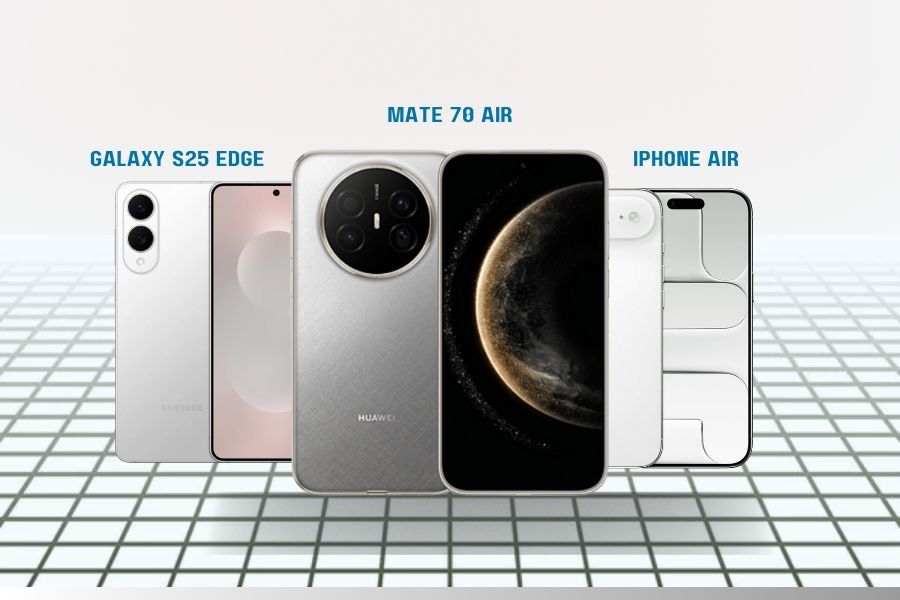
Apple and Samsung, however, seem to be taking the opposite approach. There are noticeable compromises made in pursuit of slimmer designs. Here’s how the three phones compare, and how the Huawei Mate 70 Air differs from the iPhone Air and Samsung’s Galaxy S25 Edge.
1. Size and design
The Mate 70 Air is noticeably larger than both of its rivals. It measures 165 × 81.5 × 6.6 mm and weighs 208 g. While Huawei is chasing the ultra-light smartphone trend, it’s also being thoughtful about the features we’d expect from a 2025 phone. More on that later.
The iPhone Air leans the opposite way. It’s all about being thin. At just 5.6 mm thick and 165 g, it’s the slimmest and lightest of the three.
The Galaxy S25 Edge sits in the middle. It measures 158.2 x 75.6 x 5.8 mm and weighs 163 g. It’s almost as thin as the iPhone Air but packs a slightly larger footprint.
All three phones are well built. Huawei doesn’t mention exotic materials but does bring IP68/IP69 durability, which allows survival against high-pressure water streams. Apple also offers IP68, though with deeper submersion ratings (up to 6 m). Samsung matches Huawei with IP68, but only up to 1.5 m. Huawei is the most rugged on paper.
2. Displays
The differences continue in the screen department.
Huawei makes the Mate 70 Air feel almost tablet-adjacent with a 7.0-inch LTPO OLED panel. It refreshes at 120Hz, peaks at 4000 nits, and is protected by Kunlun Glass.
Apple keeps it calmer with a 6.5-inch LTPO Super Retina XDR OLED display. It’s sharp at 1260 × 2736, and it offers features like HDR10, Dolby Vision, and a 120Hz refresh rate. Peak brightness reaches 3000 nits, making it excellent outdoors, though it dims slightly versus Huawei in numbers.
Samsung pushes clarity harder. The Galaxy S25 Edge screen is 6.7 inches, running at 1440 × 3120 for the highest pixel density of the three. It’s also LTPO and 120Hz with HDR10+ support.
All are great screens, but Huawei’s size stands out the most.
3. Software and ecosystem
The Mate 70 Air runs HarmonyOS 5.1. That’s an entirely different world from iOS and Android. It offers a familiar layout, but app availability and restrictions vary depending on your region. The phone also has satellite messaging support.
The iPhone Air doesn’t surprise. It ships with iOS 26, and Apple promises long-term support, clean UI, and tight hardware-software integration. It works seamlessly with other Apple products.
Samsung goes with Android 15, One UI 7, and promises 7 major OS upgrades. That’s longer than most Android phones typically receive and helps it match Apple’s longevity promise.
If you’re already inside a particular ecosystem, none of these phones gives you a reason to switch. Huawei’s software feels the most different; Apple’s is the most familiar; Samsung’s is the most flexible.
4. Performance
This is where the biggest differences emerge.
Huawei uses its 7nm Kirin 9020 chips (9020A or 9020B). Performance should be fine for everyday tasks, but they can’t match the raw compute power of Apple’s 3nm A19 Pro or Qualcomm’s Snapdragon 8 Elite in Samsung’s phone.
Apple’s A19 Pro sits near the top of mobile performance, especially in power efficiency. Samsung’s Snapdragon 8 Elite pushes high clock speeds and serious GPU strength, especially for gaming and editing.
So if you care about graphics or future-proof performance:
• Apple and Samsung are the clear leaders
• Huawei focuses more on efficiency and battery life
All three months offer similar memory configurations.
5. Cameras
Camera hardware is another area where these phones diverge.
Huawei puts three lenses on the back:
• 50MP main with OIS
• 12MP telephoto with 3× zoom
• 8MP ultrawide
It’s a balanced setup, with dedicated optical zoom and laser autofocus. It also supports 4K video and HDR.
The iPhone Air sticks to a single 48MP main camera. Apple is banking on computational photography, not lens count. It will likely deliver good consistency, but there’s no dedicated telephoto lens here, so lossless zoom is limited.
Samsung offers a dual-camera setup:
• 200MP main
• 12MP ultrawide
The 200MP camera is the number that sells headlines, but the lack of a telephoto lens stands out. Samsung supports 4K and even 8K recording, which Huawei and Apple don’t match at the same frame rate.
It’s without a doubt that Huawei has better cameras overall with a dedicated lens for ultrawide and telephoto. This is where the company’s decision to avoid aggressively chasing the ultra-slim trend becomes clear. You’re getting an almost flagship-level camera setup.
6. Selfies
Moreover, Huawei’s selfie camera is a modest 10.7MP unit with 4K support.
Apple goes bigger with 18MP plus a 3D depth system (SL 3D), which makes Face ID possible and can improve portrait accuracy. It also records Dolby Vision HDR.
Samsung stays simple at 12MP, but with PDAF for sharper focusing.
7. Battery and charging
This is one category that Huawei dominates. Because of its bigger size, the Mate 70 Air has a massive 6500mAh battery. Charging goes up to 66W wired.
Comparatively:
• iPhone Air: 3149mAh, wired fast charge and MagSafe
• Samsung S25 Edge: 3900mAh, 25W wired
This might be the biggest practical difference. Huawei claims all-day endurance, while Apple and Samsung feel almost midrange on battery capacity, though software optimization may help them compete.
But if you want raw capacity, there’s no competition.
8. Extras
Two small notes:
• Huawei supports a stylus, something neither competitor offers here.
• Samsung includes DeX desktop mode, which lets you use the phone like a computer.
• Apple has satellite emergency features globally; Huawei’s satellite messaging is China-only.
These might not sway buyers, but they define the phones’ different priorities.
9. Final thoughts
The Huawei Mate 70 Air, iPhone Air, and Samsung Galaxy S25 Edge sit in a similar price tier, but they don’t do the same job.
Huawei prioritizes big screens, long battery life, and triple cameras. Apple keeps things minimal, polished, and thin, leaning on software and ecosystem comfort. Samsung takes the middle road with a sharp display, high performance, and future-proof Android support.
So if you’re trying to choose between size, battery, and a versatile camera in a slim form, go with Huawei. The iPhone Air is best for you if you’re already in the Apple ecosystem and need an absolutely slim smartphone.
Samsung is the most versatile of the three with Android baked in, flagship performance, and dual cameras.
For more daily updates, please visit our News Section.
Stay ahead in tech! Join our Telegram community and sign up for our daily newsletter of top stories.