Add GIZMOCHINA as Preferred Source on Google
As an Amazon Associate, Gizmochina earns from qualifying purchases. Links on this page may earn us a commission at no extra cost to you.
When two flagship killers arrive at the exact same price, with nearly identical storage and RAM configurations, the choice becomes less about raw specs and more about what kind of experience you’re after. The iQOO 15 and OnePlus 15 both launched in India at Rs. 72,999 for the 12GB + 256GB variant and Rs. 79,999 for the 16GB + 512GB model.
Both are armed with the latest Snapdragon 8 Elite Gen 5, boast high-end AMOLED displays, generous batteries, and powerful camera systems. But once you get past the checklist, the differences start to matter.
1. Display
Both phones push boundaries with high-end AMOLED panels and 3200Hz touch sampling rates. The iQOO 15 arguably has the upper hand on sheer numbers: a 6.85-inch 2K Samsung M14 8T OLED with a 6000-nit peak brightness and 2600 nits in HBM, making it the brightest screen in India right now.
It supports 144Hz refresh rate, Dolby Vision, 2160Hz PWM dimming, and even comes with an anti-reflective film that cuts down glare to near invisible levels. Visually, this is a display that doesn’t just pop indoors, it scorches through sunlight.
The OnePlus 15, on the other hand, uses a 6.78-inch 1.5K+ AMOLED with a 165Hz gaming refresh rate. While its HBM is 1800 nits, and the panel supports ultra-low 1-nit minimum brightness, it’s not as peak-bright as the iQOO’s. OnePlus leans more into gaming smoothness with native 165fps support in titles like CoD Mobile and an ultra-responsive touch chip.
Verdict: iQOO wins for brightness and content fidelity; OnePlus wins for gaming.
| Preview | Product | |
|---|---|---|

|
OnePlus 15 | 16GB+512GB | Sand Storm | India’s First Snapdragon® 8 Elite Gen 5 | 7300mAh Battery |… | Check Price on Amazon |
Please Note: When you buy something using the links in our articles, we may earn a small commission at no cost to you.
| Preview | Product | |
|---|---|---|

|
iQOO 15 (Legend, 12GB RAM, 256GB Storage) | Fastest Snapdragon 8 Elite Gen 5 Processor* | Origin OS… | Check Price on Amazon |
Please Note: When you buy something using the links in our articles, we may earn a small commission at no cost to you.
2. Performance and Cooling
Both phones use the Snapdragon 8 Gen 5, but iQOO complements it with a Supercomputing Q3 chip for frame interpolation and 2K upscaling, especially in games. There’s also ray tracing and live-streaming enhancements built-in, making this a performance-first device. Its 8000mm² vapor chamber is the largest in iQOO history.
OnePlus 15 matches the raw power but adds a more intricate Cryo-Velocity Cooling System with 5,731mm² VC, aerospace-grade aerogel insulation, and a white graphite layer for even heat dissipation. While OnePlus doesn’t have an external frame chip like iQOO, its software and cooling combo keep sustained performance in check.
Verdict: Gamers and streamers may appreciate iQOO’s Supercomputing chip more. OnePlus focuses on core thermal refinement.
3. Performance and Cooling
Both phones are powered by the Snapdragon 8 Gen 5 platform and use fast LPDDR5X RAM and UFS 4.1 storage. The iQOO 15 is available in 12GB and 16GB LPDDR5X Ultra RAM variants with 256GB or 512GB of UFS 4.1 storage. The OnePlus 15 supports up to 16GB of LPDDR5X Ultra+ RAM, capable of 10,667Mbps speeds, and offers 512GB or 1TB storage options, giving it a slight advantage in maximum capacity.
iQOO adopts a performance-first strategy by integrating a dedicated Supercomputing Q3 chip. This chip enables 144fps frame interpolation, 2K resolution upscaling, and live-streaming over USB 3.2 without needing external hardware. It also supports ray tracing in compatible games. Thermal performance is managed by a large 8000mm² vapor chamber, the biggest in iQOO’s lineup to date.
OnePlus 15 takes a more thermal-centric approach with its Cryo-Velocity Cooling System. It combines a 5731mm² 3D vapor chamber, aerospace-grade aerogel insulation, and a white graphite layer to efficiently spread and manage heat. While it skips a dedicated display or gaming chip, its cooling hardware and software optimizations work together to deliver stable performance during long sessions.
Verdict: Both phones are equally good in this segment, and most gamers or streamers won’t notice a significant difference, so it’s a tie here.
4. Camera and Imaging
iQOO and OnePlus both bring triple 50MP cameras, but with different execution. iQOO uses a Sony IMX921 as its main, a 3x periscope telephoto, and a 150° ultra-wide. It even offers up to 100x zoom and a Supermoon mode. However, HDR video is missing, and low-light ultrawide shots feel undercooked as per reviews.
OnePlus uses a Sony IMX906, also has a 50MP ultra-wide, and a 3.5x periscope telephoto, but its real ace is the DetailMax Engine. It introduces new photography modes like Ultra-Clear 26MP, Clear Burst (10fps), and Clear Night Engine, blending computational smarts with hardware for better textures, portraits, and low-light scenes. It also records in Dolby Vision 4K at 120fps.
Verdict: OnePlus takes the edge with more advanced computational photography and richer video capture.
5. Design and Durability
The iQOO 15 features a glass back on the Legend Edition and fiberglass matte finish on the Alpha Edition, weighing up to 220g. The design is clean, with a prominent Monster Halo LED ring that acts as a notification and game feedback system. It’s IP68+IP69-rated and even supports wet-finger use.
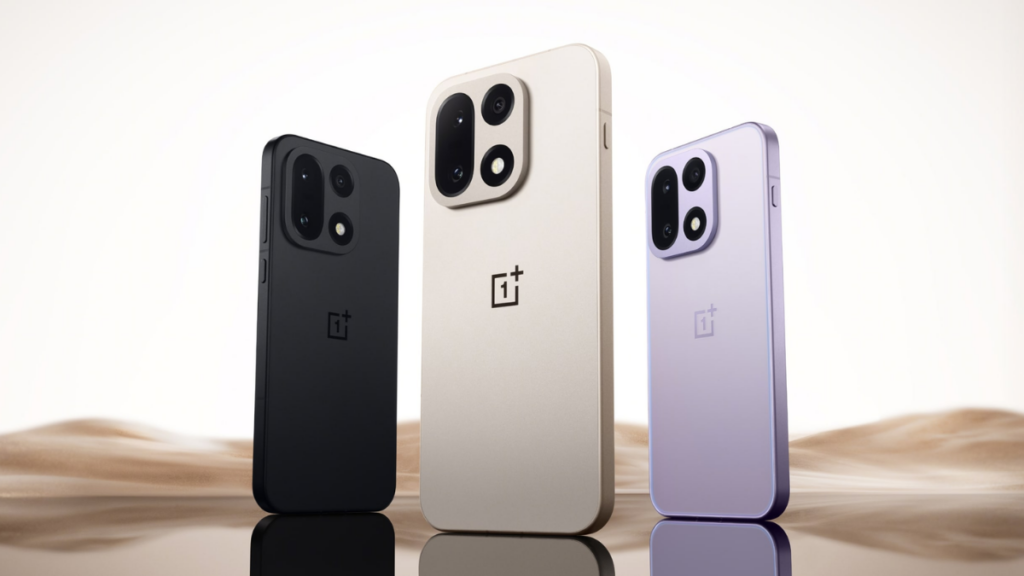
The OnePlus 15 looks more refined and comes in Infinite Black, Sand Storm, and Ultra Violet, with materials ranging from frosted glass to ceramic-grade fiberglass. It’s equally durable with IP66, IP68, IP69, and IP69K certifications, resisting high-pressure jets and extreme conditions.
Verdict: iQOO has the cooler gamer aesthetic with LED lighting, while OnePlus offers broader durability certifications and a more refined finish. If you are a gamer, then you would likely prefer the iQOO 15’s design a bit more, but general users may lean toward the OnePlus 15 for its polished and understated look.
6. Battery and Charging
The OnePlus 15 packs a 7300mAh Silicon NanoStack battery, the biggest in any OnePlus phone. It supports 120W wired and 50W wireless charging, plus bypass charging and -20°C temperature resilience.
iQOO uses a 7000mAh semi-solid silicon-carbon battery, supports 100W wired, 40W wireless, 65W PPS, and also bypass charging. Battery life is great on both, but OnePlus promises 80% health retention after 4 years.
Verdict: OnePlus takes it with more headroom, faster wired charging, and better longevity claims.
7. Software Experience
iQOO 15 runs OriginOS 6 based on Android 16. It has Copy & Go, Drag & Go, AI Retouch, and strong cross-device tools. You also get 5 Android updates + 7 years of security patches, which is class-leading.
OnePlus 15 runs OxygenOS 16, also on Android 16, and introduces Gemini AI integration, Mind Space, and Plus Mind, a context-aware memory system that acts like a second brain. It gets 4 OS updates and 6 years of security patches.
Verdict: iQOO wins for longevity. OnePlus wins for deeper AI integration and minimal bloat.
8. Final Thoughts: Which One to Buy?
The iQOO 15 suits anyone who wants a brighter display, rich gaming tools, and longer update support. It focuses on raw hardware strength, strong cooling, and consistently high frame rates, which makes it ideal for gamers and power users.
The OnePlus 15 works well for buyers who care about computational photography, premium finish, deeper AI features, and a more polished software experience. It handles gaming well too, so players who prefer a refined design and smoother software can still choose it with confidence. The overall experience stays balanced and premium.
For more daily updates, please visit our News Section.
Stay ahead in tech! Join our Telegram community and sign up for our daily newsletter of top stories! 💡