
Add GIZMOCHINA as Preferred Source on Google
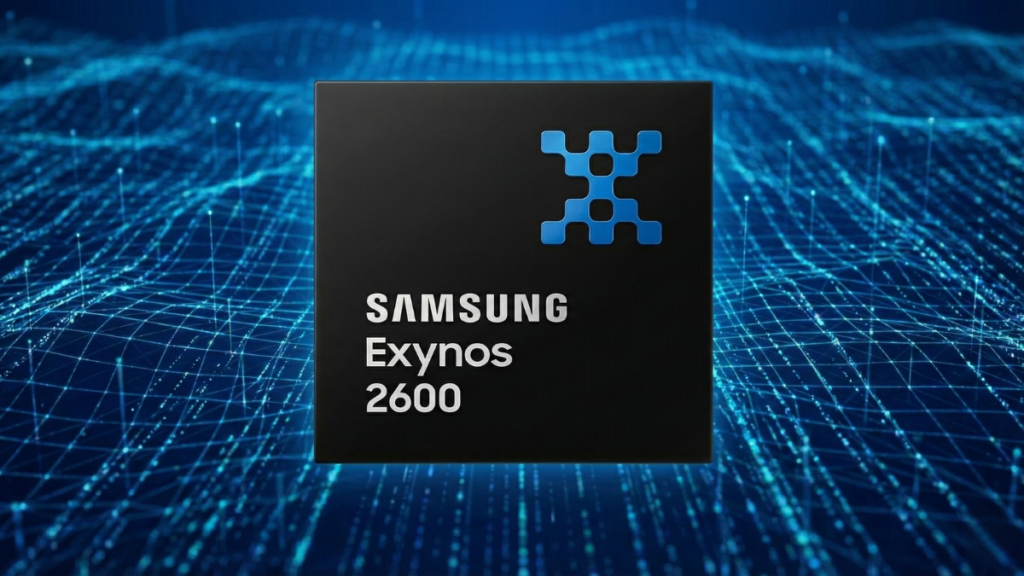
Qualcomm and MediaTek were earlier supposed to be among the first brands to push 2nm smartphone chips into the market, but Samsung has quietly taken the crown by announcing Exynos 2600 — the world’s first smartphone chip built using 2nm GAA (Gate-All-Around) manufacturing process.
The Exynos 2600 sits above the Exynos 2500, promising notable improvements in performance, thermal efficiency, and AI capabilities. Although not officially confirmed, this chip is likely to power some of the upcoming Galaxy S26 series phones in many regions.
The latest Exynos chip features a 10-core CPU based on Arm’s latest v9.3 architecture, which includes C1-Ultra and C1-Pro cores. Samsung didn’t include any low-power little cores, as the CPU only comprises big and high-performance cores.
The Exynos 2600’s CPU comprises one prime C1-Ultra core clocked at 3.8GHz, three high-performance C1-Pro cores at 3.25GHz, and six efficiency-tuned C1-Pro cores at 2.75GHz. This new structure is claimed to have improved the CPU performance by up to 39%.
Gamers should also notice some improvements, as the new Xclipse 960 GPU is claimed to offer twice the compute performance of its predecessor and up to 50% better ray tracing performance. The chip also introduces Exynos Neural Super Sampling (ENSS) technology, which further improves gaming performance by leveraging AI-based resolution upscaling and frame generation technologies.
The South Korean giant has taken a step forward towards fixing the heating issues associated with Exynos chips by introducing the new Heat Path Block (HPB) technology. It improves heat transfer using High-k EMC materials, which are said to be as effective as a heat sink, and lowers thermal resistance by up to 16%.
The Exynos 2600 chip features an AI engine with a 32K MAC NPU and brings support for ARM’s Scalable Matrix Extension 2 (SME 2), which can accelerate AI and ML-based applications and provide enhanced support for matrix operations. Samsung claims the upgraded NPU delivers a 113% increase in AI performance over its predecessor, Exynos 2500.
The chip supports up to 320MP single-camera or 64MP + 32MP dual-camera configurations. Additionally, it enables zero shutter lag for 108MP shots. The chip can do 8K/30fps and 4K/120fps HDR video recording, with support for Samsung’s APV codec for higher-quality videos. Samsung claims the improved ISP is also up to 50% more efficient.
Other specs include LPDDR5x RAM, UFS 4.1 storage, 4K displays at a refresh rate of up to 120Hz, and HDR10+ playback.
| Eynos 2600 | |
|---|---|
| Announced | December 2025 |
| Process node | Samsung’s 2nm (GAA) |
| CPU cores | 10-core |
| CPU cores | 1 x 3.8 GHz — C1-Ultra 3 x 3.25 GHz — C1-Pro 6 x 2.75 GHz — C1-Pro |
| GPU & gaming | Samsung Xclipse 960 GPU Ray tracing support Heat Path Block (HPB) Exynos Neural Super Sampling (ENSS) |
| NPU | AI engine with 32K MAC NPU |
| Memory | LPDDR5X |
| Storage | UFS 4.1 |
| Camera | up to 320MP single camera 64MP + 32MP dual cameras up to 108MP camera with zero shutter lag 8K/30fps video recording 4K/120fps HDR video recording Visual Perception System Deep Learning Video Noise Reduction Advanced Professional Video (APV) codec |
Qualcomm and MediaTek will join in next year
From the specs sheet and brand claims, the Exynos 2600 appears to offer solid gains across CPU, GPU performance, and API capabilities. Particularly, the latest measures to fix heating issues could build more confidence in potential buyers. However, Qualcomm and MediaTek aren’t sleeping either.
The two chip giants are working towards announcing their 2nm smartphone chips. According to reports, those could be called: Snapdragon 8 Elite Gen 6 and Dimensity 9600. Both will reportedly use TSMC’s 2nm (N2P) manufacturing process.
MediaTek and Qualcomm usually release their latest flagship chips around September. That’s when you can expect them to unveil their 2nm flagship chips. That’s still months away, but in the meantime, we’re likely to hear more about these chips through various leaks.
Be sure to join our Telegram channel so that you don’t miss out on the latest tech leaks and breakthroughs. You can also sign up for our daily newsletter of top stories.




Comments