
If you’ve been following the AI space closely, you likely know about Xiaomi’s growing suite of text, code, and voice LLMs. Now, the company has announced an in-house device to run these models, the Xiaomi AI Cube.
It’s a prototype mini-PC built on three proprietary chips. Unveiled at today’s XRING Chip Technology Communication Conference, the device is powered by Xiaomi’s newly introduced XRING O3, XRING O100, and XRING D100 chips.
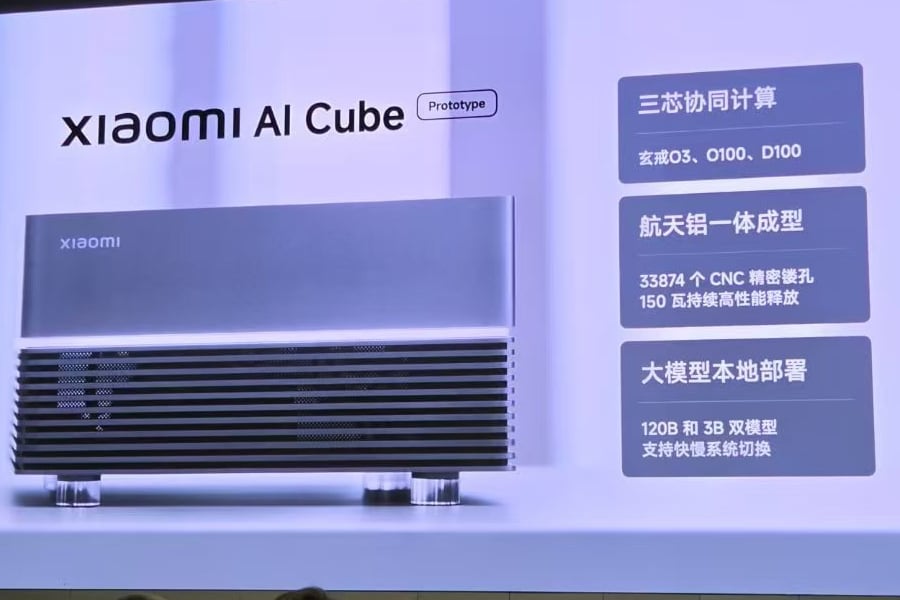
Xiaomi AI Cube is powered by XRING SoCs
The XRING O3 is the main AI SoC inside the Cube. It has a 10-core all-big-core CPU layout, a 16-core G2-Ultra NX GPU, and a 200 TOPS low-power NPU.
The XRING O100 is a high-bandwidth AI acceleration chip, built on 6nm 3D wafer-level stacking. It has 28,672 effective data lines and supports near-memory computing bandwidth of up to 1.22TB/s.
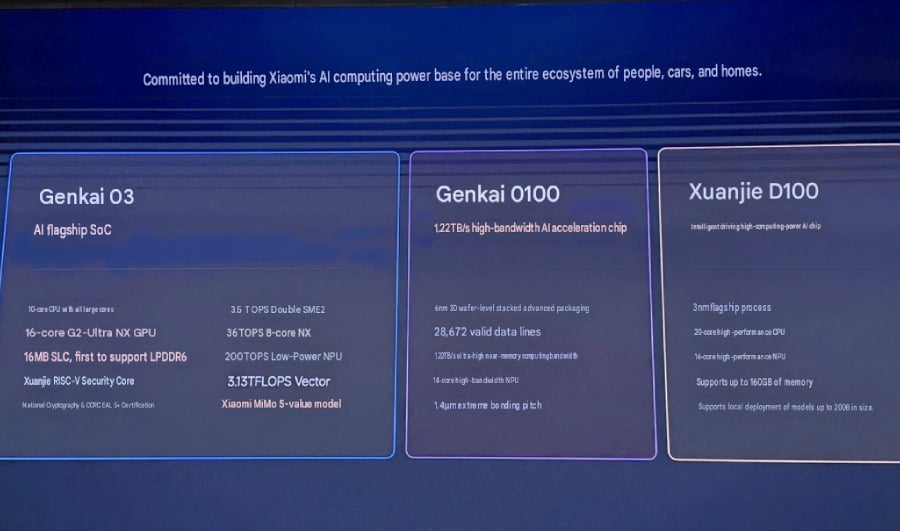
The XRING D100 is a 3nm chip meant for intelligent driving workloads, with a 20-core high-performance CPU, a 16-core high-performance NPU, and support for up to 160GB of memory.
On the outside, the AI Cube uses an aerospace-grade aluminum unibody casing with 33,874 CNC precision cutouts, and it can sustain up to 150W of continuous power.
The point of the hardware is local deployment of large models, ranging from 3B up to 120B parameters, with a toggle to switch between fast and slow system modes depending on the task. That puts it in similar territory to the Tiiny AI Pocket Lab, which also runs 120B-parameter models locally in a small form factor, though Xiaomi is using its own chips instead of third-party silicon.
This is still a prototype. Xiaomi hasn’t given a release date or price, so it’s unclear whether the AI Cube becomes an actual product or stays a technical demonstration.
For more daily updates, please visit our News Section.
Stay ahead in tech! Join our Telegram community and sign up for our daily newsletter of top stories!



Comments