As an Amazon Associate, Gizmochina earns from qualifying purchases. Links on this page may earn us a commission at no extra cost to you.
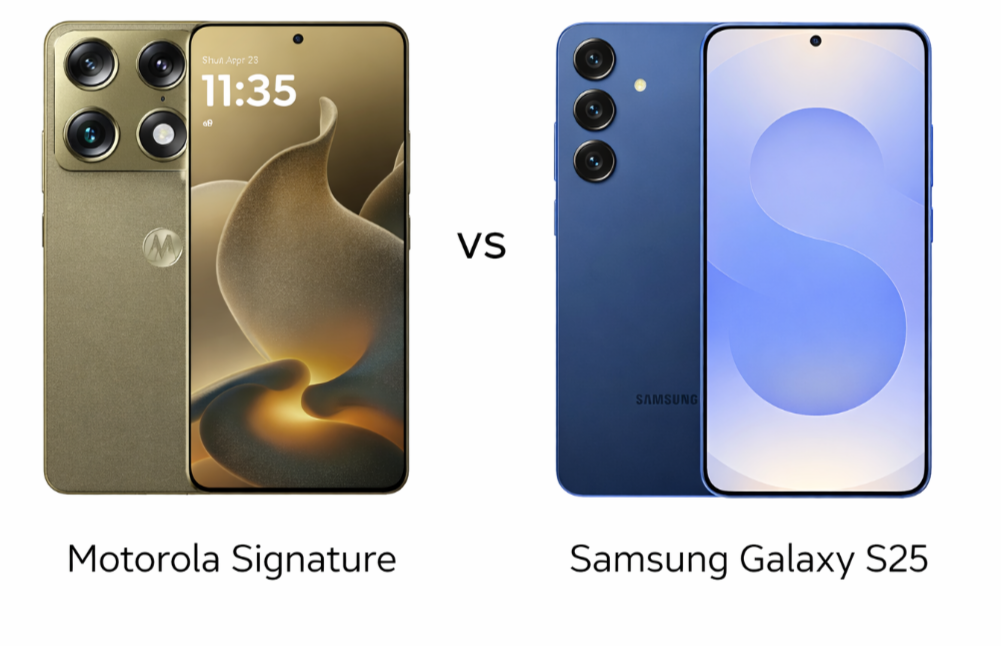
Choosing a flagship smartphone today is no longer just about brand loyalty; it is about balancing performance, innovation, and value. The Motorola Signature enters the premium segment with aggressive hardware and pricing, while the Samsung Galaxy S25 represents Samsung’s refined, ecosystem-driven approach to flagship excellence. With both offering long-term software support and cutting-edge chipsets, this comparison explores which device truly delivers the smarter overall investment.
The Motorola Signature features Gorilla Glass Victus 2 on the front with an aluminum frame and carries IP68/IP69 protection plus MIL-STD-810H compliance. It feels premium and engineered for durability, clearly targeting users who want flagship elegance with added toughness.
The Samsung Galaxy S25 uses Gorilla Glass Victus 2 on both front and back with an Armor Aluminum 2 frame and IP68 rating. Its compact form factor makes it more pocket-friendly and easier for one-handed use. Samsung’s finish feels refined and polished, while Motorola leans slightly toward bold and performance-centric design language.
Display Quality
Motorola pushes boundaries with a 6.8-inch LTPO AMOLED panel, 165Hz refresh rate, Dolby Vision, HDR10+, and a massive 6200-nit peak brightness. It is built for immersive gaming and outdoor visibility.
Samsung counters with a 6.2-inch Dynamic LTPO AMOLED 2X display at 120Hz and 2600-nit peak brightness. While smaller, it delivers sharp visuals and color tuning that feels balanced and consistent.
Verdict
Motorola wins on sheer display specs and brightness. Samsung feels more compact and refined for everyday comfort.
2. Specifications Including Battery
Performance
The Motorola Signature runs on Snapdragon 8 Gen 5 (3nm) with up to 16GB RAM and UFS 4.1 storage. It is tuned for raw power and future-ready performance, supported by Android 16 with seven major upgrades.
The Galaxy S25 features Snapdragon 8 Elite (3nm), paired with 12GB RAM and UFS 4.0 storage. Samsung’s optimization through One UI 8 ensures smooth multitasking and strong thermal management. While Motorola emphasizes peak power, Samsung focuses on stability and ecosystem polish.
Battery and Charging
Motorola packs a 5200mAh battery with 90W wired, 50W wireless, and reverse charging support. It clearly prioritizes fast top-ups and endurance.
Samsung offers a 4000mAh battery with 25W wired and 15W wireless charging. It remains reliable but not class-leading in charging speed.
Verdict
Motorola dominates in battery size and charging speed. Samsung delivers consistent, optimized performance but feels conservative on power upgrades.
3. Camera
Main and Secondary Lenses
Motorola equips a triple 50MP setup including a 3x periscope telephoto and ultrawide lens, plus 8K Dolby Vision video recording. The larger sensors and periscope zoom add versatility for photography enthusiasts.
Samsung uses a 50MP main sensor, 10MP 3x telephoto, and 12MP ultrawide. It supports 8K video and advanced computational features like Best Face. Samsung’s image processing tends to favor vibrant output, while Motorola appears to focus on hardware strength and detail retention.
Selfie Camera
Motorola offers a 50MP front camera with 4K recording and dual-pixel PDAF, giving it an edge in clarity and flexibility.
Samsung includes a 12MP dual-pixel selfie camera with HDR10+ support, optimized for natural skin tones and social media sharing.
Verdict
Motorola wins on camera hardware and selfie resolution. Samsung excels in computational photography and consistent color science.
4. Pricing
Motorola Signature is priced around $660 / ₹59,000, positioning it aggressively in the flagship space. For the hardware offered, a 165Hz display, 90W charging, periscope zoom, and 5200mAh battery, it delivers strong value.
Samsung Galaxy S25 costs approximately $800 / ₹75,000. The premium largely reflects brand value, ecosystem integration, and software refinement. Samsung devices traditionally hold resale value better and benefit from deeper ecosystem support.
Motorola clearly undercuts Samsung by a significant margin while offering higher peak specs in several areas. Samsung justifies its price through optimization, compact flagship appeal, and ecosystem continuity.
Disclaimer: Prices are approximate and may vary based on country, region, and applicable taxes.
Verdict
Motorola offers better hardware value for money. Samsung charges more for polish, brand strength, and ecosystem advantages.
5. Conclusion
Motorola stands out with its 165Hz ultra-bright display, 90W fast charging, 50MP triple camera system with periscope zoom, UWB support, and Bose-tuned audio. It feels like a performance flagship built to impress on paper and in real-world speed.
Samsung differentiates itself with One UI refinement, Samsung DeX and Wireless DeX desktop experience, compact flagship design, and long-term ecosystem reliability. It feels cohesive and mature rather than experimental.
Verdict
For most buyers, the Motorola Signature is the better overall pick because it delivers more flagship hardware for less money.
The Galaxy S25 is ideal for those who prioritize brand ecosystem, compact design, and software refinement over raw specifications.
We use cookies on our website to give you the most relevant experience by remembering your preferences and repeat visits. By clicking “Accept”, you consent to the use of ALL the cookies.
This website uses cookies to improve your experience while you navigate through the website. Out of these, the cookies that are categorized as necessary are stored on your browser as they are essential for the working of basic functionalities of the website. We also use third-party cookies that help us analyze and understand how you use this website. These cookies will be stored in your browser only with your consent. You also have the option to opt-out of these cookies. But opting out of some of these cookies may affect your browsing experience.
Necessary cookies are absolutely essential for the website to function properly. This category only includes cookies that ensures basic functionalities and security features of the website. These cookies do not store any personal information.
Any cookies that may not be particularly necessary for the website to function and is used specifically to collect user personal data via analytics, ads, other embedded contents are termed as non-necessary cookies. It is mandatory to procure user consent prior to running these cookies on your website.




Comments