Add GIZMOCHINA as Preferred Source on Google
As an Amazon Associate, Gizmochina earns from qualifying purchases. Links on this page may earn us a commission at no extra cost to you.
The AI PC era is gathering pace, with Microsoft pushing Copilot+ experiences across Windows and manufacturers responding with a new wave of AI-ready laptops. Asus has been quick to embrace this shift, refreshing its Vivobook lineup with Intel’s latest Core Ultra processors and dedicated NPUs.
Priced at Rs 1,22,990 (~$1,290) in India, the Asus Vivobook S16 (S3607AA-SH087WS) competes with premium productivity laptops from Lenovo, Dell, HP, and Acer, while inevitably drawing comparisons with Apple’s MacBook Air. After spending time with the laptop and running multiple benchmarks, here’s what the Vivobook S16 has to offer.
5Reliable performance for everyday work
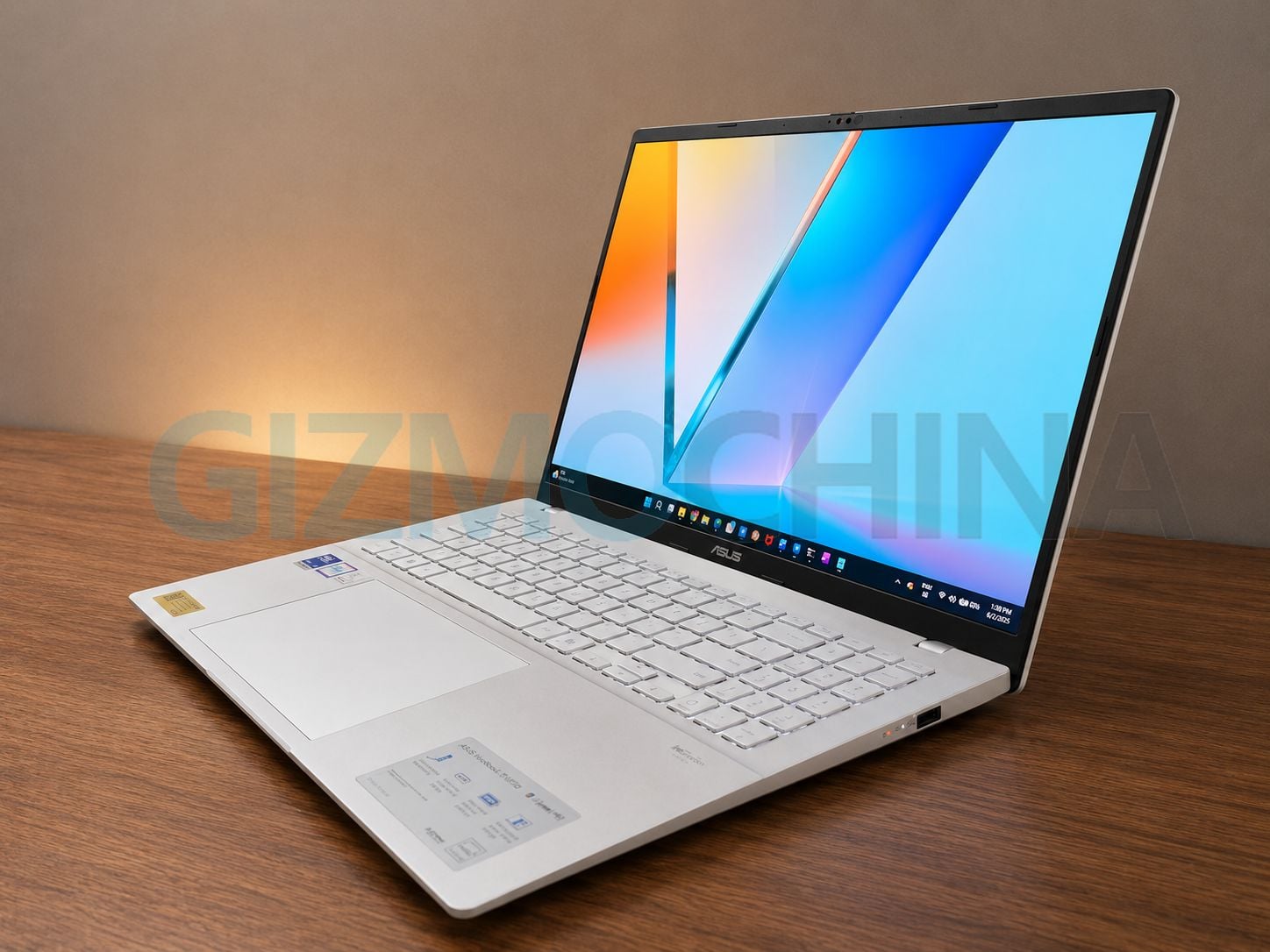
Powering the Vivobook S16 is Intel’s Core Ultra 5 325 processor paired with Intel Graphics, 16GB of DDR5 RAM, and a 512GB PCIe 4.0 SSD.
In everyday use, Windows 11 remained consistently responsive. Launching applications, handling dozens of browser tabs, working with Microsoft Office, attending video meetings, and performing light photo editing all felt smooth. The fast SSD also contributes to quick boot times and snappy application launches.
Asus provides room for future upgrades with an additional DDR5 SO-DIMM slot supporting up to 32GB of RAM, along with an extra M.2 PCIe 4.0 slot for storage expansion.
This isn’t a laptop intended for demanding video editing or AAA gaming, but it comfortably handles office work, coding, media consumption, and light creative workloads.


Benchmark results
| Benchmark | Score |
| Cinebench 2026 Single-Core | 254 pts |
| Cinebench 2026 Multi-Core | 1,092 pts |
| Geekbench 7 Single-Core | 1,862 |
| Geekbench 7 Multi-Core | 7,454 |
| Geekbench 7 GPU (Vulkan) | 14,228 |
| Geekbench AI (NPU) Single Precision | 2,615 |
| Geekbench AI (NPU) Half Precision | 25,431 |
| Geekbench AI (NPU) Quantized | 43,265 |
| 3DMark Night Raid | 15,362 |
| CrystalDiskMark Read | 6,351 MB/s |
| CrystalDiskMark Write | 4,734 MB/s |
The benchmark results reinforce the laptop’s productivity-first approach. CPU performance is more than capable of handling multitasking, while the PCIe 4.0 SSD delivers fast read and write speeds that noticeably improve responsiveness.
The integrated Intel Graphics performs well for media playback, casual gaming, and GPU-accelerated applications. Meanwhile, the Intel AI Boost NPU posts strong Geekbench AI scores, providing dedicated hardware acceleration for AI workloads and Microsoft’s Copilot+ experiences.