As an Amazon Associate, Gizmochina earns from qualifying purchases. Links on this page may earn us a commission at no extra cost to you.
Cordless vacuums have come a long way from the days of dragging a bulky machine and an even bulkier cord from room to room. Today’s models are lighter, smarter, and genuinely easy to live with. You click a button, and the vacuum tells you how dirty your floor actually is. You swap between a stick and a handheld in seconds. You get 20, 30, sometimes 90 minutes of runtime without ever plugging in. We’ve two vacuum cleaners with these features in today’s comparison.
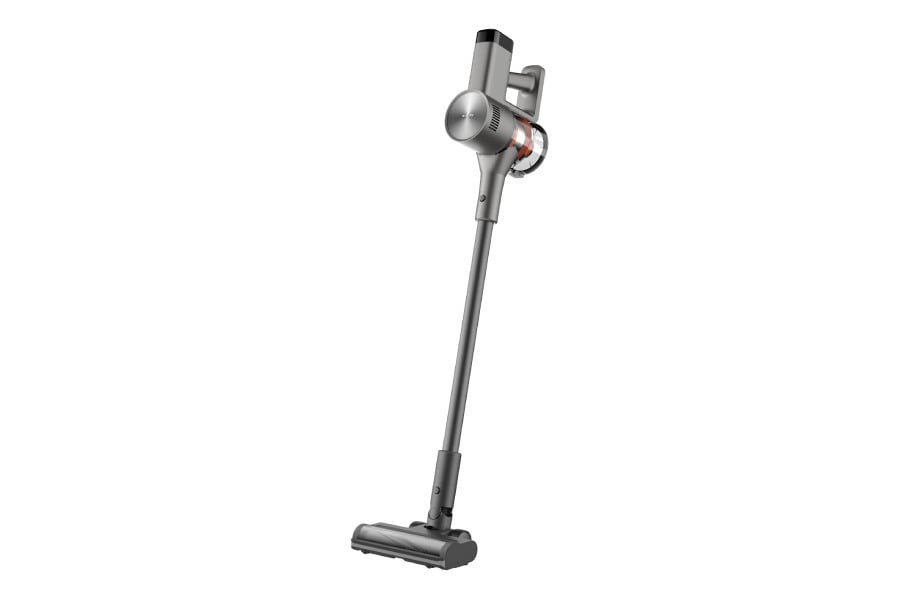
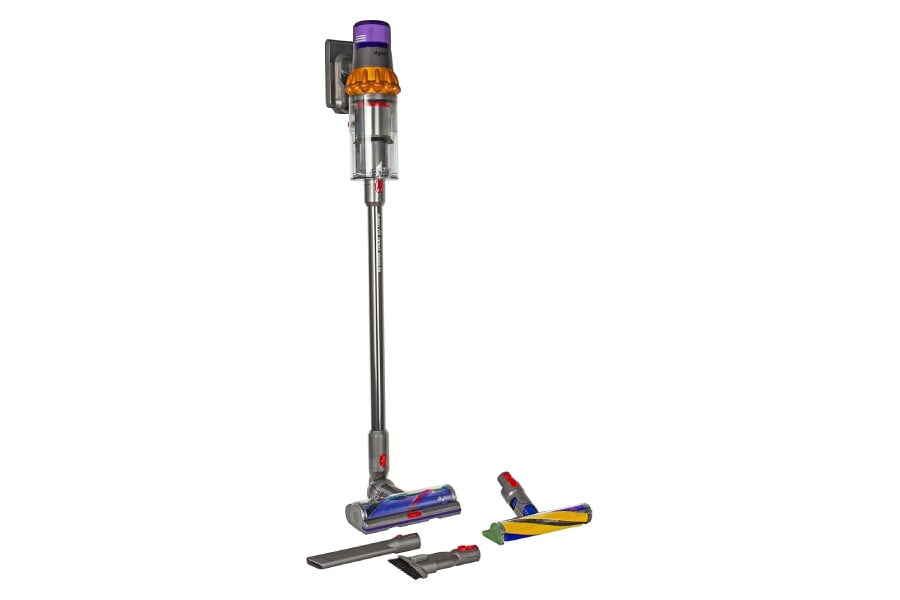
On one side, there’s Dyson’s V15 Detect, the vacuum that popularized laser dust detection and made premium cordless cleaning feel worth the price. On the other, there’s Xiaomi’s G30 Max that borrows a lot of Dyson’s playbook while charging a lot less for it. Put them side by side, and you start to see just how far cordless vacuums have come, and how close the budget option has gotten to the flagship.
Let’s start with the number every vacuum shopper checks first. The G30 Max claims up to 280 air watts of suction, working out to around 25,000 Pa. The V15 Detect sits at 230 to 240 air watts, depending on which version you buy. On paper, that puts Xiaomi ahead by a solid margin.
But air watts alone don’t tell you how a vacuum performs on your actual carpet. Dyson pairs its motor with a Digital Motorbar head that adjusts to floor type as you clean, and its cyclone system spins fast enough to generate 100,000g of centrifugal force, which keeps suction from dropping off as the bin fills. Xiaomi counters with its own 14-cone cyclone setup and three modes, Eco, Auto and Turbo, so you can trade power for runtime depending on the room.
2. Battery life
This is where the price difference starts to make more sense. The G30 Max runs for up to 90 minutes in Eco mode, dropping to around 70 minutes with the motorized brush bar attached. The V15 Detect gives you up to 60 minutes on a single charge, though Dyson sells swappable batteries to extend a cleaning session.
Xiaomi’s advantage comes from a larger 4,000mAh battery built specifically to outlast the older G11 by 50%. Dyson’s seven-cell battery is efficient and well-tested, but it simply holds less charge. For anyone cleaning a large home or several floors in one go, that extra 30 minutes from Xiaomi is hard to ignore.
3. Smart features and filtration
Dyson has built its reputation around the features it offers. The V15 Detect uses a piezo sensor that counts particles as you clean, showing the results on an LCD screen so you can see exactly what you’re picking up. There’s also a green laser on the Fluffy head that lights up dust on hard floors that you’d otherwise miss completely.
Xiaomi didn’t ignore this playbook. The G30 Max uses its own dirt-detection system: in Auto mode, a colored line on the digital display shows how much dust the vacuum is collecting in real time, and suction adjusts automatically based on how dirty the surface is. There’s no laser, but a built-in LED light near the brush head helps you spot debris under furniture or in dim corners. On filtration, Xiaomi’s five-stage system claims to trap 99.98% of particles as small as 0.3 microns, essentially matching the HEPA-level performance Dyson advertises on the V15 Detect Extra.
4. Design, attachments and everyday use
Both vacuums convert from a stick to a handheld unit with one click, and both come loaded with extras. The G30 Max ships with seven attachments, including an anti-tangle brush bar, a sofa brush and a dedicated pet brush, all stored on a wall-mounted stand that keeps them within reach. Dyson also includes similar tools with the V15 Detect Plus, such as a hair screw tool and a crevice light pipe, though the vacuum itself doesn’t include on-board storage for every attachment, something reviewers have pointed out as a minor gap.
Weight matters too if you’re cleaning stairs or carrying the vacuum room to room. The G30 Max comes in at about 4.5kg, close to the V15 Detect’s roughly 3.08kg for the main unit, though exact figures shift depending on which attachment is on the end.
5. Price
Here’s the part that matters the most. The G30 Max launched at around $324 in the US and €400 in Europe. The V15 Detect, meanwhile, typically retails between $650 and $800 depending on the bundle, and even discounted units rarely drop below $500 or $600.
That’s not a small gap. You’re looking at Xiaomi delivering comparable suction, longer battery life, similar filtration claims, and a decent attachment set for less than half of what Dyson charges for its flagship stick vacuum.
6. So which one should you buy?
If you’ve used Dyson vacuums before and trust the brand’s build quality, the V15 Detect still earns its reputation. The laser dust reveal and particle counter are genuinely satisfying to use, and Dyson’s after-sales support is well established in most markets.
But if you’re shopping on value, the G30 Max is hard to argue against. It matches or beats the V15 on the numbers that matter most for everyday cleaning, runs longer between charges, and costs a fraction of the price.
We use cookies on our website to give you the most relevant experience by remembering your preferences and repeat visits. By clicking “Accept”, you consent to the use of ALL the cookies.
This website uses cookies to improve your experience while you navigate through the website. Out of these, the cookies that are categorized as necessary are stored on your browser as they are essential for the working of basic functionalities of the website. We also use third-party cookies that help us analyze and understand how you use this website. These cookies will be stored in your browser only with your consent. You also have the option to opt-out of these cookies. But opting out of some of these cookies may affect your browsing experience.
Necessary cookies are absolutely essential for the website to function properly. This category only includes cookies that ensures basic functionalities and security features of the website. These cookies do not store any personal information.
Any cookies that may not be particularly necessary for the website to function and is used specifically to collect user personal data via analytics, ads, other embedded contents are termed as non-necessary cookies. It is mandatory to procure user consent prior to running these cookies on your website.