
Add GIZMOCHINA as Preferred Source on Google
As an Amazon Associate, Gizmochina earns from qualifying purchases. Links on this page may earn us a commission at no extra cost to you.
Choosing between the POCO M8 Power and Vivo Y500 comes down to priorities. Both smartphones target the affordable segment with AMOLED displays, large silicon-carbon batteries, stereo speakers, and Android 16. However, they approach value differently. The POCO M8 Power focuses on performance, long software support, and connectivity, while the Vivo Y500 emphasizes display quality, durability, and camera hardware. Here’s a detailed comparison to help you decide.
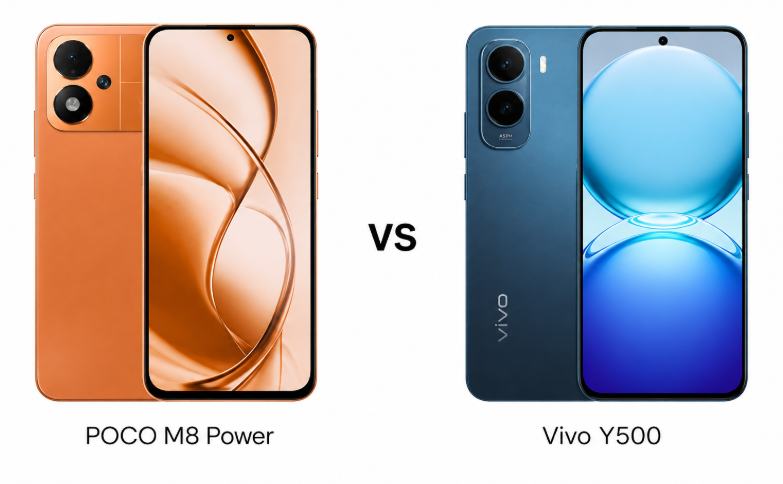
Major Features:
| Category | POCO M8 Power | Vivo Y500 | Winner |
|---|---|---|---|
| Display | 7.0-inch AMOLED, 120Hz, 1800 nits | 6.83-inch AMOLED, HDR, 120Hz, 5000 nits peak | Vivo – Sharper HDR display |
| Build & Protection | IP65, Gorilla Glass 7i | IP68/IP69, MIL-STD-810H | Vivo – Better durability |
| Processor | Snapdragon 4 Gen 4 | Unisoc T7300 | POCO – Faster chipset |
| Software | Android 16, 4 OS upgrades | Android 16 | POCO – Longer software support |
| RAM & Storage | Up to 8GB/128GB, microSD | Up to 8GB/256GB | Vivo – More storage |
| Rear Camera | 50MP | 50MP + auxiliary | Vivo – More versatile setup |
| Selfie Camera | 8MP | 32MP | Vivo – Sharper selfies |
| Battery | 8000mAh, 45W, PD3.0, reverse charging | 8100mAh, 44W, bypass charging | POCO – Better charging features |
| Connectivity | Wi-Fi 6, NFC, IR Blaster | Wi-Fi 5, Bluetooth 5.4 | POCO – More connectivity options |
| Price/Value | Around $250 / ₹25,000 | Around $250 / ₹22,000 | Vivo – Better value pricing |
Design and Display
Build and Feel
Both smartphones feature modern flat designs with AMOLED displays and under-display fingerprint scanners. The Vivo Y500 stands out with its IP68/IP69 rating and MIL-STD-810H compliance, offering significantly stronger resistance against water and dust than the POCO M8 Power’s IP65 certification. For users who frequently travel or spend time outdoors, Vivo’s durability provides extra peace of mind. Meanwhile, the POCO counters with Gorilla Glass 7i protection and practical additions such as an infrared blaster and optional NFC, making everyday usage slightly more versatile. Both feel contemporary, but Vivo clearly prioritizes protection while POCO balances durability with useful hardware extras.
Display Quality
The display is another area where both phones perform well, but the Vivo Y500 has a noticeable advantage. Its AMOLED panel delivers a sharper 1260 x 2800 resolution, HDR support, and an impressive peak brightness of up to 5,000 nits, making outdoor visibility excellent. The POCO M8 Power also offers a smooth 120Hz AMOLED display with 1,800 nits peak brightness and Gorilla Glass protection, producing vibrant colors and fluid animations. However, Vivo’s higher pixel density and HDR capabilities provide a richer viewing experience for streaming and gaming. The difference may not be dramatic indoors, but it becomes easier to appreciate in brighter environments.
Verdict
The Vivo Y500 delivers the stronger display and more premium durability, making it the better choice for multimedia users. The POCO M8 Power remains appealing thanks to Gorilla Glass protection, NFC, and infrared support, but Vivo takes this category overall.
Specifications Including Battery
Performance
Performance favors the POCO M8 Power thanks to Qualcomm’s Snapdragon 4 Gen 4 chipset. The newer processor delivers stronger CPU efficiency and a noticeably better Adreno GPU than the Vivo Y500’s Unisoc T7300 with Mali-G57 graphics. Combined with four promised Android version upgrades, the POCO also offers better long-term software value. Vivo provides up to 256GB storage in higher variants, which benefits users needing extra space, but overall processing power and future software support remain stronger on the POCO. Everyday tasks run smoothly on both, yet heavier multitasking and gaming are likely to feel more comfortable on the Snapdragon-powered device.
Battery and Charging
Battery life is excellent on both smartphones. The Vivo Y500 includes a slightly larger 8,100mAh silicon-carbon battery, while the POCO M8 Power carries an equally impressive 8,000mAh unit with 45W charging. Charging speeds are nearly identical, although POCO adds PD3.0 compatibility and 22.5W reverse wired charging, making it more flexible for charging accessories or another phone. Vivo responds with bypass charging, which helps reduce heat during gaming sessions. Both comfortably deliver multi-day endurance, but POCO offers a slightly more versatile charging package.
Verdict
The POCO M8 Power wins thanks to its faster chipset, longer software support, better graphics performance, and more feature-rich charging system. Vivo’s slightly larger battery is excellent, but POCO provides the more balanced long-term ownership experience.
Anyone still deciding between these two can check how they stack up against other options in our budget smartphone rankings.
Camera
Main and Secondary Lenses
On paper, both smartphones feature a 50MP primary camera capable of HDR photography and 1080p video recording. However, Vivo supplements its main sensor with an auxiliary camera for additional shooting assistance, while the POCO relies on a single-camera setup. Image quality is expected to remain competitive in daylight, producing detailed photos with balanced colors. Neither device targets advanced photography enthusiasts, but both should satisfy casual users. The hardware differences are relatively small, meaning image processing and software optimization are likely to play a bigger role than sensor count in everyday photography.
Selfie Camera
The selfie camera is where Vivo establishes a clear advantage. Its 32MP front-facing sensor captures significantly more detail than the POCO M8 Power’s 8MP camera, making it better suited for selfies, social media uploads, and video calls. Both phones support 1080p video recording, but Vivo’s higher-resolution sensor should produce sharper facial details and better cropping flexibility. Users who frequently rely on the front camera are likely to appreciate this upgrade immediately.
Verdict
The Vivo Y500 is the stronger camera phone overall, primarily because of its superior 32MP selfie camera and additional rear sensor. POCO delivers dependable photography, but Vivo offers a more complete imaging experience for everyday users.
Pricing
The POCO M8 Power is priced around $250 (approximately ₹25,000), while the Vivo Y500 is priced around $250 (approximately ₹22,000). Although both occupy a similar global price bracket, Vivo arrives at a noticeably lower estimated Indian price, making it more accessible. The POCO justifies its premium with the Snapdragon chipset, four Android upgrades, Wi-Fi 6, NFC, infrared blaster, and Gorilla Glass 7i. Vivo, meanwhile, delivers stronger durability, a sharper display, and a much better selfie camera for less money. Both represent strong value, but they appeal to different buyer priorities rather than competing on specifications alone.
Verdict
The Vivo Y500 offers better value for buyers focused on display quality, durability, and cameras at a lower price. The POCO M8 Power justifies its slightly higher cost with stronger performance, better connectivity, and longer software support.
Conclusion
The POCO M8 Power distinguishes itself with the Snapdragon 4 Gen 4 processor, four major Android updates, Wi-Fi 6, Gorilla Glass 7i, infrared blaster, NFC support, and flexible reverse charging. These features make it a practical choice for users who prioritize longevity and everyday performance. The Vivo Y500 counters with an excellent HDR AMOLED display, IP68/IP69 certification, MIL-STD-810H compliance, an 8,100mAh battery, bypass charging, and a significantly better 32MP selfie camera. Both smartphones are highly competitive, but they excel in different areas. One focuses on performance and software reliability, while the other emphasizes durability, multimedia, and imaging.
Verdict
Choose the POCO M8 Power for stronger overall performance, longer software support, and better long-term value. Choose the Vivo Y500 if display quality, rugged protection, selfie photography, and a lower purchase price matter more. Both are compelling options, but the better choice depends on which strengths align with daily usage.
Read More:


Comments