
Add GIZMOCHINA as Preferred Source on Google
Redmi K100 Pro and Redmi K100 Pro Max are yet to be officially unveiled, but recent leaks have already outlined much of their expected hardware. Interestingly, the two devices appear far more similar than different. Rather than separating them with different chipsets, cameras, or software experiences, Xiaomi seems to be reserving just a handful of upgrades for the Pro Max.
If the current leaks prove accurate, the K100 series could represent one of the smallest hardware gaps between two Redmi flagship models in recent years. Here’s what stands out from everything that has surfaced so far.
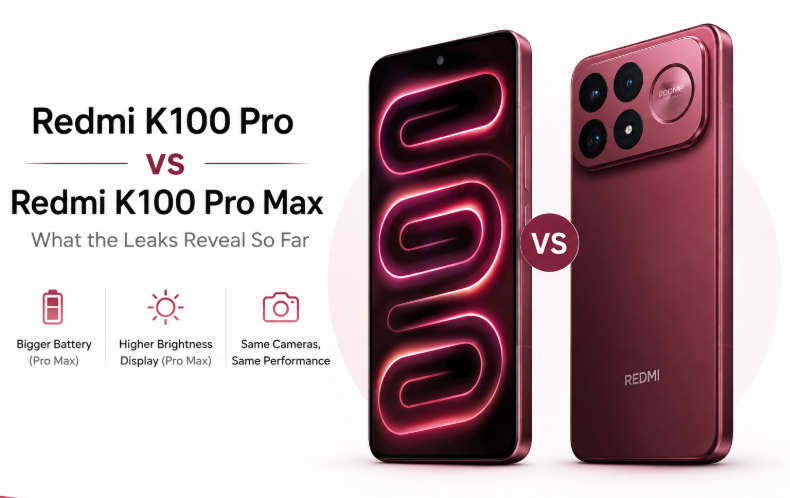
Redmi K100 Pro vs Redmi K100 Pro Max: Expected Upgrades
| Category | Redmi K100 Pro (Rumoured) | Redmi K100 Pro Max (Rumoured) | Expected Upgrade |
|---|---|---|---|
| Display | AMOLED, 185Hz, Dolby Vision, HDR10+, 2560Hz PWM | AMOLED, 185Hz, Dolby Vision, HDR10+, 2560Hz PWM, 4,500 nits peak brightness | Higher peak brightness on the Pro Max |
| Battery | 8,560mAh silicon-carbon battery | 9,070mAh silicon-carbon battery | Larger battery on the Pro Max |
| Charging | 100W wired, 50W wireless, reverse wired & wireless | 100W wired, 50W wireless, reverse wired & wireless | No change |
| Processor | Snapdragon 8 Elite Gen 5 | Snapdragon 8 Elite Gen 5 | No change |
| RAM & Storage | Up to 16GB RAM + 1TB UFS 4.1 | Up to 16GB RAM + 1TB UFS 4.1 | No change |
| Software | Android 16, HyperOS 3 | Android 16, HyperOS 3 | No change |
| Rear Cameras | 200MP + 50MP Periscope + 50MP Ultrawide | 200MP + 50MP Periscope + 50MP Ultrawide | No change (based on current leaks) |
| Selfie Camera | 32MP | 32MP | No change |
| Connectivity | Wi-Fi 7, Bluetooth 5.4, USB-C 3.2, NFC, IR Blaster | Wi-Fi 7, Bluetooth 5.4, USB-C 3.2, NFC, IR Blaster | No change |
| Audio | Stereo speakers, Bose tuning, Hi-Res Audio | Stereo speakers, Bose tuning, Hi-Res Audio | No change |
| Build & Protection | Dragon Crystal Glass, IP68/IP69 | Dragon Crystal Glass, IP68/IP69 | No change |
Xiaomi Isn’t Splitting the Core Flagship Experience
Perhaps the biggest takeaway from the leaks is that Xiaomi isn’t creating two different levels of flagship performance.
Both the Redmi K100 Pro and K100 Pro Max are expected to feature Qualcomm’s Snapdragon 8 Elite Gen 5 chipset paired with HyperOS 3 based on Android 16. Memory configurations, storage options, connectivity features, ultrasonic fingerprint sensor, stereo speakers, Wi-Fi 7, Bluetooth 5.4, USB 3.2, NFC, and even the camera hardware all appear identical.
This suggests Xiaomi wants both phones to deliver the same flagship experience instead of reserving performance features for the higher-end model. That marks a different approach from some competing flagship lineups, where the premium variant often receives exclusive hardware.
At least based on current leaks, the Pro Max is not shaping up to be a “faster” phone.
The Biggest Upgrade Appears to Be Battery Capacity
Among all the leaked specifications, battery capacity is the clearest distinction.
The Redmi K100 Pro is expected to feature an 8,560mAh silicon-carbon battery, while the K100 Pro Max could increase that figure to 9,070mAh. Those are exceptionally large capacities for flagship smartphones and continue Xiaomi’s apparent shift toward silicon-carbon battery technology.
Interestingly, charging technology doesn’t appear to change alongside the larger battery. Both models are expected to support 100W wired charging, 50W wireless charging, wired reverse charging, and wireless reverse charging.
Rather than making charging faster, Xiaomi seems to be prioritising longer endurance. If these figures are accurate, the Pro Max could simply spend more time away from the charger while maintaining the same charging experience as the standard model.
Display Differences Look Incremental, Not Transformational
The displays also tell a similar story.
Current leaks suggest both smartphones will use the same 6.9-inch AMOLED panel with Dolby Vision, HDR10+, HDR Vivid, 2560Hz PWM dimming, and a 185Hz refresh rate. Resolution also remains unchanged.
The only reported difference is peak brightness. The Redmi K100 Pro Max is tipped to reach 4,500 nits, while no comparable figure has surfaced for the standard Pro.
Although higher peak brightness can improve HDR playback and outdoor visibility, it doesn’t fundamentally change the display itself. Unless Xiaomi announces additional display technologies during launch, this currently looks like a refinement rather than a major upgrade.
Surprisingly, Cameras Don’t Separate the Two Models
Camera hardware usually provides one of the biggest differences between flagship variants, but that isn’t what current leaks suggest.
Both smartphones are expected to feature a 200MP primary sensor, a 50MP 5x periscope telephoto camera, a 50MP ultrawide camera, and a 32MP selfie camera. Video capabilities are also expected to remain identical, including support for 8K recording.
That’s notable because many manufacturers reserve improved zoom cameras or larger image sensors for their premium models. Xiaomi doesn’t appear to be taking that route this time.
Of course, specification sheets don’t always tell the whole story. Camera software, image processing, and AI photography features often remain unknown until launch, so it’s still possible that additional differences could emerge later.
What Hasn’t Leaked May Be Just as Important
One interesting aspect of the current leaks is how little separates the two devices.
Beyond the larger battery and brighter display, there are no reported differences in chipset, memory, storage, software, charging speeds, cameras, audio hardware, or connectivity.
That raises two possibilities.
The first is that Xiaomi genuinely intends to keep the two phones extremely close, allowing buyers to choose primarily between battery capacity and display brightness.
The second is that some Pro Max-exclusive features simply haven’t appeared in leaks yet. Software capabilities, AI features, thermal improvements, or camera tuning are often revealed much closer to launch than core hardware specifications.
For now, the story isn’t about dramatic hardware differences; it’s about how restrained Xiaomi’s strategy appears to be. Whether that remains true will depend on what the company reveals during the official launch, particularly if software features or AI capabilities become key points of differentiation.
Read More;


Comments