Advertisement

Add GIZMOCHINA on Google:

As an Amazon Associate, Gizmochina earns from qualifying purchases. Links on this page may earn us a commission at no extra cost to you.

OnePlus Ace 7 Pro and Redmi K100 Pro take different approaches to flagship performance. Both feature the Snapdragon 8 Elite Gen 5 family of chipsets, high-refresh-rate displays and massive batteries, but their differences become more interesting in the cameras, charging options and gaming features. While OnePlus focuses on sustained gaming performance with an integrated cooling fan, Redmi brings a more versatile camera system and wireless charging. The comparison comes down to whether raw gaming capability or a more balanced flagship experience matters more.
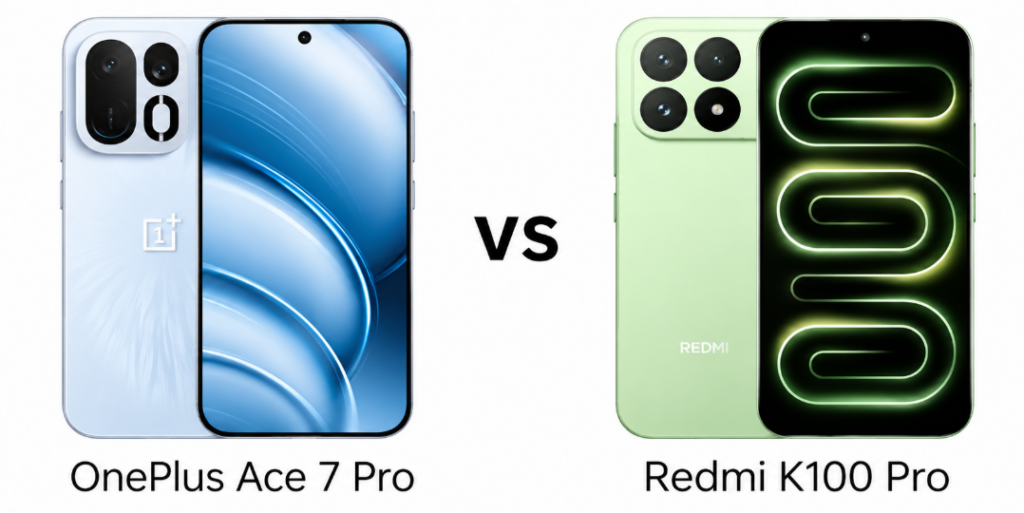
OnePlus Ace 7 Pro vs Redmi K100 Pro

Major Features:

CategoryOnePlus Ace 7 ProRedmi K100 ProWinner
BuildGlass front, aluminum frame, glass or glass-fiber backGlass front, aluminum frameOnePlus – More premium material options
DurabilityIP68/IP69KIP68/IP69OnePlus – Slightly stronger water-resistance certification
Display6.78-inch LTPO AMOLED, 185Hz6.59-inch AMOLED, 185HzOnePlus – Higher resolution and LTPO technology
Peak Brightness2000 nits4500 nitsRedmi – Higher advertised peak brightness
Display ProtectionCrystal Shield GlassNot specifiedOnePlus – Additional protection specified
ProcessorSnapdragon 8 Elite Gen 5Snapdragon 8 Elite Gen 5 V SeriesOnePlus – Standard flagship chipset
GPUAdreno 840Adreno 840Tie – Same GPU
CoolingBuilt-in bi-directional cooling fanConventional coolingOnePlus – Dedicated active cooling
RAMUp to 16GBUp to 16GBTie – Same maximum RAM
StorageUp to 1TB UFS 4.1Up to 512GB UFS 4.1OnePlus – Higher storage capacity
Main Camera200MP with OIS200MP with OISTie – Both offer 200MP main cameras
Telephoto Camera50MP periscope, 3.5x optical zoom50MP telephoto, 2.5x optical zoomOnePlus – Longer optical zoom
Ultrawide CameraNot available8MPRedmi – Additional ultrawide camera
Video Recording8K@30fps, 4K@120fps4K@60fpsOnePlus – Higher resolution and frame-rate options
Selfie Camera16MP32MPRedmi – Higher-resolution selfie camera
Selfie Video1080p@30fps4K@30fpsRedmi – Supports 4K selfie recording
SpeakersStereo speakersBose-tuned stereo speakers, Dolby AtmosRedmi – Enhanced audio tuning
Battery9000mAh8580mAhOnePlus – Larger battery capacity
Wired Charging100W100WTie – Same maximum charging speed
Wireless ChargingNot specified50WRedmi – Supports wireless charging
Reverse ChargingNot specified27W wired, 22.5W wirelessRedmi – More reverse charging options
Special FeaturesActive cooling fan, bypass chargingDolby Vision, Bose audio, wireless chargingTie – Different standout features
Price/Value$720 / ₹69,000$600 / ₹57,000Redmi – More affordable with versatile features
OverallGaming-focused flagshipAll-round flagshipRedmi – Better overall versatility and value
Disclaimer: Specs are based on available data. Actual performance may vary. Verify details from official sources before buying.

1. Design and Display

Build and Feel

The OnePlus Ace 7 Pro features a premium glass-and-aluminum construction, with Crystal Shield Glass protection and an option for a glass-fiber reinforced plastic back. Its IP68/IP69K rating provides strong protection against dust and water. The standout addition is its built-in bi-directional cooling fan, which gives the phone a distinctive gaming-focused identity. The Redmi K100 Pro takes a more conventional flagship approach with a glass front and aluminum frame. It also carries an IP68/IP69 rating, making it equally reassuring for everyday durability. However, its cleaner design may appeal to users who prefer a traditional premium smartphone over gaming-oriented styling. Both phones offer ultrasonic fingerprint sensors, adding convenience and security. Overall, the Redmi feels more understated, while the OnePlus has a stronger enthusiast appeal.

Display Quality

Both smartphones feature 185Hz AMOLED displays, making them particularly attractive for competitive gaming and exceptionally smooth scrolling. The OnePlus Ace 7 Pro offers an LTPO AMOLED panel with 1 billion colors, HDR10+ and HDR Vivid support. Its higher resolution also provides slightly sharper visuals, while 3840Hz PWM dimming should help improve viewing comfort. The Redmi K100 Pro counters with 68 billion colors, Dolby Vision, HDR10+ and HDR Vivid support. Its peak brightness of 4500 nits is considerably higher than the OnePlus’s 2000 nits, potentially giving it an advantage in bright outdoor conditions. The Redmi also offers a richer HDR feature set. However, the OnePlus has the more technically impressive display combination for gaming, particularly with its LTPO technology and higher pixel density.

Verdict

The OnePlus Ace 7 Pro wins for its sharper LTPO panel and gaming-focused display features. However, the Redmi K100 Pro offers better peak brightness and broader HDR support.

2. Specifications Including Battery

Performance

The OnePlus Ace 7 Pro runs on the Snapdragon 8 Elite Gen 5, while the Redmi K100 Pro uses the Snapdragon 8 Elite Gen 5 V Series. Both feature the same listed CPU configuration and Adreno 840 GPU, promising flagship-level performance for demanding applications, multitasking and graphics-intensive games. Both also use UFS 4.1 storage and offer configurations with up to 16GB of RAM. However, the OnePlus has an important advantage for sustained gaming: its built-in bi-directional cooling fan. Active cooling can help manage temperatures during extended gaming sessions and reduce performance throttling. The Redmi relies on its conventional thermal management system, although it remains a powerful option for everyday performance. For serious mobile gamers, the OnePlus has the more interesting hardware combination, particularly for longer gaming sessions.

Battery and Charging

Battery capacity is impressive on both smartphones. The OnePlus Ace 7 Pro packs a 9000mAh silicon-carbon battery, slightly larger than the Redmi K100 Pro’s 8580mAh unit. Both support 100W wired charging, but their additional charging features differ considerably. The OnePlus offers bypass charging, which is particularly useful during gaming because it can power the device directly without relying entirely on the battery. This can help reduce battery heat and unnecessary charging cycles. The Redmi K100 Pro, meanwhile, offers 50W wireless charging, 27W reverse wired charging and 22.5W reverse wireless charging. These options make it considerably more versatile for users with wireless accessories. Although OnePlus has the larger battery, Redmi delivers a more complete charging package for everyday convenience.

Verdict

The OnePlus Ace 7 Pro wins for its larger battery and dedicated cooling system. However, the Redmi K100 Pro offers more versatile charging, including 50W wireless charging and reverse charging.

3. Camera

Main and Secondary Lenses

The OnePlus Ace 7 Pro features a dual-camera setup led by a 200MP main sensor with OIS and a 50MP periscope telephoto camera offering 3.5x optical zoom. The periscope lens gives it an advantage for distant subjects and portrait photography, while 8K video recording and 4K at 120fps provide greater flexibility for content creators. The Redmi K100 Pro takes a more versatile approach with a triple-camera system. It combines a 200MP main camera with a 50MP telephoto lens offering 2.5x optical zoom and an 8MP ultrawide camera. The ultrawide lens is useful for landscapes and group photography, giving Redmi more shooting flexibility. Both phones feature optical image stabilisation on their main cameras. However, OnePlus offers a more capable zoom configuration, while Redmi covers more photography scenarios with its additional ultrawide lens.

Selfie Camera

The Redmi K100 Pro has a clear advantage in front-camera hardware, featuring a 32MP selfie sensor compared with the OnePlus Ace 7 Pro’s 16MP camera. More importantly, Redmi supports 4K video recording at 30fps from the front camera, making it a more attractive option for vloggers, video calls and social media creators. The OnePlus is limited to 1080p recording at 30fps, although gyro-EIS provides electronic stabilisation. Both smartphones include wide-angle selfie cameras, but Redmi’s higher resolution provides greater flexibility for detailed self-portraits and video content. The difference is particularly relevant for users who frequently record themselves rather than relying exclusively on the rear cameras. While actual image quality will depend on processing and sensor performance, Redmi has the more promising selfie camera package on paper.

Verdict

The Redmi K100 Pro wins overall for its triple-camera versatility and higher-resolution selfie camera with 4K recording. OnePlus remains the better choice for longer-range optical zoom.

4. Pricing

The OnePlus Ace 7 Pro is priced around $720 (₹69,000), positioning it firmly in the premium flagship category. The Redmi K100 Pro is priced around $600 (₹57,000), making it considerably more affordable despite offering a similarly powerful processor, a high-refresh-rate display and a large battery. The difference of approximately $120 (₹12,000) is significant, particularly for buyers comparing performance-focused smartphones. OnePlus justifies some of its higher asking price through its integrated cooling fan, larger battery and periscope telephoto camera. Redmi, meanwhile, offers a broader combination of features, including wireless charging, a triple-camera system and a more capable selfie camera. Both phones provide substantial hardware, but Redmi makes the stronger first impression from a pricing perspective.

Verdict

The Redmi K100 Pro wins on value for money. Its lower price, wireless charging and more versatile cameras make it the more sensible purchase for most buyers.

Disclaimer:
Prices are approximate and may vary based on country, region, launch timing, and applicable taxes. Always check whether the listed price is for a China unit or a global/international variant when purchasing.

5. Conclusion

The OnePlus Ace 7 Pro stands out with its built-in bi-directional cooling fan, 9000mAh battery, bypass charging and 3.5x periscope telephoto camera. These features give it a clear identity as a performance-oriented flagship designed for demanding users and extended gaming sessions. The Redmi K100 Pro, however, focuses on delivering a more complete everyday experience. Its 50W wireless charging, reverse charging capabilities, Dolby Vision display, 200MP triple-camera system and 32MP selfie camera make it a versatile alternative. 

Both smartphones offer impressive processing capabilities, fast wired charging and durable construction. The biggest difference is how they distribute their strengths. OnePlus prioritises sustained performance and gaming convenience, whereas Redmi invests in camera flexibility, charging options and multimedia features. Neither approach is inherently better, but Redmi’s combination is likely to satisfy a wider range of users.

Verdict

OnePlus Ace 7 Pro is better suited for gaming enthusiasts, thanks to its stronger performance hardware, active cooling and larger battery. The Redmi K100 Pro offers better camera versatility, wireless charging and overall value. Redmi gets a slight overall edge for its more balanced feature set, while OnePlus remains the better choice for performance-focused users. 

Disclaimer: Prices, specifications, and availability may vary by region and retailer. Recommendations in this article are based on editorial opinion, feature-based value, and market positioning at the time of writing. Readers are advised to do their own research before making a purchase.

Read More:

Comments