Advertisement

Add GIZMOCHINA as Preferred Source on Google

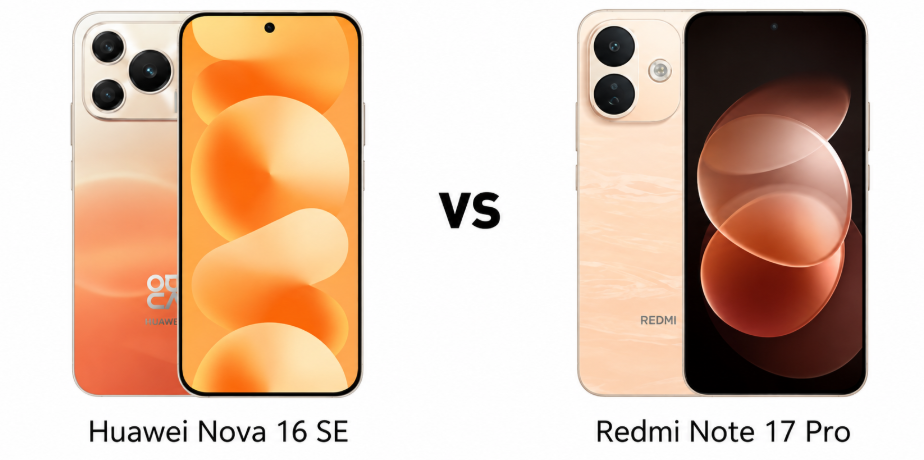
Huawei Nova 16 SE and Redmi Note 17 Pro target buyers who want large displays, big batteries, and strong everyday hardware without flagship pricing. The comparison is especially interesting because Huawei brings a massive OLED panel and an 8500mAh battery, while Redmi counters with tougher protection, newer Android software, and a more versatile camera setup.
Major Features:

CategoryHuawei Nova 16 SERedmi Note 17 ProWinner
Display6.84-inch OLED, 120Hz, 8,000 nits peak6.83-inch AMOLED, 120Hz, 3,500 nits peakHuawei — Brighter display
Display ProtectionAluminosilicate glassGorilla Glass Victus 2Redmi — Tougher protection
Build ProtectionIP65IP68/IP69KRedmi — Better durability
ProcessorKirin 8020Snapdragon 6s Gen 4Redmi — Newer platform
RAM8GBUp to 12GBRedmi — More RAM options
StorageUp to 512GBUp to 512GBHuawei — 8GB RAM standard
Storage TechnologyNot specifiedUFS 3.1Redmi — Faster storage
Main Camera50MP, 1/1.56-inch, PDAF50MP, OISHuawei — Larger sensor
Secondary CameraAuxiliary lens8MP ultrawideRedmi — More versatile
Selfie Camera32MP, 4K video16MP, 1080p videoHuawei — Better selfie specs
Rear VideoUp to 4K@30fpsUp to 1080p@30fpsHuawei — Higher resolution
Battery8,500mAh8,340mAhHuawei — Larger capacity
Charging66W wired, 5W reverse67W wired, 22.5W reverseRedmi — Better charging
SoftwareHarmonyOS 6.1Android 16, HyperOS 3Redmi — Broader compatibility
SpeakersStereoStereo with Dolby AtmosRedmi — Dolby Atmos
Fingerprint SensorSide-mountedUnder-display opticalRedmi — More premium placement
ConnectivityWi-Fi 7, Bluetooth 6.0Wi-Fi 5, Bluetooth 5.1Huawei — Newer connectivity
NFCYesYes, region dependentHuawei — Broader availability
PricePriced around $300 / ₹30,000Priced around $235 / ₹22,690Redmi — Better value
OverallStrong battery and selfie hardwareMore balanced hardware and lower priceRedmi — Better overall package
Disclaimer: Specs are based on available data. Actual performance may vary. Verify details from official sources before buying.

1. Design and Display

Build and Feel

The Huawei Nova 16 SE combines a glass front, plastic frame, and aluminum back with IP65 protection. It also features stereo speakers, NFC, an infrared port, and a side-mounted fingerprint scanner. Its design feels practical, but the protection rating is modest compared with Redmi’s much stronger water and drop resistance.

The Redmi Note 17 Pro uses Gorilla Glass Victus 2, a plastic frame and back, plus IP68/IP69K protection in many markets. It also adds an under-display fingerprint sensor and stereo speakers with Dolby Atmos. Overall, Redmi feels more reassuring for demanding everyday use, particularly for users who prioritize durability and stronger protection.

Display Quality

Both phones offer large 120Hz OLED-class displays with similarly sharp resolutions. Huawei stands out with an advertised 8,000-nit peak brightness figure, although its measurement is based on an isolated spot during video playback. It also supports 2,160Hz PWM dimming, making the display particularly interesting for sensitive eyes.

Redmi uses a 120Hz AMOLED panel with 3,840Hz PWM dimming and up to 3,500 nits peak brightness. Its Gorilla Glass Victus 2 protection adds practical value. Huawei has the more eye-catching brightness specification, but Redmi offers the more convincing overall display package for everyday use.

Verdict

Redmi wins the design and display section for stronger protection, tougher glass, and higher-frequency PWM dimming. Huawei remains appealing for its exceptionally large OLED panel and impressive advertised peak brightness.

2. Specifications Including Battery

Performance

The Huawei Nova 16 SE runs HarmonyOS 6.1 with the Kirin 8020 and Maleoon 920 GPU. It comes with 8GB RAM and storage options reaching 512GB, giving buyers plenty of room for apps and media. Its hardware should handle everyday tasks comfortably, although software ecosystem considerations remain important.

The Redmi Note 17 Pro runs Android 16 with HyperOS 3 and uses the Snapdragon 6s Gen 4. It offers configurations up to 12GB RAM and 512GB storage, with UFS 3.1 on higher-capacity versions. Redmi’s newer Android platform and broader app compatibility make it the safer performance choice for most international buyers.

Battery and Charging

Huawei packs an enormous 8,500mAh battery, paired with 66W wired charging and 5W reverse wired charging. That capacity is one of the phone’s biggest selling points and should comfortably support extended usage. For travelers and heavy users, the extra endurance could be more valuable than incremental performance gains.

Redmi carries an 8,340mAh silicon-carbon battery with slightly faster 67W charging, PD3.0 support, and 22.5W reverse wired charging. Its charging system is considerably more flexible. Huawei has the larger battery, but Redmi offers a better balance of capacity, charging compatibility, and reverse charging power.

Verdict

Redmi takes this section thanks to newer software, stronger memory options, UFS 3.1 storage, and faster, more versatile charging. Huawei counters with a slightly larger battery, making it compelling for maximum endurance.

3. Camera

Main and Secondary Lenses

Huawei uses a 50MP main camera with a large 1/1.56-inch sensor, dual-pixel PDAF, and 4K video recording. That combination gives it a potentially strong foundation for detailed everyday photography and better low-light capture. However, the listed setup lacks a clearly specified secondary camera, limiting versatility.

Redmi pairs its 50MP main camera with OIS and an 8MP ultrawide sensor. The main sensor is smaller, but optical stabilization should help with handheld photography and video. The ultrawide camera also gives Redmi greater compositional flexibility. For general photography, Redmi’s more complete camera system feels more practical.

Selfie Camera

Huawei takes a clear lead for selfies with a 32MP front camera capable of 4K video recording and gyro-EIS. That combination should appeal to creators who frequently record themselves, especially when higher-resolution front-facing video matters. It is one of the Nova 16 SE’s strongest advantages over its rival.

The Redmi Note 17 Pro uses a 16MP selfie camera with 1080p video recording. It supports HDR and panorama, but its specifications are considerably more modest. Huawei therefore looks substantially better for selfie photography and front-camera video, particularly for social content and video calls where detail matters.

Verdict

Huawei wins for selfie capability and its larger main-camera sensor, while Redmi offers the more versatile rear setup with OIS and ultrawide photography. For overall camera flexibility, Redmi has the practical advantage.

4. Pricing

The Huawei Nova 16 SE is priced around $300 or ₹30,000, placing it significantly above the Redmi Note 17 Pro. Huawei justifies some of that premium with an 8,500mAh battery, 8GB RAM across storage variants, a 32MP selfie camera, and its large OLED display.

The Redmi Note 17 Pro is priced around $235 or ₹22,690. Despite the lower price, it offers Gorilla Glass Victus 2, stronger water resistance, Android 16, HyperOS 3, OIS, an ultrawide camera, and configurations reaching 12GB RAM. That makes its hardware-to-price ratio particularly compelling.

Is the price justified? 

Huawei’s premium makes sense if battery endurance, selfie quality, and HarmonyOS are the priorities. Its 512GB option and enormous battery give it a distinctive appeal, but the higher price becomes harder to justify when Redmi offers more comprehensive hardware for considerably less money.

Redmi delivers stronger value because its lower price does not require major compromises in core hardware. Buyers receive better protection, OIS, ultrawide photography, newer Android software, and more powerful reverse charging. For most users, it is the more sensible purchase.

Verdict

Redmi is the clear value winner. Its lower price combined with stronger protection, broader camera hardware, newer software, and versatile charging makes the premium paid for Huawei difficult to justify.

Disclaimer:
Prices are approximate and may vary based on country, region, launch timing, and applicable taxes. Always check whether the listed price is for a China unit or a global/international variant when purchasing.

5. Conclusion

The Huawei Nova 16 SE stands out with its 8,500mAh battery, 32MP selfie camera with 4K recording, 2,160Hz PWM OLED display, and 512GB storage paired with 8GB RAM. Its aluminum-backed construction and HarmonyOS 6.1 also give it a distinctive identity.

The Redmi Note 17 Pro counters with Gorilla Glass Victus 2, IP68/IP69K protection, a silicon-carbon battery, 22.5W reverse charging, OIS, an ultrawide camera, UFS 3.1 storage, and Android 16 with HyperOS 3. These features make it the more balanced package overall.

Verdict

Redmi Note 17 Pro is the overall winner. It combines stronger durability, more versatile cameras, newer software, better charging flexibility, and significantly lower pricing, making it the smarter choice for most buyers.


FAQs

1. Which phone is better for everyday use?
The Redmi Note 17 Pro offers a more balanced experience with newer software, stronger protection, and versatile hardware.

2. Which phone takes better photos?
The Huawei Nova 16 SE has a larger main sensor, while Redmi offers OIS and an ultrawide camera.

3. Which phone performs better for gaming?
The Redmi Note 17 Pro is the safer choice, especially in higher-RAM configurations and with UFS 3.1 storage.

4. Which phone has better battery life?
The Huawei Nova 16 SE has a slightly larger battery, making it better suited to extended usage between charges.

5. Which phone offers better value for money?
The Redmi Note 17 Pro offers stronger overall value thanks to its lower price and more comprehensive hardware.

Disclaimer: Prices, specifications, and availability may vary by region and retailer. Recommendations in this article are based on editorial opinion, feature-based value, and market positioning at the time of writing. Readers are advised to do their own research before making a purchase.

Read More:

Comments