As an Amazon Associate, Gizmochina earns from qualifying purchases. Links on this page may earn us a commission at no extra cost to you.
TV speakers still sound thin, even on sets with gorgeous picture quality. Physics is mostly to blame here — TVs keep getting slimmer, and there’s just not enough room inside for drivers big enough to fill a living room with sound. Some brands squeeze in decent audio on their priciest models, but you’re usually paying thousands of dollars just for that.
The cheaper fix is a soundbar, and we have two new contenders in this category. TCL has just announced the Q95K in China with 1420W peak output and 11.1.4-channel audio. Samsung, meanwhile, refreshed its home audio lineup for 2026 after the HW-Q990F won major awards throughout 2025.
TCL Q95KSamsung HW-Q990F
Both offer a full, room-filling home theater setup without stacking separate speakers around your living room. Here is how they compare.
For a wider range of prices and setups beyond these two flagships, our rundown of the best soundbars of 2026 covers the field.
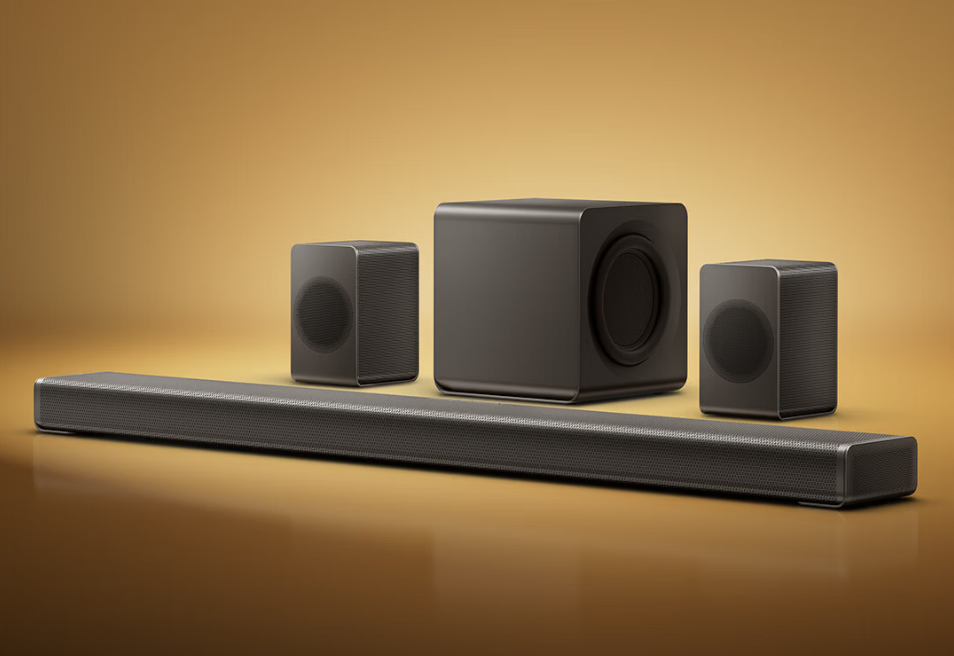
TCL’s Q95K ships as a four-piece system. You get the main bar, a wireless subwoofer, and two wireless rear speakers. Inside, the company packs 22 physical drivers across 12 independent amplifier chips, which TCL says cuts down on crosstalk between channels. The subwoofer uses two opposing 7-inch drivers that are meant to reduce vibration when the bass gets heavy.
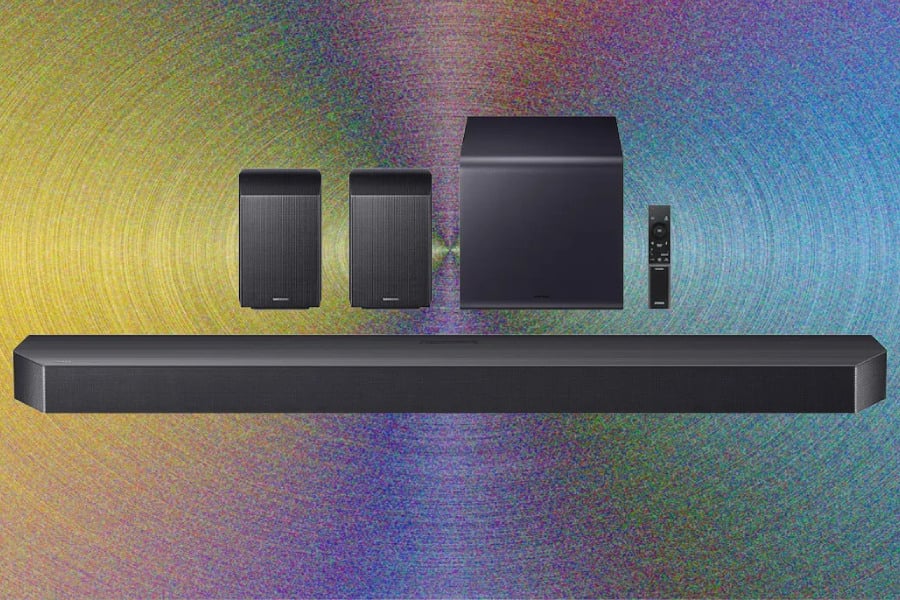
The Samsung HW-Q990F takes a similar four-piece approach: a main bar, a subwoofer, and two rear speakers. Samsung redesigned the subwoofer this year, making it smaller and about one pound lighter than the unit that shipped with the older HW-Q990D. The bar itself mixes aluminum with plastic, a change from the nearly all-metal build of last year’s model. Both companies clearly built these systems for wall mounting, and both use a dark, minimal look that avoids fabric mesh covers.
2. Channels, Power, and Audio Formats
The TCL Q95K is the loudest thing on paper, and it’s not even close. It runs an 11.1.4-channel setup with a peak output of 1,420 watts, and TCL says the system covers a frequency range of 30Hz to 20kHz while keeping distortion under 1 percent. TCL partnered with Bang & Olufsen on the tuning, and the pairing comes with a Beosonic app interface that lets you adjust sound profiles from your phone.
Samsung’s HW-Q990F also runs 11.1.4 channels, spread across 16 real speaker channels rather than TCL’s higher driver count. Samsung leans on its own software instead of an outside audio partner, with SpaceFit Sound Pro handling room calibration and an Active Voice Amplifier feature meant to keep dialogue clear at lower volumes.
Both bars support Dolby Atmos and DTS:X, so the format support lines up closely. Where they differ is in the extras: Samsung can also decode Dolby TrueHD and Dolby Digital Plus.
If you own a TV from the same brand as your soundbar, both systems reward you for it. TCL has a T-Chord feature that lets you sync the soundbar with the speakers built into compatible TCL TVs. Samsung’s version, Q-Symphony, does the same thing with recent Samsung TVs, and premium Samsung sets can even send Dolby Atmos audio to the Q990F wirelessly.
3. Connectivity and Gaming Features
For gamers, the TCL Q95K includes three HDMI 2.1 ports with 48Gbps bandwidth, and it passes through 4K video at up to 144Hz along with Variable Refresh Rate and Auto Low Latency Mode. Samsung’s HW-Q990F covers similar ground with two HDMI 2.1 inputs plus an HDMI eARC output, 4K passthrough at 120Hz, and its own VRR support.
For wireless streaming, TCL includes Wi-Fi 6, Bluetooth, Apple AirPlay 2, and Spotify Connect. Samsung offers Wi-Fi, Bluetooth 5.0, AirPlay 2, and a longer list of streaming services that includes Tidal Connect, Amazon Music, and Deezer, plus Amazon Alexa voice control built in.
4. Price and Availability
This is where the two systems pull furthest apart. The TCL Q95K costs 6,999 yuan in China, which works out to roughly $1,034. TCL also sells two step-down models alongside it: the Q85K at around $886 and the Q75K at around $694. The catch, however, is availability. As of now, the Q95K has only launched in China, and TCL has not given a timeline for a US, UK, or other Western release.
The Samsung HW-Q990F, by contrast, is already sold worldwide and was tested at £1,699 / $1,999 / AU$1,999 at launch. That is close to double the price of the TCL Q95K’s Chinese sticker price, though prices for Samsung’s Q-series soundbars, including the older HW-Q990C, tend to drop over time as newer models arrive.
5. Which One Should You Choose?
Right now, this comparison comes with an asterisk. If you live outside China, you cannot buy the TCL Q95K yet, unless you decide to import. That leaves the Samsung HW-Q990F as the only one of the two you can actually order today, and fortunately, reviewers have consistently rated it as one of the best Dolby Atmos soundbars on the market.
If TCL does bring the Q95K to Western markets, the pitch will become more interesting. It offers more physical drivers, a higher peak wattage figure, and a Bang & Olufsen tuning partnership, all at a price well below Samsung’s flagship. That said, Samsung still has the edge in software maturity, format support, streaming service variety, and a long track record of holding the top spot in global soundbar sales.
For now, buyers outside China have one clear option in this matchup. Buyers inside China get a genuinely tempting alternative, and the rest of the world will just have to wait and see if TCL brings the Q95K home.
For more daily updates, please visit ourNews Section.
We use cookies on our website to give you the most relevant experience by remembering your preferences and repeat visits. By clicking “Accept”, you consent to the use of ALL the cookies.
This website uses cookies to improve your experience while you navigate through the website. Out of these, the cookies that are categorized as necessary are stored on your browser as they are essential for the working of basic functionalities of the website. We also use third-party cookies that help us analyze and understand how you use this website. These cookies will be stored in your browser only with your consent. You also have the option to opt-out of these cookies. But opting out of some of these cookies may affect your browsing experience.
Necessary cookies are absolutely essential for the website to function properly. This category only includes cookies that ensures basic functionalities and security features of the website. These cookies do not store any personal information.
Any cookies that may not be particularly necessary for the website to function and is used specifically to collect user personal data via analytics, ads, other embedded contents are termed as non-necessary cookies. It is mandatory to procure user consent prior to running these cookies on your website.