Advertisement

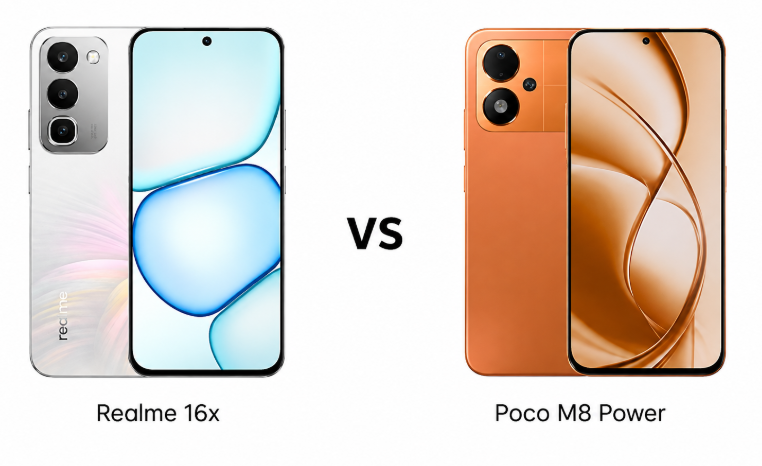
Realme 16x and Poco M8 Power take different approaches to the budget 5G segment. Realme focuses on durability, a fast 144Hz display and gaming-friendly features, while Poco pushes a larger battery, AMOLED screen and richer hardware. Here’s how the two compare on display, performance, cameras, battery and value.
Major Features:

CategoryRealme 16xPoco M8 PowerWinner
Display6.81-inch 144Hz IPS LCD, 1200 nits6.99-inch 120Hz AMOLED, 1800 nitsPoco — AMOLED and sharper resolution
BuildIP65, MIL-STD-810H, drop resistanceIP65Realme — stronger durability features
PerformanceDimensity 6300, up to 6GB RAMSnapdragon 4 Gen 4, up to 8GB RAMPoco — better chipset and RAM options
StorageUp to 256GB, shared microSD slotUp to 128GB, dedicated microSD slotRealme — higher maximum storage
Rear Camera50MP AF, 1080p up to 60fps50MP PDAF, 1080p 30fpsRealme — better video capability
Selfie Camera8MP, 1080p 30fps8MP, 1080p 30fpsTie — similar specifications
SpeakersSingle loudspeakerStereo speakersPoco — better multimedia audio
Battery7000mAh8000mAhPoco — larger capacity
Charging45W, 7W reverse, bypass charging45W, 22.5W reversePoco — stronger reverse charging
ConnectivityWi-Fi 5, Bluetooth 5.3, no NFCWi-Fi 6, NFC, IR blasterPoco — broader connectivity
Software SupportAndroid 16, up to 2 major updatesAndroid 16, up to 4 major updatesPoco — longer software support
Price / ValuePriced around $300 / ₹26,000Priced around $250 / ₹25,000Poco — more features for less
OverallRugged design and 144Hz displayAMOLED, bigger battery and richer featuresPoco — stronger all-round package
Disclaimer: Specs are based on available data. Actual performance may vary. Verify details from official sources before buying.

1. Design and Display

Build and Feel

The Realme 16x combines a glass front with a plastic frame and back, plus IP65 protection, MIL-STD-810H compliance, drop resistance and an RGB notification light. The Poco M8 Power also carries IP65 protection and adds stereo speakers with an under-display fingerprint sensor. Realme feels more rugged and practical, while Poco has a more premium multimedia-oriented character.

Display Quality

The Realme 16x uses an IPS LCD with a 144Hz refresh rate and up to 1200 nits HBM brightness. Poco takes a significant step ahead with an AMOLED panel, 120Hz refresh rate, 1080p resolution, Gorilla Glass 7i and up to 1800 nits peak brightness. Realme’s higher refresh rate helps scrolling, but Poco’s AMOLED panel delivers deeper blacks, stronger contrast and sharper visuals.

Verdict

Poco wins the display category with its AMOLED technology, higher resolution, stronger brightness and Gorilla Glass 7i. Realme’s 144Hz panel is smooth, but Poco feels considerably more premium for entertainment and everyday viewing.

2. Specifications Including Battery

Performance

The Realme 16x uses the MediaTek Dimensity 6300 with up to 6GB RAM, while the Poco M8 Power uses the Snapdragon 4 Gen 4 with up to 8GB RAM. Both offer UFS 2.2 storage, but Poco has a dedicated microSD slot. The Snapdragon platform and additional RAM make Poco better suited to multitasking and sustained everyday use.

Battery and Charging

Realme packs a 7000mAh battery with 45W wired charging, 7W reverse wired charging and bypass charging. Poco goes further with an 8000mAh battery, 45W charging and 22.5W reverse wired charging. Charging speeds are identical, but Poco’s larger battery and stronger reverse charging make it more attractive for heavy users who prioritize endurance.

Verdict

Poco wins on overall specifications with more RAM, a larger battery, stronger reverse charging and dedicated storage expansion. Realme’s bypass charging is useful for gaming, but Poco offers the broader hardware package.

3. Camera

Main and Secondary Lenses

Both smartphones feature 50MP primary rear cameras with autofocus, but Poco specifies a 26mm equivalent lens, a 1/2.76-inch sensor and PDAF. Realme supports 1080p recording at up to 60fps, giving it an advantage for video flexibility. Poco is limited to 1080p at 30fps, although its PDAF system should help with focusing during everyday photography.

Selfie Camera

Both phones use an 8MP f/2.0 front camera capable of 1080p video at 30fps. Neither offers a higher-resolution selfie sensor or additional front-facing lens. For video calls, basic portraits and social-media selfies, the two should provide broadly similar capabilities, with neither establishing a major hardware advantage.

Verdict

Realme wins narrowly because its main camera supports 1080p recording at 60fps. Poco offers PDAF and more detailed sensor specifications, but Realme provides greater video flexibility.

4. Pricing

The Realme 16x is priced around $300, or approximately ₹26,000, while the Poco M8 Power is priced around $250, or approximately ₹25,000. Poco therefore undercuts Realme on price while offering a larger battery, an AMOLED display, more RAM, and several additional hardware features.

Is the Price Justified?

Realme’s higher price can be justified by its 144Hz refresh rate, ruggedness features, bypass charging and 60fps rear video recording. However, Poco offers considerably more display technology and battery capacity while also adding stereo speakers, NFC and an infrared port. Its hardware package feels stronger for buyers prioritizing features per rupee.

Verdict

Poco offers better value for money because its lower stated price comes with an AMOLED display, larger battery, more RAM, stereo speakers and broader connectivity. Realme makes more sense for buyers prioritizing ruggedness and bypass charging.

Disclaimer:
Prices are approximate and may vary based on country, region, launch timing, and applicable taxes. Always check whether the listed price is for a China unit or a global/international variant when purchasing.

5. Conclusion

The Realme 16x differentiates itself with a 144Hz display, MIL-STD-810H compliance, drop resistance, RGB notification light, bypass charging and 60fps rear video recording. The Poco M8 Power counters with AMOLED technology, Gorilla Glass 7i, stereo speakers, NFC, an IR port, dedicated microSD expansion and substantially stronger reverse charging.

Verdict

Poco M8 Power is the stronger overall choice for most buyers, combining a better display, larger battery, more RAM and richer features at a lower stated price. Realme 16x remains appealing for ruggedness, 144Hz smoothness and bypass charging.

Disclaimer: Prices, specifications, and availability may vary by region and retailer. Recommendations in this article are based on editorial opinion, feature-based value, and market positioning at the time of writing. Readers are advised to do their own research before making a purchase.


FAQs

1. Which phone is better for gaming, Realme 16x or Poco M8 Power?
Poco M8 Power is better for gaming, thanks to its Snapdragon chipset, higher RAM options and larger battery.

2. Does Realme 16x take better photos than Poco M8 Power?
Realme 16x has an advantage for video recording, supporting 1080p at 60fps compared with Poco’s 30fps limit.

3. Which phone has better battery life?
Poco M8 Power should last longer between charges because its 8000mAh battery exceeds Realme 16x’s 7000mAh capacity.

4. Which phone offers better value for money?
Poco M8 Power offers stronger overall value with its AMOLED display, larger battery, stereo speakers and higher RAM options.

5. Should you buy Realme 16x or Poco M8 Power?
Choose Poco M8 Power for overall hardware value; Realme 16x suits buyers prioritizing durability and bypass charging.

Read Mind:

Comments