Advertisement

Add GIZMOCHINA as Preferred Source on Google

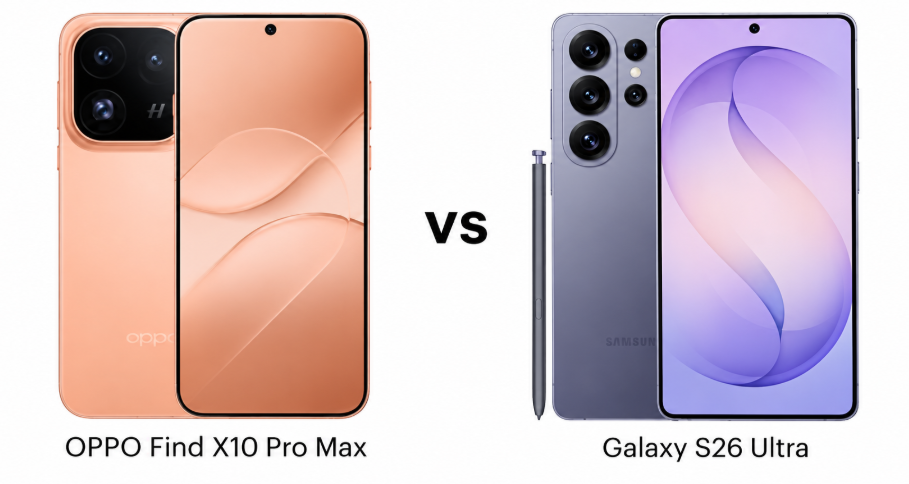
OPPO Find X10 Pro Max and Samsung Galaxy S26 Ultra represent two different approaches to the premium smartphone. OPPO pushes aggressive hardware with a 144Hz display, enormous 8,000mAh battery, triple 200MP cameras, and fast charging, while Samsung focuses on a more versatile camera system, S Pen functionality, software support, and productivity features. At very different price points, this comparison comes down to whether you want maximum hardware or a more complete flagship experience.
Major Features:

CategoryOPPO Find X10 Pro MaxSamsung Galaxy S26 UltraWinner
BuildGlass front/back, aluminum frame, Gorilla Glass Victus 2, IP68/IP69Gorilla Armor 2 front, Victus 2 back, Armor Aluminum 2, IP68OPPO — Stronger water and dust protection
Display6.78-inch LTPO AMOLED, 144Hz, up to 3,600 nits6.9-inch Dynamic AMOLED 2X, 120Hz, up to 2,600 nitsOPPO — Higher refresh rate and peak brightness
ProcessorDimensity 9600 Pro, 2nmSnapdragon 8 Elite Gen 5, 3nmOPPO — Newer 2nm process
RAMUp to 16GBUp to 16GBTie — Both offer up to 16GB
StorageUp to 1TB, UFS 4.1Up to 1TB, UFS 4.XOPPO — UFS 4.1 storage
Main Camera200MP, f/1.5, OIS200MP, f/1.4, OISSamsung — Wider aperture
Telephoto200MP periscope, 3x optical zoom10MP 3x + 50MP 5x periscopeSamsung — More versatile zoom setup
Ultrawide200MP50MPOPPO — Higher-resolution ultrawide
Selfie Camera50MP ultrawide, PDAF12MP wide, dual-pixel PDAFOPPO — Higher resolution and wider view
VideoUp to 8K 30fps, 4K 120fps, Dolby VisionUp to 8K 30fps, 4K 120fps, HDR10+OPPO — Dolby Vision support
Battery8,000mAh5,000mAhOPPO — Much larger battery
Wired Charging80W60WOPPO — Faster charging
Wireless Charging50W25W Qi2.2OPPO — Faster wireless charging
SoftwareAndroid 17, ColorOS 17Android 16, One UI 9, up to 7 major updatesSamsung — Longer update commitment
Productivity—S Pen, Samsung DeX, Wireless DeXSamsung — Superior productivity features
PriceAround $960 / ₹97,000Around $1,300 / ₹1,40,000OPPO — Lower price with extensive flagship hardware
OverallHardware-focused flagshipFeature-rich productivity flagshipOPPO — Stronger hardware value at a lower price
Disclaimer: Specs are based on available data. Actual performance may vary. Verify details from official sources before buying.

1. Design and Display

Build and Feel

Both phones deliver premium glass-and-metal construction with strong water and dust resistance, but their approaches differ. The Find X10 Pro Max uses Gorilla Glass Victus 2 and an aluminum frame, while the Galaxy S26 Ultra combines Gorilla Armor 2, Victus 2 glass, and Armor Aluminum 2. Samsung also adds an integrated stylus, giving it a clear productivity advantage. OPPO counters with stereo speakers, an ultrasonic fingerprint reader, and an infrared port. Its IP68/IP69 rating also offers stronger protection against high-pressure water jets. For a hardware-focused flagship, OPPO feels particularly well equipped.

Display Quality

OPPO takes the more aggressive approach with a 6.78-inch LTPO AMOLED panel supporting a 144Hz refresh rate, Dolby Vision, HDR10+, HDR Vivid and up to 3,600 nits peak brightness. Samsung offers a 6.9-inch Dynamic AMOLED 2X display with 120Hz, HDR10+, up to 2,600 nits and an anti-reflective coating. Samsung’s higher resolution and Privacy Display are valuable extras, while OPPO’s faster refresh rate and broader HDR support make it especially appealing for multimedia.

Verdict

OPPO has the stronger display specification sheet, particularly for high-refresh gaming and HDR content. Samsung’s anti-reflective coating and Privacy Display make its panel more adaptable for everyday use.

2. Specifications Including Battery

Performance

The Find X10 Pro Max uses the 2nm Dimensity 9600 Pro, paired with up to 16GB RAM and UFS 4.1 storage. Its high-clocked CPU and Mali-G2-Ultra-NX GPU target demanding gaming and sustained workloads. Samsung uses the 3nm Snapdragon 8 Elite Gen 5 with up to 16GB RAM and UFS 4.X storage. Both are firmly positioned at the top end of Android performance, but OPPO’s newer 2nm chip gives its hardware an intriguing efficiency and performance edge. Samsung counters with a mature flagship software ecosystem, seven major OS updates and One UI 9. For long-term ownership, Samsung feels safer; for raw hardware ambition, OPPO is more compelling.

Battery and Charging

Battery capacity is where OPPO dramatically separates itself. The global Find X10 Pro Max packs an 8,000mAh silicon-carbon battery with 80W wired charging, 50W wireless charging and 10W reverse wireless charging. Samsung uses a 5,000mAh battery with 60W wired, 25W wireless and 4.5W reverse wireless charging. The Galaxy is adequate for flagship use, but OPPO’s substantially larger battery should provide greater endurance, while its faster wireless charging adds convenience. This is one area where OPPO’s specifications translate directly into a practical advantage.

Verdict

For demanding users, OPPO’s combination of newer silicon, a much larger battery, and faster charging is the more compelling hardware package. Samsung’s advantage is its longer software commitment.

3. Camera

Main and Secondary Lenses

OPPO equips the Find X10 Pro Max with three 200MP cameras: a wide main sensor, 3x periscope telephoto and ultrawide. Hasselblad Color Calibration, laser autofocus, and 8K video add serious imaging credentials. Samsung takes a more versatile route with a 200MP main camera, dedicated 3x telephoto, 50MP 5x periscope, and 50MP ultrawide. That gives Samsung more native focal-length flexibility, especially for distant subjects. OPPO’s dual 200MP telephoto and ultrawide approach is technically impressive, but Samsung’s dedicated four-camera setup feels more practical across varied shooting scenarios. Samsung also offers features such as Best Face and Horizon Lock, reinforcing its focus on computational photography.

Selfie Camera

OPPO uses a 50MP ultrawide selfie camera with PDAF and 4K video recording at up to 60fps. Samsung has a 12MP autofocus selfie camera supporting HDR10+ and 4K video at 60fps. The higher-resolution OPPO sensor gives it stronger hardware credentials for detailed selfies and wider group shots. Samsung’s autofocus system and HDR capabilities should still produce more consistent results across challenging lighting conditions. For creators who frequently record front-facing video, both phones provide strong 4K capture, but OPPO’s higher-resolution sensor is more ambitious.

Verdict

Samsung’s camera system offers greater focal-length flexibility, while OPPO emphasizes high-resolution hardware. For varied photography, Samsung is the more versatile choice.

4. Pricing

The OPPO Find X10 Pro Max is priced around $960, or ₹97,000, while the Galaxy S26 Ultra is priced around $1,300, or ₹1,40,000. The roughly $340 price gap gives OPPO a strong value advantage, especially with its larger battery, faster charging and extensive camera hardware. Samsung’s premium reflects its S Pen, DeX and longer software support. 

Is the price justified? 

The Galaxy S26 Ultra can justify its premium through software longevity, productivity features and camera versatility. Its seven major Android updates make the higher upfront investment easier to rationalize for long-term users. OPPO offers considerably more hardware for less money, particularly with its battery, charging system and 200MP camera hardware. 

For pure flagship value, OPPO feels harder to ignore. Samsung remains the more comprehensive productivity device, especially for users who will actually use S Pen and DeX. The value equation therefore depends heavily on priorities rather than simply specifications.

Verdict

The ₹43,000 gap makes OPPO the more aggressive value proposition. Samsung’s premium is easier to justify for buyers who will use its S Pen, DeX, and longer software support.

Disclaimer:
Prices are approximate and may vary based on country, region, launch timing, and applicable taxes. Always check whether the listed price is for a China unit or a global/international variant when purchasing.

5. Conclusion

The Find X10 Pro Max stands out with its 144Hz LTPO AMOLED display, 2nm Dimensity 9600 Pro, 8,000mAh silicon-carbon battery, 80W charging and three 200MP rear cameras. It also brings IP68/IP69 protection and an infrared port. The Galaxy S26 Ultra has a different set of strengths, including its integrated S Pen, Privacy Display, Samsung DeX, UWB and seven major OS updates. Its four-camera system also provides a broader native zoom range. 

OPPO is clearly the more hardware-aggressive phone, while Samsung is built around versatility, productivity and long-term software support. The deciding factor is therefore less about whether either device feels premium and more about what kind of flagship experience the buyer values. OPPO’s combination of battery capacity, charging speed, display technology and camera hardware is difficult to overlook at its price. Samsung remains the more complete productivity-oriented flagship, particularly for users invested in the Galaxy ecosystem.

Verdict

Overall, the OPPO Find X10 Pro Max wins on hardware value, while the Galaxy S26 Ultra wins on versatility and longevity. OPPO takes the overall comparison for delivering more flagship hardware at a substantially lower price.


FAQs

1. Which phone has the better camera for zoom photography?
The Galaxy S26 Ultra offers greater zoom flexibility with dedicated 3x and 5x telephoto cameras.

2. Which phone is better for gaming?
The OPPO Find X10 Pro Max offers a newer 2nm chip and 144Hz display, making it especially attractive for gaming.

3. Which phone lasts longer on a single charge?
The OPPO Find X10 Pro Max should offer longer endurance thanks to its substantially larger 8,000mAh battery.

4. Which phone offers better value for money?
The OPPO Find X10 Pro Max offers more hardware for the price, including faster charging and a larger battery.

5. Should you buy OPPO or Samsung?
Choose OPPO for hardware value; Samsung suits buyers prioritizing productivity, software support and the S Pen.

Disclaimer: Prices, specifications, and availability may vary by region and retailer. Recommendations in this article are based on editorial opinion, feature-based value, and market positioning at the time of writing. Readers are advised to do their own research before making a purchase.

Read More:

Comments