
Add GIZMOCHINA on Google:
As an Amazon Associate, Gizmochina earns from qualifying purchases. Links on this page may earn us a commission at no extra cost to you.
Huawei Pura 90 Plus and Vivo X300 Pro approach flagship smartphone photography and performance differently. While Huawei focuses on premium display technology, a large main camera sensor and versatile charging options, Vivo brings a powerful Dimensity processor, advanced camera hardware and a more feature-rich Android experience. Both target premium buyers, but their differences could make one a considerably better purchase.
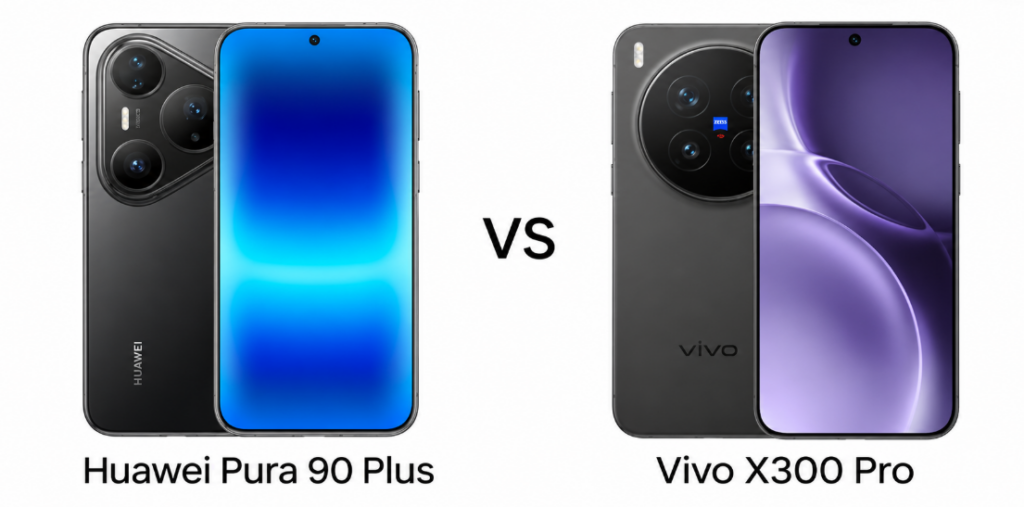
1. Major Features:
| Category | Huawei Pura 90 Plus | Vivo X300 Pro | Winner |
|---|---|---|---|
| Dimensions | 163.1 x 76.1 x 8.3 mm | 161.2 x 75.5 x 8 mm | Vivo – More compact |
| Weight | 220 g | 226 g | Huawei – Lighter |
| Build | Kunlun Glass 2, aluminium frame, glass back | Armor Glass, aluminium frame, glass back | Huawei – Kunlun Glass 2 |
| Water Resistance | IP68/IP69 | IP68/IP69 | Tie – Same rating |
| Display Type | LTPO OLED | LTPO AMOLED | Tie – Premium LTPO panels |
| Display Size | 6.8 inches | 6.78 inches | Huawei – Slightly larger |
| Resolution | 1276 x 2848 pixels | 1260 x 2800 pixels | Huawei – Higher resolution |
| Refresh Rate | 120Hz | 120Hz | Tie – Same refresh rate |
| PWM Dimming | 1440Hz | 2160Hz | Vivo – Higher PWM frequency |
| HDR Support | Not specified | HDR10+, HDR Vivid, Dolby Vision | Vivo – More HDR formats |
| Peak Brightness | Not specified | 4500 nits | Vivo – Higher peak brightness |
| Screen Protection | Kunlun Glass 2 | Armor Glass | Tie – Different protection technologies |
| Operating System | HarmonyOS 7 | Android 16, OriginOS 6 | Vivo – Android ecosystem and five major OS updates |
| Chipset | Kirin 9025 | Dimensity 9500 (3nm) | Vivo – More powerful flagship chipset |
| RAM | 12GB | Up to 16GB | Vivo – Higher RAM capacity |
| Storage | 256GB, 512GB, 1TB | 256GB, 512GB, 1TB | Vivo – Higher RAM on selected variants |
| Storage Technology | Not specified | Dual UFS 4.1 | Vivo – UFS 4.1 |
| Main Camera | 50MP, 1-inch sensor, variable aperture, OIS | 50MP, 1/1.28-inch sensor, OIS | Huawei – Larger sensor and variable aperture |
| Telephoto Camera | 48MP periscope, 4x optical zoom, OIS | 200MP periscope, 3.7x optical zoom, OIS | Vivo – Higher-resolution telephoto |
| Ultrawide Camera | 40MP | 50MP with autofocus | Vivo – Higher resolution and autofocus |
| Camera Features | Laser AF, colour spectrum sensor | Zeiss optics, T* coating, Laser AF, 3D LUT import | Vivo – More specialised camera features |
| Rear Video | 4K, 1080p, HDR Vivid | 8K@30fps, 4K@120fps, Dolby Vision HDR | Vivo – More advanced recording |
| Selfie Camera | 13MP with autofocus | 50MP with autofocus | Vivo – Higher resolution |
| Selfie Video | 4K, 1080p | 4K@60fps, 1080p | Vivo – 4K at 60fps |
| Loudspeaker | Stereo speakers | Stereo speakers | Tie – Same configuration |
| Wi-Fi | Wi-Fi 7 | Wi-Fi 7 | Tie – Same standard |
| Bluetooth | 6.0 | 5.4 | Huawei – Newer Bluetooth version |
| NFC | Yes | Yes | Tie – Both support NFC |
| Infrared | Yes | Yes | Tie – Both include infrared |
| USB | USB-C 3.2, DisplayPort 1.2, OTG | USB-C 3.2, OTG | Huawei – DisplayPort support |
| Fingerprint Sensor | Side-mounted | Under-display ultrasonic | Vivo – More advanced sensor placement and technology |
| Satellite Connectivity | BDS satellite messaging (China only) | Optional satellite connectivity, market dependent | Tie – Both offer satellite features |
| Battery Capacity | 5700mAh | 6510mAh (Global), 5440mAh (EU) | Vivo – Larger global battery |
| Wired Charging | 100W | 90W | Huawei – Faster charging |
| Wireless Charging | 80W | 40W | Huawei – Faster wireless charging |
| Reverse Charging | 18W wired, wireless reverse charging | Wired and wireless reverse charging | Huawei – 18W wired reverse charging |
| Price | Approx. $730 / ₹73,500 | Approx. $1,000 / ₹1,10,000 | Huawei – More affordable |
2. Design and Display
Build and Feel
The Huawei Pura 90 Plus features a glass front protected by Kunlun Glass 2, an aluminum frame and an aluminosilicate glass back. The Vivo X300 Pro combines Armor Glass protection with an aluminum frame and glass back. Both carry IP68/IP69 ratings, offering protection against dust and water. Huawei’s Kunlun Glass 2 adds a distinctive touch, while Vivo’s Armor Glass keeps its construction equally competitive.
Display Quality
Huawei equips the Pura 90 Plus with a 6.8-inch LTPO OLED display featuring a 1276 x 2848 resolution, 120Hz refresh rate and 1440Hz PWM dimming. The Vivo X300 Pro has a 6.78-inch LTPO AMOLED panel with a 1260 x 2800 resolution, 120Hz refresh rate and 2160Hz PWM dimming. Vivo additionally supports HDR10+, Dolby Vision and a claimed 4500-nit peak brightness, making its display more feature-rich.
Verdict
Vivo X300 Pro takes the display advantage with Dolby Vision, HDR10+ and higher peak brightness. Huawei remains competitive with its high-resolution OLED panel and Kunlun Glass 2 protection.
3. Specifications Including Battery
Performance
The Huawei Pura 90 Plus runs HarmonyOS 7 and uses the Kirin 9025 chipset, paired with 12GB RAM and up to 1TB storage. Vivo takes a different approach with Android 16, OriginOS 6 and the 3nm MediaTek Dimensity 9500 processor. It also offers up to 16GB RAM and UFS 4.1 storage. Vivo’s newer flagship chipset and higher memory configurations make it the stronger choice on paper for demanding applications and multitasking.
Battery and Charging
Huawei packs a 5700mAh battery with 100W wired charging, 80W wireless charging and 18W reverse wired charging. The Vivo X300 Pro offers a larger 6510mAh silicon-carbon battery in its global configuration, although European markets receive a 5440mAh version. Charging includes 90W wired and 40W wireless support, alongside reverse wireless and reverse wired charging. Vivo’s larger global battery capacity is appealing, while Huawei offers faster wireless charging.
Verdict
Vivo X300 Pro wins on chipset capability, RAM configurations and global battery capacity. Huawei counters with faster wired and wireless charging, but Vivo offers the more complete hardware package.
4. Camera
Main and Secondary Lenses
The Huawei Pura 90 Plus features a 50MP one-inch main camera with variable f/1.6–4.0 aperture, a 48MP periscope telephoto camera with 4x optical zoom and a 40MP ultrawide camera. Vivo counters with a 50MP main sensor, a 200MP periscope telephoto camera offering 3.7x optical zoom and a 50MP ultrawide lens. Huawei’s one-inch sensor is a notable advantage, but Vivo’s 200MP telephoto hardware offers greater resolution and dedicated macro capabilities.
Vivo also brings Zeiss optics, T* lens coating and 3D LUT import, adding more specialised photography and image-processing features. Its video capabilities extend to 8K recording at 30fps and 4K at up to 120fps, including 10-bit Log and Dolby Vision HDR. Huawei supports 4K recording with HDR Vivid, gyro-EIS and OIS. Vivo offers a more comprehensive video toolkit, making it particularly attractive to content creators.
Selfie Camera
The Huawei Pura 90 Plus features a 13MP front camera with autofocus, HDR and 4K video recording. Vivo significantly upgrades the front-camera hardware with a 50MP sensor, autofocus and a 20mm wide-angle lens. It also supports 4K recording at 30fps and 60fps. For buyers who regularly capture selfies, record front-facing videos or create social media content, Vivo’s higher-resolution camera and additional recording options make it the more versatile option.
Verdict
Vivo X300 Pro wins the overall camera comparison with its 200MP periscope, Zeiss features, advanced video recording and 50MP selfie camera. Huawei’s one-inch main sensor remains a compelling alternative.
5. Pricing
The Huawei Pura 90 Plus is priced around $730 / ₹73,500, while the Vivo X300 Pro is priced around $1,000 / ₹1,10,000. This creates a substantial price difference between the two smartphones. Huawei is considerably more affordable, making it an interesting option for buyers seeking premium camera hardware, a high-resolution display and fast charging without spending flagship-level Vivo money.
Verdict
Huawei Pura 90 Plus wins on affordability and value for money. Vivo X300 Pro costs considerably more, but its stronger overall hardware makes the premium worthwhile for demanding flagship buyers.
Disclaimer:
Prices are approximate and may vary based on country, region, launch timing, and applicable taxes. Always check whether the listed price is for a China unit or a global/international variant when purchasing.
6. Conclusion
The Huawei Pura 90 Plus stands out with its one-inch main camera sensor, Kunlun Glass 2 protection, 4x optical zoom and 80W wireless charging. Its combination of camera hardware and charging technology makes it an interesting alternative in the premium segment. The Vivo X300 Pro distinguishes itself with a 200MP periscope camera, Zeiss optics, 8K video recording, a 50MP selfie camera and a 3nm Dimensity 9500 chipset. Its Android 16 platform and up to 16GB RAM further strengthen its flagship credentials.
Verdict
Vivo X300 Pro is the overall winner. Its superior processing platform, versatile camera system, advanced video capabilities and larger global battery make it the more complete flagship, despite its significantly higher price.
Disclaimer: Prices, specifications, and availability may vary by region and retailer. Recommendations in this article are based on editorial opinion, feature-based value, and market positioning at the time of writing. Readers are advised to do their own research before making a purchase.
Read More:
- Bose Ultra Open Gen 2 vs Galaxy Buds On: Is Samsung the Better Buy?
- Vivo Buds Clip vs CMF Clip Pro: Which Open-Ear Earbuds Offer More for the Price?
- Huawei Enjoy 100 Pro vs 100 Pro Max: Is the Upgrade Worth It?
FREE NEWSLETTER
Get Gizmochina Daily
Every morning: the phone and gadget news that matters, with our take. 4 minutes.

Comments