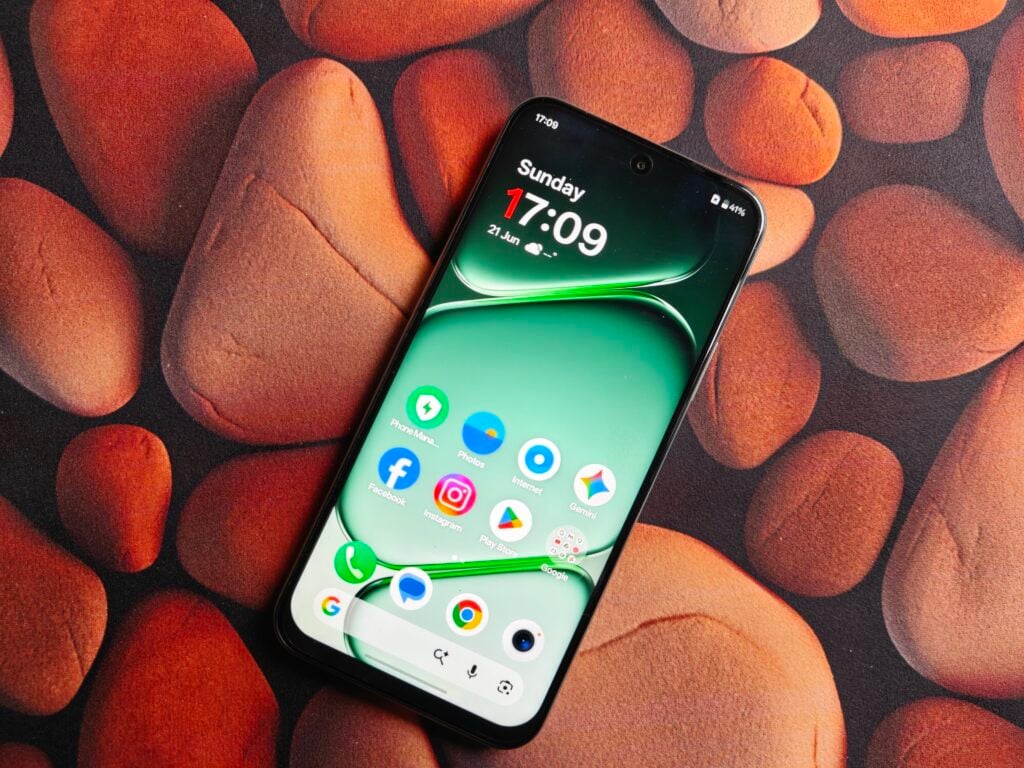
OnePlus’s new budget N series offering, the OnePlus N6, is expected to drop in India on June 30, and early unboxing leaks are already giving us a pretty good look at what’s coming.
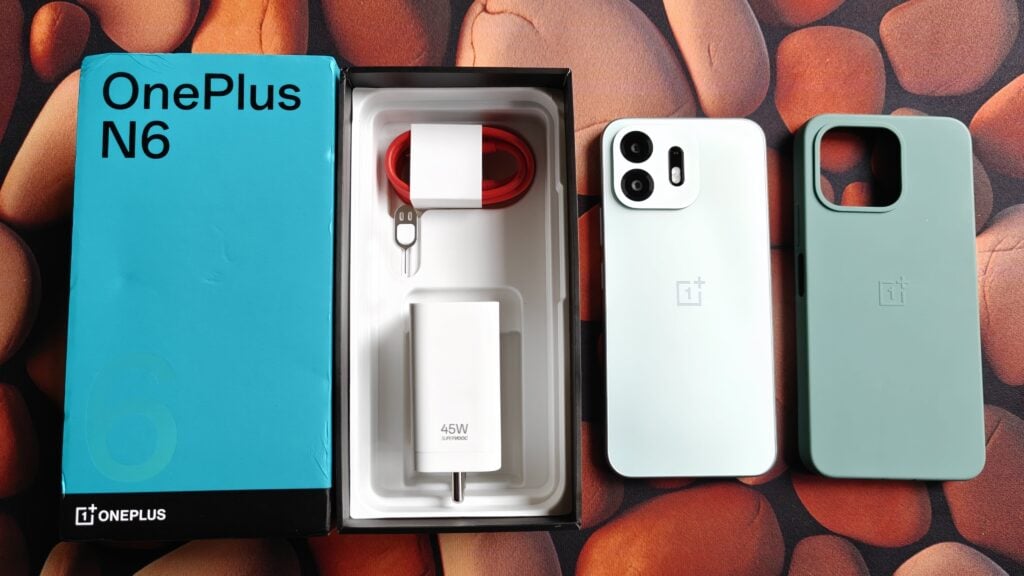
Leaker Abhishek Yadav posted some detailed photos on X showing the retail box and accessories for the Fresh Mint (that greenish) color. The phone ships with a pre-applied screen protector and a solid bundle: a 45W SuperVOOC charger, USB-C cable, clear silicone case, SIM ejector tool, and the usual paperwork. It’s nice to see the charger still included, something a lot of brands have started skipping to save costs.
OnePlus has already teased some of the key specs, and they look like a strong value pick. There’s a 50MP main rear camera that can shoot 60fps video, paired with an 8MP front camera in a centered punch-hole. The real standout is the massive 8,000mAh battery with 45W fast charging, that should easily deliver multi-day use with plenty of juice left. To keep things cool during longer sessions, it has a big 5,300 mm² vapor chamber cooling system.
Rumors suggest it’ll be powered by a MediaTek Dimensity 6000-series chip (possibly the 6300), 6GB of RAM, and run Android 16 with OxygenOS 16 out of the box. That combo should handle daily tasks, social media, and light gaming just fine. Pricing is expected to stay under ₹25,000 (around €232), which would make it one of the most compelling options in the segment, especially with that huge battery.
Overall, the N6 feels like OnePlus trying to win back the budget crowd with their “New, Neo, Never Off” approach, focusing on battery life, smooth performance, and young users who want solid value without compromises.
We’ll get the full picture, including all variants and exact pricing, on June 30. So far, the leaks and teasers are painting a pretty promising picture for a budget phone.
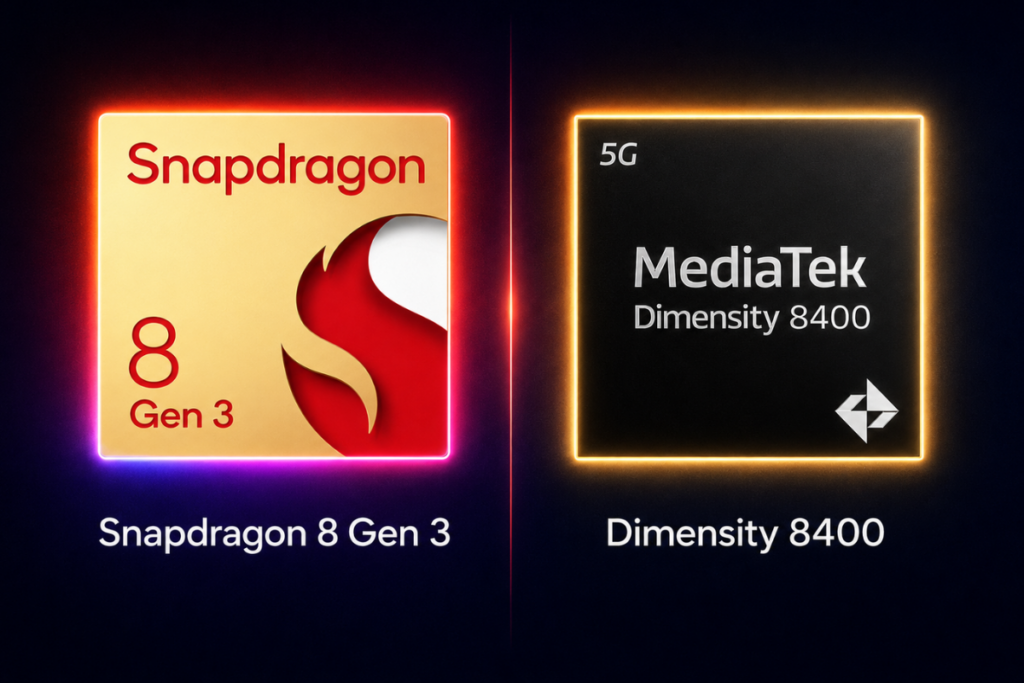
While the Snapdragon 8 Gen 3 is almost three years old, it has gained significant popularity in recent months, and all of us are aware of the reason: the rising cost of memory and RAM, and the difficulty of securing chip production. MediaTek isn’t immune to these challenges either, but its Dimensity 8400 has fast become a strong alternative for high-end devices.
Both Snapdragon 8 Gen 3 and Dimensity 8400 deliver excellent performance and power efficiency, but there are areas where one is ahead of the other. In this post, I’ll break down the benchmark scores and key differences to help you figure out the best choice for your needs.
[Note: The Dimensity 8400 Max and Dimensity 8400 Ultra simply represent brand-specific software optimizations. They share identical hardware as the Dimensity 8400.]
Here’s the spec sheet to begin with:
Snapdragon 8 Gen 3
Dimensity 8400
Announced
October 2023
December 2024
Process node
4nm (TSMC)
4nm (TSMC)
CPU
1 x 3.3 GHz (Cortex-X4) 3 x 3.15 GHz (Cortex-A720) 2 x 2.96 GHz (Cortex-A720) 2 x 2.27 GHz (Cortex-A520)
1 x 3.25 GHz (Cortex-A725) 3 x 3 GHz (Cortex-A725) 4 x 2.1 GHz (Cortex-A725)
GPU
Adreno 750 ray tracing support Snapdragon Elite Gaming features
Mali-G720 MC7 ray tracing support MediaTek HyperEngine Adaptive Gaming Technology 3.0
NPU
Qualcomm Hexagon NPU
MediaTek NPU 880
Memory
LPDDR5x, up to 4.8 GHz
LPDDR5x, up to 4.2 GHz
Storage
UFS 4.0
UFS 4 + MCQ
Camera
Qualcomm Spectra triple AI ISP (18-bit) up to 200MP single camera up to 108MP single camera with zero shutter lag up to 36MP triple cameras with zero shutter lag real-time semantic segmentation (up to 12 layers) up to 8K/30fps or 4K/120fps video recording
MediaTek Imagiq 1080 ISP up to 320MP single camera up to 32MP triple cameras at 30fps semantic segmentation support up to 4K/60fps video recording
Connectivity
Snapdragon X75 5G modem download speed: up to 10 Gbps upload speed: up to 3.5 Gbps Wi-Fi 7 (peak speed: 5.8 Gbps) Bluetooth 5.4
MediaTek 5G modem download speed: up to 5.17 Gbps Wi-Fi 6E Bluetooth 5.4
Snapdragon 8 Gen 3 vs Dimensity 8400: Benchmark numbers
Note: The benchmark tests were performed on the iQOO 12 (powered by the Snapdragon 8 Gen 3) and the iQOO Z10 Turbo (powered by the Dimensity 8400).
Geekbench score
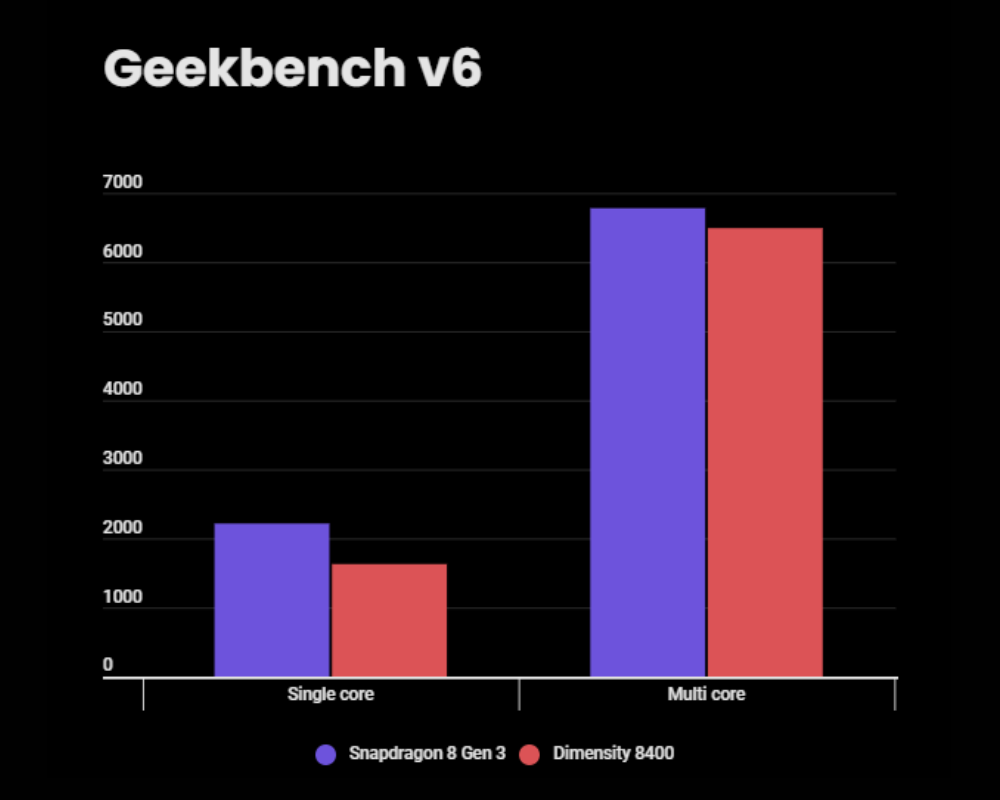
On Geekbench 6, the Snapdragon 8 Gen 3 posts a strong lead in the single-core performance, scoring 36% higher than the Dimensity 8400. That’s because of the powerful Cortex-X4 prime core.
Multi-core scores don’t have a significant difference, but the Snapdragon chip is still on the higher side.
Snapdragon 8 Gen 3
Dimensity 8400
Single core
2216
1629
Multi core
6781
6492
AnTuTu score
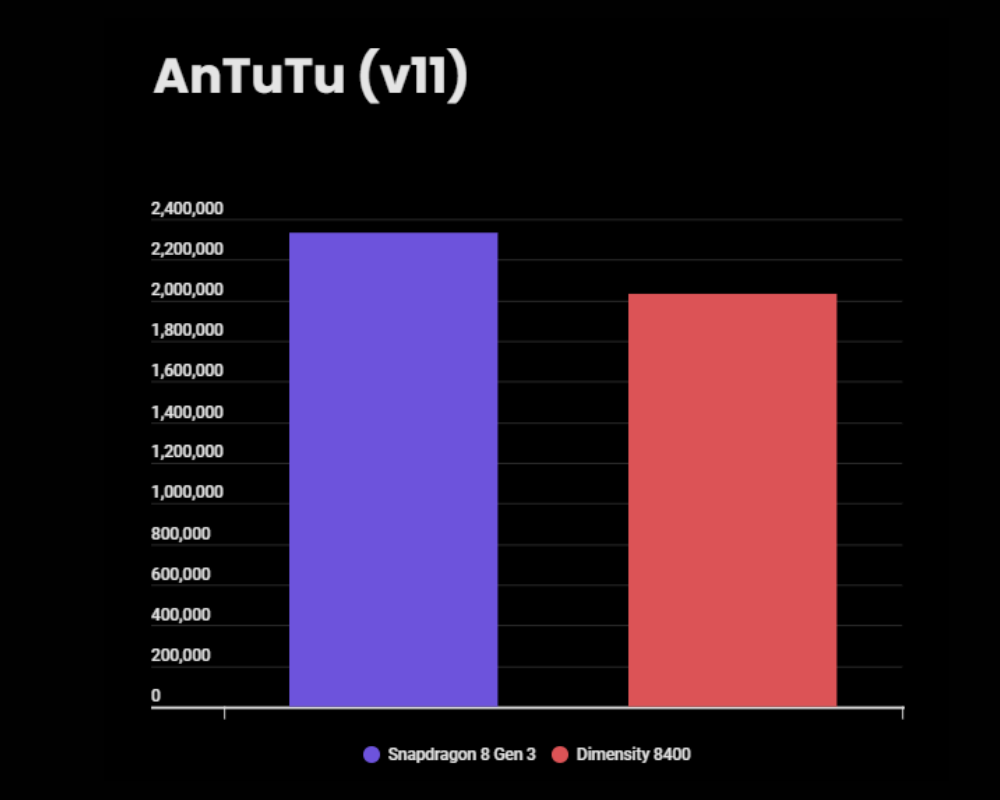
On AnTuTu v11, the iQOO 12, powered by the Snapdragon 8 Gen 3 SoC, achieves a total score of over 2.3 million, while the Dimensity 8400-powered iQOO Z10 Turbo posts a total score of just above 2 million. That’s a solid 14% boost for the Snapdragon chip.
But what matters more is the breakdown of the AnTuTu score, which provides a clearer picture.
Snapdragon 8 Gen 3
Dimensity 8400
AnTuTu score
2,332,791
2,031,886
CPU
643,123
624,883
GPU
818,651
645,958
Memory
348,240
295,315
UX
522,777
465,730
The Snapdragon 8 Gen 3 leads the CPU chart, but the difference is thin. The GPU score, however, makes a significant impact here. The Snapdragon chip achieves a massive 26% lead over the Dimensity 8400.
Memory and UX performance also favor the Snapdragon chip.
From benchmark results, it’s clear that the Snapdragon 8 Gen 3 has a more powerful CPU and GPU than the Dimensity 8400. However, benchmarks leave some important aspects untouched, such as connectivity and the camera. We’ve included the important differences in the following section.
Snapdragon 8 Gen 3 vs Dimensity 8400: Key differences that matter
Performance
Both the Snapdragon 8 Gen 3 and the Dimensity 8400 use ARM-designed CPUs but have completely different core configurations. The Snapdragon chip features a ‘1+3+2+2’ core structure, while the Dimensity chip uses a ‘1+3+4’ structure.
Snapdragon 8 Gen 3
Dimensity 8400
Prime core
1 x Cortex-X4 at 3.3 GHz
1 x Cortex-A725 at 3.25 GHz
Performance core
3 x Cortex-A720 at 3.15 GHz 2 x Cortex-A720 at 2.96 GHz
3 x Cortex-A725 at 3 GHz
Efficiency core
2 x Cortex-A520 at 2.27 GHz
4 x Cortex-A725 at 2.1 GHz
The Dimensity 8400 has an all-big-core CPU design, featuring superior mid-level and low-level cores. However, the powerful Cortex-X4 core and higher clock speeds on the Snapdragon chip have a greater impact.
For graphics-heavy tasks, the Snapdragon 8 Gen 3 has an Adreno 750 GPU, featuring more shading units and higher FLOPS than the Mali-G720 GPU on the Dimensity 8400. When it comes to gaming, the Snapdragon chip delivers higher, more consistent performance without noticeable lag.
Both processors also have integrated NPUs for on-device AI intelligence. The Hexagon NPU on the Snapdragon 8 Gen 3 supports generative AI models with up to 10 billion parameters. It also powers the image signal processor (ISP) to improve semantic segmentation, night shots, and photo expansion.
The Dimensity 8400 features a MediaTek NPU 880, optimized to support both Generative AI and Agentic AI, allowing the device to run complex, multi-step on-device AI agents. The AI engine is tightly coupled with the ISP, enabling real-time AI image and video enhancements.
Camera
The Snapdragon 8 Gen 3 utilizes the Spectra Cognitive ISP with three 18-bit pipelines to handle simultaneous data streams. It features real-time semantic segmentation up to 12 layers and integrates advanced AI features, including Video Object Eraser, Photo Expansion, Night Vision Video, and Generative AI Editing.
The Dimensity 8400, on the other hand, features a MediaTek Imagiq 1080 ISP, optimized to deliver high dynamic range, reduce noise in low-light environments, and ensure zero shutter lag across multi-camera configurations.
The Dimensity 8400 supports up to 4K video recording, while the Snapdragon 8 Gen 3 goes further up to 8K. The latter also supports Dolby HDR photo technology and Vlogger’s View.
Connectivity
The Snapdragon 8 Gen 3 utilizes an advanced Snapdragon X75 5G modem, offering up to 10 Gbps download speed and up to 3.5 Gbps of upload speed. In contrast, the Dimensity 8400 offers a lower peak speed of 5.17 Gbps.
While both chips support sub-6GHz connectivity, the Snapdragon chip also supports mmWave, which operates on ultra-high frequency bands. The Snapdragon chip also benefits from the newer Wi-Fi 7 standard, while the Dimensity 8400 is limited to Wi-Fi 6E.
Snapdragon 8 Gen 3 vs Dimensity 8400: Which is better?
The Snapdragon 8 Gen 3 is the clear winner here. It holds a distinct edge in raw performance, thanks to its higher clock speeds, powerful prime core, and superior Adreno 750 GPU. The chipset delivers more consistent, lag-free gaming and smoother graphics-heavy performance compared to the Dimensity 8400. It also offers modern connectivity features and higher peak speeds.
However, if you aren’t a gaming-heavy user, the Dimensity 8400 could be a better choice. It delivers smooth everyday performance, excellent power efficiency, and lag-free gaming on moderate settings. The Dimensity chip also stands out for agentic AI support.
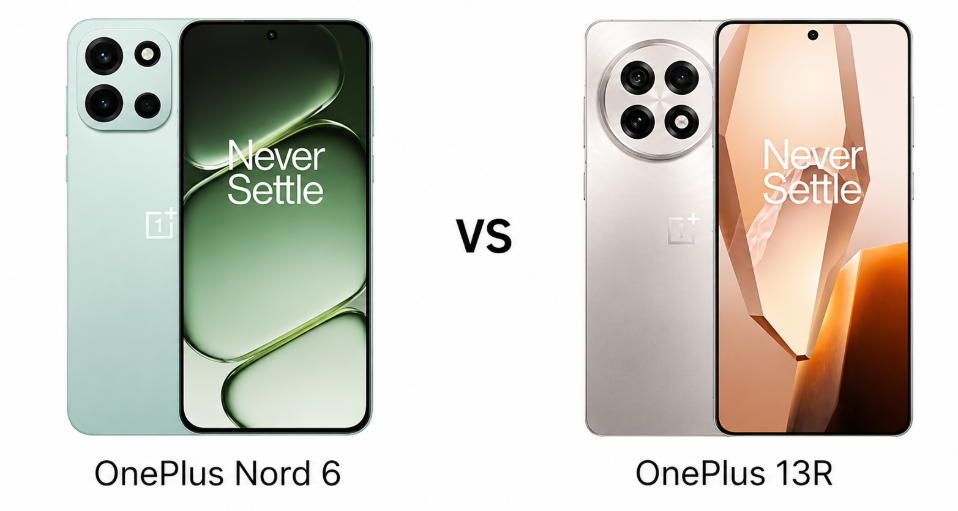
OnePlus has two compelling phones in the upper mid-range segment, but they target different buyers. The OnePlus Nord 6 is the newer 2026 model that focuses on modern hardware, exceptional battery life, and improved durability. Meanwhile, the OnePlus 13R launched in early 2025 as a premium performance-focused device with flagship-grade cameras and build quality.
Although both belong to the same brand, they prioritize different aspects of the smartphone experience. Here’s a detailed comparison to help determine which OnePlus device deserves your money.
The OnePlus Nord 6 adopts a practical approach with a plastic frame and back protected by OnePlus Crystal Guard on the front. While it doesn’t feel as premium as glass and metal, it compensates with IP68/IP69 protection and MIL-STD-810H certification, making it significantly more durable against water and dust than the OnePlus 13R. The 13R, however, offers a more premium in-hand feel thanks to its aluminum frame and glass back. It carries an IP65 rating, which is adequate for everyday use but falls behind the Nord 6’s much stronger protection. The newer Nord 6 clearly prioritizes longevity and durability over premium materials.
Display Quality
Both phones feature sharp 6.78-inch AMOLED displays with HDR support and excellent color reproduction. The Nord 6 stands out with a 165Hz refresh rate, 3840Hz PWM dimming, and up to 3600 nits peak brightness, delivering smoother animations and improved eye comfort. The OnePlus 13R counters with an LTPO AMOLED panel supporting Dolby Vision, HDR Vivid, and an even brighter 4500-nit peak. LTPO technology also improves power efficiency by dynamically adjusting the refresh rate. The Nord 6 feels smoother during gaming, while the 13R offers a richer multimedia experience.
Verdict
The OnePlus Nord 6 wins for durability and high-refresh gaming, whereas the OnePlus 13R delivers a more premium design and a better display for movies and everyday viewing.
2. Specifications Including Battery
Performance
The OnePlus Nord 6 introduces Qualcomm’s Snapdragon 8s Gen 4 paired with faster UFS 4.1 storage and Android 16 with OxygenOS 16 out of the box. Despite being positioned below the flagship series, it delivers excellent efficiency and modern AI capabilities. The OnePlus 13R uses the flagship Snapdragon 8 Gen 3, which still offers stronger GPU performance and slightly better sustained workloads, especially for demanding gaming and video editing. However, being a 2025 device means it starts with Android 15 and has one fewer year of software freshness compared to the Nord 6. The newer software gives the Nord 6 a longer useful lifespan.
Battery and Charging
Battery life is where the Nord 6 creates a huge gap. Its global model packs a massive 7500mAh battery, while the India variant increases that to an enormous 9000mAh. Combined with efficient hardware, it is built for multi-day usage. The 13R’s 6000mAh battery remains excellent, but cannot compete with such capacity. Both support 80W wired charging, though the Nord 6 also adds bypass charging and reverse wired charging for greater versatility.
Verdict
The OnePlus 13R remains the stronger raw performer, but the OnePlus Nord 6 feels like the more future-ready package thanks to newer software, dramatically larger batteries, faster storage, and improved charging features.
3. Camera
Main and Secondary Lenses
Camera hardware clearly favors the OnePlus 13R. It features a versatile triple-camera setup with a 50MP primary sensor, a dedicated 50MP telephoto lens offering 2x optical zoom, and an 8MP ultrawide camera. The telephoto lens makes portraits and zoom photography noticeably better. The Nord 6 uses a dual-camera system with a 50MP main camera and an 8MP ultrawide sensor. Optical image stabilization and 4K recording are available on both, but the lack of a telephoto lens limits the Nord 6’s photography flexibility. For users who enjoy capturing different perspectives, the 13R provides a more complete camera experience.
Selfie Camera
The Nord 6 surprisingly takes the lead for selfies with its 32MP front camera featuring autofocus and 4K video recording. The OnePlus 13R uses a simpler 16MP selfie camera limited to 1080p video. Content creators and frequent video callers are likely to appreciate the sharper selfies and higher-quality video offered by the newer Nord 6.
Verdict
The OnePlus 13R is the better overall camera phone because of its dedicated telephoto lens, but the Nord 6 delivers stronger selfies and better front-facing video quality.
4. Pricing
The OnePlus Nord 6 is priced around $500 (₹43,000), while the OnePlus 13R is priced around $450 (₹40,000). Although the 13R launched in early 2025, its lower price makes it an incredibly attractive option. Buyers get a flagship Snapdragon 8 Gen 3 processor, a premium aluminum-and-glass build, an LTPO AMOLED display, and a versatile triple-camera system with a telephoto lens for less money.
The Nord 6 commands a premium because it introduces newer hardware, Android 16 out of the box, significantly larger battery options, stronger IP68/IP69 protection, and faster UFS 4.1 storage, making it better equipped for long-term ownership.
Verdict
OnePlus 13R offers better value for money at its current pricing. However, the OnePlus Nord 6 remains worth considering for users who prioritize battery life, durability, and a newer software platform over premium materials and camera versatility.
Disclaimer: Prices are approximate and may vary based on country, region, launch timing, and applicable taxes. Always check whether the listed price is for a China unit or a global/international variant when purchasing.
5. Conclusion
The biggest difference between these phones lies in their priorities. The OnePlus Nord 6 is the newer-generation device, offering Android 16, Snapdragon 8s Gen 4, massive 7,500mAh or 9,000mAh battery options, IP68/IP69 protection, Bluetooth 6.0, and faster UFS 4.1 storage, making it a stronger choice for longevity. The OnePlus 13R, despite launching in early 2025, continues to impress with its flagship Snapdragon 8 Gen 3 chipset, premium aluminum-and-glass construction, LTPO AMOLED display with Dolby Vision, and a dedicated telephoto camera.
Verdict
The OnePlus Nord 6 is the better choice for users who want the latest software, exceptional battery life, and stronger durability for years of use. The OnePlus 13R, however, becomes the better overall buy for most people thanks to its lower price, premium design, flagship performance, and more capable rear camera system.
Disclaimer: This comparison is based on the specifications provided and is intended for general informational purposes. Actual performance, camera results, battery life, and overall experience may vary depending on real-world usage, software updates, and individual preferences.
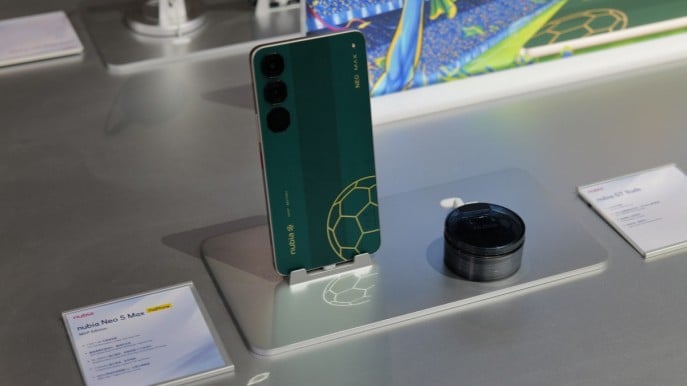
At MWC Shanghai 2026 (which kicked off on June 24), Nubia showed off the Neo 5 Max, a massive phablet-style phone built for gamers and anyone who loves immersive media on a huge screen.
The star of the show is that giant 7.5-inch 1.5K LCD display, one of the biggest you’ll find on a modern smartphone. It’s perfect for gaming, watching videos, or just multitasking. Nubia even designed it to work well as a handheld gaming device, complete with a portable grip option. On the outside, it rocks a dark green back with a soccer ball pattern that gives it a bold, sporty vibe.
Powering this large slab is MediaTek’s Dimensity 7100, a mid-range chipset used in phones like the Tecno Pova 8 and Pova Curve 2. There’s a 7000mAh battery on board, and it ships with Android 16. Gaming-focused extras like built-in capacitive touch shoulder triggers are included, staying true to the brand’s gamer-friendly DNA.
Nubia used the event to showcase the Neo 5 Max alongside some other cool stuff, including their Beanbag phone concept, Red Magic gaming phones, and a gaming tablet. The whole Neo 5 lineup (including the Neo 5 GT, which has an active cooling fan) is clearly aimed at younger gamers and Gen Z users who want fun, gaming-focused devices with physical gaming triggers and gaming-focused software features.
Interestingly, this big slab isn’t coming to the Chinese market: it’s targeted at overseas buyers looking for an affordable large-screen option. Pricing hasn’t been fully revealed yet, but previous Neo 5 models have been pretty wallet-friendly in global markets. For example, the higher-end Neo 5 GT (powered by the Dimensity 7400) launched earlier this year with a starting price around €399. Nubia is definitely trying to carve out its own fun, no-nonsense corner in the smartphone world.
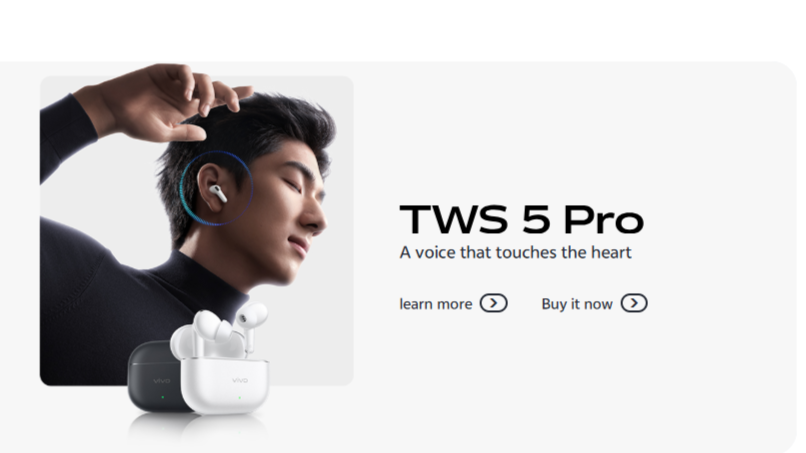
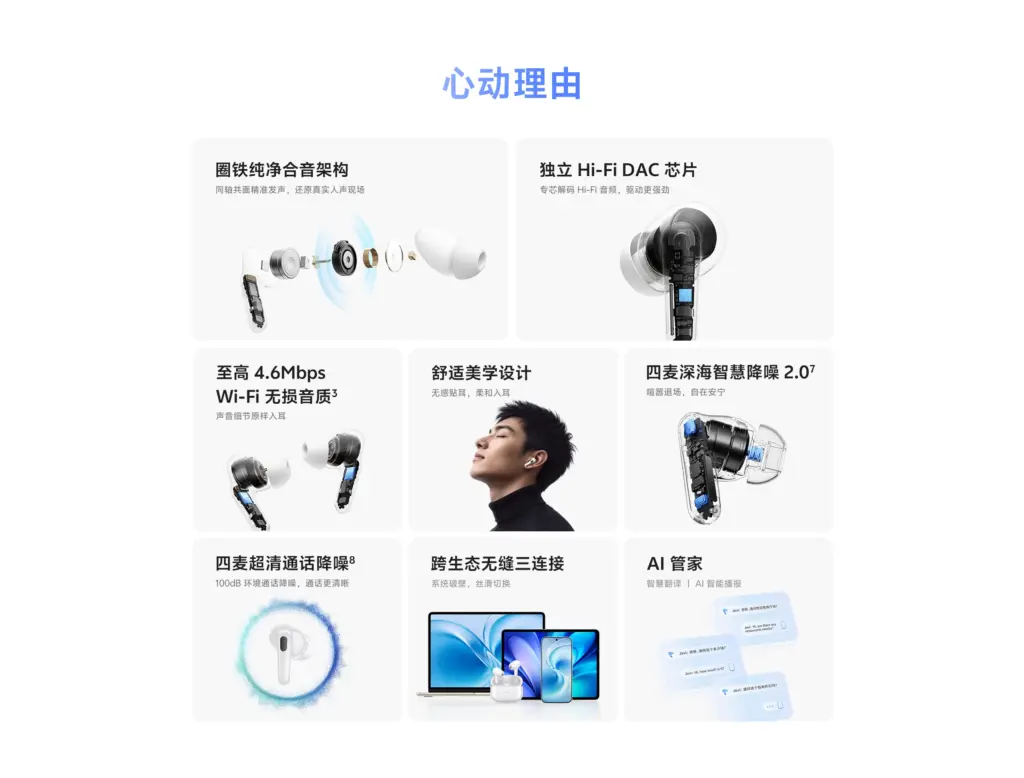
Launched today alongside some other Vivo devices, the TWS 5 Pro brings a serious focus on Hi-Fi audio in a lightweight, comfortable package. It’s got an independent Hi-Fi DAC chip, a hybrid driver setup with an 11mm dynamic driver, and support for up to 4.6Mbps Wi-Fi lossless audio transmission. That means richer details, better clarity, and less compression.
On top of that, you get spatial audio and adaptive sound that adjusts based on what you’re listening to and where you are. For calls, there are four microphones with Vivo’s “Deep Sea Intelligent Noise Cancellation 2.0”, promising up to 60dB noise reduction and clear voice pickup even in noisy environments.
Battery life looks really solid for the category. Each earbud weighs just 5.5g for comfortable all-day wear. With the charging case, you can get up to 50 hours of total playback time when using AAC codec with noise cancellation turned off. On a single charge, the earbuds deliver around 11 hours of music playback (AAC, ANC off), dropping to about 5 hours when using the higher-quality Wi-Fi lossless mode with ANC disabled.
A quick 5-minute charge in the case gives you roughly 2 extra hours of listening time. Of course, real-world results will vary depending on volume, whether you’re using noise cancellation, and which audio codec you choose.
Other handy features include Bluetooth 5.4 with multi-device pairing, a 42ms low-latency gaming mode, customizable EQ, DeepX 5.0 sound effects, and IP54 dust and water resistance.
They come in two clean colors: Original White and Silent Black. Pricing starts at 999 yuan (~ €129), with an early launch discount bringing it down to 949 yuan, pretty competitive for a flagship-style pair with these internals.
The dedicated Hi-Fi DAC is a nice upgrade for anyone chasing purer, higher-res sound, while the 60dB ANC keep it practical for commuting, calls, and travel.
Overall, if you’re after premium wireless earbuds that balance audiophile features with real-world usability, the TWS 5 Pro looks like a strong contender.
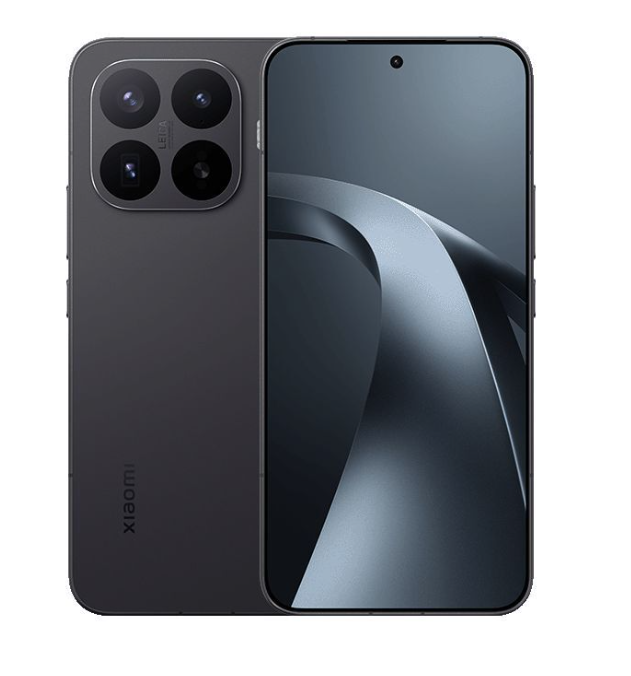
Xiaomi 17T Pro is now available at Giztop with a $100 discount, bringing the price down to $599 from its original $699. Giztop is offering the flagship smartphone with global shipping, making it easier for buyers worldwide to get their hands on Xiaomi’s latest premium device.
Packed with a powerful MediaTek Dimensity 9500 processor, Leica cameras, a massive 7,000mAh battery, and a high-refresh-rate AMOLED display, the Xiaomi 17T Pro delivers flagship features at a more affordable price.
Display and Performance
The Xiaomi 17T Pro features a large 6.83-inch AMOLED display with a 144Hz refresh rate for smooth scrolling and gaming. It supports Dolby Vision, HDR10+, HDR Vivid, 12-bit colors, and reaches up to 3,500 nits of peak brightness for excellent outdoor visibility. Powering the device is the MediaTek Dimensity 9500 3nm processor with clock speeds up to 4.21GHz, paired with 12GB LPDDR5X RAM and storage options of 256GB, 512GB, or 1TB.
Leica Cameras and Battery
Photography is one of the biggest highlights of the Xiaomi 17T Pro. It comes with a 50MP Leica main camera featuring OIS, a 50MP Leica 115mm floating telephoto camera with OIS, and a 12MP ultra-wide camera. On the front, there is a 32MP in-display selfie camera for clear selfies and video calls.
The phone packs a large 7,000mAh battery that supports 100W HyperCharge, 50W wireless charging, and 22.5W reverse wireless charging, allowing users to power other compatible devices.
Software and Connectivity
Running Xiaomi HyperOS 3, the Xiaomi 17T Pro offers smooth full-screen gesture navigation and a modern user experience. Other features include an in-display fingerprint scanner, 5G support, and Wi-Fi 7 for faster wireless connectivity.
With its flagship specifications and the current $100 discount, the Xiaomi 17T Pro offers excellent value for anyone looking to upgrade to a premium smartphone.
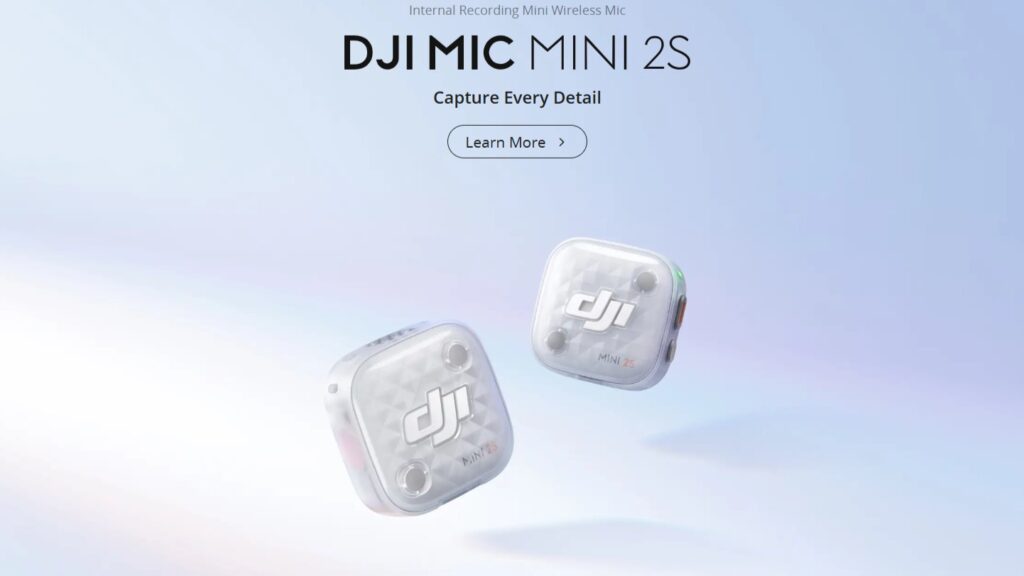
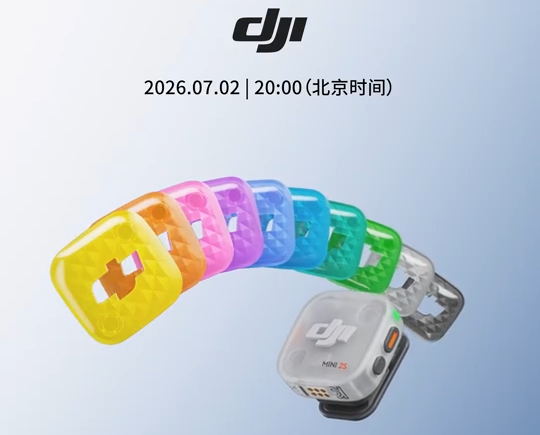
If you’ve been using (or eyeing) DJI’s Mic Mini 2, the Mic Mini 2S feels like the upgrade a lot of creators have been asking for. Set to launch officially on July 2 at 8 PM, the Mini 2S keeps everything people loved about the previous model, including its super-small size, stylish swappable magnetic covers in 10 different colors, solid transmission range, and easy-to-use voice presets. It now adds the one feature that was missing: onboard recording.
The new mic can record internally in high-resolution 24-bit/32-bit floating point, which gives you way more headroom and helps avoid nasty clipping when things get loud or unpredictable. With 14.5GB of built-in storage, you can safely capture hours of audio even if the wireless connection drops or your camera fails to record. It supports mono, stereo, and even quad-channel recording, so you can run up to four transmitters with one receiver.
The rest of the formula stays strong: up to 400 meters of range, two levels of AI noise reduction, three quick voice tone presets (Normal, Full/Rich, and Bright), and that ridiculously light 12g transmitter that basically disappears once it’s clipped on. The colorful magnetic covers are back too, so you can still match the mic to your outfit or production vibe.
DJI is launching it in four different kits to cover pretty much every use case, from a full camera and phone adapter bundle with a charging case to single-transmitter options and mobile-focused versions. Exact pricing hasn’t dropped yet, but early listings suggest it’ll sit in that premium-but-still-reasonable zone, probably a step above the Mic Mini 2.
This feels like DJI listening to feedback. The original Mini 2 looked great and performed well for its size, but a lot of solo creators and vloggers really wanted that safety net of internal recording. By pulling pro features from their bigger Mic 2 and Mic 3 systems into this tiny package, DJI has made something that should appeal strongly to mobile filmmakers, hybrid shooters, and anyone who needs reliable audio without the bulk.
We’ll know more on pricing, exact compatibility, and availability after the July 2 launch.
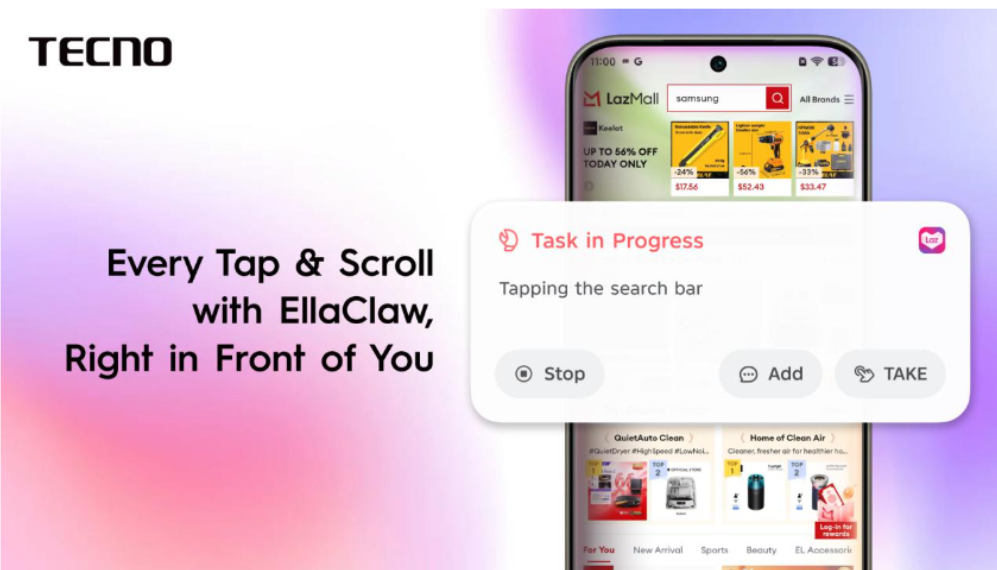
TECNO has unveiled the next stage of development for EllaClaw, its beta-stage mobile AI agent designed to make smartphones more intelligent and proactive. Announced on June 24, 2026, EllaClaw goes beyond traditional voice assistants by completing everyday tasks across apps, optimizing device performance, and providing personalized assistance. The company says its goal is to make advanced AI practical, accessible, and useful for everyday users, especially in emerging markets.
EllaClaw Brings Practical Agentic AI to Smartphones
Unlike conventional AI assistants that mainly respond to commands, EllaClaw is a cloud-based AI agent that can understand requests, plan actions, and complete tasks on a user’s behalf. It works proactively in the background to simplify complex workflows while keeping users informed about every action it performs.
TECNO says EllaClaw is designed to automate real-world tasks instead of simply answering questions, making smartphones more capable of handling everyday activities with minimal user effort.
Cross-App Intelligence Simplifies Everyday Tasks
One of EllaClaw’s biggest upgrades is its cross-app intelligence. Instead of relying on direct integrations, the AI understands graphical user interfaces (GUI), allowing it to navigate supported third-party apps much like a human user.
With user permission, EllaClaw can interact with shopping, transportation, food delivery, and smart home apps. It performs actions visibly on the screen so users can follow every step, providing greater transparency and confidence in AI-driven automation.
AI Optimizes Phone Performance with 40+ Smart Skills
EllaClaw also works as an intelligent device management assistant by monitoring and optimizing battery life, mobile data, storage, RAM, and CPU performance.
TECNO has introduced more than 40 Smart Skills to improve everyday smartphone usage. Smart CleanUp Boost frees RAM, optimizes CPU resources, and reduces system lag for smoother performance. Smart Power Drain Check detects apps that consume excessive battery and optimizes background activity to extend battery life.
The AI also includes Instant Cool-down Relief, which lowers device temperature during heavy workloads by managing background processes, while Smart Data Guardian tracks mobile data usage, learns personal usage habits, and helps users avoid excessive data consumption. TECNO says this feature is particularly useful in regions where mobile data plans remain limited.
Personalized Assistance for Daily Life
EllaClaw becomes more personalized through persistent memory, allowing it to learn user habits and preferences over time.
Its Morning Briefing combines calendar events, travel itineraries, weather updates, and curated news into a single overview. The Trip Prep Assistant helps organize travel schedules, book rides, set departure alarms, and prepare actionable travel plans before users leave.
TECNO has also added relationship-focused features that remind users to contact family members or partners, notify them about weather changes that could affect plans, and provide contextual reminders for daily activities.
Shopping, Ride Booking, and Smart Home Control
EllaClaw extends its capabilities through several cross-app AI experiences. Users can book transportation using natural language with One-Sentence Ride Hailing, while Shopping Buddy searches for products and compares options across shopping platforms such as Lazada.
The AI can also monitor connected smart home devices, provide status updates, and support smart home routines, allowing users to manage multiple connected devices through a single intelligent assistant.
Privacy and User Control Come First
TECNO says EllaClaw follows a confirmation-first privacy model. The AI asks for user approval before making important system changes or accessing supported applications, ensuring users remain in full control of their devices.
The assistant also performs actions visibly instead of silently in the background, allowing users to see exactly what it is doing. Supported apps require secure opt-in permissions before EllaClaw can access them.
Availability
TECNO says EllaClaw is currently undergoing internal testing and is available only as a closed beta. The company describes it as an exploratory AI concept and plans to announce additional features and broader availability in future updates.
With cross-app automation, system-level device optimization, more than 40 Smart Skills, and personalized assistance, TECNO is positioning EllaClaw as a practical mobile AI agent rather than a traditional chatbot. By combining proactive task automation with transparent, confirmation-first privacy controls, the company aims to make advanced AI more useful for everyday smartphone users while ensuring they remain in complete control of their devices.
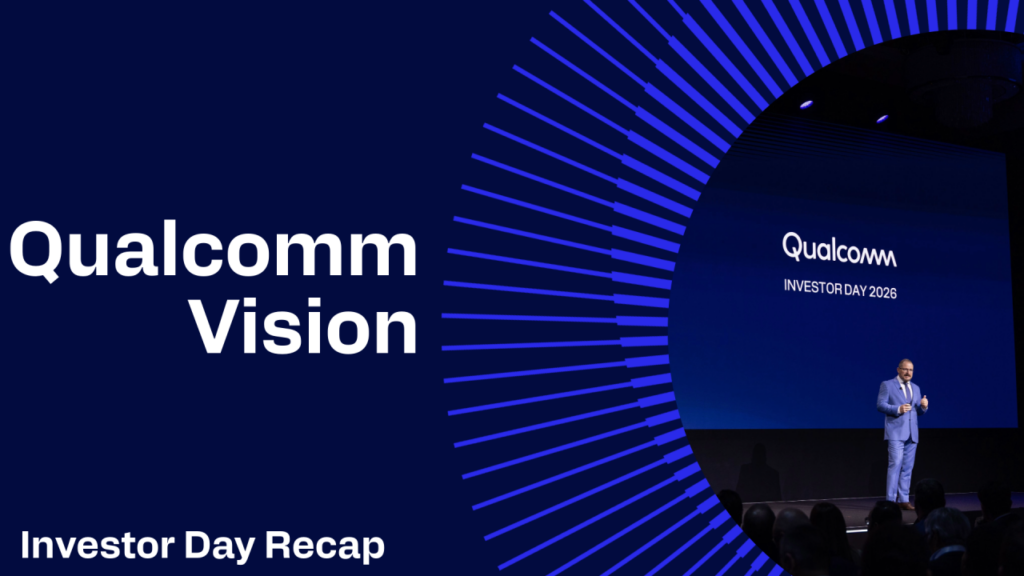
Qualcomm is making a big push into the AI infrastructure space in China, positioning itself as a serious alternative for data center chips in a market heavily restricted by US export rules. The company is clearly looking to leverage its strong existing relationships there to challenge Nvidia’s dominance.
In an interview with Nikkei Asia, Qualcomm CEO Cristiano Amon confirmed the company will bring its full range of data center products to Chinese customers. This includes the entire Dragonfly platform lineup: AI accelerators, data center CPUs, custom silicon, and connectivity solutions. Most notably, they’re planning to offer customized AI accelerators specifically tailored for China that fully comply with US export regulations.
Amon pointed out Qualcomm’s deep roots in the country, where smartphones have long made up a big chunk of its revenue. He sees the company’s established partnerships with Chinese phone makers and automotive firms as a major advantage that can now extend into data centers. “We have versions of all of our products that comply with those guidelines,” he said, adding that they’re already in active discussions with customers and are feeling optimistic about the response.
This move comes right after Qualcomm officially launched its data center chip lineup to take on AI workloads. One standout is the AI250 accelerator, which uses an innovative near-memory architecture (HBC) that could help get around some of the HBM memory shortages hitting the industry. The focus seems to be on serving inference tasks effectively while staying within regulatory limits.
It’s a smart play in a tricky geopolitical landscape. With AI demand exploding, Chinese companies are hungry for compliant, high-performance options. For Qualcomm, success here could help diversify beyond its traditional mobile business and give it a stronger foothold in the broader AI ecosystem.
We’ll need to watch for more details on timelines and actual partnerships, but this China-focused data center strategy highlights how companies are navigating trade tensions while trying to capitalize on the AI boom. It could open up some significant new growth opportunities if it lands well.
CHUWI has officially launched pre-orders for its new UniBook AI Laptop, introducing an affordable Windows notebook built around Intel’s latest Wildcat Lake platform. The laptop combines a lightweight design, AI-focused hardware, a color-accurate display, and a generous selection of ports, making it suitable for students, professionals, freelancers, and everyday users.
With an early bird price of $449, CHUWI is positioning the UniBook AI as an accessible option for users looking to experience on-device AI features without spending flagship laptop prices.
Early Bird Pricing and Launch Campaign
The CHUWI UniBook AI carries a regular retail price of $499, but customers who pre-order the laptop can purchase it for $449, saving $50 during the launch period. The offer is part of CHUWI’s “AI for Everyone, The Tournament for All” World Cup promotional campaign.
The company is also extending discounts of up to $50 on several other products, including the CoreBook Air 226V, AuBox X Copilot+ PCs, Hi10 Max 2-in-1 Windows Tablet, and CoreBook Air 1KG, giving buyers additional options if they are looking for other Windows devices.
Intel Core 3 Wildcat Lake Processor Takes Center Stage
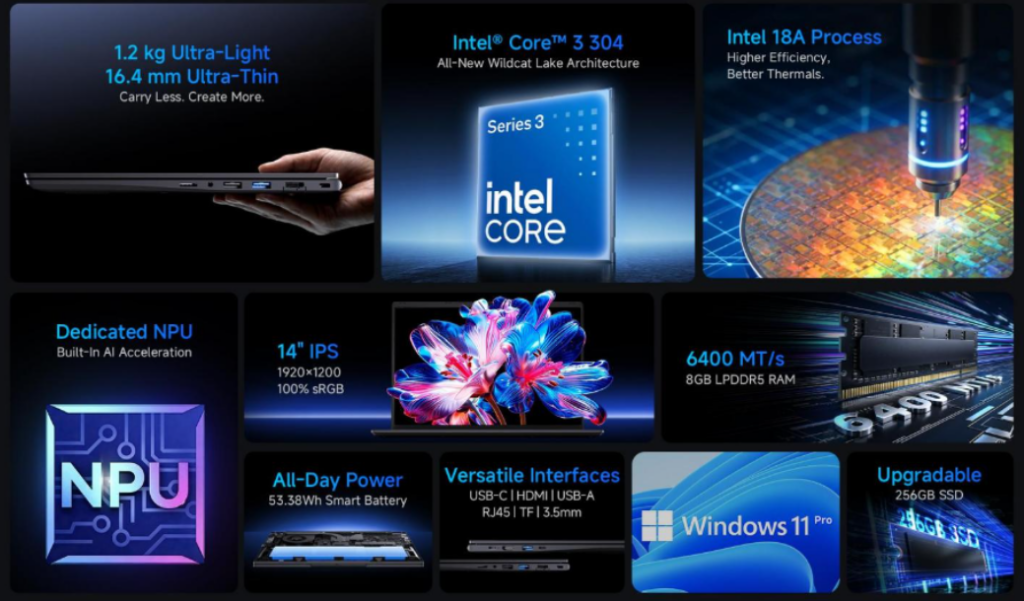
Powering the UniBook AI is Intel’s latest Core 3 Processor 304, based on the company’s advanced 18A process technology. The new processor is designed to deliver efficient everyday computing while introducing dedicated hardware for AI workloads.
The laptop uses Intel Graphics for visual performance and is aimed at handling common productivity tasks such as web browsing, office work, online learning, media consumption, and light creative applications. The new architecture also focuses on better power efficiency, helping extend battery life without sacrificing performance for everyday users.
Dedicated AI Hardware for Faster Local Processing
One of the biggest highlights of the UniBook AI is its built-in AI acceleration. The integrated graphics processor delivers up to 9 TOPS (Int8) of AI performance, while the dedicated Neural Processing Unit (NPU) provides up to 15 TOPS (Int8) for AI-specific workloads.
Instead of sending every AI request to cloud servers, the laptop can process many tasks locally. This improves response times while keeping more personal data on the device. CHUWI says the system supports AI writing assistance, real-time transcription, AI image generation, and AI-enhanced multitasking, allowing users to benefit from modern AI features during everyday work.
14-Inch WUXGA Display Built for Productivity
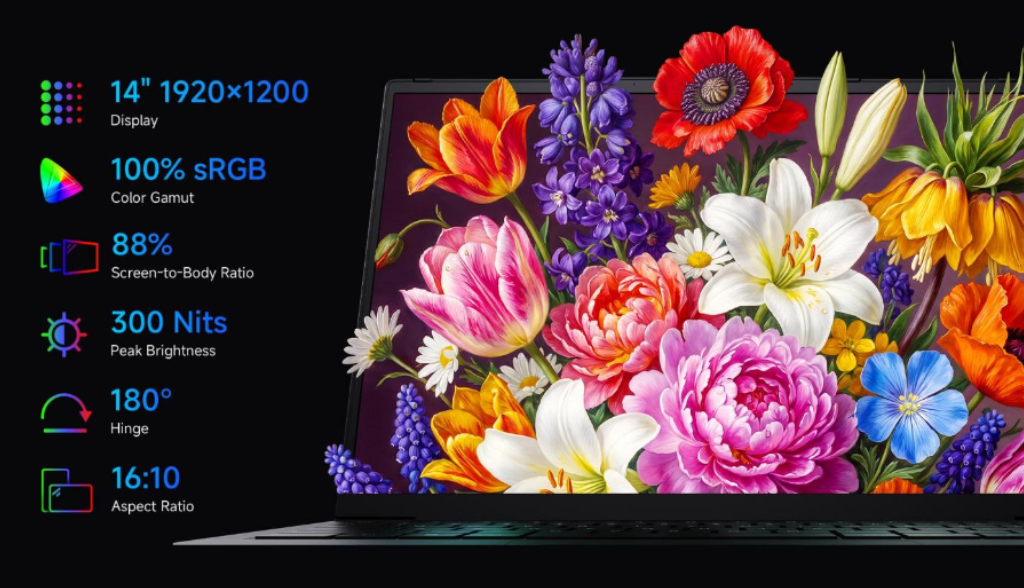
The UniBook AI features a 14-inch IPS display with a WUXGA (1920 × 1200) resolution. Unlike standard Full HD displays, the taller 16:10 aspect ratio provides additional vertical workspace, allowing users to view more content while editing documents, browsing websites, or working with spreadsheets.
The display also covers 100% of the sRGB color gamut, making it suitable for users who require accurate colors for photo editing, graphic design, or content creation. With 300 nits of brightness and an 88% screen-to-body ratio, the display is designed to deliver a comfortable viewing experience for both work and entertainment.
Lightweight Design Made for Daily Travel
CHUWI has designed the UniBook AI with portability in mind. The laptop features a lightweight metal chassis that weighs approximately 1.2kg, while its slim 16.4mm profile makes it easy to slip into a backpack or laptop bag.
The laptop measures 314.5 × 221 × 16.4mm, making it compact enough for classrooms, offices, cafés, and business travel. A 180-degree lay-flat hinge also allows the display to open completely flat, making it easier to share content with colleagues or classmates during meetings and presentations.
Comfortable Keyboard and Privacy Features
The laptop includes a backlit keyboard, allowing users to work more comfortably in dimly lit environments. A precision touchpad provides smoother navigation and supports Windows gesture controls for improved productivity.
CHUWI has also included an HD webcam for video calls along with a physical privacy shutter. This simple feature allows users to physically block the camera whenever it is not being used, offering an extra layer of privacy during remote work and online meetings.
Memory, Storage, and Battery Life
The UniBook AI comes equipped with 8GB of LPDDR5 memory running at 6400 MT/s, providing fast memory speeds for everyday multitasking. Storage is handled by a 256GB PCIe 3.0 SSD, and users can expand the storage if they need additional space for files and applications.
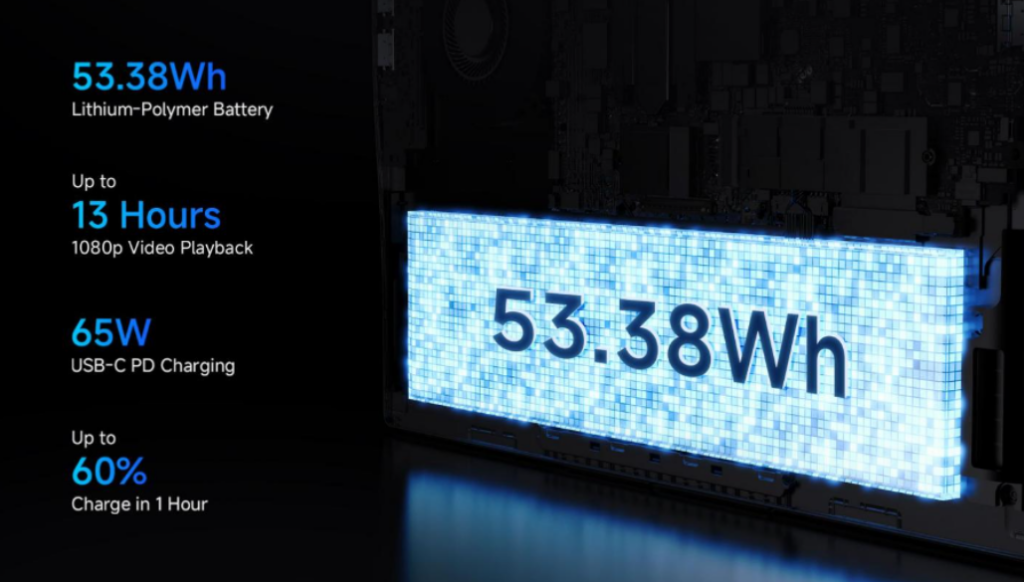
Power is supplied by a 53.38Wh battery, which CHUWI claims can deliver up to 13 hours of local 1080p video playback under suitable conditions. The laptop also supports 65W USB-C Power Delivery, allowing users to recharge using modern USB-C chargers instead of carrying a dedicated power adapter.
Extensive Port Selection Sets It Apart
One area where the UniBook AI stands out is connectivity. Many modern thin-and-light laptops have reduced the number of physical ports, often requiring users to purchase USB hubs or docking stations. CHUWI takes a different approach by including a wide selection of built-in ports.
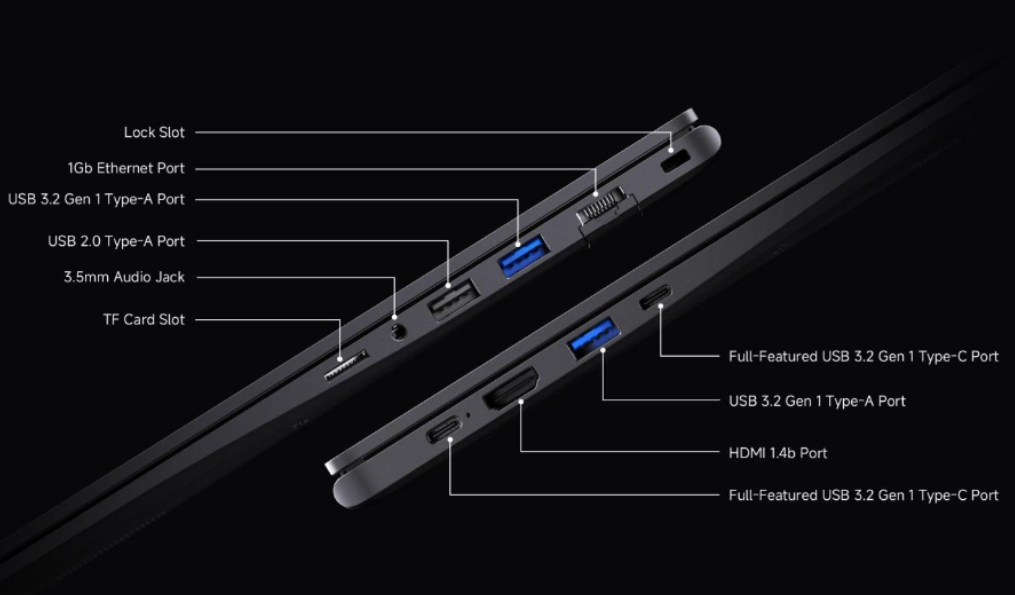
The laptop offers two full-featured USB-C ports, three USB-A ports (including two 5Gbps ports), HDMI, Gigabit Ethernet, a TF card slot, and a 3.5mm headphone jack. This allows users to connect external storage, wired internet, projectors, monitors, cameras, keyboards, and headphones without relying on adapters.
Modern Wireless Connectivity and Multi-Display Support
For wireless connectivity, the UniBook AI supports Wi-Fi 6, providing faster wireless speeds and improved network stability on compatible routers. Bluetooth 5.2 enables reliable connections with wireless headphones, mice, keyboards, and other accessories.
The laptop can also drive up to two external 4K displays at 60Hz, giving users additional screen space for multitasking, presentations, video editing, financial work, or office productivity.
Designed for Everyday Productivity
With its Intel Core 3 Wildcat Lake processor, dedicated AI hardware, lightweight metal design, color-accurate display, long battery life, and generous port selection, the CHUWI UniBook AI is designed to meet the needs of a wide range of users. Combined with Windows 11 Pro and an attractive early bird price of $449, the laptop offers an affordable entry point for those looking to experience the latest AI-powered PC features without paying premium flagship prices.
Key Specs:
Category
Specification
Model
CHUWI UniBook AI
Operating System
Windows 11 Pro
Processor
Intel Core 3 Processor 304 (Wildcat Lake)
Architecture
Intel 18A Process Technology
Graphics
Intel Graphics
GPU AI Performance
Up to 9 TOPS (Int8)
Dedicated NPU
Up to 15 TOPS (Int8)
Display
14-inch IPS
Resolution
WUXGA (1920 × 1200)
Aspect Ratio
16:10
Color Gamut
100% sRGB
Brightness
300 nits
Screen-to-Body Ratio
88%
Hinge
180° Lay-Flat
RAM
8GB LPDDR5 (6400 MT/s)
Storage
256GB PCIe 3.0 SSD (Expandable)
Battery
53.38Wh
Charging
65W USB-C Power Delivery
Battery Life
Up to 13 hours (1080p local video playback)
Keyboard
Backlit Keyboard
Touchpad
Precision Touchpad
Webcam
HD Webcam with Privacy Shutter
Wireless Connectivity
Wi-Fi 6, Bluetooth 5.2
USB-C
2 × Full-featured USB-C
USB-A
3 × USB-A (2 × 5Gbps, 1 × 480Mbps)
Other Ports
HDMI, RJ45 Gigabit Ethernet, TF Card Slot, 3.5mm Audio Jack
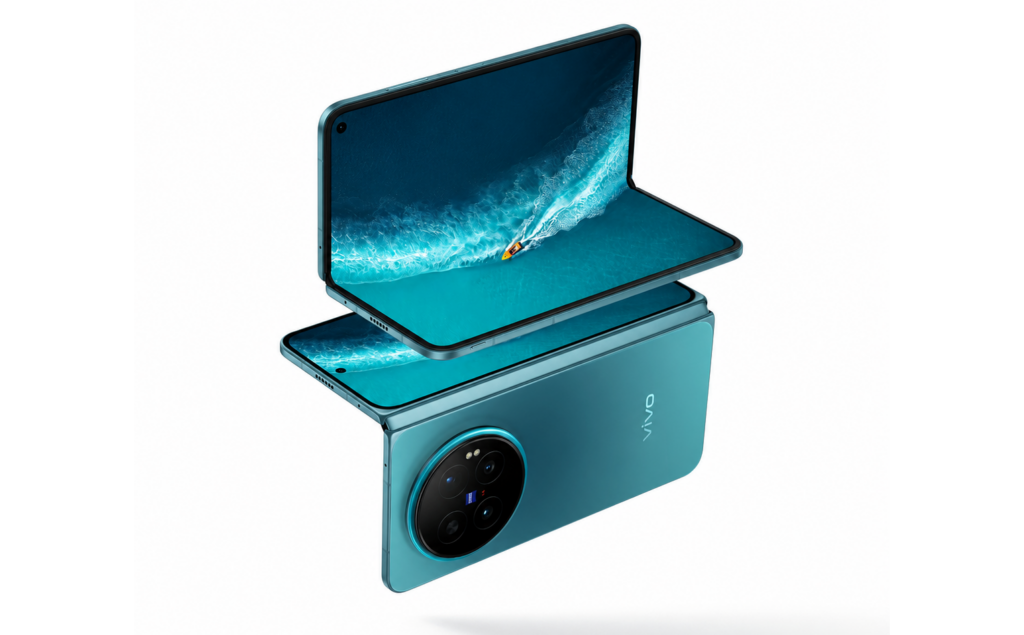
Vivo has launched its latest book-style foldable smartphone, the Vivo X Fold 6, in China. It marks a major milestone for the brand as it becomes the company’s first foldable smartphone to feature a MediaTek chipset, with previous generations relying on Snapdragon processors. It also packs Vivo’s largest-ever battery in a foldable device and introduces the brand’s first 200-megapixel rear camera system on a foldable. Read on to find out everything the Vivo X Fold 6 has to offer.
Vivo X Fold 6 specifications and features
Vivo X Fold 6
The Vivo X Fold 6 features an 8.02-inch AMOLED foldable display with a 2504 x 2312 resolution, a 1Hz to 120Hz LTPO refresh rate, Samsung M14 luminous material, up to 5,000 nits peak brightness, 1,920Hz PWM dimming and UTG protective glass.
The outer display measures 6.51 inches with a 2528 x 1120 resolution, 1Hz to 120Hz LTPO refresh rate, BOE Q11 panel, up to 5,000 nits peak brightness and second-generation Armour Glass protection. Both the cover and inner displays feature 20-megapixel selfie cameras.
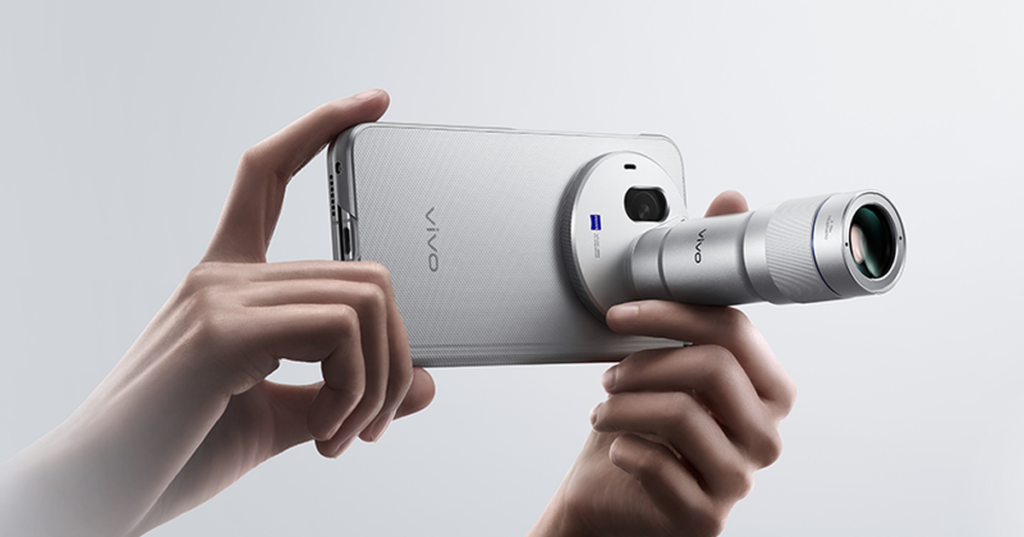
The Vivo X Fold 6 ‘s rear camera setup comprises a 200-megapixel Samsung HPB primary camera with OIS, a 50-megapixel ultra-wide camera and a 50-megapixel Sony LYTIA 602 periscope telephoto camera with VCS technology and OIS. The rear camera system also supports the Vivo Zeiss Teleconverter G2 accessory.
Vivo X Fold 6
Powering the foldable is MediaTek’s Dimensity 9500 Super Edition chipset paired with the Vivo V3+ imaging chip, LPDDR5X Ultra RAM and UFS 4.1 storage. The phone packs a 7,000mAh Blue Ocean battery with third-generation solid-state battery technology, 80W wired charging, 40W wireless charging and 5W reverse charging. It runs OriginOS 6 Fold based on Android 16.
Other highlights include IP58 and IP59 ratings, Wi-Fi 7, USB 3.2 Gen 1, NFC, an IR blaster, an X-axis linear motor, stereo speakers and a side-mounted fingerprint scanner. Depending on the finish, the device measures 4.4mm to 4.8mm when unfolded, 9.4mm to 9.9mm when folded, and weighs between 228g and 235g.
Vivo X Fold 6 price and availability
Vivo X Fold 6
The Vivo X Fold 6 is available in multiple configurations, including 12GB+256GB, 12GB+512GB, 16GB+512GB, 16GB+1TB, and a Black Gold Edition with 16GB+1TB storage. These variants are priced at CNY 7,999 (~$1,175), CNY 8,999 (~$1,320), CNY 9,999 (~$1,470), CNY 10,999 (~$1,615), and CNY 11,299 (~$1,660), respectively.
Buyers can choose from Blue Cave, Salt Lake, Extreme Night and Black Gold Edition colour options. There is currently no information on a global launch.
For more daily updates, please visit our News Section.
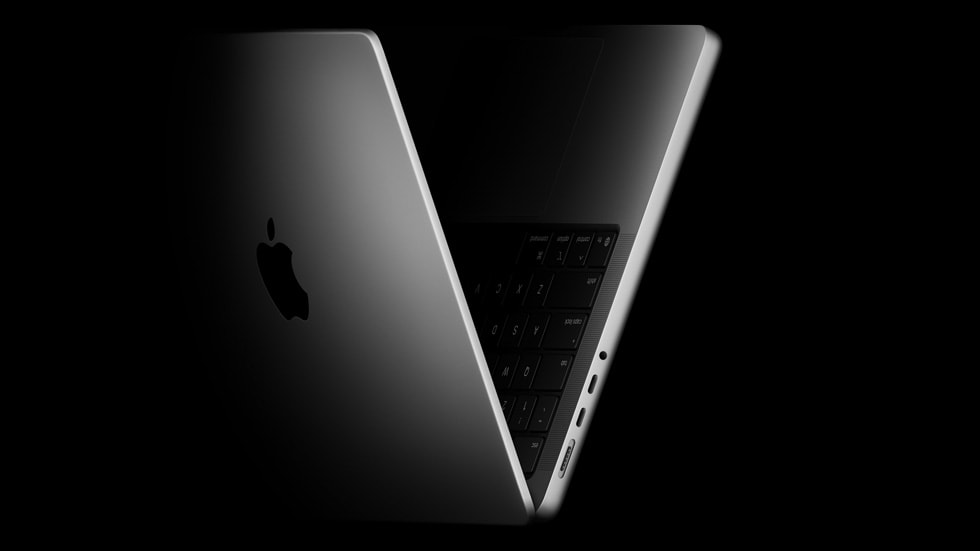
Apple could be preparing one of the biggest changes to its Mac chip strategy since the introduction of Apple Silicon. According to Bloomberg’s Mark Gurman, the company is reworking its processor roadmap, with upcoming Macs expected to follow a different release pattern than previous M-series generations.
Apple may change its M-series chip strategy
Instead of launching a complete M6 family, Apple is reportedly planning to introduce only the base M6 processor for entry-level Macs. The M6 is expected to power devices such as the refreshed 14-inch MacBook Pro and possibly other entry-level Mac models. Gurman says Apple is not developing M6 Pro or M6 Max chips, making this the first M-series generation to skip higher-end variants. The company is reportedly accelerating technologies originally planned for a later release to better support advanced on-device AI workloads and increasingly demanding graphics applications.
The M6 chip is expected to be Apple’s first processor built on TSMC’s 2nm process, replacing the 3nm technology used in recent generations. It is also tipped to feature around 200GB/s of memory bandwidth, up from approximately 153GB/s on the M5. Other expected upgrades include a redesigned memory architecture, a faster CPU across all cores, an upgraded Neural Engine for AI processing, improved video encoding and decoding, and a redesigned GPU with up to 12 graphics cores instead of 10 on the M5.
Following the base M6 launch, Apple is expected to shift its focus to the M7 family, which will reportedly include the M7, M7 Pro, M7 Max and M7 Ultra. The premium chips are said to deliver stronger AI performance, improved graphics capabilities and around 240GB/s of memory bandwidth on the standard M7. Meanwhile, Apple is still planning an M5 Ultra for a future Mac Studio, with testing reportedly involving up to 36 CPU cores, 80 GPU cores and support for as much as 768GB of unified memory.
If Apple’s reported roadmap moves ahead, it would mark a significant shift in how the company develops its Mac processors while placing AI at the centre of future silicon upgrades.
For more daily updates, please visit our News Section.
iQOO has a couple of new flagship phones lined up for the Chinese market. Next month, the brand is expected to unveil the iQOO Neo 11S powered by the Dimensity 9500. In September or October, the brand may introduce the iQOO 16 and iQOO Neo 12. Now, a new leak suggests that the iQOO 16T is also in the works.
iQOO 16T’s existence revealed
According to the tipster, iQOO will continue its T-series lineup with a new generation of smartphones. The tipster claims that the upcoming iQOO 16T series has entered the development stage and will continue to focus on large-display devices, suggesting that the brand will stick to its big-screen positioning for the next iteration.
To recall, the iQOO 15T was initially believed to be a compact flagship that would rival the OnePlus 15T, which also features a compact design. However, it launched with a large 6.82-inch AMOLED display. The latest leak claims that the iQOO 16T will continue to feature a large display like its predecessor.
Reports have revealed that the iQOO 16 will feature a 6.85-inch Samsung AMOLED display with a 2K resolution and a 165Hz refresh rate. The Neo 12, which is expected to debut alongside the iQOO 16, is said to feature a 6.83-inch AMOLED display with the same resolution.
To recall, the iQOO 15T and Neo 11 feature the same 6.82-inch BOE Q10+ AMOLED display with a 2K resolution and a 144Hz refresh rate. Therefore, it is likely that the iQOO 16T may inherit the iQOO Neo 12’s display panel. At present, there is no information available about the other specifications of the iQOO 16T. Hopefully, upcoming reports will reveal more details about it.
For more daily updates, please visit our News Section.
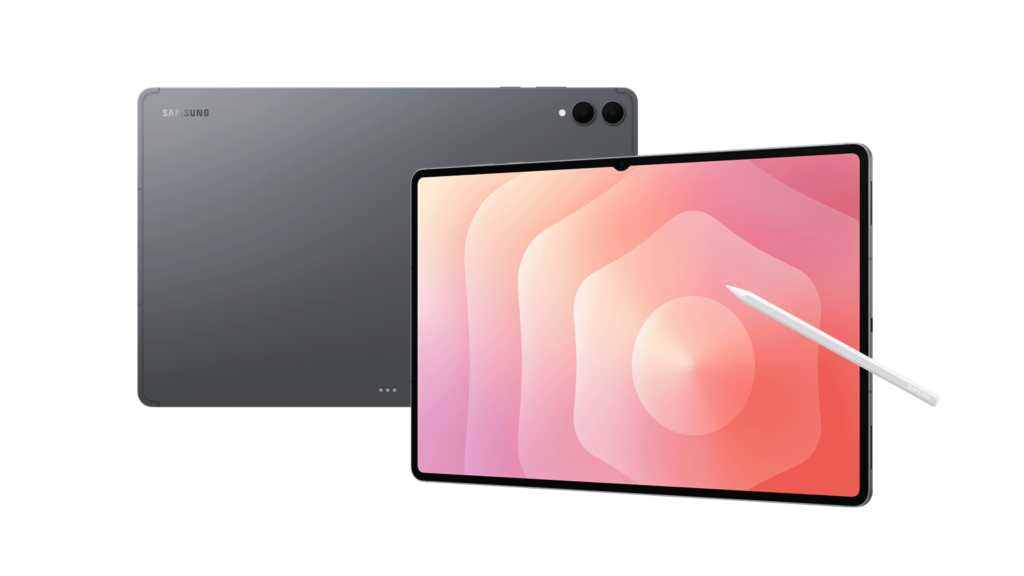
Samsung might be getting ready to give its Galaxy Tab series a fresh new look that finally lines up better with its phones. Leaked animations from the upcoming One UI 9 software suggest future tablets could ditch the big notch in favor of a punch-hole camera cutout, which would mean a much more modern, immersive screen.
SamMobile spotted the clues while digging through the One UI 9 beta firmware. The rotating device animations show tablet-style devices with a centered punch-hole front camera. Interestingly, there are two versions: one with the cutout on the long edge and another on the shorter edge, just like how phones adapt when you rotate them. These animations weren’t in One UI 8.5 (which is based on Android 16), so they look like brand-new additions for One UI 9 and Android 17.
Right now, flagship models like the Galaxy Tab S11 Ultra and S10 Ultra still use a notch for the front camera. Switching to a punch-hole design would be a pretty big step forward for the Galaxy Tab S12 Ultra: it could let Samsung shrink the bezels even more and push the screen-to-body ratio closer to what we’ve come to expect from their smartphones.
Beyond the design tweak, One UI 9 is shaping up to bring a bunch of other improvements: better AI features, smoother animations, and tighter integration across the Galaxy ecosystem. The beta is already rolling out to various phones and tablets, so we’re getting early peeks at what Samsung has planned for late 2026 and beyond.
If this punch-hole design actually makes it to production, it would put the Tab series more in line with the rest of the industry’s move toward minimal screen interruptions. As the development progresses, we should get a clearer picture of how the software and hardware are evolving together.
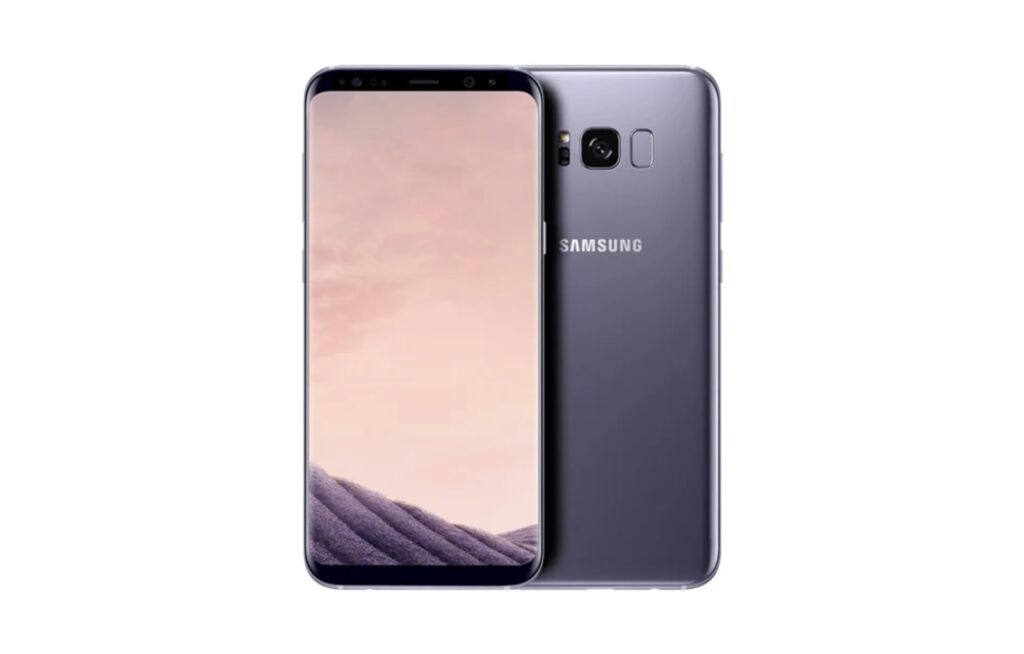
Samsung has rolled out an unexpected software update for the Galaxy S8, Galaxy S8+, and Galaxy Note 8, nearly a decade after these smartphones first debuted. While the update does not introduce new features, its arrival has surprised users because official software support for these devices ended several years ago.
Samsung rolls out a rare update for ageing flagships
Samsung Galaxy S8 Plus
According to Android Authority, the latest firmware has started reaching Verizon variants of the Galaxy S8 series and Galaxy Note 8 in the US. Verizon’s official changelog states that the update focuses on performance improvements, while SammyFans reports that it also enhances overall system stability. Although the improvements are not detailed, Samsung appears to have fine-tuned the software to keep these aging devices running more reliably.
The Galaxy S8, Galaxy S8+, and Galaxy Note 8 were introduced in 2017 and received their last scheduled software updates in 2022. Since then, the phones have remained on Android versions and security patches that are several years old. Even after this latest rollout, the devices continue to run security patches from 2021, meaning they do not receive protection against the latest security threats.
Users should not expect a refreshed interface or additional functionality with this update. Instead, it is aimed at improving everyday performance and addressing stability-related issues behind the scenes. Such updates are uncommon for smartphones that have long crossed their official end of life, making Samsung’s decision an unexpected one.
The move also follows a similar approach seen earlier this year when Apple released a software update for the iPhone 5s to keep services like FaceTime and iMessage working properly. For Galaxy S8 and Note 8 owners who still keep these devices as backups or secondary phones, this update offers a small but welcome improvement.
For more daily updates, please visit our News Section.
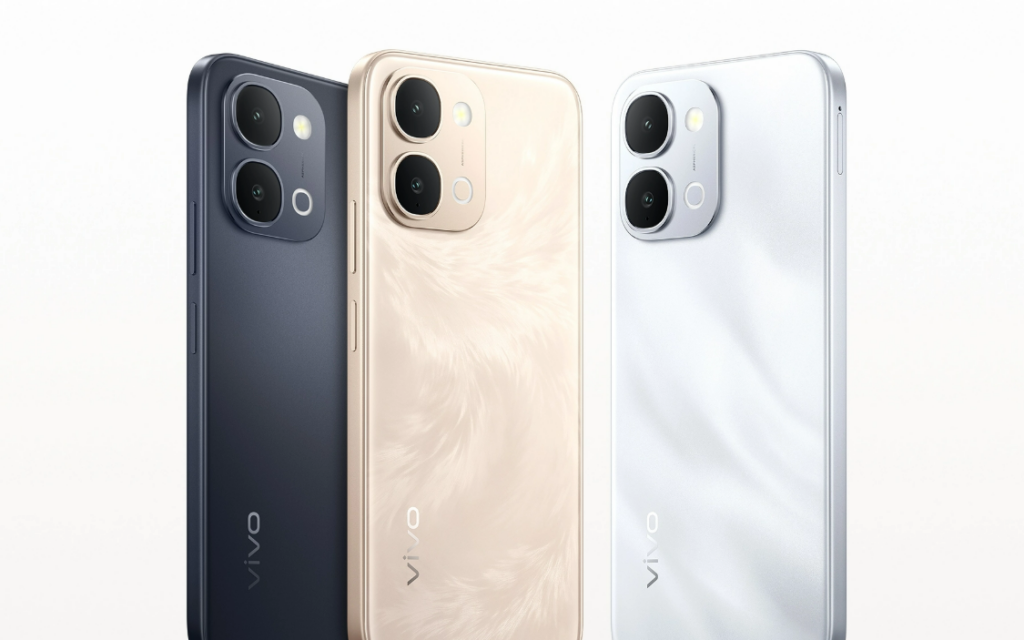
Vivo has quietly introduced a new budget 5G smartphone in China called the Vivo Y6a. The device focuses on long battery life, durability, and a smooth display experience while offering a Snapdragon chipset and the latest OriginOS software at an affordable price point.
Vivo Y6a specifications and features
Vivo Y6a
The Vivo Y6a features a 6.75-inch LCD display with a 1570 x 720 resolution, a 120Hz refresh rate, and up to 1,200 nits of peak brightness. The handset is powered by Qualcomm’s Snapdragon 4 Gen 2 chipset, paired with 8GB of LPDDR4X RAM and 256GB of UFS 3.1 storage.
The smartphone packs a massive 7,200mAh battery with support for 44W fast charging. Vivo claims the battery is designed to retain its health for up to six years, with a rated lifespan of 1,800 charging cycles. The device offers a 50-megapixel rear camera and an 8-megapixel front-facing camera. It also supports an additional 8GB of virtual RAM and runs OriginOS 6 based on Android 16.
Vivo Y6a
The Y6A comes with other features, such as stereo speakers, NFC, an IR blaster, a side-mounted fingerprint scanner, face unlock, dual SIM support, and IP69/IP68-rated water and dust resistance. Connectivity options include 5G, Wi-Fi, Bluetooth 4.2, USB Type-C, and support for aptX Adaptive audio codecs.
Vivo Y6a price and availability
The Vivo Y6a is offered in a single 8GB + 256GB configuration priced at 1,999 Yuan, which is approximately $295. Buyers can choose from Obsidian Black, Galaxy Silver, and Phoenix Gold color options. This phone is a rebranded version of the existing Y500i.
For more daily updates, please visit our News Section.
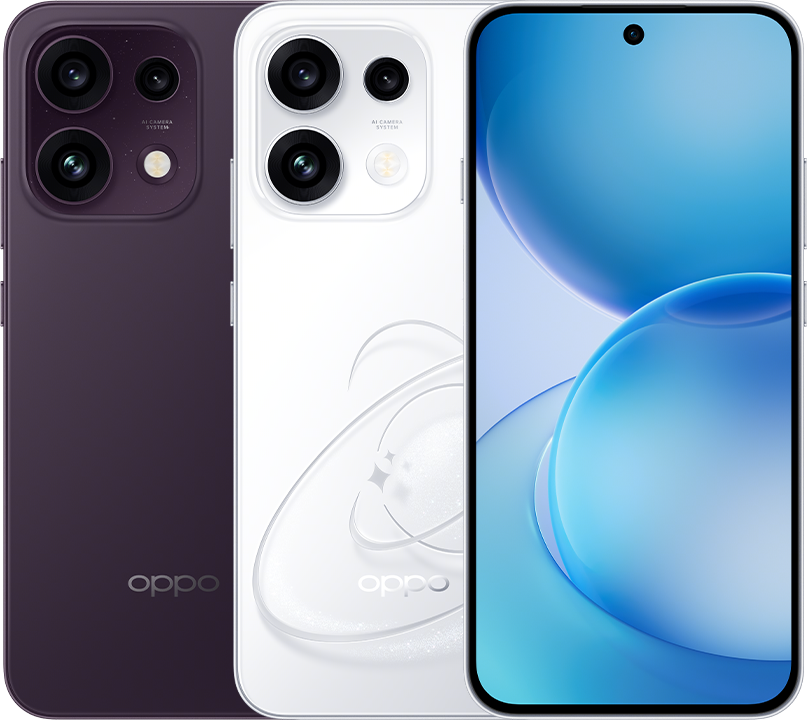
Apart from unveiling the Oppo Reno 16F, Reno 16, and Reno 16 Pro, the brand has also introduced the Oppo Reno 16 FS for the European market. The new model sits below the Reno 16 series while bringing a premium AMOLED display, a large battery, and triple 50-megapixel cameras. It is also speculated that the device could arrive in India as the Oppo Reno 16c.
Oppo Reno 16 FS specifications and features
Oppo Reno 16 FS
The Oppo Reno 16 FS features a 6.57-inch AMOLED display with an FHD+ resolution of 2372 x 1080 pixels, a 120Hz refresh rate, up to 1,400 nits high brightness mode, and 10-bit color support. For security, the display is integrated with an optical fingerprint sensor.
Under the hood, it is powered by the MediaTek Dimensity 7300 Energy chipset paired with 8GB of LPDDR4X RAM and 256GB of UFS 3.1 storage, with support for expandable storage. The phone runs ColorOS 16 based on Android.
For photography, the Reno 16 FS comes equipped with a 50-megapixel main camera with OIS, an 8-megapixel ultra-wide lens, and a 50-megapixel telephoto camera with OIS. On the front, it features a 50-megapixel autofocus selfie camera. Both the front and rear cameras support 4K video recording at 30fps.
The handset packs a 6,500mAh battery with support for 45W SuperVOOC fast charging. Other notable features include a Snap Key AI button, stereo speakers, Bluetooth 5.4, Wi-Fi 6, NFC, IP68-rated water and dust resistance, and support for eSIM. Like other Reno 16 models, the FS variant also supports the Oppo Bubble accessory.
Oppo Reno 16 FS price and availability
The Oppo Reno 16 FS is available in Purple Black and Pop White colour options. In Europe, the 8GB + 512GB variant is priced at €649. There is also speculation that the Reno 16 FS could launch in India under the Oppo Reno 16c branding.
For more daily updates, please visit our News Section.
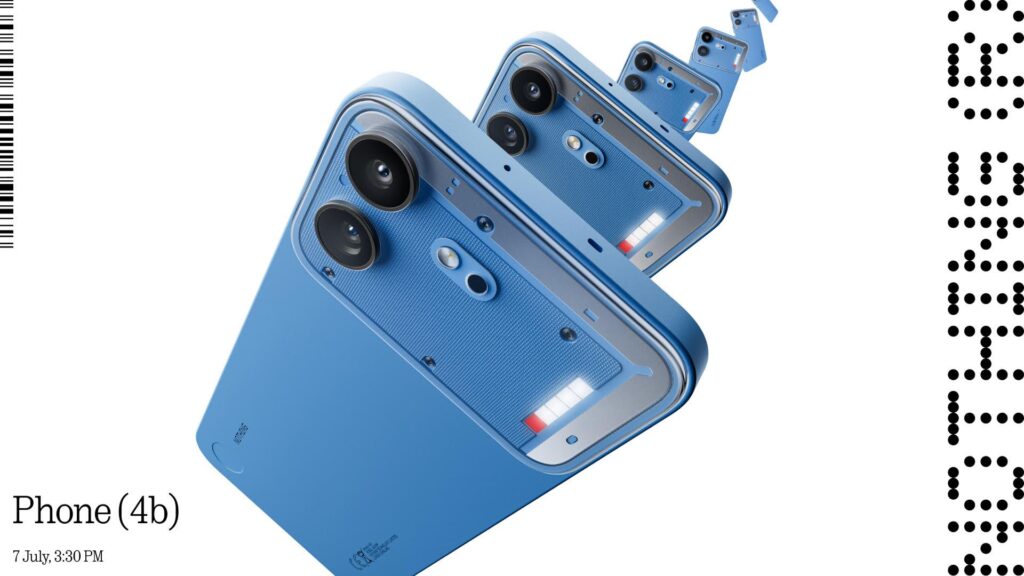
Nothing recently confirmed that its next smartphone, scheduled to launch on July 7, will be called the Nothing Phone (4b). The brand has also showcased the design of the phone through official teasers, but it is still mum on its specifications. While the device recently surfaced on Geekbench, revealing details such as its chipset and RAM, most of its other hardware remained under wraps. Now, tipster Yogesh Brar has shared several key specifications of the upcoming handset in a post on X.
Nothing Phone (4b) key specifications tipped
Nothing Phone (4b)
According to the tipster, the Nothing Phone (4b) will feature a 6.7-inch AMOLED display with a 120Hz refresh rate. Powering the device is said to be Qualcomm’s Snapdragon 6 Gen 4 chipset, which aligns with the earlier Geekbench listing. The benchmark listing also suggested that the phone will ship with 8GB of RAM and run Android 16-based Nothing OS out of the box.
The leak further claims that the Phone (4b) will feature a dual rear camera setup led by a 50-megapixel primary camera. Nothing has already confirmed the presence of two rear cameras through its official teasers.
The handset is also expected to pack a 5,400mAh battery. For storage, it is tipped to arrive in 8GB + 128GB and 8GB + 256GB variants. The device is also expected to be available in three color options, with a light blue finish already showcased by the company.
Nothing has already revealed that the Phone (4b) will feature a compact horizontal Glyph Bar instead of the full Glyph Interface seen on earlier models. The lighting strip is expected to handle notifications, charging status, and app alerts. The Geekbench listing showed the handset carrying the model number A005 and recorded single-core and multi-core scores of 1,088 and 3,155, respectively.
Nothing is expected to reveal the remaining details, including pricing and availability, at its launch event on July 7.
For more daily updates, please visit our News Section.
Redmi is reportedly working on the Redmi Note 17 family for the Chinese market. At present, there is no clarity on how many models will be part of the lineup, but recent reports have revealed that the first model will be announced in July, while the others may launch a bit later, possibly in August. Ahead of the expected launch, the alleged Note 17 model has seemingly appeared in the database of China’s 3C certification platform.
Purported Redmi Note 17 Pro gets 3C certification
Alleged Redmi Note 17 Pro 3C certified
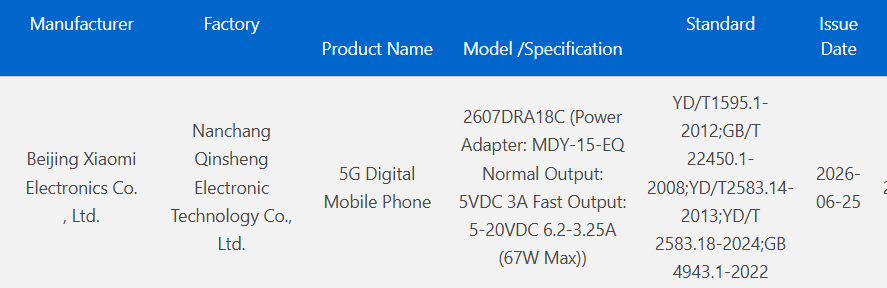
As seen above, an upcoming Xiaomi phone with model number 2607DRA18C has received approval from China’s 3C certification platform. According to previous reports, this device could be part of the Redmi Note 17 lineup.
The certification reveals that the device may ship with a 67W charger bearing the model number MDY-15-EQ. To recall, the Redmi Note 15 and Redmi Note 15 Pro, which launched in China last year, support 45W charging. With faster charging now expected, it appears that the 2607DRA18C could launch as the Redmi Note 17 Pro.
The device is speculated to launch in China in July. The other models in the series are likely to go official in August. However, it is advisable to wait for further reports to confirm the final marketing name of the 2607DRA18C.
Moving on to the specifications, the device is expected to feature a flat OLED panel with a 1.5K resolution. Under the hood, it may be powered by the Snapdragon 6 Gen 5 chipset and pack a massive 9,000mAh battery. For photography, it is expected to feature a 50-megapixel main camera.
For more daily updates, please visit our News Section.
Qualcomm’s next generation of Snapdragon 8-series chipsets has surfaced through a new leak, hinting at a broader portfolio than before. The information suggests the company is preparing multiple premium processors with different performance targets, while also facing fresh competition from MediaTek’s upcoming flagship silicon.
Multiple Snapdragon 8-series chips in works
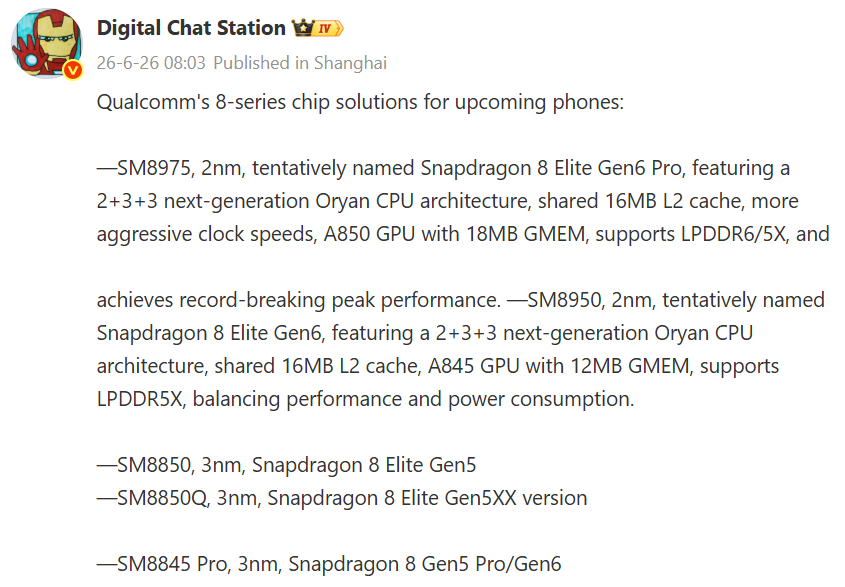
According to tipster Digital Chat Station, Qualcomm is working on two 2nm flagship chipsets. The first is the SM8975, which is tentatively expected to launch as the Snapdragon 8 Elite Gen 6 Pro. It is tipped to feature a new 2+3+3 Oryon CPU architecture, 16MB shared L2 cache, an Adreno 850 GPU with 18MB GMEM, and support for both LPDDR6 and LPDDR5X memory. The chip is said to focus on delivering the highest possible performance.
The second chipset, carrying the SM8950 model number, is expected to arrive as the Snapdragon 8 Elite Gen 6. While it is also built on a 2nm process and shares the same next-generation Oryon CPU architecture with 16MB shared L2 cache, it reportedly comes with an Adreno 845 GPU featuring 12MB GMEM. Unlike the Pro version, this chipset is said to strike a balance between performance and power efficiency while supporting LPDDR5X memory.
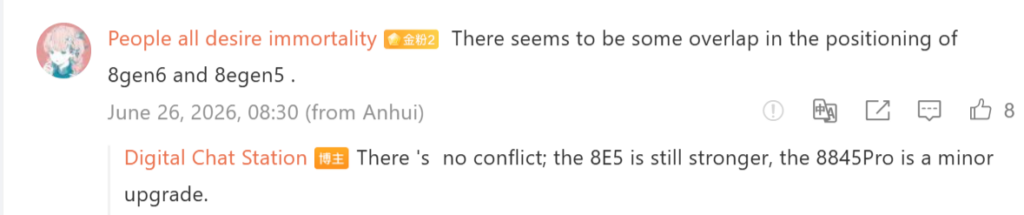
The tipster also listed several 3nm platforms that are in Qualcomm’s roadmap, including the existing SM8850 (Snapdragon 8 Elite Gen 5) and the upcoming ones, such as the SM8850Q, which may be branded as the Snapdragon 8 Elite Gen 5XX Edition, and the SM8845 Pro, which could be called the Snapdragon 8 Gen 5 Pro or Gen 6 but will be a minor upgrade over the existing Snapdragon 8 Gen 5.
MediaTek rivalry could heat up
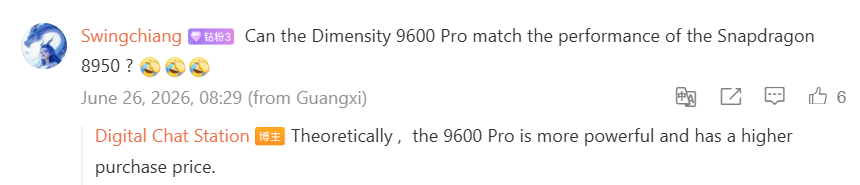
In the comments, Digital Chat Station claimed that MediaTek’s upcoming 2nm Dimensity 9600 Pro could theoretically outperform the Snapdragon 8 Elite Gen 6 (SM8950), particularly in GPU performance.
The chip is said to feature the Magni architecture and an integrated NGP neural accelerator, enabling console-level frame interpolation, improved ray tracing performance, and higher rendering efficiency.
As per other reports, this year’s Dimensity 9-series lineup is expected to include three models, namely the 3nm Dimensity 9500+, an overclocked version of the existing Dimensity 9500, along with the 2nm Dimensity 9600 and 9600 Pro.
For more daily updates, please visit our News Section.
We use cookies on our website to give you the most relevant experience by remembering your preferences and repeat visits. By clicking “Accept”, you consent to the use of ALL the cookies.
This website uses cookies to improve your experience while you navigate through the website. Out of these, the cookies that are categorized as necessary are stored on your browser as they are essential for the working of basic functionalities of the website. We also use third-party cookies that help us analyze and understand how you use this website. These cookies will be stored in your browser only with your consent. You also have the option to opt-out of these cookies. But opting out of some of these cookies may affect your browsing experience.
Necessary cookies are absolutely essential for the website to function properly. This category only includes cookies that ensures basic functionalities and security features of the website. These cookies do not store any personal information.
Any cookies that may not be particularly necessary for the website to function and is used specifically to collect user personal data via analytics, ads, other embedded contents are termed as non-necessary cookies. It is mandatory to procure user consent prior to running these cookies on your website.