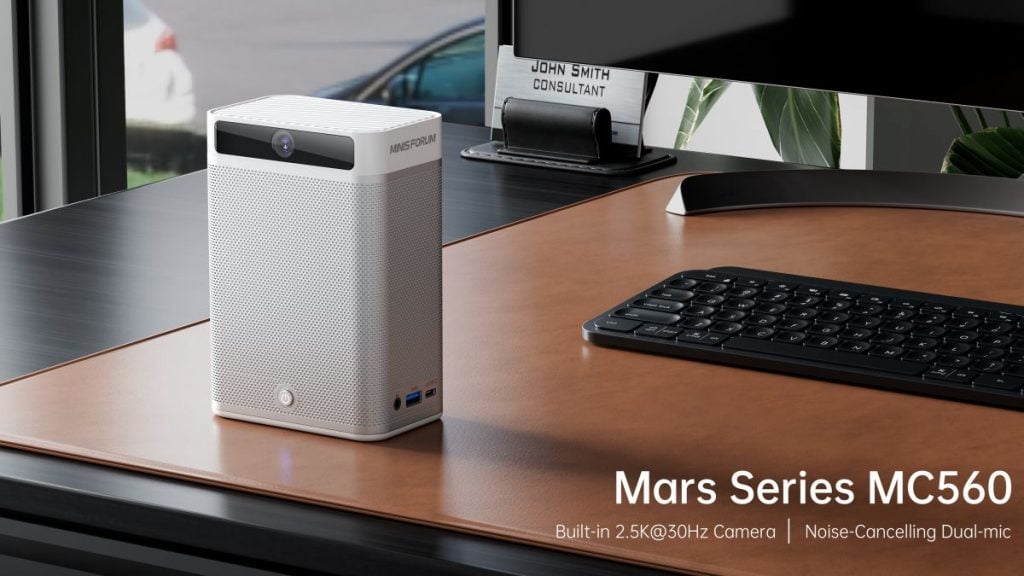
The MINISFORUM MC560 mini-PC could be launched very soon. The upcoming and yet-to-be-released mini PC is equipped with a 2.5K camera and speakers. The MINISFORUM lineup of compact computers provides a variety of options for home, office, and gaming applications.
The MINISFORUM Mars MC560 is a unique mini PC on its own. It packs all the needed functionality of a laptop and desktop PC combined. It is also well-primed for video conferencing with its built-in 2.5K camera. It also offers stereo speakers and dual microphones for a great video conferencing experience.
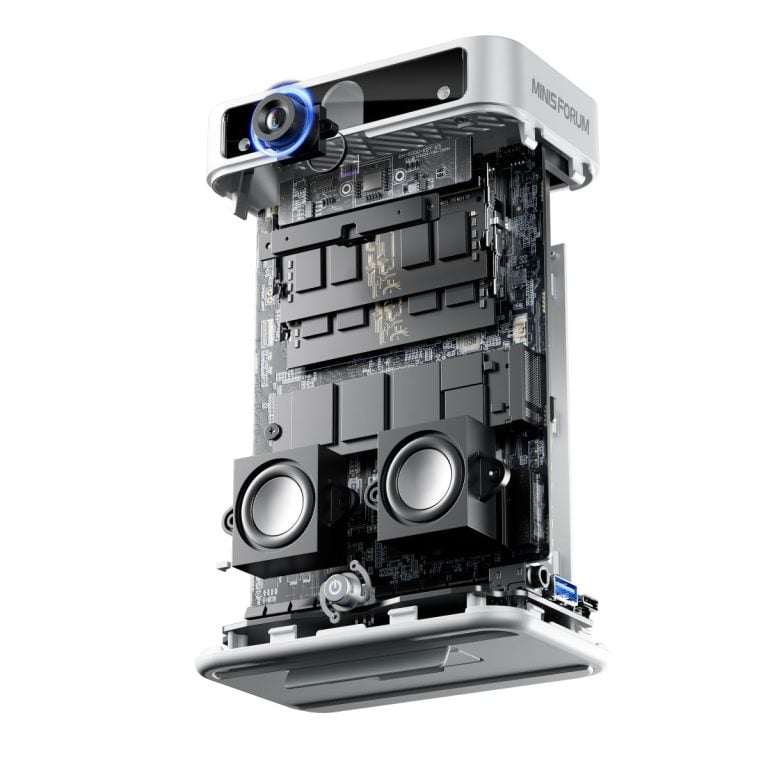
The mini PC has dimensions of 4.2 inches by 2.7 inches across and 6 inches high. The MC560 is taller than most of the current mini PCs. The extra height provides room for many of the features of the device. The integrated stereo speakers and the webcam are some of these features that stand the product out.
The new MINISFORUM computer is powered by the AMD Ryzen 5 5600U 6-core, 12-thread processor. The processor combines with Radeon RX Vega 7 graphics.
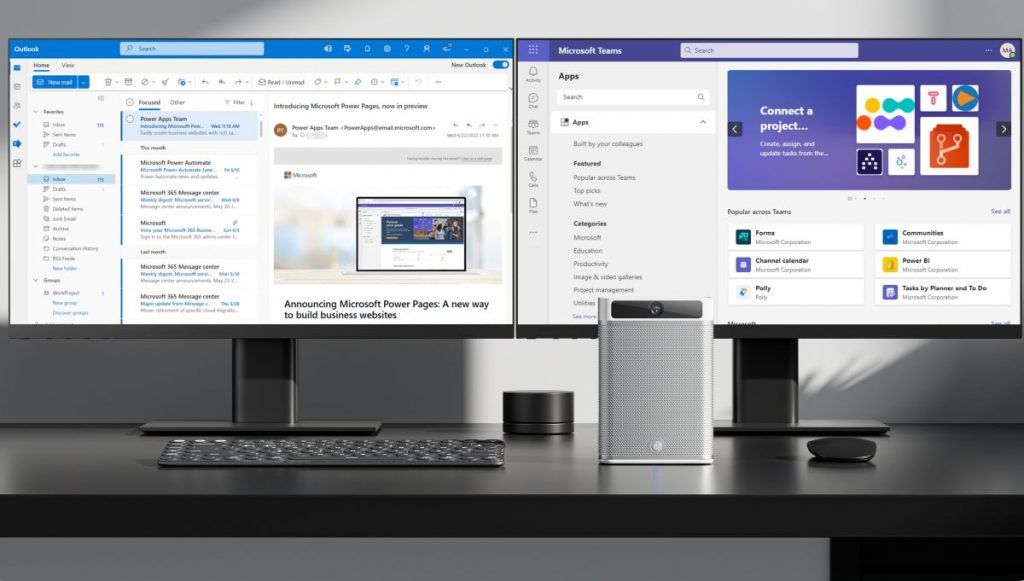
The company says up to two 4K displays could be connected to the MC560. It offers up to 64GB of DDR4-3200 memory, Wi-Fi 6E, and Bluetooth 5.2 connectivity. There is an assortment of ports at the sides and back of the mini PC including HDMI, USB 3.2, Gigabit Ethernet, and a 3.5mm audio jack, among others.
The 2.5K webcam supports HDR capture and it has a 94-degree field of view. Likely, the model will also feature some form of tilting but details are lacking at this time. However, the webcam is not able to capture 4K HDR videos. It can only deliver 2.5K at 30 frames per second. A third-party webcam with 4K, 60 fps support could, however, be added to the mini PC to serve such a purpose.
The MINISFORUM MC560 supports beam-forming technology for efficient noise modulation. The beam-forming technology also enhances noise reduction for clarity of speech. Although no specifics have been provided, the product could be unveiled soon. Pricing and global availability details are also lacking for the device.
Nothing says it has opened its physical store to retail its products including smartphones and TWS earbuds. It is also in talks with some US carriers to sell new smartphones through their stores. The Nothing identity has been accentuated with the transparent design of the Nothing phone. The Nothing physical store has opened in London and with 7 days a week operation.
The Nothing Phone(1) remains an iconic and innovative Android smartphone that propelled Nothing to greater prominence. Nothing’s CEO Carl Pei says the company is making concrete moves to enter the lucrative United States market.
The Phone(1) has been unable to tickle the imagination of US consumers and Nothing wants to change that narrative. The London-based OEM says it has made significant progress in talks with US carriers to potentially launch a future product. These engagements between OEMs and network carriers tend to favor the bigger companies. These companies can develop obligatory and carrier-specific software updates, as well as manufacture new products with a discount regime.
Nothing’s new physical store is an investment not common with rising OEMs, thus it is a decent achievement. It is expected that more stores will join the current one located on more than two floors in its London facility. There is a great collection of audio products together with the Nothing Phone(1) in the store.
The store is expected to be open from 10 am to 7 pm on Mondays to Saturdays, as well as 12-6 pm on Sundays. There are no fine details on the stage of talks between Nothing and carrier networks in the US. It is also not known what specific US carriers are being engaged by the company. An entry into the US could transform the fortunes of the Nothing brand. We expect the OEM to pursue the talks with energy and commitment.
Honda has announced the 2024 N-Van EV with a range of 200km and a pint-size design. The new vehicle is the electric version of the 2018 gas-powered version of the car. It is a commercial vehicle developed to meet the Kei car requirements. It is a workhorse with a length of about 134 inches and can seat up to four people. The 2024 Honda N-Van EV will be available in Japan.
Honda hopes to debut the N-Van EV in spring 2024 and its compact space is maximized for its battery. The new EV, according to Honda, is versatile and could be deployed for either commercial or personal use.
The pricing of the N-Van also seems highly competitive at 1 million yen (~$7,300). Some of the popular EV minivans like the Mitsubishi eK X and Nissan Sakura are priced from $14,000 up to $17,700.
The 2018 N-Van is powered by a three-cylinder turbocharged engine with up to 64hp power (47kW) and 104Nm torque. Manual and CVT gearboxes are also available for the car, as well as front-wheel or all-wheel drive options.
The N-Van is also a great car that can be used as a camper or a purpose-built hill-climb vehicle. The gas-powered model offers extra cargo space by folding the front passenger seat. The Honda N-Van EV will bear a great semblance to its ICE sibling even in terms of its versatility.
While we expect further developments before 2024, the N-Van EV could also enter overseas markets. These details will become known as the scheduled launch gets closer. Several other specs are lacking for the N-Van EV including its top speed, electric motor, and interior setup.
The OPPO Reno9 Pro hitten the shelves a few days ago with three different variants: along the vanilla version with midrange-class specifications and the Pro+ flagship variant, there is the intermediate version OPPO Reno9 Pro with high-end specifications offered at an interesting price. Despite coming with a more affordable price than the Pro Plus variant, it still provides flagship-class performance and an amazing design. In the same price range, one of the best device out there is the Xiaomi 12T, the latest Xiaomi upper-midrange phone launched in the global market. A lot of people are wondering which of these phone is actually the best and we decided to help you find out through this article. So, if interested, you can go ahead and read this comparison between the main specifications of the OPPO Reno9 Pro and the Xiaomi 12T.
OPPO Reno9 Pro vs Xiaomi 12T
OPPO Reno9 Pro
Xiaomi 12T
DIMENSIONS AND WEIGHT
162.3 x 74.2 x 7.2 mm,
174 g
163.1 x 75.9 x 8.6 mm,
202 g
DISPLAY
6.7 inches, 1080 x 2412 pixels (Full HD+), AMOLED
6.67 inches, 1220 x 2712 pixels (Full HD+), AMOLED
PROCESSOR
Mediatek Dimensity 8100 Max, octa-core 2.85 GHz
Mediatek Dimensity 8100 Ultra, octa-core 2.85 GHz
MEMORY
16 GB RAM, 256 GB – 16 GB RAM, 512 GB
8 GB RAM, 128 GB – 8 GB RAM, 256 GB
SOFTWARE
Android 13, ColorOS
Android 12, MIUI
CONNECTIVITY
Wi-Fi 802.11 a/b/g/n/ac/6, Bluetooth 5.3, GPS
Wi-Fi 802.11 a/b/g/n/ac/6, Bluetooth 5.3, GPS
CAMERA
Dual 50 + 8 MP, f/1.8 + f/2.2
32 MP f/2.4 front camera
Triple 108 + 8 + 2 MP, f/1.7 + f/2.2 + f/2.4
20 MP f/2.2 front camera
BATTERY
4500 mAh, fast charging 67W
5000 mAh, Fast Charging 120W
ADDITIONAL FEATURES
5G, dual SIM, reverse charging
5G, dual SIM
Design
The most impressive design here belongs to the OPPO Reno9 Pro. First of all, it is one of the thinnest phones in the world, with a thickness of just 7.2 mm. It is also very lightweight as it weighs just 174 grams. Further, its rear side is very elegant with its refined color options and a minimalistic camera module including sensors placed directly on the rear cover. Last but not least, on the front, it has a curved screen at the sides, just like the most expensive Android phones out there. The Xiaomi 12T is not much attractive in terms of design: it has a thicker and heavier body, a flat display, it is not the most beautiful phone you can get. So, if you mind about the design, you know what to choose.
Display
Even though they are not flagship displays, the panels of these phones are pretty impressive. But the one found on the Xiaomi 12T is a bit more interesting. It is one of the first displays with a 1.5K resolution of 1220 x 2712 pixels and it is an AMOLED panel able to show up to 68 billion colors. It comes with a diagonal of 6.67 inches, a 120 Hz refresh rate, HDR10+ certification, and an in-display fingerprint reader. With the OPPO Reno9 Pro, you get an AMOLED display able to show up to one billion colors with a diagonal of 6.7 inches, a Full HD+ resolution of 1080 x 2412 pixels, a 120 Hz refresh rate, HDR10+ certification, and an in-display fingerprint scanner. Note that only the Xiaomi 12T comes with stereo speakers, while the Reno 9 Pro has a mono speaker.
Specs & Software
The processor found on the Xiaomi 12T is slightly better than the one found on the OPPO Reno9 Pro, but the difference is just marginal. On the other hand, the OPPO Reno9 Pro has a higher quantity of RAM: 16 GB instead of just 8 GB, and it is a lot more important than the difference between the two chipsets. Anyway, the OPPO Reno9 Pro is powered by the Dimensity 8100 Max mobile platform by MediaTek sporting an octa-core architecture and built with a 5 nm production process. The chipset is composed of four Cortex A78 performance cores running at a max frequency of 2.85 GHz, four Cortex A55 CPUs running at 2 GHz, and a Mali G610 MC6 GPU: the same configuration as the Dimensity 8100 Ultra found on the Xiaomi 12T. As we said, the RAM is different, and we add that the internal storage is different too: the Reno 9 Pro gets up to 512 GB, while the Xiaomi 12T stops at 256 GB.
Camera
The Xiaomi 12T has a more interesting rear camera department because it sports OIS on its 108 MP main camera, but the OPPO Reno9 Pro has a better 50 MP main sensor, as well as a better 32 MP selfie shooter.
With the Xiaomi 12T, you can get a bigger battery and a longer battery life: the capacity of the battery is 5000 mAh instead of just 4500 mAh found on the Reno 9 Pro. Further, it is able to charge quicker thanks to 120W fast charging, while the OPPO Reno9 Pro supports 67W fast charging.
Price
You need at least $500/€470 in order to purchase the OPPO Reno9 Pro, while the Xiaomi 12T starts from about $552/€520 at the actual change. Which one would you pick?
Emergency SOS through Satellite Mode is a brand-new function available on the recently released Apple iPhone 14 range. The SOS mode is a standard feature on almost all smartphones on the market, but the one found in the new iPhone 14 series is more advanced. The new iPhones’ satellite-based SOS capability had previously gone live in the US and Canada. The feature is currently accessible in a few chosen countries in Europe, the brand has now been publicly announced.
When cellular or Wi-Fi access is unavailable, the function enables iPhone owners to send messages—rather than traditional phone calls—to emergency services in order to assist them. The iPhone 14 will urge you to “Report Emergency” and will present you with a questionnaire to gather information about your condition after you attempt to call emergency services the conventional method but are unsuccessful. Your location, altitude, iPhone battery life, and your Medical ID will be submitted together with your responses to the questionnaire (if available). Notifying your emergency contacts is another possibility.
The ground stations and satellite network of Globalstar received significant enhancements thanks to the Cupertino company. As a result, the new iPhone 14 Emergency SOS service will be supported by nearly 300 Globalstar employees. According to Apple, Emergency SOS uses a band designated for mobile satellite services. The total amount Apple spent on the Emergency SOS programme was $450 million. The majority of such money was used to build the feature’s infrastructure in association with satellite service provider Globalstar.
Next year, more countries will receive Emergency SOS through satellite, according to Apple. With the purchase of a compatible iPhone 14 (including the 14, 14 Plus, 14 Pro, and 14 Pro Max), two years of the service are free. It is not yet known how much the service will cost once those two years have passed. There is a demo mode you may utilise to become accustomed to the feature if you want to test it out but aren’t currently in an emergency.
Artificial intelligence (AI) technology is constantly developing and advancing. It is used in a wide range of fields, including healthcare, finance, and customer service. In the near future, it will also be used in the design of Audi cars. Audi, like many other car manufacturers, is exploring the potential of AI to improve the design and functionality of its vehicles.
Audi Leverages AI to Enhance the Creative Process in its Rim Design with In-house Developed Software FelGAN
Audi has revealed that it is using artificial intelligence (AI) for the first time in its design process, with the development of an AI-based software called FelGAN. The software uses generative adversarial networks (GANs) to provide designers with new sources of inspiration and ideas for their work.
Source: Audi
FelGAN acts as a kind of idea hub for Audi’s rim design team, allowing designers to exchange new versions and variations of their designs. The AI is able to create photo-realistic designs itself, or recombine existing designs in a targeted way. This allows designers to discover new motifs and perspectives, and to use the AI’s suggestions to further develop and refine their own creations.
The AI’s user interface, which is based on Streamlit technology, allows for quick feedback and short development cycles between the design and IT teams. The components of the AI application, which require significant processing power, are run in the cloud, so designers do not have to rely on local hardware when using the software.
In addition to providing inspiration, FelGAN also assigns a mathematical value, known as “DNA”, to each design it creates. This allows designers to reproduce the designs at any time. Designers can also feed the program with their own designs and photos, adding them to the virtual experimental surface. Special algorithms are used to determine the appropriate DNA values for these inputs.
Overall, FelGAN is helping Audi’s designers to think outside the box and experiment with new ideas and approaches. By developing the AI software in-house, Audi is also demonstrating its competence in an important and emerging field. The company has stated that it aims to use AI in all departments, as part of its goal to become a data-driven company.
Inno Day 2022, Oppo’s annual event to showcase new products, is scheduled for December 14 this year. The phone maker is expected to introduce a bunch of new stuff during the event. The new foldable Find N2 series is confirmed to debut during the second day of the event. Oppo will also unveil its second self-developed chip, dubbed Mariana MariSilicon Y. It is an audio-specific chipset that will improve the sound quality of Bluetooth headsets. Here are the details.
Oppo India recently posted a video on YouTube (now unlisted) detailing the new MariSilicon Y chipset. The video reveals MariSilicon Y is a Bluetooth audio chip that supports 24-bit/192kHz ultra-high quality lossless audio, up to 12Mbps bandwidth, and AI algorithm up to 590 GOPS.
It will come with local Music Extraction technology and personalized spatial audio. It will use a TSMC N6RF chip, which is based on advanced RF CMOS technology. More details about the new chipset will be announced at the time of launch. We’ll keep you posted.
As mentioned, the Oppo Find N2 series will also debut during the event. The lineup includes the new Oppo Find N2 horizontally folding phone and Oppo Find N2 Flip.
Leaks suggest the Find N2 will feature a 7.1-inch LTPO AMOLED display with a 120Hz screen refresh rate. Under the hood, it will be powered by the Qualcomm Snapdragon 8+ Gen 1 chip, coupled with 12GB of RAM. It will have a triple-camera setup, including a 50MP primary sensor, a 48MP lens, and a 32MP Sony IMX709 telephoto lens.
Find N2 Flip could have a 6.8-inch AMOLED display that offers a resolution of 1080 x 2520 pixels and a refresh rate of 120Hz. It may be powered by the Dimensity 9000 chipset, paired with up to 12 GB of RAM and 512 GB of internal storage. The device is expected to have a 4,300mAh battery with 44W charging.
BM and Rapidus have announced a strategic partnership to build advanced semiconductor technology and ecosystem in Japan. As part of the agreement, Rapidus and IBM will further develop IBM’s breakthrough 2 nanometer (nm) node technology for implementation by Rapidus at its fab in Japan.
IBM and Rapidus Partner to Develop Advanced Semiconductor Technology in Japan
IBM and Rapidus have announced a strategic partnership to build advanced semiconductor technology and ecosystem in Japan. As part of the agreement, Rapidus and IBM will further develop IBM’s breakthrough 2 nanometer (nm) node technology for implementation by Rapidus at its fab in Japan.
Rapidus Corporation is a leading developer and manufacturer of advanced logic semiconductors, and was established with the endorsement of major Japanese companies. The company’s partnership with IBM will leverage the latter’s decades of expertise in semiconductor research and design. In 2021, IBM announced that it had developed the world’s first 2 nm node chip, which is projected to achieve 45% better performance or 75% more energy efficiency than leading 7 nm chips.
“It is my great pleasure to announce today that Rapidus has officially partnered with IBM for the joint development of 2 nm node technology,” said Atsuyoshi Koike, President and CEO of Rapidus. “This is a long-desired international collaboration, truly essential for Japan to once again play a vital role in the semiconductor supply chain. I am fully confident that this collaboration will pave the way for our goal of contribution to the well-being of humanity through advanced logic semiconductors produced with technologies jointly developed with IBM.”
The partnership is part of Japan’s initiatives to become a global leader in semiconductor research, development, and manufacturing. As part of the agreement, Rapidus scientists and engineers will work alongside IBM Japan and IBM researchers at the Albany NanoTech Complex owned and operated by NY CREATES in Albany, New York – one of the world’s most advanced semiconductor research facilities.
Rapidus is planning to deploy differentiated strategies in manufacturing, including automation and efficiency, to ensure speed to market and competitiveness. The company expects to start mass-production of its 2 nm technology in the latter half of the 2020s.
Apple launched the iPad 10th generation in October. Now, the tablet has received popular YouTuber JerryRigEverything’s (Zack Nelson) comprehensive durability test and teardown. He has uploaded the video on his YouTube channel. Apple claims that the 10th generation iPad is made of 100 percent recycled aluminium.
The YouTube video of the iPad 10th gen is 10 minutes long. It starts with a scratch test at the 4-minute mark. On the Mohs hardness scale, the display gets visible marks at level 6 and deeper grooves at level 7. The tablet’s sides are then subjected to a scrape test. The Youtuber says that it is made of anodized aluminium. The power button that doubles up as a fingerprint scanner does not scratch. However, the back panel was prone to scratches and Zack is seen sketching a cartoon character.
After the scratch test, the screen is then subjected to a fire test for 15 seconds via a lighter. It makes the pixels on the LCD panel turn Black but recovers after some time.
The iPad 10th generation finally goes for a bend test. It snaps in to two when applying pressure from the back panel. The tablet’s weak spot is said to be its keyboard connector dots on the side. The YouTuber then tears down the iPad and adds that looks pretty repairable.
As for the key specifications, the iPad 10th generation features a 10.9-inch LED display bearing a resolution of 2,360 x 1,640 pixels and offering 500 nits brightness along with True Tone technology. It has a 12MP front and rear-facing camera. The tablet is powered by an A14 Bionic chipset and packs up to 256GB storage.
Oppo has been rolling out ColorOS 13 update to its devices at an impressive speed. The OEM has already updated a majority of flagship and mid-range devices and is hard at work extending the latest version of Android to older devices. In the latest development, Oppo is releasing stable ColorOS 13 based Android 13 update for the Oppo Reno5 Pro+ and Reno6 Pro+ in China. Here are the details.
As announced by the company, Oppo Reno5 Pro+ and Reno6 Pro are now receiving stable ColorOS 13 update in China. The update will also roll out to the Reno5 Pro+ Artist Limited Edition 5G and the Reno6 Pro+ 5G Detective Conan Limited Edition.
In order to get this update, users need to make sure their device has been upgraded to the basic version. To check go to Settings> About This Device> Version Information> Version Number.
As usual, the software update is being pushed in batches and it will take some time to reach every unit. Users of the above-mentioned devices can go to Settings to check whether their device has received the update.
Oppo has revealed it will update a large number of devices this month. As per the rollout schedule, the brand will release a stable ColorOS update for Oppo Pad, Reno 5 series, and 10 other devices. You can check out the December rollout plan here.
To recall, ColorOS 13 was officially released in August at the OPPO Developer Conference 2022. The latest software comes with significant upgrades. It brings a new Aquamorphic design, improved animations, security and privacy improvements, and Material You icons. The company also introduced new OPPO Sans 3.0 fonts.
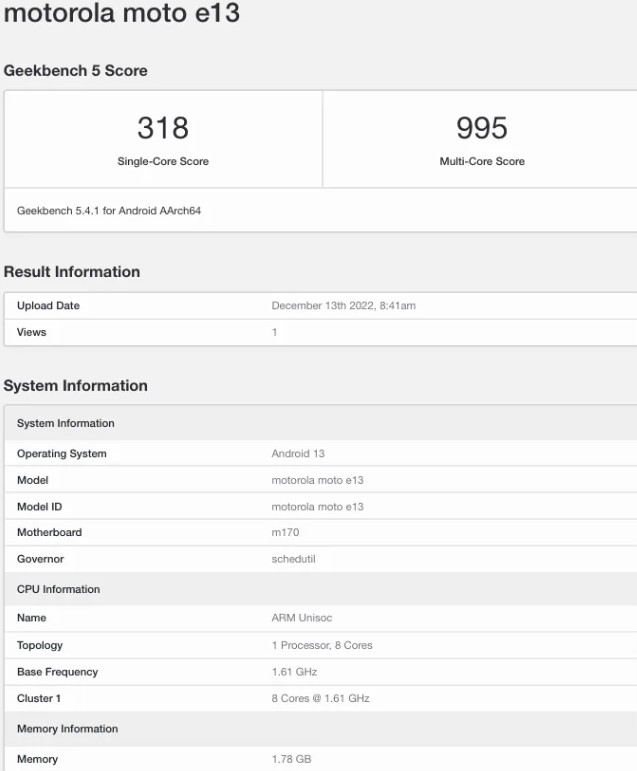
Last week, the Moto G13 bagged NBTC and BIS certifications in Thailand and India respectively. Now a new Moto E-series phone has appeared on Geekench benchmarking platform. The device is the Moto E13. The database listing reveals key specifications of the smartphone. Read on to know more about the Moto E13 below.
As per Geekbench, the Moto E13 is listed with an ARM Unisoc T606 processor. It comprises of eight cores clocked at 1.61GHz. The device will pack 2GB RAM and run on Android 13 OS out of the box. We assume that it will be an Android Go phone since the RAM is less than 3GB. The smartphone scores 318 points in Geekbench’s single-core tests and 995 points in the multi-core test. Apart from this, the benchmarking platform does not reveal any additional details about the smartphone.
Motorola’s E-series phones are budget devices. From the Geekbench specifications, the E13 seems to be an entry-level smartphone. We can expect more details about the device to surface online in the coming weeks.
In other news, Motorola is gearing up to launch the Moto X40 in China this Thursday. It is confirmed to come with a centre-aligned punch-hole curved display, a 4,600mAh battery unit with 125W charging, an IP68 rating, and a horizontal camera lock feature. The smartphone is expected to feature a 6.67-inch FHD+ AMOLED screen with a 144Hz refresh rate and HDR10+ support. The device will be equipped with Snapdragon 8 Gen 2 SoC under the hood and pack up to 16GB LPDDR5 RAM and 512GB UFS 3.1 storage.
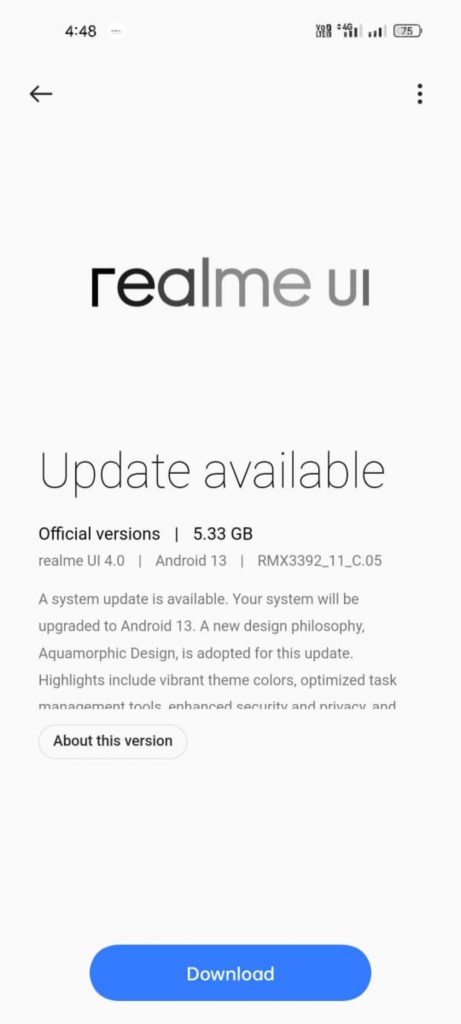
Realme 9 Pro+ was one of the most famous midrange smartphones of the company. The device was mainly in the talks because of its good primary camera and an ugly-looking chin on the front display. The beta testing for the smartphone went live a few weeks back and now finally the stable update for the Android 13-based RealmeUI 4.0 has started rolling out to the device. The newly revamped RealmeUI 4.0 skin brings many new features and optimization to the device.
According to the information, the latest RealmeUI 4.0 stable update for the device comes with the build number RMX3392_11_C.05. The update weighs around whipping 5.33GBs in size. The update is currently rolling out in a staged rollout manner and will be available to the broader public in the upcoming days. The enrolled beta users are first getting the update followed by the stable users. You can check for the update by going to Settings >> About Phone >> Check for updates.
Reference Image
If you have not received the update yet then we suggest you hold on for a few more days and you may receive the OTA update soon. Additionally, the brand may release an updated package soon. So if you want to manually update the smartphone, you will be able to do it using the package.
When it comes to functionality, RealmeUI 4.0 makes significant changes to the entire user interface. It adds a completely redesigned notification panel, a modernised animation engine, and an enhanced haptic experience. Additional new features include customizable Omojis, new fingerprint animations, Spotify music control on the AOD screen, and a host of others. In an effort to improve user experience, the brand has worked to further refine the UI.
The Vivo V16 series is in the news since October. The successor of the Vivo S15 series is rumored to launch by the end of December. Ahead of that, more details about these phones have been emerging on the internet.
Today, a reliable source has leaked the design of the Vivo S16 Pro. Let’s check out what this handset will look like.
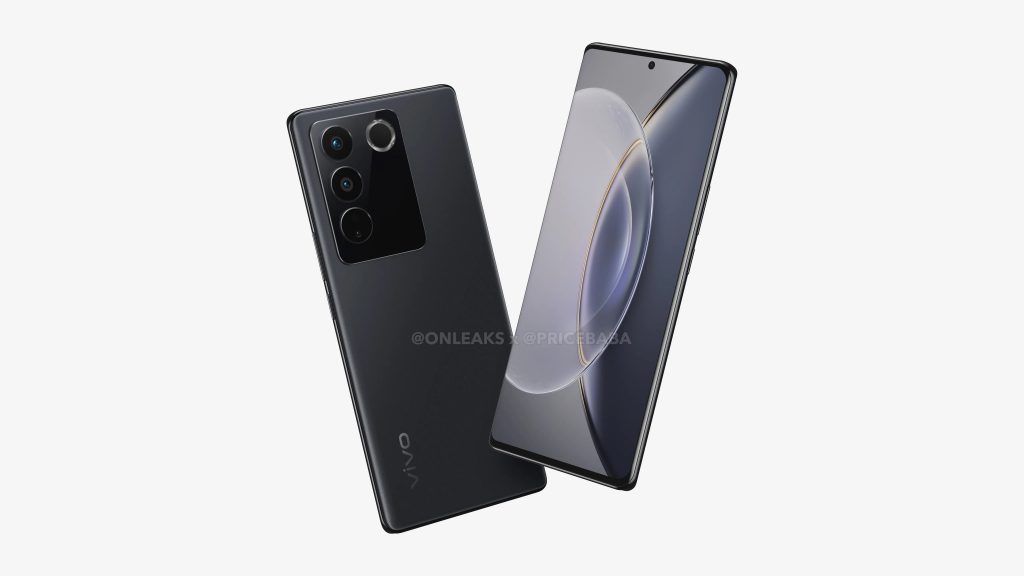
Prolific leaker @OnLeaks (Steve Hemmerstoffer) has partnered with PriceBaba to share the 3D CAD renders of the upcoming Vivo S16 Pro. As per the images and the video, the phone will have a slightly different design compared to its predecessor.
The Vivo S16 Pro’s camera island will be rectangular and larger than that of the Vivo S15 Pro. The island will house three same-sized camera holes and an LED ring. Whereas, one of the three camera holes on the back of the Vivo S15 Pro is smaller than the other two.
The front of the S16 Pro will be dominated by a curved display, just like on the S15 Pro. At the bottom, it will have a speaker grille, a USB Type-C port, and a primary microphone hole. While the top will only include a secondary microphone hole and the volume as well as power keys will be located on the right side.
The tipster says that the handset will sport a 6.6-inch display. Finally, the device will measure 164 x 74.9 x 7.5mm in dimensions.
According to leaks and rumors, the Vivo S16 Pro will be powered by a MediaTek Dimensity 8200 chipset. It will flaunt a 120Hz OLED display and will house a Vivo V1+ chip for image processing.
The smartphone will carry support for 80W fast wired charging and will be available in three colors, such as black, green, and gold.
The Vivo S16 Pro is expected to be accompanied by Vivo S16 and Vivo S16e powered by Qualcomm Snapdragon 870 and Samsung Exynos 1080 chipsets, respectively.
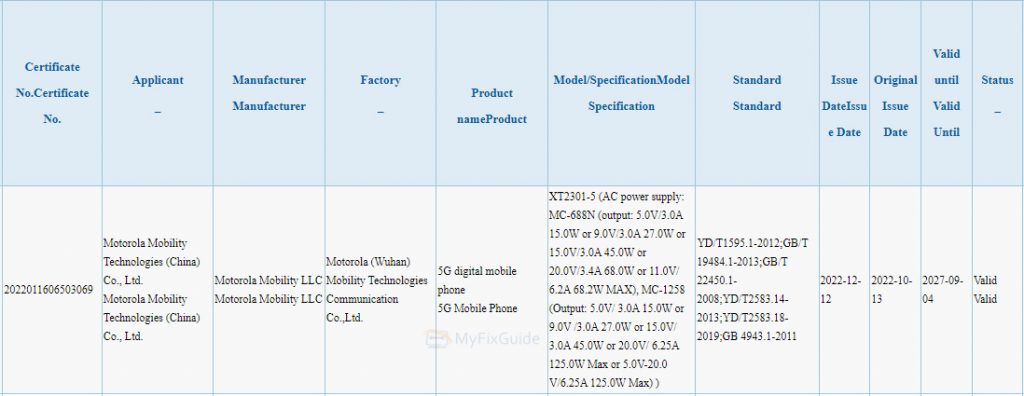
Moto X40 is set to launch in China on December 15th. It will arrive as the successor to the X30 that debuted last year. So far, the smartphone is only confirmed to come with a 4,600mAh battery unit with support for 125W charging. Now ahead of the launch the device has been spotted on China’s 3C certification website revealing that it will come in two variants with different charging speeds.
As per 3C, the Moto X40 is listed with model number XT2301-5. It reveals a 68W charger having model number MC-668N and another 125W GaN charger with model number MC-1258. The latest development is in line with the TENAA listing that revealed the Moto X40 in two variants with different battery capacities and charging speeds. The X40 model supporting 68W speed will be backed by a 5,000mAh battery cell.
The Moto X40 is confirmed to come with IP68 certification against dust and water resistance. It will feature a centre-aligned punch-hole display with a curved screen. The device will have a horizontal lock camera feature that is said to be some action camera mode.
Apart from this, the rest of the specs of the Moto X40 remain a mystery. It is expected to come with a 6.67-inch FHD+ AMOLED display with a 144Hz refresh rate and HDR10+ support. The device will be equipped with Snapdragon 8 Gen 2 SoC under the hood and pack up to 16GB LPDDR5 RAM and 512GB UFS 3.1 storage.
We will learn more details about the Moto X40 at the launch event on Thursday.
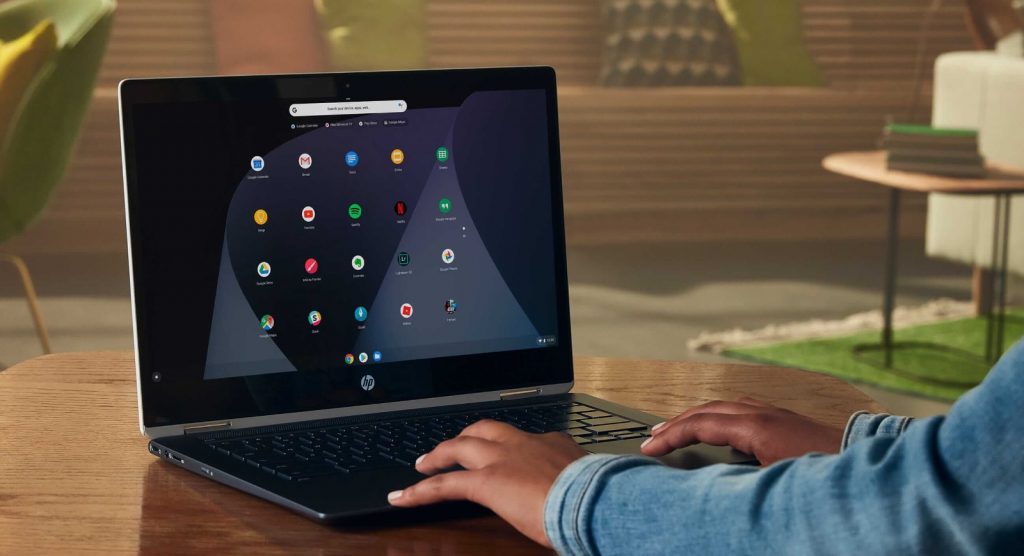
The upcoming Linux 6.2 kernel will include new features for ChromeOS, Google’s operating system for Chromebooks. One of the key new features is a driver for the ChromeOS Human Presence Sensor (HPS), which is used for detecting when one or more humans are present in front of a Chromebook.
Linux 6.2 Adding Driver for Google’s ChromeOS Human Presence Sensor
The Linux 6.2 kernel is set to include a new driver for Google’s ChromeOS Human Presence Sensor (HPS), which is used for detecting when one or more humans are present in front of a Chromebook. The cros_hps_i2c driver will be mainlined in the Linux 6.2 kernel to support the HPS, which is found on newer Chromebooks.
The driver doesn’t report on the presence of humans, but user-space interfacing with the sensor can be done through an exposed character device. The HPS is used for a variety of purposes, such as adaptive backlight handling and deferring the screensaver. The patch-set from Google explains the new driver and its capabilities:
“This patch introduces a driver for the ChromeOS human presence sensor (aka. HPS). The driver supports a sensor connected to the I2C bus and identified as “GOOG0020” in the ACPI tables.
When loaded, the driver exports the sensor to userspace through a character device. This device only supports power management, i.e., communication with the sensor must be done through regular I2C transmissions from userspace.
Power management is implemented by enabling the respective power GPIO while at least one userspace process holds an open fd on the character device. By default, the device is powered down if there are no active clients.”
Privacy-conscious users can rest easy knowing that the hardware firmware for the HPS is open-source. The firmware, I2C protocol, and other technical documentation can be found on GoogleSource.com. The new driver was sent in as part of the Chrome platform updates for the Linux 6.2 merge window. In addition to the new HPS driver, other updates in the pull request include setting PROBE_PREFER_ASYNCHRONOUS for more ChromeOS drivers to speed up boot times for Chromebooks.
BOE is apparently investing in Honor, the former subsidiary of Huawei. The company is investing into Honor, which will help strengthen the ties between the two brands while also increasing their competitiveness in the market.
According to a new report, the known Chinese display maker is further reinforcing its relations with Honor. This would make BOE have a better standing in the country’s semiconductor display industrial chain, as per industry experts. The former Huawei sub brand had recently completed a new round of strategic financing from six new investors. This included the likes of BOE, China International Capital Corp Qizhi Equity Investment Center, Gousen Capital and Shenzhen Baoan District Investment Management Group.
Earlier this month, Honor stated that the company has been shifting its focus on “diversifying shareholding structure, and has always adhered to the principle of openness and collaboration.” For those unaware, BOE is a major supplier for various smartphone brands, which includes major clients like Huawei, Xiaomi, Oppo, Vivo, and Honor. The company is also best known for its OLED panel, which competes with Samsung and LG in the market.
As per Zhou Hua, chief analyst at CINNO Researchm “”For Honor, it is important to have a stable and reliable source of display panels as the company is ramping up efforts to expand its presence in the smartphone market.” So the strengthening of relations between the two will only benefit the company.
The increasing price of smartphones has made them a valuable target for thieves. This problem has been made worse by the fact that stolen smartphones can be difficult to locate, putting the personal data and privacy of their owners at risk. However, the recent authorization of Meizu Technology’s anti-theft patent offers a potential solution. This technology allows users to easily find their lost or stolen devices and protect their personal information.
Meizu Granted Patent For Anti-Theft Technology For Smartphones
Meizu Technology has recently been granted a patent for its anti-theft technology for smartphones. This patent is a response to the growing problem of stolen or lost smartphones, which can be difficult to locate and may result in the loss of personal data and breach of privacy.
Representational image of Meizu 18 series
The patent specification outlines how the technology works. When the owner of a smartphone activates the anti-theft technology, the device receives a control instruction. Upon receiving the instruction, the smartphone is controlled into a black screen mode, rendering it inoperable. The SIM card slot is also locked, preventing others from using the device.
Alternatively, the technology can turn on the internet access function of the device and send location information, allowing the owner to locate the device. This can be useful if the device is not in the black screen mode or the SIM card slot is not locked.
Overall, this technology offers a solution to the problem of lost or stolen smartphones, protecting the user’s privacy and ensuring that lost devices can be located. The patent granted to Meizu Technology provides peace of mind for smartphone users, knowing that their device is protected against theft and can be easily located if it is lost or stolen.
Last month, Samsung‘s Galaxy M14 5G budget smartphone surfaced on Geekbench, revealing some of its key specifications like its chipset details, RAM, and operating system. Now, the smartphone has been spotted on the Bureau of Indian Standards certification website, indicating that it will launch in India soon.
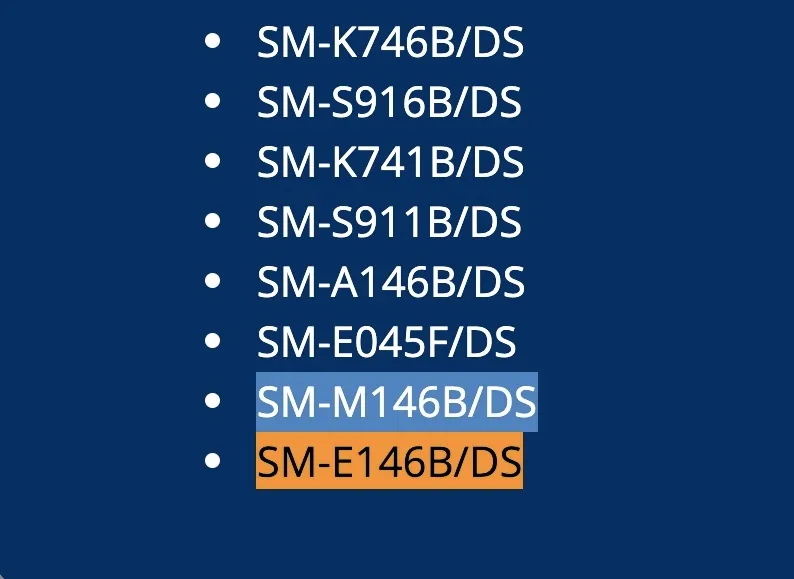
The device appeared on BIS bearing the modern number SM-M146B/DS. Along with the M14 5G, the possible Galaxy F14 5G also appeared on BIS with model number SM-E146B/DS. The listing did not reveal any details regarding the specifications, so let’s take a look at the information available so far.
Samsung Galaxy M13 4G & 5G
According to the Geekbench listing of the Galaxy M14 5G, it features the Exynos s5e8535 SoC, which could be the upcoming Exynos 1330 chipset. The Geekbench score reveals that the chipset is quite capable considering it is being included in a budget range device. It has two cores clocked at 2.4GHz and six cores clocked at 2.00GHz. This comes with 4GB of RAM, but the company might also provide other RAM and storage options. The Galaxy M14 5G will come pre-installed with the Android 13 operating system and the One UI 5.0 skin, according to the Geekbench listing.
Regarding the Samsung Galaxy F14 5G, it is anticipated that this will be an improved model of the Samsung Galaxy F13, which was introduced in India in June of this year. The Galaxy F13 has a 6,000mAh battery, a Full HD+ display, a 50MP camera system, an Exynos 850 chipset, and 4GB of RAM. Therefore, we can anticipate an improvement with the Galaxy F14 5G.
Red Magic has just recently launched a new gaming related product in its home market of China. The device in question is a new 27 inch gaming monitor that arrives with some notable specs and features.
The Chinese smartphone maker had announced a new Red Magic 27 inch esports ready display. This variant of the gaming monitor sports a 27 inch panel that supports 2K 2560 x 1440p resolution with a 99 percent DCI P3 color gamut and a color accuracy Delta E of less than 2. This gaming monitor even houses a number of ports, including HDMI 2.0, Display Port 1.4, and even USB Type C ports as well.
This screen also offer users 400nits of peak brightness and offers high 240Hz refresh rate, which makes it perfect for PC gaming. For those unaware, the brand had launched a gaming monitor with 4K resolution earlier this year. Now, Red Magic has released a 2K version of this display. While the resolution is lower than the 4K variant, it has a higher refresh rate than the 160Hz one found in the 4K model. It also includes DisplayHDR 400 certifications as well.
Looking at the design of this gaming monitor, we can see that the company has released the gaming monitor with thin bezels on the sides and the top. On the other hand, the bottom has a small chin. The brand has began pre-orders for this gaming monitor that has a price tag of 2,499 Yuan (roughly 358 US Dollars).
OnePlus has been long criticized for slower Android updates. To provide better software support to its users, the company discontinued the development of HydrogenOS and merged OxygenOS with ColorOS.
Though this move is considered controversial among the international media and netizens, it is doing wonders for the brand. For the first time, the company finishes the latest Android rollout for almost all of its eligible devices (except one) in China within just 4 months.
OnePlus now sells a wide variety of phones across different price segments globally. But in China, it only sells a single budget model called OnePlus Ace Racing Edition. While the other models in the portfolio fall under mid-range and premium segments.
Apart from that one budget handset, OnePlus is done away with delivering Android 13 stable for its entire portfolio of phones released in China from 2020 to 2023.
The following OnePlus smartphones are currently running the Android 13-based ColorOS 13 stable software in China.
OnePlus 10 Pro
OnePlus 9 Pro
OnePlus 9
OnePlus 9RT
OnePlus 9R
OnePlus 8 Pro
OnePlus 8
OnePlus 8T
OnePlus Ace Pro
OnePlus Ace
Even outside mainland China, OnePlus is only left with updating its Nord lineup to the latest Android version.
Ever since Oppo entered the western markets, it started adapting its software ColorOS for those customers. Currently, ColorOS 13 is one of the best Android skins available globally.
At the same time, Oppo has also sped up software development. The rollout is getting faster with every generation since ColorOS 11.
Hence, it makes sense for OnePlus as a subsidiary of Oppo to use ColorOS. This has enabled the two brands deliver the Android 13 update to eligible devices much faster. Additionally, OnePlus now promises 4 Android updates and 5 years of security updates for select devices releasing in 2023 and later.
For the unaware, Oppo even became the first company other than Google to release Android 13 stable update for its devices this year. Although it was beaten by Samsung in the last couple of months in terms of covering a vast majority of phones and tablets, it is still commendable.
We use cookies on our website to give you the most relevant experience by remembering your preferences and repeat visits. By clicking “Accept”, you consent to the use of ALL the cookies.
This website uses cookies to improve your experience while you navigate through the website. Out of these, the cookies that are categorized as necessary are stored on your browser as they are essential for the working of basic functionalities of the website. We also use third-party cookies that help us analyze and understand how you use this website. These cookies will be stored in your browser only with your consent. You also have the option to opt-out of these cookies. But opting out of some of these cookies may affect your browsing experience.
Necessary cookies are absolutely essential for the website to function properly. This category only includes cookies that ensures basic functionalities and security features of the website. These cookies do not store any personal information.
Any cookies that may not be particularly necessary for the website to function and is used specifically to collect user personal data via analytics, ads, other embedded contents are termed as non-necessary cookies. It is mandatory to procure user consent prior to running these cookies on your website.