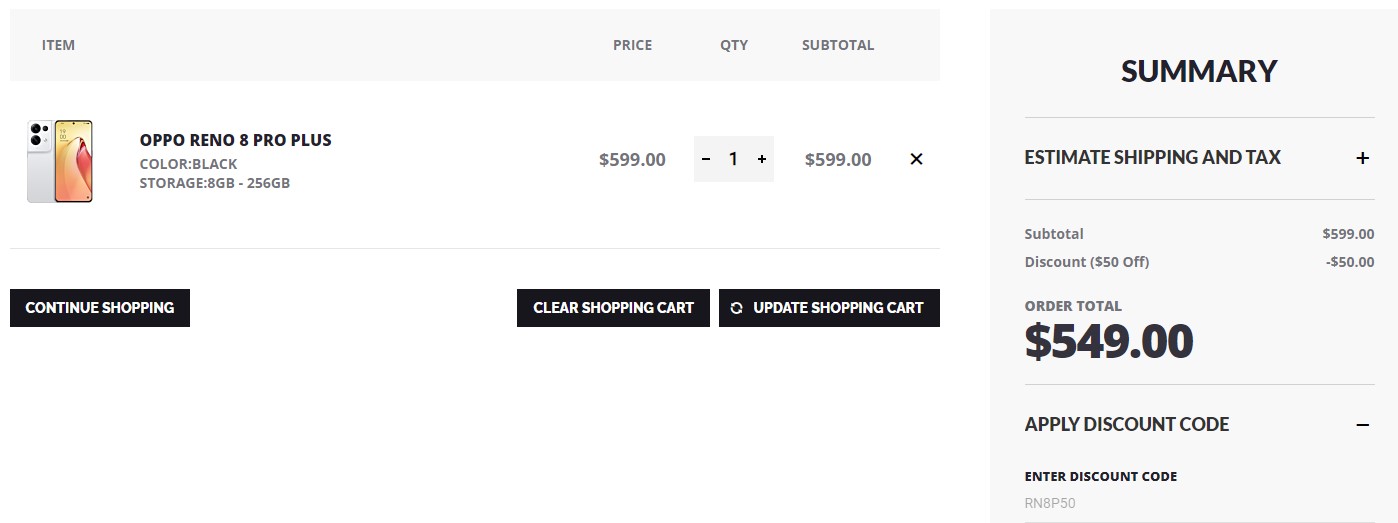
Giztop is giving a $50 coupon for OPPO Reno 8 Pro Plus. The smartphone that generally retails for $599 can now be bought for a discounted price of $549 using the coupon code: RN8P50 only on Giztop. Please note that this coupon expires on 10 August 2022.
Generally retailing for $599 you can now buy OPPO Reno 8 Pro Plus for $549 only on Giztop. This price is applicable to the base variant only. This is a limited-time offer. So place your order before the coupon expires.
For more information on such exciting deals and offers check out our deals hub.
Vivo is preparing to launch a new budget range smartphone in the market dubbed the Vivo Y02s. Last week, the Y02s was spotted on the FCC certification website, and now, the device has appeared on the company’s global website.
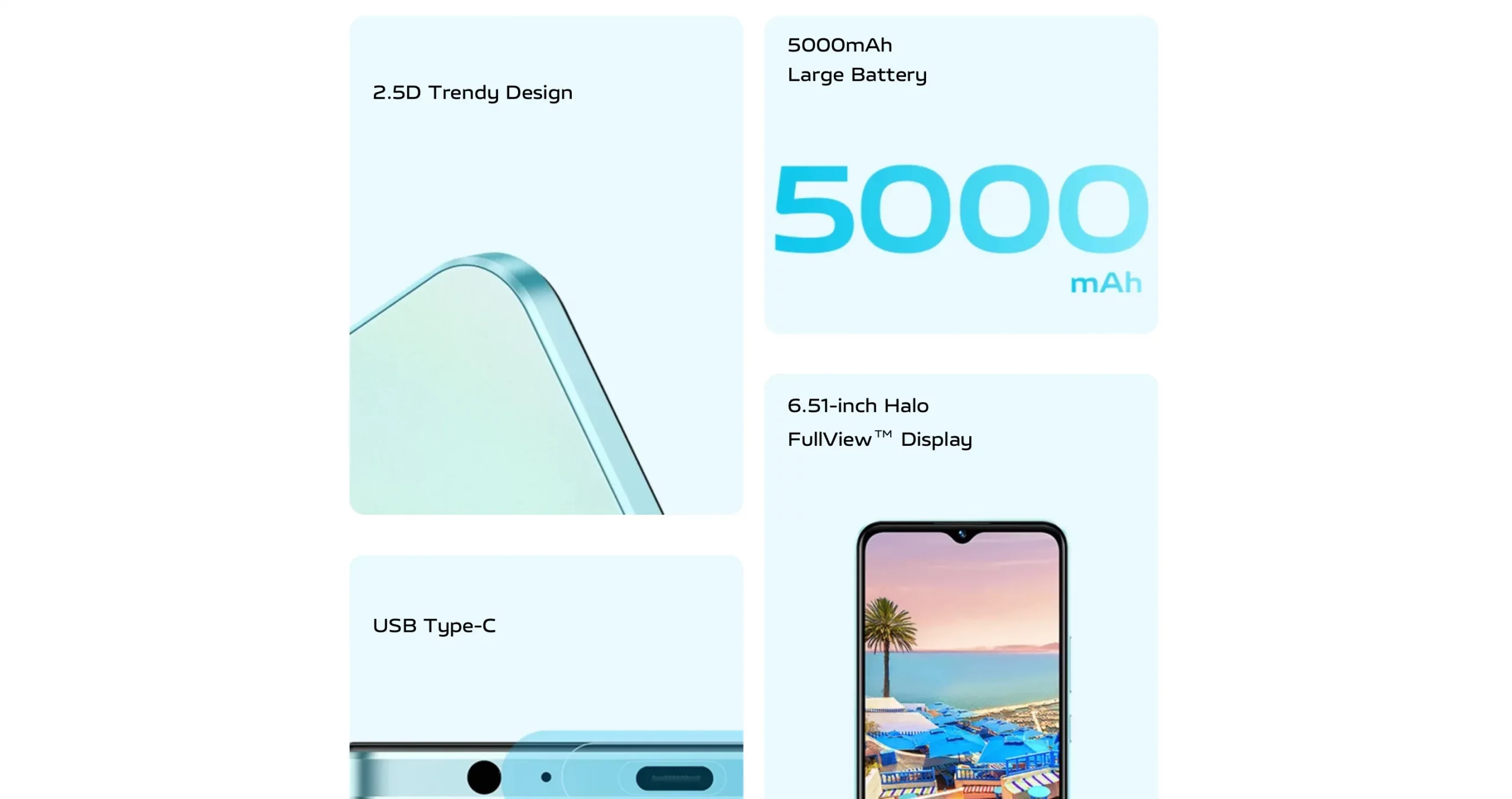
The Vivo Y02s made a brief appearance on Vivo’s website earlier today, revealing its key specifications. The listing has since been taken down, however, it was up long enough for us to confirm that the smartphone has a 6.51-inch HD+ IPS LCD display with a dew-drop notch, HD+ resolution and 60Hz refresh rate. It has a flat back panel made out of polycarbonate and flat edges with curved ends to make the device comfortable to hold for the user.
The Y02s has a MediaTek Helio P35 chipset under the hood with 3GB of RAM and 32GB of internal storage. The battery has a 5,000mAh capacity and comes with support for 10W charging via a USB Type-C port. Vivo claims that the phone can offer up to 18 hours of online HD video streaming, 7 hours of gaming, or 22 hours of music playback. As expected from a budget range device, it retains the 3.5mm audio jack.
As for the camera module, it has two circular cutouts, one of which houses the 8-megapixel primary sensor while the other houses an LED flash. On the front, the smartphone brings a 5-megapixel sensor for selfies and video calls.
Other than that, the listing has also revealed the color variants of the device – Fluorite Black and Vibrant Blue. However, its exact date of launch and pricing is still under wraps.
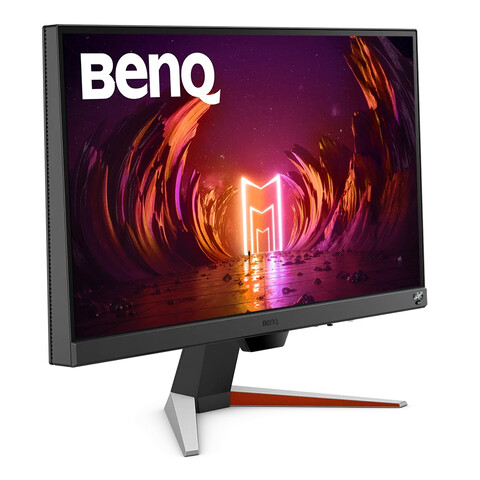
The BenQ EX240N gaming monitor with the MOBIUZ VA panel and 4ms response time has been unveiled. The new gaming monitor has a 165Hz refresh rate and offers a 1080p video resolution. It also supports AMD FreeSync Premium and has dual 2.5W speakers. The EX240N has a 23.8-inch display offering up to 250 nits of brightness. The gaming monitor has a contrast ratio of 3000:1 and 72% NTSC color space coverage.
Its super low latency with a 1ms MPRT response time and 165Hz refresh rate will be a delight for gamers. The dual speaker system of the gaming monitor accounts for some proportion of its 40W power consumption. This can be significantly reduced when it is connected to a headphone via its 3.5mm jack. The gaming monitor also features HDMI 2.0 and DisplayPort 1.2 connections. You can use the new BenQ gaming monitor for current gaming consoles although its maximum refresh rate is only achieved via its DisplayPort input from a PC.
BenQ has not provided release and availability details yet but the monitor could retail for about $200. The FPS mode, AMD FreeSync Premium, and Motion Blur Reduction are all featured in the EX240N. An alternative model, the EX240 comes with a 10cm adjustable stand and will cost $240. The EX240 also features an additional HDMI port and swivel capabilities.
BenQ says the EX240N is designed to evoke an immersive gaming experience with its subtle and realistic colors. It will deliver the highest quality expected by gamers. The fast response time and no tearing present are also key highlights of the new BenQ gaming monitor. A 3-year limited warranty is available for the BenQ EX240N gaming monitor.
Redmi Note-11 series is quite popular in India and it has decent smartphones including the Redmi Note 11 Pro+ 5G, Note 11T 5G, and more. Now, it seems that the company is going to launch yet another smartphone under the Note-11 series. As per a tipster, the new smartphone will be a rebranded Redmi Note 10S and will be called Redmi Note 11 SE.
Noted tipster Kacper Skrzypek has spotted the moniker “Redmi Note 11 SE” in the MIUI code. However, the tipster claims that the device is for the Indian market and will be different from the one launched in China earlier this year. The MIUI code reveals that the device will be a rebranded Redmi Note 10S that was launched last year.
It is also claimed that the same device will also debut in some markets as the Poco M5s, which has already been spotted on multiple certifications sites.
Redmi Note 10S
If this leak is anything to go by, the Note 11 SE will likely have the same specs as the 10S, which means it will feature a 6.43-inch AMOLED display that offers a Full HD+ resolution and a standard 60Hz refresh rate. It could be powered by a MediaTek Helio G95 processor paired with 8GB of RAM and 128GB of storage.
As far as the cameras are concerned, Redmi Note 11 SE may house a quad-camera setup on the back consisting of a 64-megapixel main camera, an 8-megapixel ultrawide camera, and a pair of 2-megapixel sensors for depth and macro. The device will be fueled by a 5000mAh battery supporting 33W fast charging. On the software front, it may run MIUI 13 based on Android 12 out of the box.
Lenovo has unveiled the Legion Y700 Ultimate Edition tablet with an 8-inch display in China. The new Android tablet also features a color-changing glass back and is offered at a discounted price of 3,299 yuan (~$489). As with the Legion Y700, the Lenovo Legion Y700 Ultimate Edition may not be globally available yet.
The standard model, the Legion Y700 was released in China last February. The Legion Y700 Ultimate Edition comes with identical features to the standard model. The tablet is a great gaming device and is as compact as it can get for an Android tablet. It is powered by a Snapdragon 870 chipset and has a chrome shell exterior design. The LCD panel of the Legion Y700 has a 120Hz display refresh rate. Two color options are available for the new tablet namely ice white and glare blue.
The Legion Y700 Ultimate Edition is priced at 3,699 yuan (~$549) and it includes an inductive rear glass panel. The glass back changes colors while the tablet is in operation and could be exciting to gamers. The illuminating effects of RGB lighting during gaming can give a lift to some gaming enthusiasts.
There are now three versions of the model in China while it remains unavailable globally. Gaming enthusiasts outside China who are desirous of trying their hands on a compact Android gaming tablet could get it via resellers. Lenovo remains silent on scaling up the availability of the Legion Y700 tablet.
Earlier this month, Xiaomilaunched the Redmi Buds 3 Lite in India along with the Redmi K50i 5G smartphone. The earbuds are positioned as an affordable pair of TWS earphones with impressive value for money. Now, the earbuds have officially gone for sale and are available at a discounted price for a limited amount of time.
Redmi Buds 3 Lite pricing & availability
Redmi Buds 3 Lite is priced at Rs. 1,999 (roughly $25) in the Indian market. However, it will sell for an introductory price of Rs. 1,499 for the first 48 hours. The Buds 3 Lite will go on sale starting today (July 31) at 12 PM IST on Amazon and the mi store.
Redmi Buds 3 Lite specs
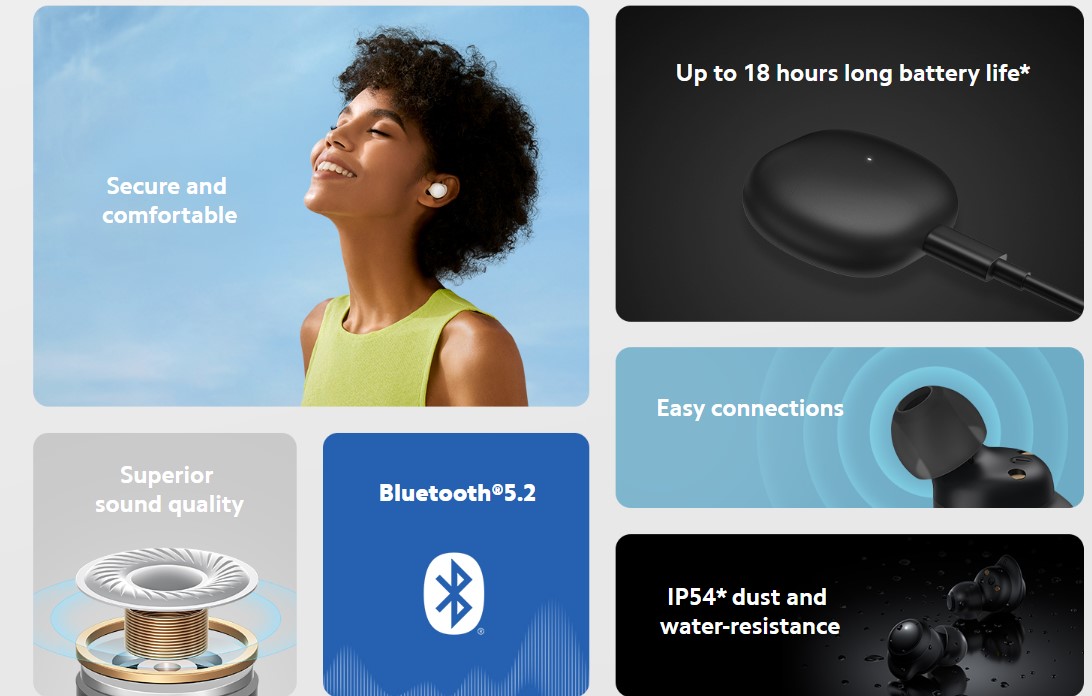
For the price, the Redmi Buds 3 Lite has outstanding features. It has Bluetooth 5.2 connectivity, USB Type-C charging, and a claimed battery life of up to 18 hours between the earphones and the charging case. Up to 5 hours of listening time can be obtained from a single charge of the earbuds alone.
6mm dynamic drivers tuned by Xiaomi Sound Lab power the Redmi Buds 3 Lite. Although the earbuds lack active noise cancellation, the manufacturer says that they nonetheless provide respectable noise blocking thanks to a noise reduction algorithm. A low latency gaming option is also available on the Redmi Buds Lite for an immersive gaming experience.
The earbuds have a number of touch controls that enable users to adjust the volume, decline or answer calls, disable game mode, activate voice assistant, and more.
Only Black is available in terms of color options for the Redmi Buds 3 Lite. The Redmi Buds 3 Lite’s earbuds weigh 4.2 grams each and have dimensions of 24.5 x 16.7 x 24.6mm. The charging case weighs 35 grams and has dimensions of 60 by 46 by 23.7mm.
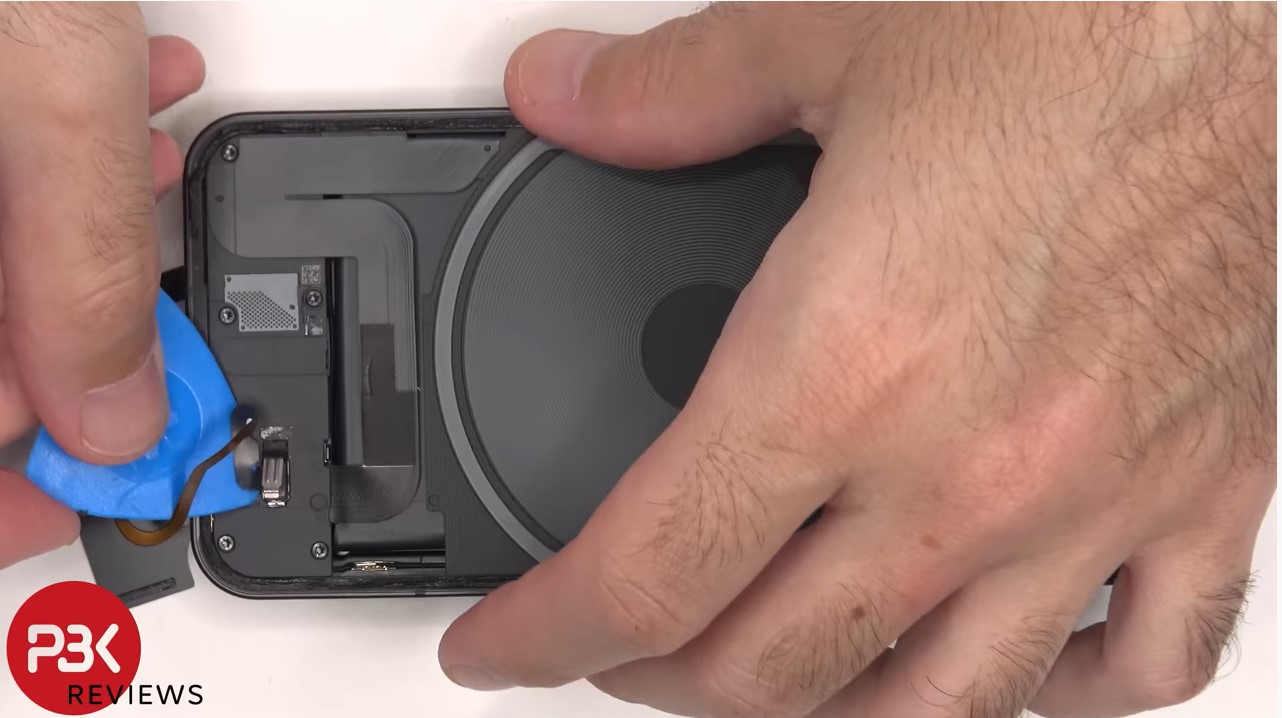
Nothing‘s first smartphone, the Phone (1) sports a unique transparent design that provided sufficient buzz preceding its eventual launch. A new video that shows the Nothing Phone (1) being disassembled has surfaced. The video emanated from the YouTube channel PBK Reviews and outlined the teardown and reassembly of the Phone (1). It was taken apart bit by bit and then fixed back.
The disassembling process began by removal of the SIM module and then applying heat to soften the adhesive covering of the device. Other components were carefully removed with the moderator alerting users to be careful in the process. The flex cables, top speaker, wireless charging cable, and other components were carefully removed to gain access to the cameras. There are graphite heat dissipation components atop the main board. On the main board, there is a 50MP primary lens and a 50MP ultra-wide sensor. The 4,500mAh battery is removed and reveals an array of cables and components.
The replacement of the Phone (1) screen can be very complicated due to the processes before getting access to the screen. The Nothing Phone (1) gets a very low repairability score of 3 out of 10. The video is concluded by reassembling the device and it was successfully powered on.
The teardown/ reassembly video of the Phone (1) was quite comprehensive. All the components of the mid-range device were well explained and carefully taken apart. The device supports 33W wired and 15W wireless charging, with reverse charging also supported. The Phone (1) is also splash resistant and is priced at $745 for the 12GB+ 256GB model.
OPPO Reno8 Pro debuted in the global market with totally different specifications from the Chinese version because it is a rebrand of the Reno8 Pro Plus. Meanwhile, Google launched the new Pixel 6a in several European markets, with a promo launch giving you the true wireless earbuds Pixel Buds A as a gift. The bundle is very attractive and it will be very interesting to discover which of these two devices will offer the highest value for money in the European market. The OPPO Reno8 Pro Global is supposed to come to Europe during the month of September. Meanwhile, we want to prepare you through a comparison between the specifications of the Google Pixel 6a and the OPPO Reno8 Pro Global. They are very different phones, but probably you won’t be able to tell the same about their prices: that is the reason why we decided for a comparison.
Google Pixel 6a vs OPPO Reno8 Pro Global
Google Pixel 6a
OPPO Reno8 Pro Global
DIMENSIONS AND WEIGHT
152.2 x 71.8 x 8.9 mm,
178 g
161.2 x 74.2 x 7.3 mm,
183 g
DISPLAY
6.1 inches, 1080 x 2400 pixels (Full HD+), OLED
6.7 inches, 1080 x 2412 pixels (Full HD+), AMOLED
PROCESSOR
Google Tensor, octa-core 2.8 GHz
Mediatek Dimensity 8100 Max, octa-core 2.85 GHz
MEMORY
6 GB RAM, 128 GB
8 GB RAM, 256 GB – 12 GB RAM, 256 GB
SOFTWARE
Android 12
Android 12, ColorOS
CONNECTIVITY
Wi-Fi 802.11 a/b/g/n/ac/6, Bluetooth 5.2, GPS
Wi-Fi 802.11 a/b/g/n/ac/6, Bluetooth 5.3, GPS
CAMERA
Dual 12.2 + 12 MP, f/1.7 + f/2.2
8 MP f/2.0 front camera
Triple 50 + 8 + 2 MP, f/1.8 + f/2.2 + f/2.4
32 MP f/2.4 front camera
BATTERY
4410 mAh, fast charging 18W
5000 mAh, Fast Charging 80W
ADDITIONAL FEATURES
5G, dual SIM, IP67 water resistant
5G, dual SIM
Design
The Google Pixel 6a is a very interesting phone because it is one of the most compact high-end devices out there, thanks to its smaller display. But not only because of that: it is also lightweight and water resistant: the IP67 certification proves it is dust and water resistant. It is built with a plastic back and an aluminum frame, and it has a variant supporting the eSIM technology. It has a very original design with cameras placed horizontally. The OPPO Reno8 Pro Global has bigger dimensions due to the presence of a bigger display, but it is thinner than its rival. Unfortunately, it does not offer any certification for the protection against water and dust, but it is built with premium materials: aluminum for the frame and glass for the back, while the front panel is protected by Gorilla Glass 5. Do you prefer a compact but cheaper phone or a bigger but thinner device with premium materials?
Display
The displays of these two devices are great, but the OPPO Reno8 Pro Global has the best one. It comes with an AMOLED display sporting a diagonal of 6.7 inches, showing up to one billion colors. The resolution is Full HD+ with 1080 x 2412 pixels and the display has a 120 Hz refresh rate and the HDR10+ certification, as well as a 950 nits peak brightness and an in-display fingerprint reader. The Google Pixel 6a has a great OLED display with a 6.1-inch diagonal, a Full HD+ resolution of 1080 x 2400 pixels, HDR certification, and an in-display fingerprint reader, but it lacks the 120 Hz refresh rate and it is not able to show one billion colors but it stops at 16 million. However, it remains very interesting because it is a compact panel, easy to use with one hand, and the phone is comfortable to keep in a pocket. Both the handsets are equipped with stereo speakers, but they do not feature audio jacks.
Specs & Software
The Google Pixel 6a is powered by the Google Tensor: the first proprietary chipset by Google. It is built at 5 nm and it has an octa-core architecture composed of two Cortex X1 CPUs running at a max frequency of 2.8 GHz, two Cortex A76 CPUs running at a frequency of 2.25 GHz, and four Cortex A55 CPUs running at 1.8 GHz, as well as a Mali G78 MP20 GPU. The chipset is paired with 6 GB of RAM and 128 GB of UFS 3.1 internal storage. The OPPO Reno8 Pro Global is fueled by the MediaTek Dimensity 8100 Max mobile platform: an upgraded version of the Dimensity 8100 with higher AI capabilities. It is a chipset built at 5 nm with an octa-core architecture composed of four Cortex A78 CPUs running at a max frequency of 2.85 GHz, four Cortex A55 CPUs running at 2 GHz, and a Mali G610 MC6 GPU. The Dimensity 8100 by Mediatek is a better chipset than the Google Tensor found on the Pixel 6a. Further, it is paired with up to 12 GB of RAM and up to 256 GB of UFS 3.1 internal storage, definitely better than the 6/128 GB configuration of the Pixel 6a. Both the phones run Android 12 out of the box, but the Google one will most likely get longer software support.
Camera
The main rear camera of the OPPO Reno8 Pro is definitely better than the one found on the Google Pixel 6a. It is a Sony IMX766 chipset with OIS support, aided by the MariSilicon X. We are talking about the first proprietary NPU by OPPO improving night photography and videos thanks to a power of 18 TOPS. The Reno8 Pro even provides a better front camera with a 32 MP resolution.
The OPPO Reno8 Pro Global has a slightly bigger battery than the Google Pixel 6a and it charges way quicker thanks to 80W fast charging, that is the reason why it wins the battery comparison.
Price
The OPPO Reno8 Pro starts from €550/$550 in India, while the Pixel 6a begins at €460/$460 globally (prices vary depending on the market). The Reno is definitely a better phone if we consider hardware, display, and cameras, but the compact size and the long software support of the Pixel still make it a very intriguing choice.
Google Pixel 6a vs OPPO Reno8 Pro Global: PRO and CONS
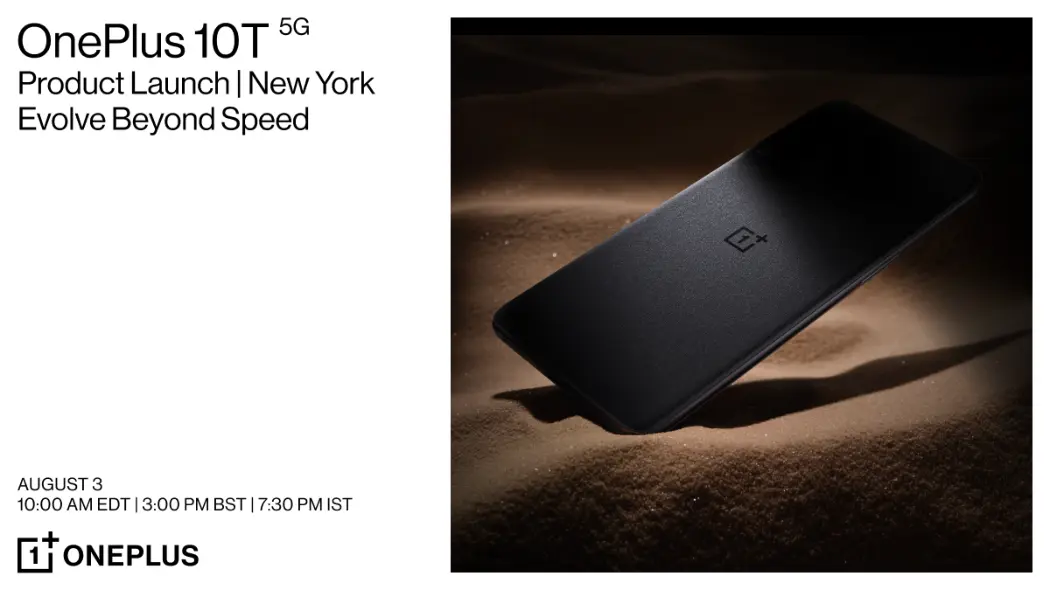
OnePlus is gearing up to launch a new flagship-tier device in the global market dubbed the OnePlus 10T on August 3rd. The device will also launch in China on the same day as the OnePlus Ace Pro.
Ahead of the launch, the company has teased some of the specifications of the OnePlus Ace Pro already. These include the industry-first eight-channel vapor chamber, 150W fast charging, and 16GB RAM+ 256GB storage variant. Now, the brand has also teased the display specs of the Ace Pro, so let’s take a look at the details.
The official teaser reveals that the smartphone will come with a 6.7-inch AMOLED display. The display will have a 120Hz refresh rate and a 720Hz touch sampling rate. It will feature support for HDR10+ and will also be capable of producing 1.07 billion colors. Lastly, the teaser states that the phone will come with super thin bezels measuring just 1.48mm in thickness. The teaser does not reveal the resolution of the device, but leaks so far have suggested that it will be a Full HD+ resolution panel with a 20:9 aspect ratio.
As for other details about the device, it will be equipped with the latest Snapdragon 8+ Gen 1 flagship chipset, which will come paired with up to 16GB of RAM and 256GB of storage in the Indian market. As for China, a 16GB + 512GB variant is rumored.
The camera setup is said to include a 50-megapixel Sony IMX766 primary sensor with OIS support, an 8-megapixel ultra-wide camera, and a 2-megapixel macro camera. For selfies, it will feature a 16-megapixel front-facing camera. Lastly, the smartphone will pack a 4,800mAh battery with 150W rapid charging support and will come with Android 12-based Color0S 12.1 out of the box (OxygenOS in the global market).
The OnePlus 10T has been extensively teased these past few weeks on the brand’s official social media pages, as well as being leaked on many electronics safety certifications and benchmarking platforms. In this roundup article, we at Gizmochina have compiled all the info that you should know about the OnePlus 10T.
OnePlus 10T Specs and Design
Starting with the engine powering the OnePlus 10T, the latest Snapdragon 8+ Gen 1 SoC by Qualcomm promises to deliver 10% higher CPU and GPU performance, 4 times faster AI performance and 30% better power efficiency compared to the top-end OnePlus 10 Pro launched earlier this year.
Source: OnePlus
On the topic of speed, the OnePlus 10T will also feature a massive 16GB of LPDDR5 RAM and 256GB of fast UFS 3.1 internal storage to provide a smoother and speedier multitasking experience. The screen can also keep up with the speed that the OnePlus 10T provides as it is a 6.7-inch 120Hz refresh rate E4 AMOLED display with a centered punch hole cutout that houses the selfie camera at the front.
The device features an in-screen fingerprint sensor that is both secure and fast for users to unlock their phones. Charging-wise, the OnePlus 10T features the brand’s most rapid charging yet at 150W wired fast charging support. The 150W SuperVOOC charging support onboard promises to charge the OnePlus 10T’s 4800mAh battery in just 10 minutes, and the battery endurance is said to last the user a full day.
Coming to the less exciting features, the cameras of the OnePlus 10T is a rather conventional Android budget flagship triple-camera setup. The main lens is a Sony IMX766 sensor with OIS, the ultra-wide is a unknown 8MP sensor, the third sensor is a 2MP macro lens and the front-facing camera is a 16MP unit for selfies.
Other things to note about the OnePlus 10T design are that this OnePlus flagship will not be featuring Hasselblad’s branding on its cameras and that the OnePlus 10T will be the first-ever OnePlus flagship to ditch the alert slider. OnePlus’ reasoning for the abandonment of the alert slider is that it wanted to make space for the speedy 150W fast charging and larger 4800mAh battery that would benefit the users more than the alert slider.
OnePlus 10T Colors and Pricing
The OnePlus 10T is officially announced to be arriving in 2 colour options: Matte Black and Glossy Green.
The OnePlus 10T is expected to launch at a lower starting price than the OnePlus 10 Pro, which means that it could start at US$749//£659/€749/Rs 49,999. For reference, the OnePlus 10 Pro was launched globally starting from US$899/£799/€899/Rs 66,999.
Back in 2019, Motorola entered the foldable smartphone segment with the iconic Moto Razr which was greatly inspired by the OG feature phone series of the same name. The company then launched the Moto Razr 2020 which was an improved version of the first-gen smartphone.
For some reason, Motorola didn’t launch a Razr smartphone in 2021, but this year it’s coming strong with the latest Moto Razr 2022. So, let’s take a look at what we can expect from the foldable device.
Moto Razr 2022 Launch Date
Motorola has confirmed that it will be launching the Moto Razr 2022 alongside the Moto X30 Pro in a launch event scheduled on August 2, a week ahead of the launch of Samsung’s Galaxy Flip 4 and Fold 4.
The event will begin at 7:30 PM GMT+8. It will also be live streamed so that you can witness the launch from the comfort of your home. The smartphone is currently launching in China and will soon make its debut in the international market.
Moto Razr 2022 Design
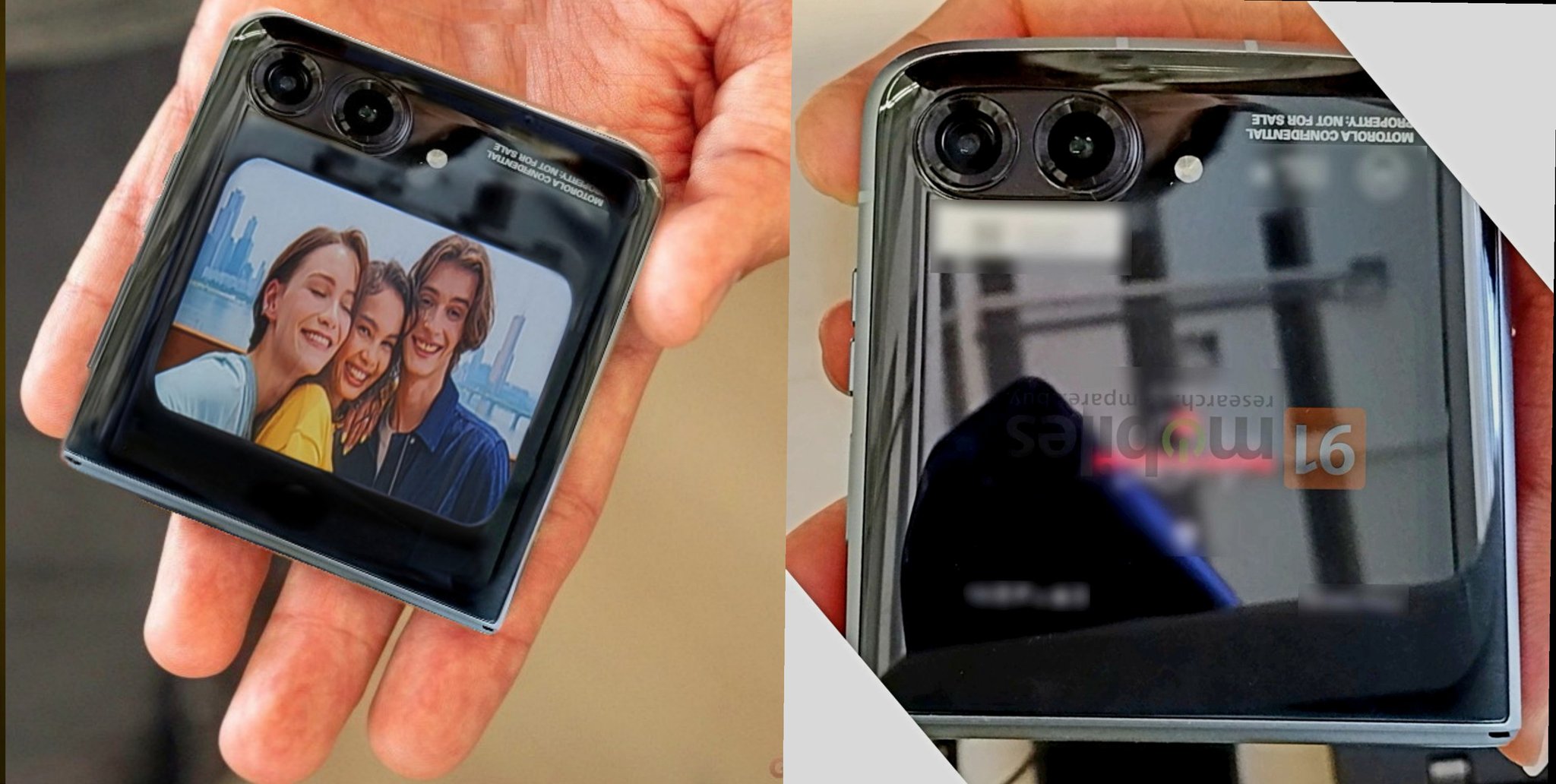
As per the leaked renders and a promotional video by Motorola, the new Razr 2022 will land with a completely new appearance. It will have a boxier, squared-off design and will look nothing like the previous models.
Motorola Razr 2022
The upcoming foldable phone has lost its trademark chin at the bottom and resembles Samsung’s Galaxy Flips to a great extent. The phone’s display will have a centered hole punch for the selfie camera. The display appears to be neat and has no visible crease. On the outside of the phone, there are two main cameras and an exterior display that covers most of the front part.
The fingerprint sensor on the device has also been shifted to the side-mounted power button which is a welcome move because the fingerprint sensor placement on previous Razrs was not very impressive. Overall, the new Razr 2022 looks sleek and better than earlier models. It is also said to be available in multiple color options.
Moto Razr 2022 Specifications
Motorola managed to keep the specs of the Razr 2022 under wraps for a long time but a recent TENNA listing revealed it all. As per the listing, the device will have a 6.7-inch foldable AMOLED display that will offer a Full HD+ resolution and a 20:9 aspect ratio. The device is also rumored to feature a 120Hz refresh rate.
If we talk about the processor, the Moto Razr 2022 will be powered by Snapdragon 8+ Gen 1 Soc, in fact, it will be the world’s first foldable device to feature this processor. In addition, it will be available with up to 18 GB of RAM and 512 GB of built-in storage. The latest moto foldable is definitely going to be a powerful smartphone and will go head-to-head with Samsung’s Flip 4.
The device will be fueled by 3500mAh dual-cell battery which is a significant increase over the previous models. The charging speed of the device is not known yet but it will likely come with fast-charging support.
The device will run Android 12 OS based on MyUI out of the box. The device’s dimensions when unfolded are 166.99 × 79.79 × 7.62mm. It is likely to be available in a variety of hues, including black, white, blue, cyan, green, gold, red, silver, and grey. It weighs about 200 grams.
Moto Razr 2022 Cameras
The camera on Moto Razr 2020 was rather disappointing, it featured a sole 16-megapixel snapper which wasn’t actually good. However, with the Razr 2022, Motorola seems to be stepping things up. The latest foldable has a dual camera setup on the back and they are rumored to be pretty good.
Reports suggest the device will have a 50-megapixel main sensor with an f/1.8 aperture, accompanied by a 13-megapixel ultrawide lens. While on the front, it may have a 32-megapixel shooter for selfies and video calls, and as mentioned, it’ll be placed in a hole-punched cutout.
Moto Razr 2022 Expected Price
The Moto Razr 2022 is expected to be priced at around $1,200. Surprisingly, it’s less than Razr 2020, which costs around $1,399. Again, this is just the rumored pricing and we are not sure if it’s for the base variant or the max variant.
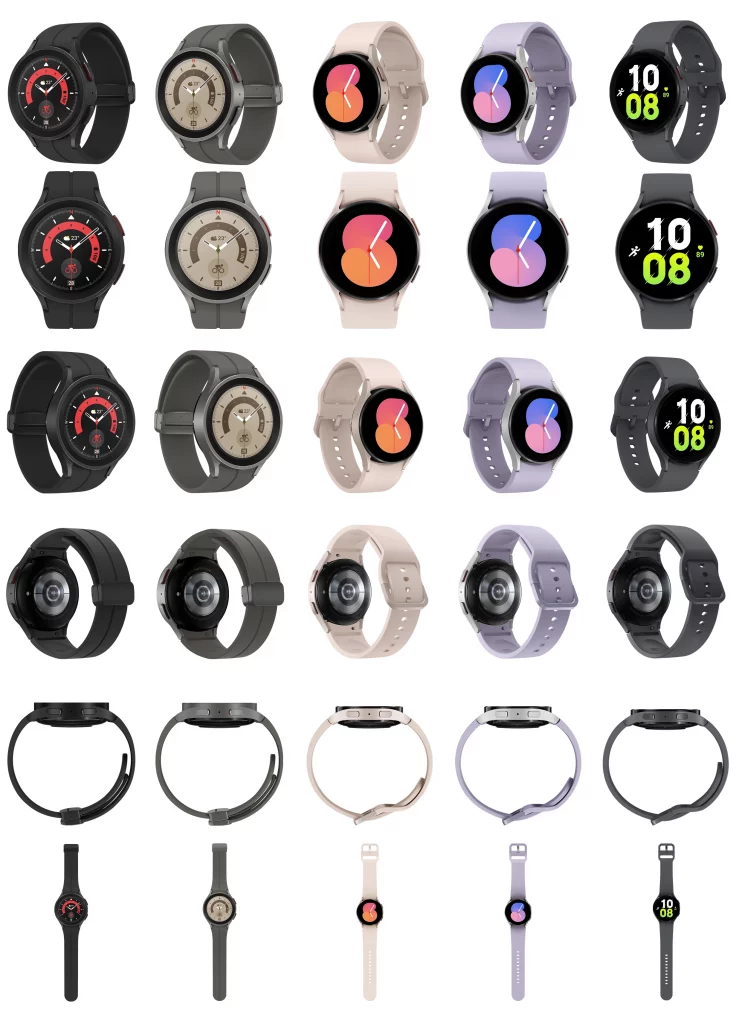
Samsung Galaxy Watch 5 series has been spotted in high-quality leaked renders. The leaked images have been shared by reliable tipster Evan Blass (aka evleaks) in collaboration with publication 91Mobiles. The next-generation Galaxy Watch is set to debut at the brand’s Unpacked event on August 10th.
The leaked renders give us a better look at the upcoming Galaxy Watch 5 and Watch 5 Pro. From the left to right, upon a closer inspection, the first two variants have a model number SM-R920 and R925F respectively corresponding to the Galaxy Watch 5 Pro. Both have a 45mm dial size and a sporty watch band.
The next three in the line are likely the regular Galaxy Watch 5 with model numbers SM-R900, SM-R905F, and SM-R910. These will be available in 40mm and 44mm dial sizes. The regular Watch 5 features silicone straps with a buckle mechanism.
The Pro variant is seen with large bezels and is thicker (probably due to a bigger battery) compared to the standard version. All five smartwatches i.e. the Galaxy Watch 5 Pro and Watch 5 feature two physical buttons on the right side and a small cutout that we assume to be a microphone. The Galaxy Watch 5 series will be water-resistant up to 5 meters.
The Galaxy Watch 5 series will come with built-in GPS. One variant in the Galaxy Watch 5 Pro (SM-R925F) and the regular Galaxy Watch 5 (SM-R905F) will come with LTE support. The Pro variant is seen in Black and Brown colour wheras the regular version is expected to be available in Rose Gold, Lavender, and Black colours.
Nvidia is expected to be working on the cutting-edge new generation RTX 40 series graphics cards. The American tech giant is planning three variants, namely RTX 4070, RTX 4080, and RTX 4090.
All the new RTX 40 series graphics cards were tested on the basis of the 3DMark TimeSpy Extreme Test and the performance capabilities have been revealed. The following facts are courtesy of popular leaker @kopite7kimi. According to the leaker, the RTX 40 series will be groundbreaking in terms of efficiency and power.
RTX 4080, TSE >15000, RTX 4070, TSE ~10000. These scores are based on specs I mentioned before. Honestly, it's not quite sure yet except RTX 4090. Well, I don't care.
As usual, use caution when interpreting these results. Kopite admits they aren’t quite certain of the information supplied, but the leaker has a remarkable track record for accuracy. It’s unclear whether Kopite truly saw some real performance data and only obscured it to protect the (not so) innocent, or if these are just educated estimations. We’ve been generating similar estimates based on suspected specs for a while.
For comparison, Kopite already released RTX 4090 Time Spy Extreme data a week prior, which shows that GPU performance is around 30% faster than the RTX 3090 Tis with the highest clock speeds and liquid cooling. Kopite’s RTX 4080 and 4070 statistics aren’t that stunning when used as a starting point with that data.
Kopite predicts that the RTX 4080 will achieve a Time Spy Extreme graphics score of 15,000 points, which is slightly higher than the RTX 3090 Ti’s result at regular frequencies. With regard to Time Spy Extreme, in particular, this information would make the RTX 4080 40% to 50% quicker than the RTX 3080 10GB, which would be a significant generational advancement. Customers will receive a very potent graphics card for the money if GPU pricing for the 4080 is even remotely comparable to those for the 3080.
The RTX 4070 projections aren’t as remarkable, but they still represent a good generation-to-generation improvement (if true). The majority of the RTX 3080 10GB results in the 3DMark results browser completely align with Kopite’s prediction that the RTX 4070 will get 10,000 points in Time Spy Extreme. This corresponds to a performance increase of 25% over the 3070 and performance on par with the RTX 3080.
For the RTX 4090 and 4080 in particular, it will almost probably result in record-breaking generational performance increases, which is something we’ve long believed about Nvidia’s RTX 40-series design. However, it will increase power consumption. The price of GPUs is now the largest unknowable, and it could change significantly depending on supply-chain concerns and the launch date for the 40-series. Performance is only useful to a certain extent if it is affordable.
Also, keep in mind that 3DMark simply reflects one artificial graphics test; what we actually want to see are benchmarks from actual gaming.
OnePlus 10T launch is just around the corner and the news of yet another OnePlus flagship has already started online. As per a report, a new OnePlus flagship with Snapdragon 8+ Gen1 SoC has been spotted on Geekbench benchmarking site. The listed smartphone is expected to be the alleged OnePlus 10RT. Recent reports suggest that the device has also bagged BIS India certification.
A listing on Geekbench, first spotted by MySmartPrice, shows a OnePlus device with model number CPH2413. The model number is rumored to be associated with the purported OnePlus 10RT. The listed device could run Android 12 with 8GB RAM.
OnePlus 10T
The processor in the listing can be seen to have four cores clocked at 2.02 GHz, three cores clocked at 2.75 GHz, and one prime core clocked at 3.19 GHz. This configuration suggests that the device is equipped with Qualcomm’s latest Snapdragon 8+ Gen1 Soc. The processor is paired with Adreno 730 GPU.
The handset has scored 828 points in single-core testing and 3,414 points in multi-core testing on Geekbench. These were all the details we could get from the Geekbench listing. Do note that the listed device is not confirmed to be the OnePlus 10RT, and it could even be the OnePlus 10T, which is launching on August 3.
Possible OnePlus 10RT may be equipped with an AMOLED display that offers 120Hz refresh rate. It may have a triple rear camera setup, including a 50-megapixel primary sensor, an 8-megapixel secondary shooter, and a 2-megapixel camera. The device may also feature up to 150W charging support because we all know OnePlus is a company that loves fast charging.
Lenovo has a lineup of premium tablets under its Xiaoxin brand, and the company is soon expected to launch a new device named Lenovo Xiaoxin Pad Pro 2022.
Ahead of the official launch, some of the key specifications of the device have been leaked online as the tablet with model number TB138FCxxxxx passed through the 3C certification.
As per the latest information shared by Digital Chat Station, the Lenovo Xiaoxin Pad Pro 2022 will feature an OLED display with a 2K screen resolution and a high refresh rate. Under the hoof, the device will come powered by the Qualcomm Snapdragon 870 processor.
The report further adds that the tablet will be powered by an 8,200mAh battery which will have support for 68W fast charging.
Additionally, there’s another Lenovo tablet with model number TB132FU that has passed the 3C certification in China. This model is expected to come powered by the MediaTek Xunkun 1300T processor and have support for 30W fast charging.
Currently, the exact launch date for these new tablets coming from Lenovo is not yet known, but reports indicate that the device could go official sometime in August this year.
Vivo V25e has been spotted on Google Play suggesting that the smartphone may soon be launched globally. The smartphone is a part of the Vivo V25 series, which also consists of the Vivo V25 and Vivo V25 Pro. It is listed to be powered by a MediaTek Helio SoC with 8GB of RAM. The handset is expected to be the cheapest one in the series.
The Google Play listing was initially spotted by MySmartPrice. The listing features a Vivo handset with the model number V2201 and the moniker “Vivo V25e. This smartphone is expected to be the cheapest model in the Vivo V25 series. As per the listing, it could be powered by a MediaTek Helio G99 SoC, paired with a Mali G57 GPU. It may pack 8GB of RAM, but we could also expect a lower 4GB RAM variant.
vivo V23e
The Vivo V25e will likely have a 1080 x 2404 pixel resolution, which indicates that it will feature a Full HD+ panel. The display is also listed to have a screen density of 440. On the software front, the phone will run on Android 12 out of the box, which may be based on FunTouch OS.
Last month, the device was also spotted on the EEC website hinting that it will also launch in European countries. It is not confirmed yet but the Vivo V25e may also make its debut in the Indian market. Vivo hasn’t revealed any details about the device yet. We’ll keep an eye out for updates and let you know.
The Vivo V25e will succeed the Vivo 23e that was launched earlier this year. The device came with Dimensity 810, 6.44-inch AMOLED display, 50-megapixel triple rear camera set up, 4,050mAh and much more.
OPPO Reno8 Pro just debuted in the global market: the Global version is actually a rebrand of the device known in China as the OPPO Reno8 Pro Plus. A few days before, Realme launched a new flagship placed in the same price range: the Realme GT 2 Master Explorer Edition. It is not a top-tier flagship, just like the Reno, but it is placed exactly in the middle between the Realme GT 2 and the GT 2 Pro. That is also a reason why it is a perfect competitor for the new Reno8 Pro. So should you go for the Realme flagship killer or choose the OPPO high-end? This is a comparison between the specifications of the Realme GT 2 Master Explorer Edition and the OPPO Reno8 Pro Global which will let you find out.
Realme GT 2 Master Explorer Edition vs OPPO Reno8 Pro Global
Realme GT 2 Master Explorer Edition
OPPO Reno8 Pro Global
DIMENSIONS AND WEIGHT
161.3 x 74.3 x 8.2 mm,
195 g
161.2 x 74.2 x 7.3 mm,
183 g
DISPLAY
6.7 inches, 1080 x 2400 pixels (Full HD+), AMOLED
6.7 inches, 1080 x 2412 pixels (Full HD+), AMOLED
PROCESSOR
Qualcomm Snapdragon 8+ Gen 1, octa-core 3.19 GHz
Mediatek Dimensity 8100 Max, octa-core 2.85 GHz
MEMORY
8 GB RAM, 256 GB – 12 GB RAM, 256 GB
8 GB RAM, 256 GB – 12 GB RAM, 256 GB
SOFTWARE
Android 12, Realme UI
Android 12, ColorOS
CONNECTIVITY
Wi-Fi 802.11 a/b/g/n/ac/6, Bluetooth 5.2, GPS
Wi-Fi 802.11 a/b/g/n/ac/6, Bluetooth 5.3, GPS
CAMERA
Triple 50 + 50 + 2 MP, f/1.9 + f/2.2 + f/2.4
16 MP f/2.4 front camera
Triple 50 + 8 + 2 MP, f/1.8 + f/2.2 + f/2.4
32 MP f/2.4 front camera
BATTERY
5000 mAh, fast charging 100W
5000 mAh, Fast Charging 80W
ADDITIONAL FEATURES
5G, dual SIM
5G, dual SIM
Design
These phones come with a very original design. The Realme GT 2 Master Explorer Edition comes in a color option resembling a travel trunk, with a back cover made of leather and a brown aluminum frame. It is very beautiful and distinctive, and in case you do not like it, there are other standard color variants. The OPPO Reno8 Pro Global is a more traditional phone in terms of design, but it is made with premium materials: it has a glass back, an aluminum frame, and a front glass protected by Corning’s Gorilla Glass 5. Further, it is thinner and lighter than the Realme flagship killer, with a thickness of just 7.3 mm and a weight of just 183 grams. Both these handsets come with a very high screen to body ratio: the display takes more than 90 percent of the front side and even the chin is very thin, as thin as the other three bezels.
Display
It looks like the OPPO Reno8 Pro Global and the Realme GT 2 Master Explorer Edition are equipped with the same display. That is the reason why, if you are evaluating these two phones, you should focus on the remaining specifications. Coming back to the displays, they are AMOLED panels with a diagonal of 6.7 inches able to show up to one billion colors thanks to a 10-bit color depth. They sport a Full HD+ resolution of 1080 x 2400 pixels, a 120 Hz refresh rate, the HDR10+ certification, a peak brightness of 950 nits, and an in-display fingerprint scanner. We are not talking about the most advanced panel out there, but it still belongs to the high-end segment with amazing color reproduction and a high refresh rate. The Realme GT 2 Master Explorer Edition and the OPPO Reno8 Pro Global are equipped with stereo speakers, but they do not have a 3.5 mm audio jack.
Specs & Software
The king of hardware in this comparison is the Realme GT 2 Master Explorer Edition, which is also one of the most powerful phones out there. It is powered by the Snapdragon 8+ Gen 1 mobile platform: currently, it is the best processor by Qualcomm. It is an octa-core chipset built at 4 nm and composed of a Cortex X2 CPU running at a max frequency of 3.19 GHz, three Cortex A710 CPUs running at 2.75 GHz, and four Cortex A510 CPUs running at 1.8 GHz, as well as an Adreno 730 GPU. The OPPO Reno8 Pro is fueled by an octa-core MediaTek Dimensity 8100 Max mobile platform: an upgraded variant of the Dimensity 8100 with better AI capabilities. It is a chipset built at 5 nm with an octa-core architecture composed of four Cortex A78 CPUs running at a max frequency of 2.85 GHz, four Cortex A55 CPUs running at 2 GHz, and a Mali G610 MC6 GPU. Both the handsets run Android 12 out of the box, but the ColorOS 12.1 found on the OPPO Reno8 Pro is a bit more advanced than the Realme UI 3.0.
Camera
When it comes to the main camera, the OPPO Reno8 Pro Global is a more interesting phone because it is supported by the MariSilicon X proprietary NPU achieving better image quality in night photography and videos. On the other hand, the Realme GT 2 Master Explorer Edition has a better ultrawide sensor with a 50 MP resolution (instead of a poor 8 MP one). Last but not least, the Reno has a superior 32 MP selfie shooter.
The Realme GT 2 Master Explorer Edition has a bigger battery and, alongside its efficient chipset, it provides a longer battery life. It even supports a faster charging technology with a power of 100W. The OPPO Reno8 Pro Global is thinner but it has a smaller 4500 mAh battery with 80W fast charging.
Price
The OPPO Reno8 Pro Global is priced at Rs. 45,999 / $580 in India, while the Realme GT 2 Master Explorer Edition is supposed to hit the Indian market with an Rs. 41,000 / $518 starting price. If so, Realme will offer a higher value for money.
Realme GT 2 Master Explorer Edition vs OPPO Reno8 Pro Global: PRO and CONS
Earlier this year, Xiaomi‘s sub-brand Redmi released a couple of numbered devices in India. These are the affordable Redmi 10 and the Redmi 10A. There is also a Redmi C which is not available in the Indian market. However, it appears that the company is not done with the Redmi 10 series in India, as there is another device on the way.
According to a screenshot shared by tipster Mukul Sharma, a device named the Redmi 10 2020 made an appearance on Xiaomi India’s website. No information other than the name is available at this moment but considering that there is no mention of 5G, we are likely looking at a 4G device.
Redmi 10A
We could also speculate that the device might be a Redmi 10C, but considering that the Redmi 10 is a better value for money compared to that device, it is highly unlikely.
So, what can we expect from the smartphone? Well, considering the fact that Redmi targets the Rs. 10,000-13,000 segment with their numbered devices, we could expect a Full HD display as many devices under Rs. 10,000 are already providing it in the Indian market. If this does happen then there is also a chance that we might get a weaker chipset with the device compared to the Redmi 10’s Snapdragon 680. This, however, is mere speculation right now, and we would like to wait for more information to surface to paint a clearer image.
In the meantime, we can look at the specification of the current Redmi 10 to get an idea of what to expect from the Redmi 10 2022.
Redmi 10 Specs
The Redmi 10 has a 6.71-inch display (LCD) with a resolution of 720 x 1650p (HD+) and a 60Hz refresh rate.
Under the hood, the phone comes with a Snapdragon 680 chipset paired with up to 6GB of LPDDR4 RAM and 28GB of UFS 2.2 storage. It packs a giant 6,000mAh battery paired with 18W fast charging. As for the operating system, the device boots MIUI 13 based on Android 11 out of the box.
For optics, it has a 50MP primary sensor and a 2MP depth sensor on the back. Whereas, for selfies and video calls, there’s a 5MP shooter on the front. Other features of the device include dual SIM card slots, 4G connectivity, dual-band WiFi, Bluetooth 5.0a dedicated MicroSD card slot, a 3.5mm headphone jack, a USB Type-C port, and GNSS.
Samsung has debunked speculations that it is discontinuing the production of Exynos chips. Rumors have been rife that the company will forgo Exynos SoCs in its flagship offerings by 223/2024. It has also been inferred that Samsung will also jettison the production of the chips subsequently. A recent report monitored in South Korea quotes Samsung as saying that the rumor is false.
The statement from Samsung came during its Q2 2022 conference call where it outlined its performance for the quarter. Samsung says it will not discontinue its Exynos manufacturing business and it is working on expanding the competitiveness of the Exynos brand. Samsung says it hopes to collaborate with other IP businesses and begin early developments to shore up the market share of its major clients.
Samsung is also reportedly developing a premium processor specifically for the Galaxy S series. Samsung’s 1,000+ Dream Team is rumored to be working on the new high-end chip. It is however rumored that the efforts to deliver on the current premium Galaxy S chip have led Samsung to delay the release of a new Exynos chip.
The target release date for the new Galaxy S series chip is 2025. The upcoming Galaxy S23 models will have only Snapdragon SoCs. Samsung reiterates that it plans to continue on its investment trajectory by analyzing the market outlook and global demands in the medium and long term.
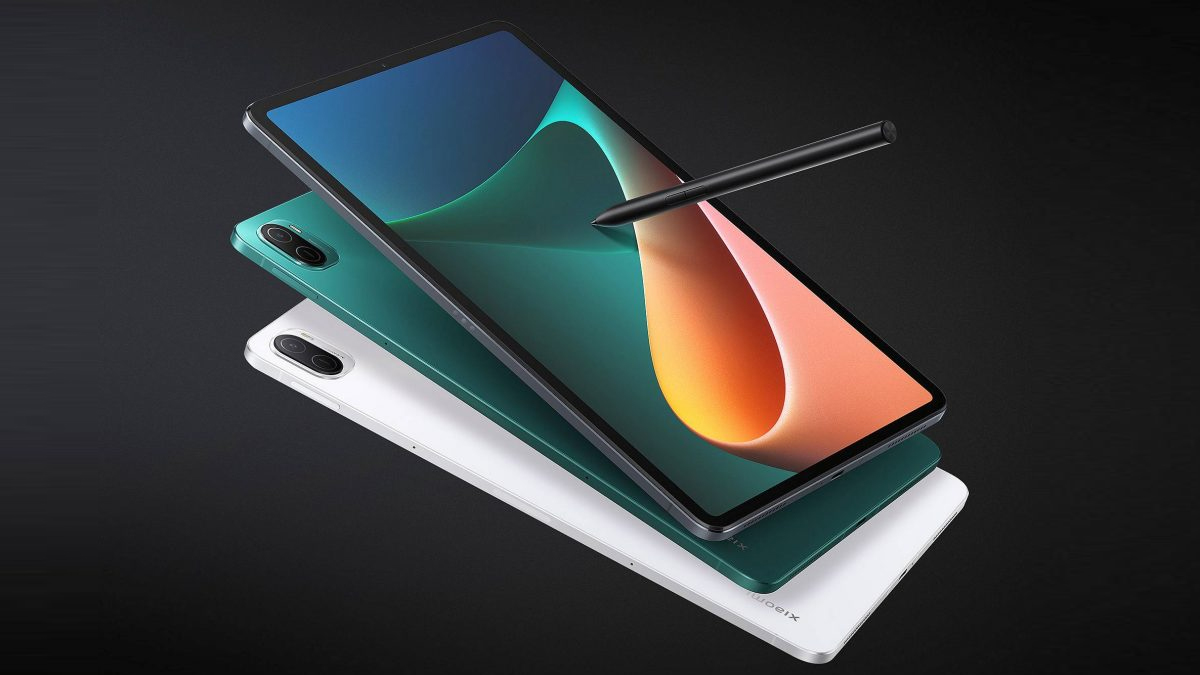
More details about the upcoming Xiaomi Pad 6 series have surfaced. It is rumored that the lineup will include a tablet powered by the Snapdragon 8 Gen 1 chipset. The specified model will have a 14-inch screen and is rumored to have similar specs to the Samsung Galaxy Tab S8 Ultra.
A tipster, Digital Chat Station provided the new details relating to the Xiaomi Pad 6 series. The lineup is expected to be released this year but there are no specifics yet. It is noted that the Snapdragon 8 Gen 1 was alluded to by the tipster. The latest premium chipset in the Snapdragon lineup is the 8+ Gen 1. The tipster says that the most expensive model in the lineup will also be the largest, which is the 14-inch model. It will however come with a competitive price as an affordable alternative to the S8 Ultra.
The MediaTek Dimensity 8100 could also power one of the tablets in the Pad 6 series, according to the tipster. The Xiaomi Pad 6 flagship will have a battery capacity of up to 9,000mAh but is reportedly yet to be registered. It should be noted that these rumored specs for the Xiaomi iPad 6 series are yet speculative. Xiaomi is yet to provide definitive details of its upcoming tablet lineup for this year. The release date, pricing, and global availability details of the Pad 6 series are yet to surface.
We use cookies on our website to give you the most relevant experience by remembering your preferences and repeat visits. By clicking “Accept”, you consent to the use of ALL the cookies.
This website uses cookies to improve your experience while you navigate through the website. Out of these, the cookies that are categorized as necessary are stored on your browser as they are essential for the working of basic functionalities of the website. We also use third-party cookies that help us analyze and understand how you use this website. These cookies will be stored in your browser only with your consent. You also have the option to opt-out of these cookies. But opting out of some of these cookies may affect your browsing experience.
Necessary cookies are absolutely essential for the website to function properly. This category only includes cookies that ensures basic functionalities and security features of the website. These cookies do not store any personal information.
Any cookies that may not be particularly necessary for the website to function and is used specifically to collect user personal data via analytics, ads, other embedded contents are termed as non-necessary cookies. It is mandatory to procure user consent prior to running these cookies on your website.