Elista has launched its new Xplore Google TV Smart TV series in India with three 4K models that share the same hardware and software features. The series includes the TDU85GA (215 cm), TDU75GA (189 cm) and TDU65GA (165 cm). All models come with bezel-less displays, HDR10 support, Dolby Audio and the latest Google TV interface.
The TDU85GA features a 215 cm (85-inch) 4K display with HDR10 and Dolby Audio. It has 2GB RAM, 16GB internal storage, built-in Chromecast, three HDMI ports and Dual Band Wi-Fi. The TV supports hands-free “Hey Google” voice control and provides direct access to Netflix, Prime Video, YouTube and other streaming apps on Google TV.
The TDU75GA offers the same setup in a 189 cm (75-inch) size. It carries the same 4K panel, HDR10, Dolby Audio and Google TV software. It also includes 2GB RAM, 16GB storage, built-in Chromecast, three HDMI ports and Dual Band Wi-Fi. The features match the 85-inch model without any changes.
The TDU65GA completes the lineup with a 165 cm (65-inch) 4K screen. Like the other two models, it supports HDR10, Dolby Audio, hands-free Google Assistant, built-in Chromecast, 2GB RAM, 16GB storage, three HDMI ports and Dual Band Wi-Fi. All three TVs run Google TV with unified search, personalized recommendations, multi-user profiles and easy smartphone casting and control.
Across the series, Elista keeps the configuration uniform. Buyers only need to choose the screen size they prefer, as every model offers the same performance and feature set.
Last month, Nubia unveiled the Red Magic 11 Pro series powered by the Snapdragon 8 Elite Gen 5 chipset. The brand is now reportedly working on an entry-level phone from the same series called the Red Magic 11 Air. It appears that the said device has surfaced with model number NX799J in the database of the TENAA certification platform. The listing has revealed all the important specs of the device.
Red Magic 11 Air specifications (rumored)
Red Magic 10 Air
As per the TENAA listing, the alleged Red Magic 11 Air features a 6.85-inch OLED screen that offers a resolution of 1216 x 2688 pixels. It has a 16-megapixel selfie camera, which could be integrated beneath the display.
The Red Magic 11 Air’s rear camera setup has a 50-megapixel main camera and an 8-megapixel ultra-wide lens. There seems to be a downgrade in the camera department, as the previous generation, the Red Magic 10 Air, featured dual 50-megapixel cameras on the back. It is expected to ship with Red Magic OS-based Android 16.
The Red Magic 11 Air is powered by an unknown 4.2GHz chip. Its topmost variant may offer a 24GB+1TB configuration, whereas its base model could arrive with a 12GB+256GB configuration. It has a rated battery of 6780mAh capacity, indicating a typical capacity of about 7,000mAh.
At present, there is no information about the Red Magic 11 Air’s fast charging capabilities. Lastly, the device measures 163.82 x 76.54 x 7.85mm and weighs around 207 grams.
Red Magic 11 Air launch timeframe (expected)
To recall, the Red Magic 10 Air debuted in April 2025 in China. Now that the alleged Red Magic 11 Air has already been TENAA certified, it appears that it may launch as early as December or in the first quarter of 2026 in China.
For more daily updates, please visit our News Section.
Vivo has officially teased its next generation of flagship smartphones. The Vivo X300 (Review) and Vivo X300 Pro are arriving in India soon, and the teaser posters showcase their camera systems. From 200MP cameras to Zeiss tuning, here’s everything you need to know.
What’s coming in the Vivo X300 series cameras?
Vivo X300 Camera Teaser
Ahead of the 2nd December 2025 launch, the Chinese tech giant officially released dedicated Amazon and Flipkart microsites that teased the upcoming flagship’s camera systems. Looking at the image posters, the standard Vivo X300 packs a 200MP ISOCELL HPB main camera with an f/1.68 aperture and OIS support (Optical Image Stabilization), a 50MP Samsung JN1 ultra wide angle lens, and a 50MP Zeiss APO telephoto shooter, which is a Sony LYT602 sensor with OIS support.
Just like before, the camera system arrives with both Zeiss tuning and Zeiss lenses for an improved photography experience. On the other hand, the Vivo X300 Pro also gets the same 200MP camera, but this is a Zeiss APO telephoto shooter with OIS on the flagship phone. The main camera is a 50MP Sony LYT828 main camera with a larger sensor size (f.1/57 aperture, OIS) and the same 50MP Samsung JN1 ultra wide angle lens.
Vivo X300 Pro Camera Teaser
Apart from this, both devices will ship with Vivo’s V3+ imaging chip and MediaTek’s latest and greatest Dimensity 9500 SoC. The Vivo X300 Pro model also gets a VS1 imaging chip, as well as the Vivo Zeiss 2.35x telephoto extender that is sold separately. Vivo’s new flagships run on the Android 16 OS that is paired with OriginOS 6 custom skin. Other notable features include a unibody 3D glass with metal frames and ultra slim uniform bezels. The standard X300 arrives in Phantom Black, Mist Blue, and Summit Red, while the Pro variant will debut in Dune Brown and Phantom Black.
For more daily updates, please visit our News Section.
Realme has officially announced the launch date for its new C-series budget friendly smartphone. The Realme C85 was just spotted in a new teaser, which confirmed its release in the Indian market. So here’s everything you need to know.
Realme C85 Coming to India with a Monster Battery on November 28
The Chinese brand revealed that the Realme C85 model will debut in India on 28th November 2025 at 12PM IST. The Flipkart microsite is already live, showcasing some of its key specs along with the launch date. Looking at the listing, the Realme C85 will be powered by a gigantic 7,000mAh battery pack, which promises to offer up to 22 hours of video streaming, 50 hours of calling, or even 145 hours of music playback on a single full charge.
Realme C85
Realme is claiming that this device can even offer up to 9 hours of standby time or 40 minutes of calling even at 1 percent charge. This budget phone supports 45W wired fast charging, along with 6.5W reverse charging speeds as well. The Realme C85 will arrive with a military grade shock resistance and an IP69 rating for water and dust resistance. Other key features revealed on the teaser were a bright 1200 nits AMOLED display on the front, while the rear packs a 50MP Sony main camera that will support AI tools for picture editing.
To recall, the company first unveiled the Realem C85 series in the Vietnamese market earlier this month. It is unclear whether it will be the same exact model, since the standard C85 featured an LCD panel, while the Pro variant came with an AMOLED panel. So stick around for more, as we will be covering the launch.
For more daily updates, please visit our News Section.
OnePlus has finally confirmed the design of the OnePlus Ace 6T, which is set to debut later this month in China. Today, the brand rolled out the official images to showcase its color options. The Ace 6T’s images suggest that its design could be identical to the OnePlus 15R, which is expected to hit the global market in the coming days.
OnePlus Ace 6T design revealed
The OnePlus Ace 6T can be seen sporting a flat display on the front and a dual-camera setup on the back. Its right edge has a volume rocker and a power button, whereas its left edge has a Plus key for summoning Mind Space and frequently accessed features. As can be seen, the phone will be available in shades, such as Flash Black, Fleeting Green, and Electric Violet.
OnePlus Ace 6T specifications (rumored)
Recent reports suggest that the OnePlus Ace 6T is shaping up to be a performance-focused device. It is said to weigh roughly 216 grams and offer IP68/69 protection against dust and water. The phone is also tipped to include dual speakers, NFC, an x-axis linear motor, and an ultrasonic fingerprint sensor embedded in the display.
On the inside, the Ace 6T is expected to be powered by the Snapdragon 8 Gen 5, Qualcomm’s upcoming flagship chipset. The phone may feature a large 6.83-inch OLED display, delivering a 1.5K resolution and a 165Hz refresh rate, which should make it particularly appealing for gaming and high-speed visuals.
In terms of cameras, leaks indicate a 50-megapixel main sensor with OIS, paired with an 8-megapixel ultra-wide camera, while the front will reportedly house a 32-megapixel selfie shooter. It will run on ColorOS 16-absed Android 16.
OnePlus has also revealed that a special Genshin Impact Kamisato Ayaka edition of the OnePlus Ace 6T is on the way. While the design has been teased, the brand has not yet announced when this variant or the standard model will be released.
Nothing has recently begun its Android 16 rollout, which comes with the latest Nothing OS 4.0 skin at the top. It was none other than the Nothing Phone 3, the company’s first flagship phone, getting the first bite, and now we’ve better clarity about how and when the update will expand to the remaining models.
Nothing has announced a vague rollout timeline for Nothing OS 4.0 that doesn’t reveal the exact dates, but anyway, it’s better than not having one. As per the timeline, the remaining Nothing phones (except the Nothing Phone 1) will receive the Android 16 update over the coming weeks, and the CMF phones will join the party by the end of the year. As for the Nothing Phone (3a) Lite, it’s scheduled to receive the update in early 2026.
Based on the official statement, here’s the timeline that we came up with:
Next 1-2 weeks:
Nothing Phone 3a
Nothing Phone 3a Pro
Nothing Phone 2
Nothing Phone 2a
Second half of December:
CMF Phone 2 Pro
CMF Phone 1
January 2026:
Nothing Phone 3a Lite
If your Nothing phone is on the list, ensure it has no pending updates. To check for the available updates, go to Settings > System > System updates. Also, Nothing OS 4.0 is a major upgrade with a download size weighing about 3-5GB. So, ensure that the device has sufficient storage before downloading the update, and that it has at least 40% battery before hitting the install button.
Nothing took longer than its peers to begin the Android 16 rollout, but it appears it will be among the first brands to wrap it up. A small product portfolio is one reason, but the brand has also been known for the rapid expansion of major updates.
To find out when the update starts rolling out for your device, you can regularly visit the Nothing Community or our Android 16 section. Alternatively, you can join our Telegram channel for instant notification about the latest software updates and all the biggest tech headlines.
Sharp has unveiled its new Aquos MiniLED JP7000 series, a 4K TV lineup that will go on sale later this month. The series comes in 50, 55, 65, and 75 inches. Sharp has not shared prices yet.
The JP7000 series uses MiniLED backlighting with hundreds of small LEDs arranged in controlled dimming zones. This design improves contrast by allowing bright and dark areas of the screen to adjust independently. It also delivers high brightness, which helps the TV perform well in both dark rooms and bright living spaces. A QLED Quantum Dot layer boosts color accuracy and increases the color range, covering a large part of the DCI-P3 and BT.2020 gamuts. Sharp says viewers will see more vivid colors, smoother transitions, and realistic tones.
The TVs support Dolby Vision and HDR10. Dolby Vision uses dynamic metadata to adjust brightness and colour for every frame, which helps preserve detail in scenes with both bright and dark elements. Sharp’s Aquos Smooth Motion feature aims to reduce blur and maintain clarity during fast action, although the refresh rate is limited to 60 Hz. The displays have a nearly frameless design and sit on a central aluminum stand.
For audio, Sharp worked with Harman Kardon to tune a system with two 12 W speakers. The TVs also support Dolby Atmos for a more spacious sound experience. Connectivity options include HDMI with eARC, USB, dual-band Wi-Fi, and Bluetooth.
Google TV powers the interface. Popular apps such as Netflix, YouTube, Google Play Movies & TV, and Prime Video come preinstalled. Google Assistant is built in, allowing voice control for searching content, managing playlists, or controlling smart home devices. Users can also control the TV through the Google TV app on their phones, which is useful for typing passwords or navigating menus. Google Cast lets users stream videos, apps, photos, and more from their phone, tablet, or laptop.
Sharp is positioning the Aquos MiniLED JP7000 lineup as an affordable upgrade for anyone looking for better brightness, color, and smart features in a 4K TV.
For more daily updates, please visit our News Section.
AutoFlight, the Chinese eVTOL maker backed by battery giant CATL, has unveiled something that honestly looks like it was pulled straight out of a sci-fi movie: a floating airport for air taxis. Yes, literally a vertiport that sits on water — ocean, lake, river, wherever you want — and operates on its own without needing to plug into anything on land.
The company is calling it an eVTOL Water Vertiport, but the idea is pretty simple. It’s a modular platform that acts as both a landing pad and a charging point for electric aircraft. The whole thing is powered by solar panels and its own energy storage system, so it can essentially run independently once deployed. AutoFlight says it can drop these platforms pretty much anywhere, from busy coastal areas to far-off offshore zones, thanks to built-in comms equipment and an automated dispatch setup.
What the company really seems to be pushing is a future where you don’t have one or two of these pads, but clusters of them — what it calls a “Sea-Air Super Hub.” In theory, that could support everything from emergency response missions to maintaining offshore wind farms and oil rigs. AutoFlight claims response times for rescue operations could be cut in half, while routine offshore maintenance could speed up by as much as 10×. And in cities, these floating pads could give air taxis direct shortcuts across harbors or wide rivers without relying on crowded airports or dedicated land-based infrastructure.
AutoFlight isn’t some early-stage startup testing the waters, either. The company already has orders for more than 2,000 aircraft across cargo, passenger, rescue, and firefighting roles. CATL — which has poured hundreds of millions into the project — is also working on dedicated aviation batteries and even future “condensed batteries” that could eventually support electric aircraft flying over 2,000 miles on a single charge.
Put all of that together, and this floating vertiport starts to feel less like a publicity stunt and more like the first piece of a bigger plan. If AutoFlight and CATL can actually make this ecosystem work, we may be looking at a new kind of coastal and offshore transportation where aircraft don’t just lift off from land — they take off from the water itself.
One of the longest-running annoyances between Android and iPhone users might finally be coming to an end. After years of watching AirDrop work effortlessly inside Apple’s ecosystem, Android users are about to get their own way to send files directly to iPhones.
For those unfamiliar, Quick Share is Android’s system-level feature that currently lets users share files to other Android devices and even Windows PCs conveniently. Google recently announced that Quick Share will now also support sending files to iPhones via the same wireless method Apple uses for AirDrop. The catch, at least for now, is that this new cross-platform support only works on the Tensor G5-powered Pixel 10 series. In other words, only a tiny slice of Android users can actually take advantage of it today.
Qualcomm has now confirmed that the Quick Share to AirDrop feature is on its way to Snapdragon-powered devices. The confirmation came from the official Snapdragon account on X, which reposted Google’s announcement and added a short teaser: “Can’t wait for people to use this once enabled on Snapdragon in the near future.”
Google had hinted that wider support was planned, but Qualcomm putting it out in the open makes it clear this won’t remain a Pixel-only perk.
There’s still no official rollout date or list of supported Snapdragon chipsets. Given the wording, it’s safe to assume that newer Snapdragon generations will get it first, followed by a gradual expansion across phones from Samsung, Xiaomi, OnePlus, Motorola, and pretty much every other major brand that depends on Qualcomm silicon.
MediaTek and Samsung haven’t said anything yet about their Dimensity and Exynos platforms. Since Quick Share is baked into Android itself, support for those chips is still expected — they just haven’t confirmed it publicly.
It also looks likely that Quick Share’s cross-platform abilities will spread beyond phones. Devices like Android tablets and Chromebooks already support Quick Share internally, so the same pipeline could eventually allow them to send files over to iPhones and iPads as well.
For something as simple as sharing a photo, the divide between Android and iOS has been surprisingly stubborn for years. With Qualcomm finally joining the conversation, that gap is about to get a lot smaller — and a lot more convenient.
Amazfit has launched a new Tactical Black version of the T-Rex 3 Pro 44 mm smartwatch in the US. The same color was released in China earlier this month as Onyx Black, and listings on Amazfit’s European stores show it will arrive in Europe soon.
Amazfit’s T-Rex 3 Pro 44 mmAmazfit’s T-Rex 3 Pro 48 mm
The Tactical Black model keeps the same features as the existing 44 mm and 48 mm T-Rex 3 Pro versions. It includes the integrated dual color flashlight built into the frame, which remains one of the key upgrades over the regular T-Rex 3.
The T-Rex 3 Pro 44 mm supports route planning and offline maps. It uses a six satellite positioning system for more accurate tracking during outdoor activities. The watch also includes a built in speaker and microphone for Bluetooth calling. Fitness features include more than 180 activity modes and health tracking for heart rate, skin temperature and sleep.
The smartwatch has a 1.32 inch AMOLED display. Battery life is rated for around 19 days on a single charge with typical use. The overall design remains focused on durability and outdoor use while offering enough everyday tools to function as a daily smartwatch.
Pricing & availability
The Amazfit T-Rex 3 Pro 44 mm Tactical Black is now on sale in the US for 379.99 dollars, reflecting a 20 dollar discount on the original 399.99 dollar price.
ALLDOCUBE iWork GT Ultra is the latest 13-inch 2-in-1 tablet PC designed for users who need both power and portability in one device. It follows the success of the 2022 iWork GT and the 2023 Ryzen-powered iWork GT, adding more performance, a larger display, and smarter AI features. Whether you’re a student, professional, or creative user, this device combines tablet mobility with full laptop capability, making it ideal for work, study, entertainment, and everyday use.
Deal & Availability
The ALLDOCUBE iWork GT Ultra is now officially available as part of the brand’s Pre-Holiday Shopping Season event, running from November 7 to December 3, with discounts of up to 40% off.
The new device was launched on ALLDOCUBE’s official Amazon stores in both Japan and Europe. Customers in Japan can purchase the full device bundle for 118,999 yen via Amazon Japan, while European buyers can get the device bundle along with the stylus included for €799.99 on Amazon Europe.
Both regions offer convenient shipping options, making it easy to take advantage of this limited-time launch deal.
Performance & Productivity
At the heart of the iWork GT Ultra is the Intel Core Ultra 5 125H processor, offering fast and smooth performance for heavy apps, spreadsheets, multitasking, and even video editing. The built-in Intel AI Boost and the “AI Tri-Engine” (NPU + CPU + GPU) ensure improved productivity and efficient real-time processing. It boots up in just 7 seconds, so you can start working instantly. The machine stays responsive even under pressure, thanks to its optimized hardware and cooling system.
Display Quality
The device features a bright and sharp 13-inch 2.5K in-cell display with 2560×1600 resolution. With 500 cd/m² brightness and near 180° viewing angles, it delivers vivid colors and crisp visuals. The fully laminated touch panel and in-cell technology provide smooth, responsive interactions, perfect for drawing, note-taking, reading, or streaming.
2-in-1 Versatility
The iWork GT Ultra offers true 2-in-1 flexibility. In tablet mode, it’s great for handwriting, illustrations, and entertainment. Switching to laptop mode is easy with the magnetic Pogo Pin Smart Keyboard, making it ideal for typing, office tasks, and productivity work. Both modes are optimized to deliver a seamless experience.
Hardware & Features
The device includes 16GB LPDDR5 RAM and a fast 1TB PCIe SSD, giving you plenty of room for files and smooth multitasking. A 4096-level stylus (sold separately) supports detailed sketching and writing. The dual-fan cooling system keeps performance stable while maintaining low noise levels. It also includes dual speakers, digital microphones, and front + rear cameras, perfect for calls, meetings, and scanning documents.
Graphics & AI Performance
With Intel Arc Graphics based on Xᵉ LPG architecture and 112 Xᵉ cores, the iWork GT Ultra delivers discrete-class GPU performance. This allows smooth rendering, light gaming, and enhanced media work. The dedicated NPU supports AI features like background blur, noise reduction, and intelligent processing. Built-in Copilot helps with organizing tasks, research, planning, and creativity.
Design & Portability
Weighing only 850g and just 9.9mm thick, the iWork GT Ultra is ultra-light and easy to carry. Its magnesium–aluminum alloy body ensures durability, while the 155° adjustable kickstand gives you flexible viewing angles for working, drawing, or streaming anywhere.
Battery & Charging
The device supports 65W PD fast charging and lasts up to 7 hours on a single charge. It also comes with a 100W PD adapter for quicker power delivery, ensuring minimal downtime during busy days.
Connectivity & Ports
Running Windows 11, the iWork GT Ultra supports multitouch gestures, snap layouts, tablet mode, and instant wake. It includes Wi-Fi 6 and Bluetooth 5.2 for faster wireless performance. Port options include 2× USB-C and 1× USB-A, making it easy to connect chargers, displays, storage, and accessories.
Who Is It For?
This device is ideal for users who want a lightweight yet powerful machine that works great as both a tablet and a laptop. It suits anyone working across multiple apps, creative tools, or productivity tasks, and those who value a high-quality display, strong performance, and easy mobility.
Oppo is gearing up for an ambitious refresh of its premium smartphone lineup in China. The company is working on a new foldable flagship alongside multiple X-series models, one of which will feature a compact design. A fresh leak from tipster Digital Chat Station offers an early look at what to expect from these upcoming devices.
Oppo Find N6
According to the leak, Oppo will kick off its flagship cycle with the Find N6, a large foldable device positioned to become the first foldable phone powered by the Snapdragon 8 Elite Gen 5 platform. The device has already completed internal filing, and its top variant is expected to include satellite communication support.
To recall, the Find N5 was not equipped with the standard version of the Snapdragon 8 Elite chipset but rather a binned variant featuring a 7-core CPU configuration instead of the full 8-core layout. It remains to be seen whether the Find N6 will use the regular 8-core Snapdragon 8 Elite Gen 5 or a new 7-core edition.
Oppo Find X9 Ultra
He also reiterated that Oppo’s Snapdragon 8 Elite Gen 5–powered imaging flagship, the Find X9 Ultra, and its compact sibling, the Find X9s, are targeting strong positions in the top segment, with their hardware configurations largely finalized.
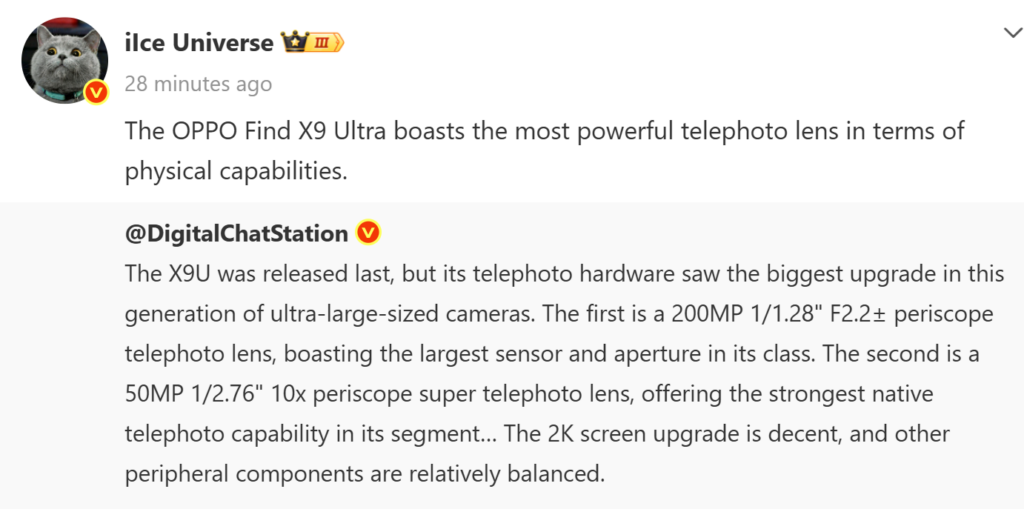
The major upgrades for the Find X9 Ultra include a 200-megapixel IMX09E main camera and an IMX09A periscope telephoto unit offering around 3x optical zoom, along with improved long-range zoom capabilities.
As per a previous leak by the same source, the Find X9 Ultra’s rear camera setup will have two 50-megapixel periscope telephoto cameras and an ultra-wide lens apart from the IMX90E primary sensor.
The leak revealed that the other periscope telephoto cameras on the Find X9 Ultra will be backed by the flagship Sony LYT-828 sensor, which also serve as the primary sensor on the Oppo Find X9 Pro and Vivo X300 Pro. The leak also mentioned that the X9 Ultra the device will feature a 50-megapixel front-facing camera.
Oppo Find X9s
The Dimensity 9500 Plus-powered Find X9s is positioned as a compact flagship with meaningful hardware upgrades. It is said to come with a refreshed 6.3-inch display, a substantial battery capacity nearing 7,000mAh, and an ultrasonic in-display fingerprint sensor. This said chipset appears to be an overclocked version of the existing D9500. Development of the Find X9s is reportedly progressing quickly, hinting at an earlier-than-expected release.
Oppo is unlikely to unveil these devices simultaneously. These devices are expected to debut in China within the first quarter through separate launch events.
For more daily updates, please visit our News Section.
Final has released the UX1000, the latest addition to its UX series of wireless headphones. The model is available in Japan starting Friday, November 21, 2025, and is aimed at listeners who want clear sound, strong noise canceling and long battery life at an affordable price.
The UX1000 uses a driver that has been tuned after studying its acoustic behavior in detail. final has applied a small equalizer adjustment to smooth out the harsh high-frequency peaks that can occur with Bluetooth listening. This helps prevent listening fatigue and produces deep bass and sharp highs, giving the headphones a clean and balanced sound across all types of music.
The headphones are equipped with hybrid noise canceling that uses both feedforward and feedback microphones. The algorithm used is designed to reduce outside noise without harming sound quality. For situations where users need to hear what is happening around them, the UX1000 includes an Ambient Mode that makes surrounding sounds easier to notice.
The UX1000 comes in two colors, Black and Greige. The surface has a matte finish that resists hydrolysis and reduces fingerprints, oil and dirt. The finish is also designed to provide a comfortable and non-slip grip.
Battery performance is one of the main features. The UX1000 offers up to 70 hours of music playback with ANC turned off and up to 40 hours with ANC on. A full charge takes about two hours. The battery capacity is 500 mA. The headphones weigh 250 g and support multipoint connection. The foldable design makes them easier to store in a bag.
Other specifications include Bluetooth 5.4, a playback frequency range of 20 Hz to 20 kHz, and codec support for SBC and AAC. Supported profiles are A2DP, AVRCP, HFP and GAVDP. The UX1000 is priced at 7,980 yen (~$50) including tax.
MediaTek has officially released its latest automotive cockpit processor, the Dimensity Cockpit P1 Ultra. Built on an advanced 4nm manufacturing process, the chip prioritizes high performance, robust AI capabilities, and enhanced in-car entertainment features. MediaTek says the first car models utilizing this chip will be launched soon.
MediaTek Dimensity P1 Ultra Specs
The P1 Ultra comes with a powerful 8-core CPU that delivers up to 175K DMIPS of computing power. For graphics, MediaTek has added a hardware-level ray-tracing GPU that offers up to 1800 GFLOPS of performance.
On the AI side, the P1 Ultra includes a dedicated NPU capable of 23 TOPS, and MediaTek says it can even run edge-side generative AI. Thanks to the Armv9 architecture and built-in AI units, the chip supports 7-billion-parameter large language models directly inside the car.
As a result, you can expect it to handle features like advanced voice assistants, multimodal interactions, on-device image generation (like Stable Diffusion), and even AI-based safety monitoring can run without needing cloud support.
MediaTek has also focused on reducing development time for automakers. The P1 Ultra integrates multiple components, including smart cockpit, connectivity modules, and T-BOX into a single platform.
It supports 5G, dual-band Wi-Fi, Bluetooth, GNSS, and even includes a built-in modem. For cameras, there’s an HDR ISP with AI noise reduction, AI 3A, and other enhancements. This helps with features such as 360-degree surround view, driving recorders, and cabin monitoring.
For entertainment, the P1 Ultra supports up to six displays at the same time, and thanks to MediaTek’s MiraVision tech, it can handle 4K 60fps video playback and recording. This means cars can offer multi-screen setups for the driver, passengers, and rear-seat entertainment systems, all powered by a single chip.
MediaTek also confirmed that the Dimensity Cockpit P1 Ultra will come in three versions — 5G, 4G, and Wi-Fi models — all featuring an 8-core CPU and 6-core GPU.
For more daily updates, please visit our News Section.
A recent leak revealed the memory configurations and color options of the upcoming Realme 16 Pro. The same leak confirmed that the 16 Pro’s model number for the Indian market is RMX5120. The Chinese edition of the phone, bearing the model number RMX5121, has surfaced in the TENAA certification database. The listing has revealed the key specifications of the device ahead of its launch.
Realme 16 Pro specifications (rumored)
Realme 15 Pro
As per the TENAA listing, the Realme 16 Pro measures 162.6 x 77.6 x 7.75mm and weighs 192 grams. It will feature a 6.78-inch OLED screen that supports a 1.5K resolution of 2772 x 1272 pixels. While it is not mentioned in the listing, it is expected to support a 144Hz refresh rate like its predecessor.
For photography, the Realme 16 Pro is equipped with a 200-megapixel + 8-megapixel dual-camera setup on the back. On the front, it features a 50-megapixel selfie camera.
The Realme 16 Pro is expected to come preloaded with Realme UI 7-based Android 16. Under the hood, the device is equipped with an unknown chip that works at 2.5GHz.
In China, the device will be available with 8GB, 12GB, and 16GB of RAM and 128GB, 256GB, 512GB, and 1TB of storage. As per a recent leak, the device will arrive in India in configurations such as 8GB+128GB, 8GB+256GB, 12GB+256GB, and 12GB+512GB.
The Realme 16 Pro packs a 7,000mAh battery, but TENAA only mentions its rated capacity as 6,830mAh. Likely, it may offer 80W wired charging like its previous generation. The listing also mentions that it has an ultrasonic in-screen fingerprint sensor and an IR blaster.
The TENAA listing does not include images yet, so there is no clue about its design.
For more daily updates, please visit our News Section.
Tim Cook is not stepping down as Apple CEO anytime soon. Despite a recent report from the Financial Times claiming Cook may exit between January and June 2026, Bloomberg’s Mark Gurman has called the timeline premature and inaccurate.
Image: REUTERS
In his latest Power On newsletter, Gurman said he would be “shocked” if Cook leaves by mid-2026. He noted that there are currently no internal signs suggesting a leadership transition is about to happen. Cook, who turned 65 this month, remains actively involved in Apple’s product roadmap, including its upcoming AI push.
Gurman confirmed that Apple has been planning for Cook’s eventual departure. John Ternus, Apple’s Senior Vice President of Hardware Engineering, remains the top internal candidate to succeed Cook. Ternus leads development for iPhone, Mac, and Vision Pro and has taken on more responsibilities in recent months.
The Financial Times report claimed that Apple could announce Cook’s exit plan before WWDC 2026 to ensure a smooth handoff. Gurman disagreed, stating that the story did not come from sources with direct knowledge and was not part of any internal communication strategy. He also dismissed theories that the story was a deliberate leak to test public reaction.
Gurman also said that given Apple’s tremendous success under Cook, he has earned the right to decide his own future. After stepping down, Cook is expected to remain as Chairman of the board, allowing him to influence Apple’s direction for years to come.
Cook has led Apple since 2011, following the death of Steve Jobs. Under his leadership, Apple became the first $3 trillion company and launched major products including the Apple Watch, AirPods, M-series Macs, and Vision Pro.
For more daily updates, please visit our News Section.
A new budget flagship smartphone from OnePlus is arriving soon, and it might bring a powerful chipset that is perfect for gaming. Earlier this month, the OnePlus 15R was teased ahead of its global debut. Now, it has been spotted in a new leak, so here’s what you need to know.
OnePlus 15R Rumored to Pack Powerful Snapdragon 8 Gen 5
The Chinese brand’s upcoming OnePlus 15R is expected to be positioned right below the flagship OnePlus 15, which is powered by the Snapdragon 8 Elite Gen 5. But ahead of the OnePlus 15R’s official announcement, a tweet from tipster Debayan Roy (Gadgets Data) claims that his sources have confirmed that this model will debut with the Snapdragon 8 Gen 5.
OnePlus 15R/Ace 6T
That’s not all, he further adds that the budget flagship will also arrive with a dual camera setup on the rear, which consists of a 50MP + 50MP setup. These specifications are in line with our previous reports, as the OnePlus 15R is expected to be the first Snapdragon 8 Gen 5 powered smartphone to debut in the global market. Furthermore, the OnePlus 15R is also expected to be a rebranded OnePlus Ace 6T model, which is set to launch in the Chinese market soon.
The new Ace 6T smartphone will feature a dual camera setup on the rear with a 50MP main camera, along with a 50MP ultra wide angle lens. To recall, the OnePlus 13R packed a triple camera setup that also included a telephoto shooter. So just like the flagship OnePlus 15, even the budget 15R is seeing a downgrade in some areas. Keep in mind that this is still just speculation at this point, so stick around for more.
For more daily updates, please visit our News Section.
Microsoft’s latest Xbox Cloud Gaming service is now arriving in LG smart TVs. In a new announcement, LG Electronics confirmed that its smart TVs will support online game streaming in the Indian market. So here’s everything you need to know.
LG Smart TVs Get Console Gaming Experience Without a Console
The South Korean tech giant is now allowing users to stream Xbox titles directly from their smart TVs without needing a dedicated console. Microsoft recently unveiled its Xbox Cloud gaming service in the Indian market, and LG smart TV owners can take advantage of this platform. LG has just released the LG Gaming Portal, which allows for a console gaming experience thanks to the integration of the new Xbox app.
LG Gaming Portal
This application brings access to more than 4,000 games from Microsoft’s vast Xbox gaming library. That’s not all, users are also getting access to 600 free single and multiplayer titles. The LG Gaming Portal is a new hub for gaming on webOS, while also combining content from multiple partners. LG Smart TVs owners that have an Xbox Game Pass subscription, a compatible controller, and a stable internet connection can now play popular AAA titles like the Call of Duty franchise. But this release isn’t available on every single LG smart TV model.
LG is rolling out the update that brings the Gaming Portal to webOS to compatible smart TVs that debuted between 2021 and 2025. So if you wish to get a console level gaming experience without buying a new Xbox or PlayStation, just update your LG smart TV, get the Xbox Game Pass, and start gaming.
For more daily updates, please visit our News Section.
Ray-Ban Meta Gen 1 smart glasses have officially made their debut in the Indian market. Back in May 2025, Ray-Bans and Meta collaborated for their first ever smart glasses, and now we are getting a refreshed model with a built in display. So here are its specs, price, and launch offers.
Ray-Ban Meta Gen 1 Smart Glasses: What does it offer?
One of the biggest differences between the original smart glasses and the Ray-Ban Meta Gen 1 is the addition of the display in the lens, which have a 1280 x 1280 pixels per eye. The camera on the front can capture 12MP still pictures and 6MP video recording. It arrives with Meta AI integration that activates via “Hey Meta”. This brings access to various hands free control and information searches.
Ray-Ban Meta Gen 1 Smart Glasses
Meta also brings the new AI powered smart glasses with a bunch of features tailored for the Indian market. So here’s what you get:
Support for Hindi Language
Celebrity AI voice of Deepika Padukone
Restyle feature for AI powered image edits
UPI Lite support coming soon
You can buy these smart glasses in multiple variants, including prescription, sun, polarized, and Transitions. These are sold with a compact charging case and visible LED indicators when recording videos.
While the original Ray-Ban Meta glasses debuted in India for Rs 29,900, the new Ray-Ban Meta Gen 1 smart glasses arrive for Rs 22,920 thanks to a 20% discount and bank offers on major e-retailer platforms like Flipkart, Amazon, and Reliance Digital’s official website.
Huawei has just unveiled the Enjoy 70x Premium Edition in China. Despite its name, this smartphone was released as an affordable device in the brand’s home market, arriving as a new variant of the Enjoy 70x that launched earlier this year. So let’s check it out.
Huawei Enjoy 70x Premium Edition Goes Live in China for Budget Pricing
The Chinese tech giant just launched the Huawei Enjoy 70x Premium Edition in China with a tall 6.78-inch curved AMOLED display with an FHD+ resolution. Under the hood, this smartphone is equipped with Kirin 8000 SoC, which is faster than the Kirin 8000A that powered the standard Enjoy 70x model. A massive 6,100mAh battery pack powers the Enjoy 70x Premium Edition, which supports 40W Turbo SuperCharge wired fast charging.
Huawei Enjoy 70x Premium Edition
For photography, the rear has a 50MP main camera that is paired with a 2MP depth sensor. Meanwhile, the front houses an 8MP shooter for selfies and video calls. While this budget phone houses a huge battery capacity, the Enjoy 70x Premium Edition measures just 7.98mm thick and weighs 189 grams. Other notable features of the device include Beidou satellite messaging, X-Key, AI wet hand touch controls, an in-display fingerprint scanner, dual SIM support, AIS image stabilization system, Bluetooth 5.1, and an IP64 rating for water and dust resistance.

Huawei just unveiled the Enjoy 70x in the Chinese market in three color options, namely Starry Sea Blue, Obsidian Black, and Gold Sand. It is also available in two storage configurations. The base 256GB model carried a 1,899 Yuan (roughly $267) price tag, while the higher end 512GB option is available for 2,199 Yuan (roughly $309). This model is listed for pre-orders on Huawei Mall, with first sales kicking off on 27th November 2025.
For more daily updates, please visit our News Section.
We use cookies on our website to give you the most relevant experience by remembering your preferences and repeat visits. By clicking “Accept”, you consent to the use of ALL the cookies.
This website uses cookies to improve your experience while you navigate through the website. Out of these, the cookies that are categorized as necessary are stored on your browser as they are essential for the working of basic functionalities of the website. We also use third-party cookies that help us analyze and understand how you use this website. These cookies will be stored in your browser only with your consent. You also have the option to opt-out of these cookies. But opting out of some of these cookies may affect your browsing experience.
Necessary cookies are absolutely essential for the website to function properly. This category only includes cookies that ensures basic functionalities and security features of the website. These cookies do not store any personal information.
Any cookies that may not be particularly necessary for the website to function and is used specifically to collect user personal data via analytics, ads, other embedded contents are termed as non-necessary cookies. It is mandatory to procure user consent prior to running these cookies on your website.