Vivo X300 Pro and Honor Magic 8 Pro are two of the most talked-about flagships of the year, attracting buyers who want cutting-edge performance, premium design, and long-term value. This comparison matters because both phones target power users, mobile photographers, and enthusiasts who expect top-tier hardware with meaningful real-world benefits. With each device offering its own blend of innovation and refinement, comparing them helps buyers understand which flagship aligns better with their priorities
Both smartphones present a premium flagship identity, but they do so with different design philosophies. The Vivo X300 Pro leans into a more luxurious, glass-heavy approach supported by an aluminum alloy frame, giving it a refined, high-end aesthetic. Honor Magic 8 Pro opts for durability with Giant Rhino Glass on the front and a reinforced plastic back, delivering a more rugged but still modern look. The IP68/IP69 ratings on both devices ensure strong protection, but Honor’s IP69K rating adds a slight edge for extreme water-jet resistance. Overall, Vivo’s design feels more sophisticated, while Honor prioritizes toughness.
Display Quality
Vivo offers an LTPO AMOLED panel with rich color depth, HDR certifications, and extremely high peak brightness. Honor counters with an LTPO OLED display featuring a remarkably high PWM rate that benefits users sensitive to flicker. Honor’s peak brightness is also impressive, making outdoor visibility excellent. Vivo’s display feels more cinematic, while Honor delivers technical advantages suited for long-term viewing comfort.
Verdict
Honor has the more versatile and eye-comfort-focused display, while Vivo delivers a more polished and visually immersive experience. Design preference depends on whether luxury (Vivo) or durability (Honor) matters more.
2. Specifications
Performance
The Vivo X300 Pro is powered by MediaTek’s Dimensity 9500, a strong and efficient flagship-class chip ideal for performance stability. Its CPU and GPU combination is tuned for consistent thermal behavior, which helps during extended gaming and multitasking. Honor Magic 8 Pro steps ahead with the Snapdragon 8 Elite Gen 5, bringing higher clock speeds, stronger graphics, and future-ready on-device AI performance. Honor’s overall processing package feels more elite and better suited for demanding workflows or long-term performance gains.
Battery and Charging
Honor has a larger battery capacity globally and supports extremely fast wired and wireless charging, especially in its Chinese variant. Vivo still offers strong endurance with its Si/C battery and meaningful fast charging options, but Honor’s charging configuration is simply more aggressive and versatile. Users who rely on frequent top-ups or heavy screen time will find Honor’s battery system more accommodating.
Verdict
Honor Magic 8 Pro clearly leads in raw performance and charging flexibility, while Vivo maintains dependable stability and efficiency best suited for consistent daily use.
3. Camera
Main and Secondary Lenses
Both phones use a similar triple-camera approach with high-resolution primary and periscope telephoto lenses, but their tuning philosophies differ. Vivo’s camera system is heavily influenced by ZEISS optics, giving its images a more natural tone and film-like contrast that appeals to photography-focused users. The 200MP periscope lens offers macro capability, adding creative versatility. Honor’s setup also includes a 200MP periscope module with strong OIS and a wide field of view, tuned for higher clarity and brighter exposures. Its ultrawide lens provides a slightly broader perspective. Honor’s performance feels more computationally advanced, while Vivo feels more artistic.
Selfie Camera
Vivo’s 50MP AF selfie camera focuses on sharpness and detail with natural color accuracy, making it excellent for portrait-style selfies. Honor adds a 3D TOF sensor for secure face authentication and enhanced depth mapping, giving it a more feature-rich front-camera system. Honor’s selfies feel more software-driven, while Vivo leans on optical purity.
Verdict
Vivo appeals more to photography enthusiasts who value color science and ZEISS tuning. Honor excels in versatility, computational strength, and added front-camera features.
4. Pricing
Honor Magic 8 Pro starts around $850, while the Vivo X300 Pro is slightly more affordable at approximately $800. The difference is small, but it positions Vivo as the more value-oriented option for users wanting strong cameras, premium build quality, and reliable performance without stretching the budget. Honor, on the other hand, justifies its higher price through superior processing power, faster charging technologies, and extended software support with up to seven major Android upgrades, an advantage rare in the Android ecosystem. The price gap can feel negligible considering the upgrades Honor delivers, especially for long-term buyers.
Verdict
Vivo offers better value on paper, but Honor provides more longevity and raw performance per dollar. Users deciding based strictly on price will lean toward Vivo, while those prioritizing extended software support and high-end power will find Honor worth the extra cost.
Disclaimer: Prices are approximate and may vary based on country, region, and applicable taxes.
5. Conclusion
Vivo X300 Pro’s strengths lie in its ZEISS-backed camera system, refined design, dependable performance tuning, and a display that feels cinematic. It caters to users who want consistent quality across photography, build, and daily usability.
Honor Magic 8 Pro pushes harder with next-gen processing, extended software updates, advanced charging speeds, and additional technologies such as a TOF sensor and optional satellite features in certain regions. Its display’s ultra-high PWM dimming also makes it a great choice for users sensitive to eye strain.
Each phone offers a unique identity: Vivo focuses on elegance and optical authenticity, while Honor prioritizes raw power and future-proofing.
Verdict
Choose Vivo X300 Pro if premium design, natural photography output, and a balanced feature set matter most. Pick the Honor Magic 8 Pro for performance-heavy workloads, superior battery charging, and long-term software value. Both are excellent flagships, but their priorities cater to different types of power users.
Blaupunkt has introduced its new SonicQ QLED TV series in India, offering three screen sizes and a strong mix of display, sound and smart capabilities. The lineup arrives with features such as a QLED 4K panel, 120Hz MEMC, Dolby Vision and 80W stereo speakers, making it an interesting choice for entertainment and gaming. Readers looking for full specifications, performance details, and pricing can find the complete breakdown below.
Blaupunkt SonicQ QLED TV series specifications and features
Blaupunkt SonicQ QLED TV
The Blaupunkt SonicQ QLED TV lineup comes in 55-inch, 65-inch and 75-inch variants, all featuring a slim, bezel-less design with an alloy stand for a clean and modern look. Each model is equipped with a QLED 4K display capable of producing 1.1 billion colors.
With HDR10+, Dolby Vision and a peak brightness of 550 nits, the TVs aim to deliver detailed highlights and vibrant scenes. The 120Hz MEMC system paired with VRR and ALLM helps reduce blur and judder, improving clarity for sports and gaming content.
The Blaupunkt SonicQ QLED TV series come with 2GB RAM and 32GB internal storage, offering enough room for apps and performance stability. Sound output is handled by an 80W stereo box speaker system enhanced by Dolby Atmos and Dolby Digital, delivering a more engaging audio experience for movies and games.
The series runs Google TV 5.0 out of the box, offering personalized recommendations, profile support and access to a wide range of apps. Content platforms such as Netflix, Prime Video, Disney+ Hotstar, Apple TV and YouTube are all supported. For connectivity, the TVs feature dual-band Wi-Fi, Bluetooth 5.0, multiple HDMI and USB ports, and compatibility with soundbars and gaming consoles. The Google Assistant remote includes shortcut keys for Netflix, Prime Video, YouTube and a favourite app button for quick access.
Blaupunkt SonicQ QLED TV series price and availability
The Blaupunkt SonicQ QLED TV range is available exclusively on Flipkart starting today. The 55-inch model is priced at Rs 32,999, the 65-inch version costs Rs 44,999, and the 75-inch variant is listed at Rs 65,999. All models come in a single sleek finish and may be available with platform-specific bank offers or discounts, depending on the sale period.
For more daily updates, please visit our News Section.
Vivo is expected to unveil the Vivo X300 Ultra in the first half of 2026 in China. One of its major attractions could be that it may debut as the world’s first flagship phone equipped with dual 200-megapixel cameras. In a new leak, tipster Digital Chat Station has revealed the exact month in which the device may debut in China.
Vivo X300 Ultra launch timeframe (rumored)
Vivo X300 Ultra launch timeframe for China tipped
As can be seen above, DCS claims that the Snapdragon 8 Elite Gen 5-powered Ultra-branded phone from Vivo is tentatively scheduled to debut in March 2026. While he did not specify the device’s name, it is evident that he could be referring to the Vivo X300 Ultra.
To recall, the Vivo X200 Ultra was unveiled in April 2025. The new leak suggests that the X300 Ultra will debut nearly a month earlier than the previous generation. One major change that could be seen on the X300s is that it may feature the Dimensity 9500 Plus, which appears to be an overclocked version of the D9500.
Vivo X300 Ultra specifications (rumored)
As per reports, the Vivo X300 Ultra will feature a 6.8-inch OLED 2K 120Hz screen and the Snapdragon 8 Elite Gen 5 chip. Its rear camera setup will comprise a 200-megapixel (Sony IMX09E, OIS) + 50-megapixel (Sony LYT-828) + 200-megapixel (Samsung HPB, periscope telephoto with OIS). For selfies, it will feature a 50-megapixel front camera.
At present, there is no information about the phone’s battery and charging capabilities. It is speculated that Vivo may also unveil the Vivo X300s, an updated version of the existing X300, alongside the X300 Ultra in March 2026 in China.
Global launch expected
In related news, the Vivo X300 Ultra could be the company’s first “Ultra”-branded flagship phone to release globally. The device has been spotted in the IMEI database with model number V2562. Likely, it will reach the global market in the second quarter of 2026.
For more daily updates, please visit our News Section.
Last month, Realme unveiled the Realme GT 8 and GT 8 Pro smartphones in China. Now, the brand is expected to ship its focus to Neo 8 series, which may include multiple models, such as the Realme Neo 8, Neo 8x, Neo 8 SE, and Neo 8 Turbo, which are expected to debut in the next few months in China. These devices are expected to succeed current generation’s Realme Neo 7, Neo 7x, Neo 7 SE, and Neo 7 Turbo. A new leak by tipster Smart Pikachu claims that the Realme plans to unveil the Neo 8 soon.
Realme Neo 8 coming soon
As can be seen above, the tipster claims that the Realme Neo 8 will be launching soon. According to him, the phone will come with a metal middle frame, an ultrasonic fingerprint scanner, and a large battery described as being “8k+” in capacity, suggesting an 8,000mAh+ battery.
Recent reports have revealed that the Realme Neo 8 will feature a 6.78-inch flat OLED LTPS screen with support for a 1.5K reoslution and an ultrasonic in-screen fingerprint scanner. For photography, it will feature a 50-megapixel main camera.
DCS revealed that the Realme Neo 8 will be powered by the Snapdragon 8 Gen 5. The said chip will be first seen on the OnePlus Ace 6T, which is expected to launch this month in China.
Realme Neo 7
However, the latest leak by tipster Smart Pikachu claims that the chipset information circulating online is not accurate. To recall, the Realme Neo 7. which debuted in December 2024, featured the Dimensity 9300 Plus chipset. Therefore, it remains to be seen whether the Neo 8 will feature the Snapdragon 8 Gen 5 or the existing Dimensity 9400+ chip.
For more daily updates, please visit our News Section.
The comparison between the iQOO 15 and Redmi K90 Pro Max matters because both target buyers who want true flagship performance without paying ultra-premium prices. These devices appeal to power users, mobile gamers, and camera-focused shoppers looking for maximum value at the upper-mid to premium tier. Comparing them is essential because each prioritizes different strengths, display quality, battery endurance, long-term performance, and imaging versatility, making the choice less about raw power and more about which flagship philosophy suits the user best.
Both smartphones offer premium materials and water resistance, giving them a flagship-level sense of durability. The iQOO 15 adds a color-changing rear panel, which makes it visually striking and more playful, whereas the Redmi K90 Pro Max leans toward a cleaner, more professional finish. Its aluminum frame and reinforced glass help it feel slightly more robust. Buyers who value aesthetics may find the iQOO more expressive, while those preferring a classic flagship look may appreciate Redmi’s design approach.
Display Quality
The iQOO 15 uses an LTPO AMOLED panel with a higher refresh rate and more advanced brightness levels, resulting in a display that feels livelier and more refined for gaming and HDR content. Redmi counters with a vibrant AMOLED screen as well, delivering excellent clarity and smoothness, though its resolution is lower. The K90 Pro Max prioritizes efficiency and viewing comfort with high-frequency PWM, making it suitable for long usage without eye fatigue.
Verdict
The iQOO 15 pulls ahead in sheer display sharpness and premium feel, while the Redmi K90 Pro Max offers a durable build and comfortable long-term viewing. The choice boils down to vibrancy versus practicality.
2. Specifications
Performance
Both devices run on the Snapdragon 8 Elite Gen 5, ensuring top-tier performance suitable for heavy multitasking and long-term software support. App launches, animations, and gaming responsiveness feel equally flagship-level on both. The iQOO 15, however, benefits from a more gaming-tuned optimization style, giving it a slight edge when sustained performance and thermal stability matter most. Redmi’s HyperOS approach feels more balanced and polished, appealing to users wanting smooth everyday handling over competitive performance.
Battery and Charging
Redmi K90 Pro Max packs a larger battery and matches the iQOO’s fast wired charging while also offering stronger wireless and reverse wireless capabilities. This gives it a more flexible charging ecosystem. The iQOO 15 remains efficient and charges quickly, but its wireless speeds are lower. Overall endurance tends to favor the Redmi, especially for users who depend heavily on wireless charging or extended screen-on usage.
Verdict
Both phones excel in raw performance, but Redmi’s bigger battery and more capable charging system give it a practical advantage for heavy users.
3. Camera
Main and Secondary Lenses
Both phones include triple-camera setups with large sensors and OIS. The iQOO 15 delivers consistent results with strong clarity and color balance, especially useful for action shots and quick captures. Its 3x periscope lens offers good zoom versatility without sacrificing detail. The Redmi K90 Pro Max pushes harder with a larger primary sensor and a 5x optical zoom periscope, allowing for more confident low-light shots and cleaner long-range detail. Its color spectrum sensor also helps maintain accuracy in difficult lighting.
Selfie Camera
Both provide a 32 MP front camera capable of sharp 4K video. The iQOO produces natural skin tones and slightly smoother HDR handling, making it suitable for creators. Redmi focuses on a sharper, contrast-heavy output that appeals to users who prefer vivid, punchy selfies.
Verdict
Redmi K90 Pro Max leads in zoom and primary sensor performance, making it more versatile. The iQOO 15 remains strong, especially for fast, reliable captures and balanced colors.
4. Pricing
The Redmi K90 Pro Max delivers an aggressive price-to-performance ratio at around $550, making it one of the most value-packed flagships currently available. With a bigger battery, stronger zoom system, and premium audio tuning, its lower price feels extremely competitive.
The iQOO 15, priced at around $650, justifies the extra cost through its sharper display, gaming-oriented optimization, and a more premium visual experience. For users who prioritize display fidelity and performance tuning, the higher price may feel reasonable.
Budget-conscious buyers who still want top-tier hardware will naturally gravitate toward Redmi’s offering, while performance-focused users willing to pay a bit more may prefer the iQOO approach.
Overall, Redmi offers better pure value, but iQOO appeals to those who want a more polished flagship experience.
Disclaimer: Prices are approximate and may vary based on country, region, and applicable taxes.
5. Conclusion
The iQOO 15 stands out with its ultra-sharp LTPO display, color-changing panel, and gaming-tuned optimizations that deliver stable performance even under heavy load. Its clean imaging style and dependable processing make it ideal for users who want a visually striking yet performance-driven device.
The Redmi K90 Pro Max distinguishes itself through its larger battery, superior zoom capabilities, enhanced wireless charging, and Bose-tuned audio system. It offers a strong all-rounder identity, blending multimedia, battery endurance, and camera versatility into a compelling package for everyday users and creators alike.
Verdict
Choose the iQOO 15 for a premium screen, performance refinements, and a flagship feel focused on speed and smoothness. Choose the Redmi K90 Pro Max if value, battery life, audio quality, and camera versatility are your top priorities. Both are excellent, but each excels for different types of users.
Xiaomi has introduced the Sound Pocket speaker in Europe and the UK, following its earlier preview. The compact speaker has already won a Red Dot design award and is built for simple, everyday use with a focus on portability and stable wireless performance.
The Sound Pocket weighs about 200 g, similar to a small bottled coffee, and measures 90.8 x 74.4 x 42.6 mm. It has a smooth and glossy finish, a rubber anti-loss lanyard and a design that can stand vertically or lie horizontally. It also comes with IP67 dust and water resistance, making it suitable for outdoor use at the beach, by the pool or during rainy conditions.
The speaker uses a 5 W driver with a large mesh area and an engineered sound cavity. It includes a built-in subwoofer for deeper bass. Xiaomi says the speaker adjusts frequencies automatically for balanced audio and uses smart volume control to keep details clear at low volumes. A woofer extension system helps it reach lower frequencies than typical compact speakers.
The Sound Pocket supports Bluetooth 5.4 with a 25 m transmission range. Two identical units can pair together in TWS mode. Once connected, one plays the left channel and the other plays the right channel, creating a wider stereo setup. The speaker also includes a microphone for hands-free calling.
Battery life reaches up to 10 hours of playback at 40 percent volume. It uses a 1000 mAh lithium-ion battery that charges fully in about three hours with a 5V 1A input.
Pricing & availability
Xiaomi offers the Sound Pocket in Black, Blue Gray and Pocket Pink. The black version includes an orange accent for a more distinct look. In Germany, the speaker is priced at €24.99, and in the UK it sells for £14.99. For launch, prices have dropped to €14.99 and £12.99.
For more daily updates, please visit our News Section.
While Poco is gearing up to launch the Poco F8 Pro and F8 Ultra for the global market, the brand is also said to be working on the Poco X8 series. In a new development, a new SGS certification listing has revealed early details about the upcoming Poco X8 Pro. Here’s a look at the details that have surfaced through the SGS listing.

Poco X8 Pro key details revealed
Poco X7 Pro
The device, linked to the model number 2511FPC34G, has shown up on SGS certification records with information about its connectivity and charging hardware. It is listed with standard features such as Bluetooth, WLAN, NFC and 5G support across bands including n1, n3, n7, n8, n28, n38, n41 and n78.
The listing confirms the use of a USB Type C port and references a battery labelled BM6Q, pointing to a 6500 mAh capacity with a rated value of 6330 mAh. The accompanying power adapter, identified as MDY-19-EX, supports 100W wired charging and carries Class II protection.
The said device was spotted at the EEC certification back in July this year, but the listing did not reveal anything significant about it. According to earlier leaks, the Poco X8 series is expected to launch in January next year.
Could be Redmi Turbo 5’s rebranded version
Past reports have suggested that the Poco X8 Pro could arrive as a rebranded version of the yet-to-launch Redmi Turbo 5. Supporting this theory, a Redmi device with the model number 2511FRT34C appeared on the 3C certification website earlier this month.
The shared similarities in model numbering have strengthened expectations that Poco may follow its usual strategy of adapting certain Redmi models for global markets under the Poco badge.
If this turns out to be accurate, the Poco X8 Pro may carry much of the same hardware profile as the upcoming Redmi Turbo 5 when both devices finally go official.
As per reports, the Turbo 5, which will be a China-exclusive device, will feature a 6.67-inch flat OLED LTPS 1.5K screen, a metal middle frame, a Dimensity 8500-Ultra (upcoming), and a battery of around 7,000mAh capacity. There is a possibility that the Poco X8 Pro, heading to the global market, may pack a smaller battery, as seen above. As far as Turbo 5 is concerned, it may launch as early as next month (December) in China.
For more daily updates, please visit our News Section.
A new research note from analyst Jeff Pu outlines Apple’s early 2026 product plans, highlighting updates to its budget iPhone line and other entry-level devices. Pu’s claims, based on industry supply chain signals, offer an initial look at how Apple could expand its affordable lineup next year. Here’s a look at the details shared by the analyst.
iPhone 17e tipped for upgraded camera and design
According to Pu, the iPhone 17e is expected to arrive in early 2026 as the successor to the iPhone 16e. One of its major changes could be an 18-megapixel front camera with Center Stage support, matching the main iPhone 17’s setup.
The device may also run on the A19 chip, narrowing the performance gap between Apple’s budget and flagship offerings. The report adds that Apple could replace the notch with a Dynamic Island cut-out, marking the first time this design appears on an “e” model.
Connectivity upgrades may include Apple’s C1 modem and potentially the N1 wireless chip, which is said to improve peer-to-peer transfers and energy efficiency. These updates suggest a more feature-rich position for Apple’s most affordable iPhone.
A previous leak revealed that the iPhone 17e will be equipped with a 6.1-inch OLED 60Hz screen with a Dynamic Island design. It will continue to feature a 48-megapixel rear camera, and its design is also expected to see a major change.
MacBook and iPad also expected in 2026
Pu’s note also mentions an entry-level MacBook aimed at students and budget-focused buyers. The laptop may feature a 13-inch display, run the A18 Pro chip and come in several colors. Pricing is expected to fall between $699 and $899, although Pu hints that some hardware compromises may be required to reach that range.
Meanwhile, a 12th-generation iPad is also reportedly planned, retaining a familiar design but switching to the A18 chip. This upgrade would enable Apple Intelligence features on the base iPad for the first time.
For more daily updates, please visit our News Section.
Oppo has launched the Reno 15 series in China and is now expected to introduce the Reno 15c in the country as well. At the same time, the brand is reportedly preparing for the global debut of the Reno 15 lineup. Ahead of this international rollout, the Reno 15 models have already received key certifications.
Oppo Reno 15 Pro 5G
Oppo Reno 15 Pro 5G NBTC listingOppo Reno 15 Pro 5G – TUV – 80W chargingOppo Reno 15 Pro 5G – BIS listing
As can be seen above, the Oppo Reno 15 Pro 5G bearing the model number CPH2813 has appeared in the databases of certification platforms like NBTC (Thailand), India’s BIS, and TUV.
Last week, the device was spotted at the TDRA certification in the UAE. The model number was seen at Europe’s EEC certification back in August, but the listing did not carry a moniker.
Except for the TUV listing, which reveals support for 80W charging, the other certifications have not revealed anything significant.
Oppo Reno 15F 5G
Oppo Reno 15F 5G TDRA listing
The Oppo Reno 15F 5G with model number CPH2801 has been approved by the UAE’s TDRA authority. The device has also been approved by the TUV authority, revealing support for 80W charging.
Oppo Reno 15F 5G – TUV listing
The Reno 15F 5G has also received other certifications, such as EEC, IMDA, and BIS.
At present, the standard Reno 15 5G’s moniker has not appeared in any of the certifications. Likely, the device may soon appear at certification platforms in the coming days.
For more daily updates, please visit our News Section.
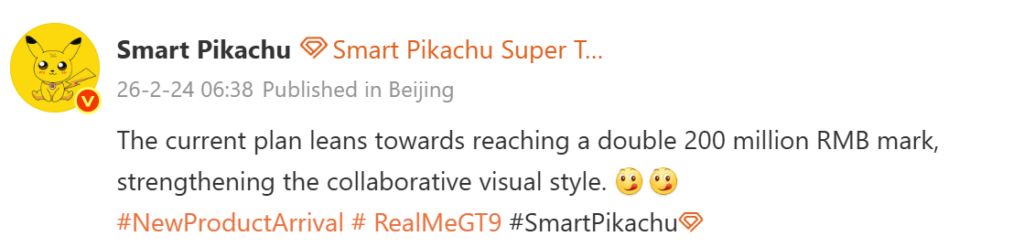
Redmi unveiled the Redmi K90 and Redmi K90 Pro Max equipped with the Snapdragon 8-series chipsets in China. A new leak, courtesy of tipster Smart Pikachu, has revealed that the company is planning to add more models to the series. He has also revealed the screen size of the two expected models.
Redmi K90 Pro, K90 Ultra in the works
Redmi K90 series to soon add more models
According to the tipster, the Redmi K90 series may introduce two new models possibly positioned as the K90 Pro and the K90 Ultra. These phones are expected to feature 6.6-inch and 6.8-inch displays, adding more variety to the current lineup.
The existing Redmi K90 comes with a 6.59-inch screen designed to balance one-hand comfort with adequate viewing space, while the K90 Pro Max includes a 6.9-inch panel for users who prefer a more immersive display.
The rumored upgrades place the new models between these established sizes, catering to different preferences. Early speculation also suggests the Pro variant could adopt the Dimensity 9500 chipset, while the Ultra model may shift to the Dimensity 9500 Plus for improved performance.
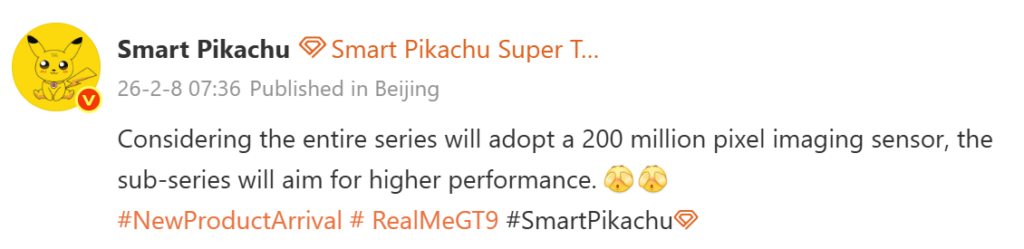
As per a previous leak, the Redmi K90 Ultra may include a 6.8-inch LTPS OLED panel with 1.5K resolution and a high 165 Hz refresh rate. Rounded corners, a metal middle frame, and stronger water protection are also said to be part of the design. Audio is another focus area, as existing K90 models feature speakers tuned in collaboration with Bose, and the upcoming models may continue this partnership.
A major highlight is the possibility of an approximately 8,000mAh battery, which would be a significant upgrade over earlier models. The Ultra is expected to prioritize performance with a high frame rate software layer and a MediaTek Dimensity 9 series chipset.


If Redmi follows its usual release cycle, the K90 Ultra could arrive in mid-2026 in China. There is no launch timeframe for the Redmi K90 Pro, but it is likely that the company may aim to make it official in the first half of 2026.
For more daily updates, please visit our News Section.
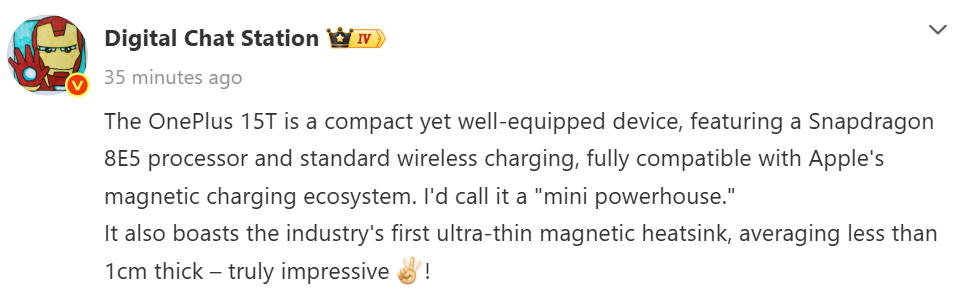
OnePlus is expected to unveil the OnePlus Ace 6T later this month in China. Next year, the brand is expected to unveil the OnePlus 15T, a compact flagship phone, in around March 2026 in China. Ahead of the launch, the rumor mill has been gradually revealing details about the 15T. A new leak, courtesy of tipster Digital Chat Station, has revealed details about the screen refresh rate and weight.
OnePlus 15T screen refresh rate, thickness tipped
OnePlus 15T display refresh rate
The OnePlus 15, Ace 6, and the upcoming Ace 6T are all equipped with 165Hz displays. The new leak suggests that the OnePlus’s upcoming compact phone, which is the OnePlus 15T, will have a 6.3-inch display with support for a 165Hz refresh rate.
Additionally, he also mentioned that the thickness of the device will exceed 8.5mm. To recall, the OnePlus 13 has a 6.32-inch 120Hz OLED screen and measures 8.2mm despite packing a 6,260mAh battery.
Rumors surrounding the OnePlus 15T’s battery size claim that it will pack a battery of around 7,000mAh. With such a significant leap in battery capacity, an increase in device thickness is inevitable.
Other reports have revealed that the OnePlus 15T will feature the Snapdragon 8 Elite Gen 5 chipset and an ultrasonic in-screen fingerprint sensor. In terms of build, the device will have a metal middle frame and an IP68-rated body.
In related news, a couple of other compact flagship phones are also said to be in the works for the Chinese market. These include the Oppo Find X9s, Vivo X300s, and Honor Magic 8 Mini. A recent report claimed that the rumored iQOO 15 Mini has been shelved. What sets the OP15T apart from these competitors is that the rivals are expected to feature MediaTek’s upcoming Dimensity 9500 Plus chipset.
For more daily updates, please visit our News Section.
Smartphone gimbals are no longer just tools for vloggers or indie filmmakers. In 2025, they’ve evolved into AI-enhanced, stabilization-first accessories that can turn any phone into a pro-grade content device.
Whether you’re shooting TikToks, streaming workouts, or capturing pet antics, the latest generation of affordable mobile gimbals delivers professional-level tracking, stabilization, and lighting, at prices that won’t blow your budget.
If you’re planning to invest in one, aim for the $100–$150 range. That sweet spot brings significant upgrades in tracking accuracy, mechanical stability, and overall build quality. For content creators who rely on these tools day in and day out, spending a little more upfront often gets you the best bang for your buck.
Here’s a deep dive into the best models under $150, with options that balance software intelligence, mechanical fluidity, and everyday usability.
DJI’s Osmo Mobile 8 pushes smartphone filmmaking forward with native pet and human tracking, 360° pan rotation, and robust 3-axis stabilization. It works natively with Apple DockKit and integrates gesture recognition, zoom tracking, and Dual Lens Boost for dynamic composition across wide and telephoto lenses.
This gimbal features an integrated tripod and extension rod, a side control wheel for intuitive zoom, focus, and fill light adjustments, and a 10-hour battery that doubles as a smartphone charger for extended use. It boasts ActiveTrack 7.0 for intelligent, persistent subject tracking and a multifunctional module that supports mic pairing, lighting, and gesture detection, perfect for solo creators.
This is a serious mobile tool for creators who want intelligent tracking and pro features in a pocketable rig.
Please Note: When you buy something using the links in our articles, we may earn a small commission at no cost to you.
2. DJI Osmo Mobile 7P
The Osmo Mobile 7P simplifies content capture without cutting key features. It retains DJI’s seventh-gen stabilization and ActiveTrack 7.0 while supporting the optional multifunctional module for gesture-based subject tracking.
The built-in tripod and extension rod provide the flexibility needed for easy low-angle shooting and wider selfies. This gimbal ensures quick startup: it powers on automatically when unfolded and offers native compatibility with your phone’s camera app, eliminating the need for the DJI Mimo app. It also includes phone charging support for convenience.
For creators looking to save a few dollars without sacrificing stabilization or tracking, the 7P covers most core needs in a lighter package.
Please Note: When you buy something using the links in our articles, we may earn a small commission at no cost to you.
3. Zhiyun Smooth 5S AI
Zhiyun’s Smooth 5S AI targets advanced users. The magnetic AI tracker works both front and rear, enabling smart tracking and remote framing. It supports gesture control and pairs with native camera apps or Zhiyun’s ZY Cami and StaCam apps.
It features a powerful, integrated fill light on the tilt axis that delivers 650 lux of illumination, which can be boosted to over 2000 lux with two optional magnetic lights. The gimbal uses an orthogonal 3-axis structure to guarantee smooth motion even during high-speed filming. Switching settings is fast and intuitive thanks to an all-in-one control panel.
Smooth 5S AI is ideal for creators who need better lighting, extended stabilization performance, and advanced app control without jumping into pro-grade territory.
Please Note: When you buy something using the links in our articles, we may earn a small commission at no cost to you.
4. Zhiyun Smooth Q5 Ultra
For creators who just want the basics done well, with a few bonus features, the Smooth Q5 Ultra is a sleeper hit. It includes gesture-based tracking, a detachable remote, voice control, a 215mm extension pole, and a 13.5-hour battery.
The built-in 226 lux fill light and compact remote transform it into a solo creator’s dream, and intuitive tilt/pan wrist gestures unlock new ways to shoot without touching the gimbal. It doesn’t quite match the AI prowess of pricier gimbals, but for casual TikTok, vlog, or travel shots, it more than gets the job done.
Price: $99
5. Hohem iSteady M7
While the price is slightly above the sub-$150 range, the iSteady M7 stands out for its high payload capacity of 500g, which accommodates phones with lenses and microphones. It features a 193mm extension pole, 360° pan rotation, and a large tilt range.
The detachable OLED touchscreen remote allows live monitoring and gimbal control from up to 10 meters away. It supports magnetic RGB+CCT fill lights and includes advanced features like Inception Mode and dynamic orientation switching.
This model suits advanced mobile creators who need to attach extras and want precise remote shooting in outdoor or professional settings.
Please Note: When you buy something using the links in our articles, we may earn a small commission at no cost to you.
6. Hohem iSteady V3 Ultra
For those who want flagship AI smarts in a beginner-friendly package, the V3 Ultra is seriously compelling. It features a detachable touchscreen remote, multimodal AI tracking (people, pets, vehicles), a three-color fill light, and a 205mm extension pole.
Reliable tracking remains locked on, even when the subject is briefly obscured, and the 360° infinite pan rotation allows for cinematic sweeping shots. It is balanced for all-day shoots with a 9-hour battery and a 400g payload capacity. Furthermore, achieving professional results is made easier by the Hohem Joy app’s creative templates and motion presets, eliminating the need to be an editing expert.
Please Note: When you buy something using the links in our articles, we may earn a small commission at no cost to you.
7. Insta360 Flow 2 Pro
Flow 2 Pro comes with native Apple DockKit support. It works across 200+ iOS apps with no need for third-party modules or setup headaches. It also introduces multi-person tracking, perfect for group dances, live podcasts, or collaborative shoots.
Tracking is handled via AI with three-axis stabilization, and the gimbal includes a built-in selfie stick, tripod, and spotlight. If you’re deep into the iOS ecosystem, this is the smartest, most seamless experience you can get without blowing your budget.
Please Note: When you buy something using the links in our articles, we may earn a small commission at no cost to you.
8. Insta360 Flow 2 Plus
The Flow 2 Plus includes the AI Tracker by default and supports both iOS and Android ecosystems. It offers full gesture tracking, 360° panning, built-in lighting, and seamless app compatibility. It also supports remote smartphone-based control, which turns another phone into a preview and shooting tool.
The 207mm selfie stick and built-in tripod make it versatile, and the 10-hour battery with USB-C charging means you can shoot all day without interruptions.
Update: A new update from Tecno reveals that starting Dec. 1, the first 10,000 Spark Go 5G buyers will receive a complimentary 1-month Jio Truly Unlimited 5G prepaid plan valued at Rs 349.
Original story continues…
Tecno has announced a significant milestone after clearing the network enhancement criteria established by Jio. According to the company and Jio, Tecno is the first smartphone brand in India to meet the stringent requirements for the operator’s true 5G rollout. This breakthrough reveals that Tecno’s devices will now perform reliably even in areas with challenging connectivity.
Tecno’s integration with Jio true 5G network
Tecno meets Jio’s 5G network requirements
Technically, Tecno has integrated several of Jio’s network upgrade features to maximise performance on the 5G standalone network. Its new “Tecno Signal Core” system supports full 5G SA compatibility, which helps deliver faster speeds and stable signal even in crowded or weak signal zones.
The company has implemented new radio carrier aggregation supporting critical frequency bands including n28 to improve coverage in suburbs and rural zones. Voice over New Radio (VoNR) is enabled for high-definition voice calls over the 5G network. Tecno also supports dynamic slot aggregation, key local bands for widespread coverage throughout India, and Smart Signal Detection for rapid network recovery.
On the software side, Tecno offers 4G+5G DSDA functionality and a visual 5G+/5G++ icon logic to help users verify active strong signals. The hardware antennas and reception performance have been tuned for better performance in busy areas and remote places.
This achievement strengthens Tecno’s presence across India, especially in small towns and villages where signal quality varies drastically. Users looking for a smartphone that stays connected consistently in demanding environments should consider Tecno’s lineup. The collaboration can benefit consumers switching to 5G or living in regions where network reliability is often unpredictable.
For more daily updates, please visit our News Section.
OnePlus president Louis Li has shared a concise preview of what users can expect from the upcoming OnePlus Ace 6T. While he avoided giving away the entire feature set, he offered enough hints to confirm that the phone is positioned as a performance-focused alternative in the brand’s lineup. He also confirmed several details about the device, including a Genshin Impact Kamisato Ayaka special edition.
OnePlus Ace 6T key details confirmed
OnePlus Ace 6T
From Li’s brief breakdown, the OnePlus Ace 6T is framed as a new option for users who want flagship-level performance without stepping into the ultra-premium price segment. It is confirmed to debut Qualcomm’s next-generation Snapdragon 8 Gen 5 chipset globally, indicating a significant leap in power efficiency and raw speed.
The phone is set to feature a battery capacity starting with an “8”, indicating that it will pack an 8,000mAh+ battery. The handset is also confirmed to support 100W fast charging.
Gaming appears to be a central highlight. Li mentioned a new internal gaming engine designed to handle gameplay at up to 165 frames per second. This is supported by a 165Hz display refresh rate, a dedicated esports-oriented triple-chip setup, and support for 144fps mode in Honor of Kings.
The phone will also include bypass charging and the same gyroscope used in the OnePlus 15 to improve motion accuracy. Durability is another area where the device seems to stand out. It is said to carry IP66, IP68, IP69, and IP69K ratings, which collectively point to strong dust and water resistance.
OnePlus is also introducing a new Glacier cooling system, promising the largest heat dissipation structure the brand has designed so far. The Ace 6T will come with an ultrasonic 3D fingerprint sensor and a special Genshin Impact Kamisato Ayaka edition.
In related news, well-known tipster Evan Blass has leaked the official renders of the Ace 6T, giving a first look at its design. The handset can be seen sporting a flat display on the front and a dual-camera setup on the back. It also features a Plus key on the left edge. As per reports, the device will come in green and purple variants.
For more daily updates, please visit our News Section.
After launching the Realme P4 5G lineup in August, the company is already preparing to add another member to the series, the Realme P4x 5G. A microsite for the phone has quietly appeared on Flipkart, suggesting that an official announcement may be just around the corner.
Flipkart’s teaser confirms support for 90fps gaming in GT Mode, along with a punch-hole display and slim bezels.
The P4x 5G is also being advertised as a multitasking workhorse. According to Realme, the phone can keep up to 90 apps running in the background without slowing down.
Moreover, the phone will support 45W fast wired charging and include bypass charging. The latter lets the phone draw power directly from the charger instead of the battery, helping reduce heat during long gaming sessions.
Realme also claims the P4x 5G will be the only phone in its segment to include a vapour chamber cooling system.
Realme P4x 5G Specifications
To add to that, tipster Sudhanshu Ambhore has shared a broader list of specs as well. According to him, the phone will feature a 6.72-inch FHD+ LCD with a fast 144Hz refresh rate.
Powering the device is a MediaTek Dimensity 7400 Ultra chipset. Its camera setup includes a 50MP main and 2MP auxiliary lens on the rear and an 8MP sensor for selfies. The device has a 7,000mAh battery to keep everything running.
Realme’s P4x 5G will succeed the Realme P3x 5G and will join the P4 line as the third member after P4 and P4 Pro 5G. More official details are likely to roll out in the coming days, once the company formally announces the launch date.
Samsung’s A-series usually gets a predictable refresh every year. The 2025 Galaxy A56, for instance, will get a successor in 2026 in the form of the A57.
However, the company hasn’t touched its Galaxy A7x series in years. The last model in the series was Galaxy A73 from 2022, and Samsung never followed it with A74 or A75. Now, it looks like Samsung may finally be preparing a comeback.
A new Samsung device with the model number SM-A776B has surfaced on Geekbench, and the label strongly hints that this could be the long-awaited Galaxy A77. Samsung’s model numbers almost always follow a pattern, and this one fits perfectly into the A7x family.
Samsung Galaxy A77 Geekbench
What makes the listing more interesting is what’s inside the phone. The benchmark entry shows a new Exynos chipset with a GPU from its flagship Exynos 2400 chip.
The SoC has three high-performance cores clocked at 2.78GHz, three mid cores at 2.30GHz, and four efficiency cores running at 1.82GHz. And for graphics, it uses the Xclipse 940. The tested unit also features 8GB of RAM and is running Android 16.
In terms of raw performance, the Galaxy A77 prototype achieves 1,673 points in single-core and 5,597 points in multi-core tests on Geekbench 6. Those are strong numbers for a mid-range device, putting it closer to upper-tier phones than typical A-series models.
It’s still too early to know when or if Samsung will officially revive the A7x lineup, but this leak suggests that the company hasn’t forgotten about the segment. And if the Galaxy A77 really ships with this new Exynos chip, Samsung might finally bring some flagship-level features back into its upper mid-range phones.
BYD showed up at the 2025 Guangzhou Auto Show with a clear intention: steal the spotlight. And with the debut of the YANGWANG U9 Xtreme, the company may have done exactly that. The limited-run electric hypercar is now officially the fastest production car on the planet.
The big number making headlines is its 496.22 km/h (308 mph) top speed, delivered by a four-motor setup pushing close to 3,000 hp. That’s enough to leapfrog the Bugatti Chiron and give BYD bragging rights few expected from a EV. The company also claimed a 6:59.157 Nürburgring lap time—another eyebrow-raiser for a brand better known for mass-market cars than track weapons.
Only 30 units of the YANGWANG U9 Xtreme are being built, which practically guarantees collector status before the first customer even sits inside. It also slots BYD into a rare corner of the industry where extreme performance isn’t just a feature—it’s the entire mission.
Inside the car is a fully reworked version of BYD’s e⁴ AWD system, upgraded DiSus-X body control, custom aero, and a shell covered in carbon fiber. The oversized wings, vented hood, and huge rear diffuser aren’t just for show—they help keep the car steady as it pushes toward 500 km/h.
Braking comes from titanium alloy calipers paired with a custom carbon-ceramic kit, while the semi-slick GitiSport e·GTR2 PRO tires are rated for a ridiculous 500 km/h, which tells you everything about the performance envelope BYD is aiming for.
At the heart of it all is the new 30C Blade Battery, designed specifically for extreme discharge loads. It uses a dual-layer cooling system and low-resistance cells that can dump massive power in an instant—exactly what you need when each wheel has its own motor.
Pricing is expected to land well below the million-dollar crowd. And judging by the reaction in Guangzhou, BYD has just planted a very loud flag in the hypercar world—one that’s hard to ignore.
Oppo is preparing to expand its Reno 15 lineup in China with the upcoming Reno 15c. The company previously teased the device during the Reno 15 launch event earlier this month, but did not reveal any technical details. Oppo described the phone as an “entry-level choice” designed for trendy looks, smooth performance, and everyday reliability.
Oppo Reno 15 series
Now, a new leak from tipster Digital Chat Station has disclosed the main specifications of the Reno 15c. According to the leak, the phone features a 6.59-inch LTPS OLED flat display with a 1.5K resolution and 120Hz refresh rate. It uses the Qualcomm Snapdragon 7 Gen 4 processor with up to 12GB and 512GB storage.
The Reno 15c includes a 50-megapixel front camera and a triple rear camera setup. The leak mentions a 50-megapixel main sensor, an 8-megapixel ultrawide lens, and a 50-megapixel telephoto camera. Another tipster, Bald Panda, claims these sensors could include the Sony LYT-600 for the main camera, Sony IMX355 for the ultrawide lens, and Samsung JN5 for the telephoto unit.
As per DCS, the device supports 80W wired fast charging and weighs 197 grams. It uses a short-focus optical fingerprint sensor for biometric security. Oppo plans to offer the phone in three colors: Aurora Blue, College Blue, and Starlight Bow.
In terms of design, the Reno 15c appears similar to the Reno 15 and Reno 15 Pro models. It shares the same glossy back panel but introduces a minor change to the camera layout. The LED flash has been moved to the bottom of the module, setting it apart from its siblings.
Oppo has not officially confirmed the Reno 15c’s launch date, but the device is expected to arrive in China in December. The pricing is likely to fall below the standard Reno 15 model.
Oppo is also working on global variants of the Reno 15 series. The global lineup could differ from the Chinese models. It remains unclear whether the Reno 15c will be part of the international launch.
For more daily updates, please visit our News Section.
Xiaomi has officially launched the Smart Door Lock M40 and opened pre-orders in China. The device is priced at 3299 yuan ($464) for its first sale. The company also introduced the higher-end M40 Pro model last month. The M40 retains most of the features found on the Pro version, with minor differences such as the removal of palm-vein recognition and a slightly smaller 4.94-inch touchscreen.
Xiaomi Smart Door Lock M40 Specifications
The Smart Door Lock M40 includes an AI dual-camera peephole system with a 175-degree 3MP wide-angle camera and a 128-degree 2MP secondary camera. The system supports panoramic viewing, video calling, and real-time notifications. Xiaomi has equipped the lock with six infrared night vision lights and added multiple night modes for better visibility in low-light conditions.
The M40 features a full-body automatic lock mechanism and uses a straight-insert C-grade mechanical cylinder. This cylinder remains operable even when the external panel is damaged. The lock also includes a safety chipset, encrypted communication protocols, and structural reinforcements to protect against physical tampering and hacking attempts.
The front panel measures 431 x 98 x 46 mm, and the rear panel is slightly shorter at 421 mm in height. The device weighs 5.18 kilograms. Xiaomi uses a combination of metal and internal sensors to improve durability and stability across different environments.
The power system includes an 8000mAh rechargeable lithium battery and a set of four AA alkaline batteries for backup. Both inner and outer panels support Type-C ports for emergency power input. The system also allows reverse wireless charging from supported smartphones. The lithium battery supports up to 4.5 months of use, while the AA batteries can extend usage up to six months.
For connectivity, it features Bluetooth 5.3, NFC, and Wi-Fi 6 on the 2.4GHz band. The lock works with Xiaomi HyperOS and supports remote access, instant alerts, and intercom functions through the Mi Home app. Control extends across smartphones, tablets, TVs, and the Xiaomi SU7 car system. It also supports voice and video interactions through WeChat.
Xiaomi claims the M40 can operate in temperatures ranging from -10°C to 55°C. The lock supports 12 unlocking methods, including AI 3D facial recognition, AI fingerprint recognition, NFC cards, numeric passwords, and app-based control.
In related news, Xiaomi recently launched a smart car humidifier with HyperOS, USB-C connectivity, and support for the SU7 and YU7 models. The company also introduced a new 12kg front-load washing machine with HyperOS integration and 25 smart wash modes.
For more daily updates, please visit our News Section.
Xiaomi has launched the Mijia Smart In-Car Humidifier in China at a retail price of 129 yuan (around $18). The new device supports HyperOS in-car connectivity with the Xiaomi SU7 series (including the Ultra model) and the Xiaomi YU7 series. It delivers a maximum humidification rate of 230 mL per hour and targets users looking for a compact, car-friendly humidifier with smart features.
Mijia Car Humidifier Specifications
The Mijia humidifier features a cylindrical design measuring 71 mm in diameter and 151 mm in height. It weighs 288 grams and fits most standard vehicle cup holders. Xiaomi has equipped the device with a 210 mL transparent water tank that supports direct top-filling. The tank uses antibacterial silver-ion materials with a verified sterilization rate above 99 percent.
The humidifier uses a cotton-free design and supports Xiaomi’s live-water circulation system. It features an internal pump that moves water from the tank to the top-mounted ultrasonic atomizer. This setup maintains consistent mist output and avoids mold growth. The device reaches a mist height of at least 10 cm and supports two power levels. At level two, the humidification rate maintains a minimum of 30 mL/h, suitable for enclosed spaces such as car interiors.
Xiaomi has included several smart control options. The humidifier integrates with HyperOS Connect for in-car operation. It also works with the Mi Home app and supports voice control via Xiaomi’s Xiao Ai assistant. SU7 and YU7 owners can activate the humidifier remotely before entering the vehicle, allowing cabin humidity to reach a comfortable level in advance.
The device runs on a 5V power supply through a USB-C port and consumes 4.5 W of power. It supports multiple safety mechanisms, including automatic shutdown when tilted past 60 degrees or when water runs low.
The humidifier withstands high internal temperatures up to 85°C, making it suitable for parked cars exposed to sunlight. It operates at noise levels below 32 dB(A), ensuring quiet performance during use.
We use cookies on our website to give you the most relevant experience by remembering your preferences and repeat visits. By clicking “Accept”, you consent to the use of ALL the cookies.
This website uses cookies to improve your experience while you navigate through the website. Out of these, the cookies that are categorized as necessary are stored on your browser as they are essential for the working of basic functionalities of the website. We also use third-party cookies that help us analyze and understand how you use this website. These cookies will be stored in your browser only with your consent. You also have the option to opt-out of these cookies. But opting out of some of these cookies may affect your browsing experience.
Necessary cookies are absolutely essential for the website to function properly. This category only includes cookies that ensures basic functionalities and security features of the website. These cookies do not store any personal information.
Any cookies that may not be particularly necessary for the website to function and is used specifically to collect user personal data via analytics, ads, other embedded contents are termed as non-necessary cookies. It is mandatory to procure user consent prior to running these cookies on your website.