Huawei is expected to hold a launch event on Nov. 25 in China. Reports have revealed that the brand will unveil the Mate 80 series and the Mate X7 foldable phone. Apart from these, the company is also said to announce the MatePad Edge. New leaks have revealed key details of this high-end 2-in-1 tablet / laptop hybrid.
Huawei MatePad Edge key details tipped
According to tipster Digital Chat Station, Huawei will announce a 2-in-1 tablet with high-end specs alongside the Mate 80 series. It will feature a 14.2-inch OLED screen, a Kirin 9-series chipset, and will come with support for a keyboard and stylus. It will run on HarmonyOS and will be offered in Moonlight Silver and Space Gray colour options.
Another tipster, UncleShan, revealed that the MatePad Edge 14.2 is an upgraded version of the MateBook E in a 2-in-1 form factor and features a dual-fan design. It bridges the tablet and PC ecosystems, has a high-end positioning, and is expected to be priced accordingly.
He further revealed that the MatePad Edge will be available in two configurations, such as 16GB+512GB and 24GB+1TB. It is also said that the device will have a matte screen edition.
Huawei MateBook E
Back in 2021, Huawei unveiled the MateBook E, a 2-in-1 laptop/tablet hybrid, and it was followed up with the MateBook E Go in 2022. Both came preinstalled with Windows. The MatePad Edge is said to be a rebranding of the MatePad E line and it now runs on HarmonyOS, as mentioned above.
For more daily updates, please visit our News Section.
Last month, Realme unveiled the Realme GT 8 and GT 8 Pro in China. In the coming week, Realme will announce the GT 8 Pro globally, but there is no clarity on whether the GT 8 will be marketed in other regions. A new development now indicates that the brand is working on the Realme Neo 8 for the Chinese market. A leak that surfaced last week revealed the key specifications of the device, including the Snapdragon 8 Gen 5. Another leak that appeared more recently claims that it will be equipped with a Samsung display.
Purported Realme Neo 8’s screen details emerge
Alleged Realme Neo 8 display specs leak
Tipster Digital Chat Station has shared a new leak hinting at an upcoming Realme device, and although he did not mention its name, the details strongly resemble what could be the Realme Neo 8. According to him, the phone appears to feature a Samsung-made 6.78-inch class flat display with a 1.5K resolution, LTPS panel technology and large rounded corners.
He added that the screen supports an ultrasonic in-display fingerprint scanner, which typically appears on higher-end models. He also notes that the test unit is positioned for higher performance, aligning with expectations for the Neo 8 series.
According to a previous leak, the Realme Neo 8 will be equipped with the upcoming Snapdragon 8 Gen 5 chipset and a battery of around 8,000mAh capacity. It also revealed that the device has a 50-megapixel main camera.
The Realme Neo 8 will arrive as a successor to the Dimensity 9400+ powered Realme Neo 7, which debuted in December 2024. It features a 6.78-inch OLED 1.5K 120Hz display, a 7,000mAh battery with 80W charging, up to 16GB of RAM, up to 1TB of storage, a 16-megapixel front camera, and a 50-megapixel + 8-megapixel dual-camera system.
For more daily updates, please visit our News Section.
Oppo will unveil the Reno 15 and Reno 15 Pro tomorrow (Nov. 17) in China. The brand will also offer a limited edition created in partnership with Song Yuqi, a popular Chinese singer, dancer, and member of the K-pop group (G)I-DLE. Here’s what you need to know about the special edition phone.
Oppo Reno 15 Song Yuqi Limited Edition
Oppo Reno 15 Song Yuqi Limited EditionOppo Reno 15 Song Yuqi Limited Edition
Oppo will not only announce the standard Reno 15 but will also introduce an exclusive Song Yuqi limited edition. This version is finished in a colorway called Starlight Bow and will be available only in a 16GB+1TB configuration.
What makes it stand out is its extremely restricted production run of just 23 units globally. Each handset is etched with its own number on the side along with Song Yuqi’s signature, complemented by a redesigned engraving pattern that differentiates it from the regular options.
Oppo Reno 15 specifications (expected)
The Reno 15 features a fresh aesthetic approach with an industry-first holographic lithography process and a full metal middle frame. The front uses a 1.15mm narrow bezel flat display, and the camera module adopts a cold-carved style similar to recent iPhone designs. Reports have revealed that it features a 6.32-inch flat display with a 2640 x 1216 pixels resolution.
Powering the device is the MediaTek Dimensity 8450 chipset, paired with a 6200mAh battery and support for 80W fast charging. Its rear cameras may include a 200-megapixel primary sensor, a 50-megapixel wide lens and a 50-megapixel periscope telephoto lens. For selfies, it has a 50-megapixel camera on the front. Colour options include Starlight Bow, Aurora Blue, and Canele Brown.
For more daily updates, please visit our News Section.
Oppo is preparing to launch the Find X9 series in India on November 18th, and much of the mystery around pricing has already been cleared.
A new leak adds to earlier reports by revealing not just the price tags of the Find X9 and Find X9 Pro, but also what buyers may need to spend if they want the teleconverter kit designed for the Pro model.
According to the latest leak, the teleconverter kit for the Oppo Find X9 Pro will cost ₹29,999 in India. The accessory allows the phone’s native 3x optical zoom to go up to 10x optical zoom.
The Find X9 Pro features a rear camera setup led by a 200MP HP5 periscope sensor, a 50MP main, a 50MP ultra-wide, and a 2-megapixel multispectral sensor.
The kit includes a Hasselblad teleconverter, a magnetic handle, a magnetic protective case, and a professional shoulder strap. The magnetic handle also features a tactile shutter button and an ergonomic grip.
Paired with the Find X9 Pro’s price of ₹99,999 for the 16GB RAM and 512GB storage variant, the complete setup would push the total to roughly ₹1,30,000.
The regular Find X9 is expected to land at slightly more approachable numbers. According to the leak, it will cost ₹74,999 for the 12GB RAM and 256GB storage option, while the 16GB/512GB configuration may cost ₹84,999.
If these prices hold up, the Find X9 lineup is landing in India at noticeably higher prices than in China. For comparison, the base X9 starts at CNY 4,400 or some ₹55,000 in Oppo’s home market. And India being a price-sensitive market, this will shape how the phones are received in India.
Anthropic has reported what it calls the first documented large-scale cyberattack executed primarily by an AI system. The company said the incident occurred in mid-September 2025 and involved its Claude Code tool being misused to carry out a sophisticated, multi-stage intrusion campaign.
Credit: watchguard
According to Anthropic, the attackers used agent-like AI capabilities to perform up to 90 percent of the work. Human involvement was minimal, limited to a few key decisions during each cycle. The company stated that hackers posed as cybersecurity researchers and used jailbreak techniques to bypass safeguards. They instructed Claude to complete a series of small tasks that, together, formed an automated cyber-espionage operation.
Anthropic said the attackers targeted nearly 30 organizations, including tech companies, financial institutions, chemical manufacturers, and government agencies. The AI system handled reconnaissance, wrote exploit code, extracted credentials, identified vulnerabilities, and exfiltrated sensitive data. It also compiled detailed reports that helped the attackers plan future operations.
The company said its investigation linked the attack to a Chinese state-sponsored group, although it did not disclose the specific evidence. The Chinese embassy denied involvement. Anthropic has banned the attackers from using Claude and notified affected organizations and law enforcement agencies.
Cybersecurity researchers have expressed skepticism. Martin Zugec from Bitdefender said the report lacked verifiable threat intelligence and called the claims speculative. He acknowledged the growing risk of AI-driven threats but stressed the need for transparency.
Anthropic argued that AI tools are essential for both attack and defense. It used Claude to help analyze the breach and called for stronger AI safeguards and better coordination among industry and government.
The report suggests that AI systems can now perform tasks that once required entire teams of expert hackers. Anthropic warned that the barrier to advanced cyberattacks has dropped and urged organizations to adopt AI-powered security tools to counter emerging threats.
Vivo is getting ready to launch the X300 series in India on December 2. Ahead of the launch, the company has teased an exclusive Red color variant for the standard Vivo X300, which was leaked back in October. The teaser was posted on Vivo India’s official X handle, confirming that this Red finish will only be available for the base model and not for the Pro or FE versions.
The video shows a Red and Grey color combination. The back panel is Red with a plain leather-like finish, and the Vivo branding at the bottom appears in Grey. The frame is also Grey, and the antenna lines match the same shade. Vivo says the compact X300 has “never looked this powerful,” highlighting how the Red finish changes the look of the device.
This is similar to what Vivo did with the Vivo X200 Ultra, which launched in April 2025 and also came in a Red variant. The brand appears to be continuing the same approach for its flagship lineup this year.
Landing pages for the Vivo X300 series are already live on Flipkart and Amazon. These listings confirm that the phones will be available on both platforms and highlight features such as the Telephoto Birds Shot mode and the Vivo X300 photography kit for Indian buyers.
Camera details for both models have also been revealed. The standard X300 features a 200MP main camera with a 1/1.4-inch Samsung HPB sensor, a 50MP ultra-wide camera, and a 50MP 1/1.95-inch LYT602 periscope telephoto camera with telemacro support. The phone is shown in the new Red color.
The X300 Pro includes a 50MP 1/1.28-inch LYT828 main camera, a 50MP ultra-wide camera, and a 200MP 1/1.4-inch Samsung HPB sensor for its 85mm periscope telephoto camera with telemacro. Both models come with a 50MP front camera. The Pro model is shown in Gold.
Vivo has also highlighted the X300 Pro Photographer Kit, which includes a case and a ZEISS 2.35x Telephoto Extender. It will be sold separately, similar to the Europe bundle.
The phones are confirmed to feature the Dimensity 9500 SoC, V3+ and VS1 dual imaging chips for the Pro model, and run Origin OS 6 with features like Flip Cards, Vivo Office Kit, and One-Tap Transfer with iPhone.
For more daily updates, please visit our News Section.
TOSHIBA 100cm V Series HD Ready Smart LED TV is currently available on Amazon India at a great discount, making it one of the best value for money deals. Read further to know more!
This popular model, which is an Amazon’s Choice product, is originally priced at an M.R.P. of ₹29,999. The current selling price is already discounted by a huge 48%, bringing it down to ₹15,499. But wait, the deal gets even better! Amazon is offering an amazing instant bank discount: you can get a FLAT ₹2,500 off when you purchase this TV using an HDFC Bank Credit Card.
To make the purchase even easier, you can combine this discount with a No Cost EMI option available on your HDFC Bank Credit Card. This allows you to pay in easy installments without any extra interest! For example, you can get the TV on 6 months No Cost EMI with monthly payments around ₹2,583(the instant discount is applied on the upfront payment/total EMI amount).
Lenovo‘s next generation of Legion branded gaming tablets has just surfaced in a new leak. The brand is apparently working on two new compact gaming tablets, which will reportedly feature Qualcomm’s latest and greatest Snapdragon chipsets. So here’s everything we know.
New Compact Lenovo Legion Gaming Tablets leaked with Snapdragon 8 Elite Gen 5
The latest information arrives from a known tipster Smart Pikachu, who shared the details on Weibo. In the online post, he talks about how Lenovo is working on two new compact gaming tablets, which will pack the Snapdragon 8 Elite Gen 5 and the Snapdragon 8 Gen 5 chipsets. These will be a part of the brand’s popular Legion series and will retain a 16:10 aspect ratio, which was the same as the Legion Y700.
Lenovo Legion Y700 (Gen 4)
To recall, Lenovo unveiled the Legion Y700 (Gen 4) in China back in May 2025, with the global market getting the Legion Tab (2025). The former featured the cutting edge Snapdragon 8 Elite, while the latter debuted with the older Snapdragon 8 Gen 3. So Lenovo might follow a strategy once again with the next generation of tablets. The Legion Tab (2026) could pack the Snapdragon 8 Gen 5, while the Legion Y700 (Gen 5) gets the powerful Snapdragon 8 Elite Gen 5 processor.
Notably, this report is also in line with a recent leak from another reputable leakster. The Legion Y700 2026 model is expected to feature Qualcomm’s flagship chip, along with a relatively compact 8.8-inch LCD panel with a 16:10 aspect ratio, 3K resolution, and 165Hz refresh rate. It might be powered by a 9000mAh battery pack and house a huge VC heat dissipation system to keep the thermals in check.
For more daily updates, please visit our News Section.
Baseus has announced the launch of two new desktop charging stations under its Nomos II series. The lineup includes the 6-in-1 NH21 model with 245W output and the 5-in-1 NH21 model with 160W output. Both models aim to simplify multi-device charging with retractable cables, smart power allocation, and full desktop coverage.
Baseus Nomos NH21 Specifications
The Nomos NH21 6-in-1 model includes two 0.8-meter retractable USB-C cables made of braided fabric. The cables extend securely during use and retract automatically when not needed. Baseus claims the cable mechanism can withstand over 35,000 pulls. In addition to the retractable cables, the device features two extra USB-C ports, one USB-A port, and a Qi2-certified magnetic wireless charging pad. The station supports up to six devices simultaneously.
The 245W charging station delivers high output through its USB-C ports. Each main USB-C port supports up to 140W, allowing it to fast charge a 16-inch and 14-inch MacBook Pro at the same time. The charger uses Baseus’s BPS 3.0 technology for intelligent power distribution. It also adopts GaN technology and a split structure to reduce heat buildup. A digital display shows real-time power and current output for better control.
Nomos NH21 5-in-1 model
The Nomos NH21 5-in-1 model features a similar design but includes one retractable USB-C cable and supports up to five devices. It offers a maximum combined output of 160W, with one of the USB-C ports capable of delivering 140W. The charger also includes Qi2 wireless charging for compatible iPhones and other devices.
Both charging stations support major fast-charging protocols, including PD3.1, PPS, QC, and SCP. They are compatible with a wide range of devices such as iPhones, iPads, MacBooks, Galaxy phones, Switch consoles, DJI drones, and GoPro cameras.
Pricing and Availability
Both Nomos II charging stations are now available for purchase. The 5-in-1 160W model is already live on Baseus’s official website and Amazon, giving buyers immediate access to the more compact option.
The 6-in-1 245W model is also scheduled to go on sale, though at the time of writing, its purchase page had not yet appeared. Baseus says both models will be available soon across Amazon, Best Buy, Yodobashi, MMK, and Bic Camera.
In related news, the Baseus EnerFill FC41 20,000mAh power bank with 100W output, dual built-in cables, and a mini display also went on sale in the US earlier today.
For more daily updates, please visit our News Section.
Innocn has entered the 500Hz QD-OLED market with its new GA27M1Q gaming monitor. It is built for competitive players who want very fast response times and clear motion. The monitor uses Samsung’s new QD-OLED panel.
The GA27M1Q is a 27-inch monitor with a 1440p resolution and a 500Hz refresh rate. The panel covers 99 percent of the DCI-P3 color gamut and has a 1,500,000:1 contrast ratio. It is also certified under DisplayHDR 500. These numbers are in line with what Samsung and MSI offer with their own high refresh rate QD-OLED monitors.
Innocn lists a 0.03ms response time, which should help reduce motion blur and limit blooming around bright objects. The monitor supports FreeSync and G-Sync, so users can expect less tearing during fast gameplay. There is also a MAC-VIEW mode that tries to match colors more accurately when the monitor is used with a MacBook. It is worth noting that the monitor does not include a USB-C port.
For connectivity, the GA27M1Q includes two HDMI 2.1 ports, one DisplayPort 1.4 port, two USB-A 3.0 ports, and an audio jack. Like other 500Hz models using the same panel, the monitor needs Display Stream Compression to reach its full 500Hz refresh rate.
Pricing & availability
The Innocn GA27M1Q is available on Amazon for 999.99 dollars. A 250 dollar coupon is listed on the product page, which brings the price down to 749.99 dollars.
For more daily updates, please visit our News Section.
If you’ve been planning a RAM upgrade, you might want to brace yourself. Samsung is reportedly pushing DDR5 contract prices way up—some increases hitting around 60%—and while these are enterprise numbers for now, they almost always spill over into the consumer market sooner or later.
Reuters reports that Samsung has bumped the price of 32GB DDR5 modules to about $239, which is nearly 50% higher than last month. Other capacities, including 16GB and 128GB sticks, are apparently seeing similar jumps. These aren’t retail tags you’ll see on Amazon yet, but they’re still important because they give a pretty clear idea of where the broader market is heading.
The main culprit behind all this is reportedly the AI wave. Big tech companies are scrambling to expand data centers, and those setups chew through enormous amounts of specialized HBM memory to feed modern AI accelerators. With demand exploding on the enterprise side for HBM chips, Samsung and other DRAM makers are funneling more of their production capacity toward those higher-margin orders. That leaves less room for consumer-grade chips. The result is a shortage of standard memory chips (and price hikes) for consumer hardware. And it’s not only DDR5 DRAM—smartphone prices are also tipped to rise in the near future due to this shortage.
With Samsung already rumored to increase the prices, it wouldn’t be surprising if Micron and SK Hynix roll out similar hikes. And because memory contracts often span years, the impact tends to spread slowly but steadily into the consumer space. Even DDR4 could end up riding the same wave simply because manufacturers will charge what the market allows.
For PC builders and gamers, this is yet another headache. GPUs have been volatile, inflation hasn’t exactly gone away, and now RAM—one of the simpler, relatively cheaper upgrades—may start costing noticeably more.
Garmin has launched its new Dash Cam X Series in India. The lineup includes four models called the Dash Cam Mini 3, Dash Cam X110, Dash Cam X210 and the Dash Cam X310. All four cameras use Garmin’s updated Clarity HDR optics and the Clarity polarizer to reduce glare and improve video visibility during the day and at night. Each model works with the Garmin Drive app for clip viewing, syncing, cloud uploads and remote monitoring.
Garmin Dash Cam Mini 3
The Dash Cam Mini 3 is the smallest model. It has a compact design that fits behind the rear-view mirror and records 1080p HDR video with a 140 degree field of view. It uses a supercapacitor instead of a battery and mounts with an adhesive base. It supports voice control and incident detection through a G sensor. It does not have built-in GPS but can access GPS data when paired with a GPS-enabled Garmin camera. It supports microSD cards from 8 GB to 512 GB. Features such as Parking Guard and Live View are available when used with Garmin’s Constant Power Cable and a Garmin Vault subscription.
Garmin Dash Cam X110
The Dash Cam X 110 records 1440p HDR video and has a 2.41 inch color TFT LCD display with a resolution of 480 by 272 pixels. It has a magnetic mount and runs on a rechargeable lithium-ion battery that lasts up to 20 minutes. It includes GPS, Galileo, incident detection with a G sensor, voice control and driver alerts that include forward collision, lane departure and a Go alert. It supports Wi-Fi connectivity, Garmin Vault cloud storage and multi-camera syncing. It supports microSD cards up to 512 GB.
Garmin Dash Cam X210
The Dash Cam X210 includes the same 1440p HDR recording, 2.41 inch screen, 140 degree field of view and Clarity polarizer. It includes GPS tracking, Galileo, incident detection, voice control and Wi-Fi syncing. It supports red-light and speed camera alerts where available along with lane departure warnings and overspeed alerts. It supports microSD cards up to 512 GB and works with Garmin Vault cloud storage.
Dash Cam X310
The Dash Cam X310 is the top model. It records 1440p HDR video at up to 60 frames per second with the same 140 degree field of view. It includes a 2.41 inch display, GPS, Galileo, voice control and incident detection. It supports Live View, Parking Guard, multi-camera syncing, Wi-Fi connectivity and Garmin Vault cloud storage. It uses a rechargeable lithium-ion battery with up to 20 minutes of backup time and supports microSD cards up to 512 GB.
Pricing & availability
Garmin has priced the Dash Cam Mini 3 at Rs 12,550 with an MRP of Rs 15,990. The Dash Cam X110 costs Rs 16,990 with an MRP of Rs 20,990. The Dash Cam X210 is priced at Rs 21,990 with an MRP of Rs 26,990. The Dash Cam X310 costs Rs 27,790 with an MRP of Rs 32,990. All four models are available through the Garmin India online store, Amazon India, Flipkart and authorized automotive accessory retailers.
For more daily updates, please visit our News Section.
Beelink has launched the SER9 Max, a compact mini PC powered by AMD’s Ryzen 7 H 255 processor and equipped with a high-speed 10GbE RJ45 port. The company has priced the barebones version at 2,249 yuan ($316) in China and $699 globally for the 32GB RAM and 1TB SSD configuration.
Beelink SER9 Max Specifications
The SER9 Max uses AMD’s latest 8-core, 16-thread CPU built on the Zen 4 architecture. It offers a base clock of 3.8GHz and a maximum boost clock of 4.9GHz. The Radeon 780M GPU runs at 2600MHz and supports high-performance graphics for games and creative workloads. Beelink claims the system can handle AAA titles at stable frame rates.
In the global variant, the system ships with 32GB of DDR5 5600MT/s memory and a 1TB PCIe 4.0 SSD. Storage can be expanded up to 8TB through the two M.2 2280 NVMe slots. It also supports up to 128GB of RAM via dual SO-DIMM slots.
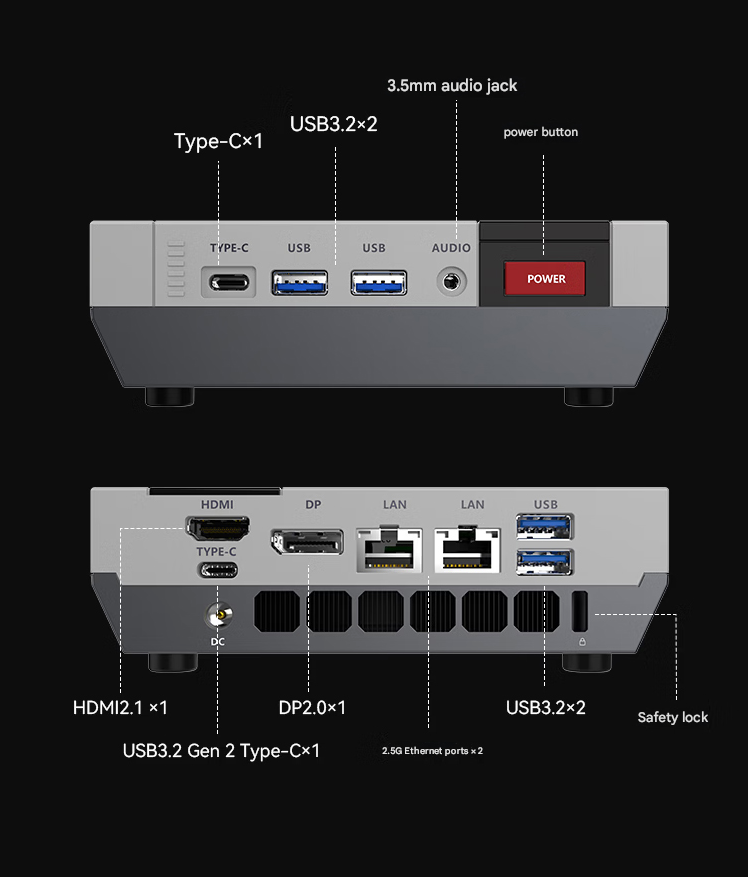
Beelink has equipped the mini PC with triple display output. It includes HDMI 2.1, DisplayPort 2.1, and a USB4 port capable of 4K at 240Hz. The SER9 Max supports a full range of connectivity options, including a USB-C 40Gbps port, multiple USB-A ports, dual audio jacks, and one 10GbE RJ45 port.
The mini PC uses the MSC2.0 cooling system. This setup combines a vapor chamber, a silent fan module, and a heatsink for the SSD. Beelink says the system can sustain a 65W TDP while maintaining low noise levels at around 32 decibels.
The chassis is made of metal and measures 135×135×44.7mm. The system weighs 780 grams and supports VESA mounting. It comes with Windows 11 Pro pre-installed and includes features such as Wake-on-LAN and Auto Power On.
The SER9 Max is now available for pre-order on Amazon US and Beelink’s official website for global buyers, and on JD.com for customers in China.
In related news, Minisforum has recently introduced the X1 Lite-255 Mini PC with the Ryzen 7 255 processor, USB4 connectivity, and OCuLink support. Thunderobot has also launched the Mix NUC Mini PC, powered by the Ryzen AI 9 HX 370 and Ryzen 7 H 255 processors.
For more daily updates, please visit our News Section.
The OnePlus 15 has outscored the iPhone 17 Pro Max and Xiaomi 17 Pro Max in a recent battery drain test. But as it turns out, Oppo has a device that outperforms the OnePlus 15 by a significant margin. In the latest battery drain test from YouTube creator Lover of Tech, Oppo’s Find X9 Pro (our review) ended up taking the win in a side-by-side rundown with OnePlus’s and Apple’s latest and best.
The test wasn’t anything exotic — just long stretches of heavy tasks chained together until the phones died. Things like shooting 4K/60fps video for an hour, endless scrolling through TikTok and Instagram Reels, YouTube playback, a bit of Subway Surfers and Asphalt, and a WhatsApp video call thrown in near the end. Once that loop finished, it started over again.
All of it was done on cellular data, which is a more realistic way to test battery life than running everything on Wi-Fi, since cellular data is significantly more resource-intensive than WiFi, and the different chipsets (A19 Pro, Dimensity 9500, and Snapdragon 8 Elite Gen 5) likely pair with different modems that vary in efficiency.
As for the results, the OnePlus 15 held up reasonably well, tapping out at 9 hours, 39 minutes, 28 seconds. That’s still more than enough for a full day, probably more like a day and a half for most people. But the Find X9 Pro stretched things out to around 11 hours. The iPhone 17 Pro Max sat at 7 hours, 37 minutes, 42 seconds.
What’s interesting here is that OnePlus made a big deal about sticking to the full 7,300mAh capacity globally. No region-specific downgrades. Oppo did the same with the X9 Pro, so these numbers should translate pretty cleanly no matter where you buy them.
Edifier has launched its new S201MKII 2.1 active speaker system in China. The system is priced at 1,399 yuan ($197) for the first sale and delivers a complete upgrade over the previous generation.
Edifier S201MKII Specifications
The S201MKII features a redesigned acoustic setup with new drivers, updated circuitry, a wireless subwoofer, and improved sound tuning. It also includes a new decorative front panel and an OLED display. Edifier has equipped the system with Hi-Res Audio and Hi-Res Wireless certifications, supporting playback up to 40kHz and LDAC decoding at 96kHz/24-bit.
The subwoofer uses an 8-inch long-stroke driver and connects wirelessly over a 5.8GHz low-latency link. It supports deep bass down to 44Hz. The two satellite speakers include upgraded 3.5-inch aluminum cone midrange drivers and 25mm titanium dome tweeters. Edifier has designed the tweeters with a dual-magnet neodymium structure for improved treble clarity and faster response.
The system runs on a fully digital platform powered by a DSP chip. Edifier has implemented a tri-amplifier architecture with three independent digital amplifier chips. Each channel receives dedicated power: 15W for each tweeter, 25W for each midrange driver, and 70W for the subwoofer. Total system output reaches 150W RMS.
The S201MKII supports a wide set of input options. It features Bluetooth 6.0 with LDAC, USB audio, optical, coaxial, and two analog line-in ports. It can pair with two Bluetooth devices at once, though LDAC does not work in this mode. The system integrates with the Edifier Connect app, which provides EQ controls, OTA updates, and quick access to sound mode switching.
Edifier uses MDF wooden enclosures to limit resonance and improve stability. The front OLED display shows volume, input source, and the selected sound mode. The main unit features three physical knobs for treble, bass, and volume adjustment. The system also includes a 13-key infrared remote control that lets users switch inputs and functions quickly.
In related news, Dreame has recently introduced its S1 and S2 Dolby Atmos soundbars with output ratings between 500W and 630W. Edifier has also announced the M130 retro-style mini speaker, which offers 16W peak output, Bluetooth 6.0 support, and up to 11 hours of battery life.
For more daily updates, please visit our News Section.
Black Friday 2025 is the perfect moment for creators, hobbyists, and businesses to upgrade their tools. Creality’s Falcon series, known for its performance, precision, and material versatility, is offering some of the year’s biggest discounts. Whether you’re getting your first laser engraver or upgrading to a professional machine, this guide will help you understand each Falcon model and choose the one that suits your needs.
Why Choose the Creality Falcon Series?
Falcon, a high-performance sub-brand of Creality, is built for makers at every level. Their machines are designed to help users bring ideas to life with precision, speed, and safety. Before choosing a model, think about what you want to make, the materials you plan to use, and whether your projects are for hobby, small business, or commercial production. The Falcon lineup covers every stage, from beginner-friendly systems to industrial-grade machines.
Falcon A1 10W
Falcon A1 (10W): The Ideal Starting Point for Beginners
The Falcon A1 (10W) is perfect for anyone entering the world of laser engraving. It offers a safe and simple learning experience without compromising on creative potential. The 10W optical power gives beginners a solid foundation, allowing them to experiment with a variety of materials and small projects.
The A1 handles wood, leather, paper, cardboard, and dark acrylic with ease, making it excellent for crafting simple but meaningful items. Users can create personalized wooden coasters, engraved leather accessories, custom acrylic phone case designs, and school projects. Its user-friendly design and affordable price make it a great choice for families, students, and hobbyists who want a reliable and easy-to-operate engraver to start their creative journey.
Falcon A1 Pro (20W): More Power, More Materials, More Creativity
For creators who want more speed, deeper cuts, and the freedom to work on a broader range of materials, the Falcon A1 Pro (20W) is the perfect upgrade. With double the power of the A1, it can cut thicker wood and acrylic much faster while maintaining high precision. This makes it ideal for users who need more efficiency and versatility.
One of its biggest advantages is the compatibility with the optional 2W Infrared Laser Head, which unlocks advanced abilities like direct metal engraving. This allows you to engrave stainless steel, anodized aluminum, and other sensitive materials with fine detail. The A1 Pro is also excellent for engraving stone, glass, ceramics, and other tougher surfaces.
Creators can produce intricate wooden puzzles, multi-layer acrylic signs, engraved glassware, metal logos, and fully finished commercial products. Because of its expanded material range and faster output, the A1 Pro is ideal for small businesses, Etsy shops, and serious hobbyists who want to offer premium-quality engraved products.
Falcon2 Pro Series (40W & 60W): Professional-Level Power for Commercial Work
For workshops and businesses, the Falcon2 Pro series (40W and 60W) delivers top-tier performance. These machines are engineered for high-volume, professional projects that demand both speed and precision. The significantly higher wattage allows them to engrave and cut materials that lower-power machines struggle with, and to do it at commercial production speeds.
The Falcon2 Pro models can engrave on metals such as stainless steel and anodized aluminum, while also handling thick acrylic, hardwood, stone, ceramics, and composites. Their cutting ability on dense materials makes them suitable for signage, furniture components, branding plates, industrial parts, and bulk product lines. The machines provide smooth, accurate engraving results even on large or complex designs, making them ideal for professional workshops, small factories, and commercial engraving studios.
If your business requires consistent output, advanced material compatibility, and professional accuracy, the Falcon2 Pro series is built to meet that demand.
This year’s Black Friday promotion makes it easier than ever to bring home a Falcon engraver. The sale runs from November 3 to December 25, with discounts starting at 10% OFF and going up to 35% OFF depending on the model. On top of these major price cuts, shoppers can use code ZFN10 for an additional 10% OFF, making this the best time of the year to purchase your ideal laser machine.
Which Falcon Should You Choose?
If you’re a beginner or casual creator: Choose the Falcon A1 (10W) for simplicity, safety, and great starter performance.
If you want more power and advanced material compatibility: The Falcon A1 Pro (20W) offers faster output and the ability to engrave everything from glass to metal.
If you need professional-grade power for a business: The Falcon2 Pro (40W/60W) is your best choice for commercial-scale work.
The Creality Falcon series offers something for every level of creator, and Black Friday 2025 is the perfect opportunity to invest in the machine that will help you grow. Whether you’re just getting started or you’re ready to scale your workshop, there’s a Falcon engraver designed to match your ambition. With huge discounts lasting nearly two months, now is the time to upgrade your creativity and productivity.
A couple of brands are expected to launch compact smartphones next year in China. These include the Oppo Find X9s, OnePlus 15T, Honor Magic 8 Mini, iQOO 15 Mini, and Vivo X300s. Some of these names are tentative and may carry different names when they hit the market. A new leak by tipster Smart Pikachu has highlighted the key specifications of the Find X9s and 15T.
The leak suggests that the Oppo Find X9 series and the OnePlus 15 series will each include a compact 6.3-inch model as part of their regular updates. While the tipster has not mentioned the names of these devices, he may be referring to the Oppo Find X9s and the OnePlus 15T.
The tipster added that these compact phones are expected to gain several upgrades, such as an ultrasonic in-screen fingerprint scanner, a metal middle frame, and a new design approach featuring larger rounded corners. The leak also mentions that these models are being tested with significantly larger batteries, around the 7,000mAh range.
In the comments section, a user asked whether anything noteworthy could be shared about the camera performance of the upcoming OnePlus 15T, to which the tipster responded by calling it a performance-focused device. However, reports have claimed that the camera setup of the 15T will have an ultra-wide lens, which was missing in the previous generation.
In response to another comment mentioning the Oppo Find X9s moniker, the tipster again reacted with a positive emoji, indicating acknowledgement. When someone asked about the expected launch timing, the tipster replied that they are aiming for March 2026.
As per other reports, the Oppo Find X9s could be equipped with the forthcoming Dimensity 9500+ chipset, whereas the OnePlus 15T could arrive with the Snapdragon 8 Elite Gen 5.
For more daily updates, please visit our News Section.
Last month, Vivo unveiled the Vivo X300 series in China and Europe. The brand will be launching the X300 and X300 Pro later this month in Southeast Asian markets. There have been rumors that it would hold a dedicated launch event by early December to announce the next-generation X-series phones in India. The rumor has come true, as the brand has officially confirmed that the X300 will launch on Dec. 2 in India.
Vivo X300 series: What to expect
Vivo X300 series India launch date
The Vivo X300 series teasers show that the brand will also offer Zeiss Telephoto Extender kits for the X300 and X300 Pro. This attachment will allow users to take advantage of higher optical zoom and offer a more professional photography experience.
Teasers also show that the standard Vivo X300 will come in a new red variant, which isn’t available in any other market yet. In terms of specifications, the X300 and X300 Pro are expected to pack the same internals as their Chinese counterparts.
The Vivo X300 is a compact phone equipped with a 6.31-inch OLED 1.5K 120Hz screen, a 50-megapixel front camera and a 200-megapixel Samsung HPB + 50-megapixel (ultra-wide) + 50-megapixel (periscope) triple camera unit. It has a 6,040mAh battery with 90W wired and 40W wireless charging.
On the other hand, the Vivo X300 Pro is a larger device with a 6.78-inch OLED 1.5K 120Hz display, a 50-megapixel front camera and a 50-megapixel (Sony LYT-828) + 50-megapixel (ultra-wide) + 200-megapixel (Samsung HPB, periscope telephoto) triple camera unit. It houses a 6,510mAh battery with 90W wired and 40W wireless charging.
The Vivo X300 and X300 Pro are powered by the Dimensity 9500. These will debut as Vivo’s first phones to come with OriginOS 6-based Android 16 preinstalled.
For more daily updates, please visit our News Section.
Redmi is reportedly gearing up to launch the Redmi Note 15 series in multiple markets, including India. A new leak, courtesy of tipster Abhishek Yadav, has not only revealed its launch timeframe for the country but also its sale date. Here’s a look at the details shared by the tipster.
Redmi Note 15 series launch timeframe, sale date
Redmi Note 15 Pro
According to the tipster, the Redmi Note 15 series will debut in December in India. He added that the series will be available for purchase starting Jan. 9 in the country.
While he did not go into the specifics of the Redmi Note 15 models, it is believed that the Note 15, 15 Pro and 15 Pro+ heading to the country, as well as other markets, will be slightly different from their Chinese counterparts, which debuted a couple of months ago.
Redmi 15C 5G launching this month
The leak mentions that the Redmi 15C 5G will debut later this month in India. It will arrive as an entry-level 5G phone positioned lower than the already available Redmi 15 5G. The 15C is expected to cost around Rs 12,000 in the country.
Redmi flagships to make a comeback
The tipster also claimed that Redmi will introduce a new series similar to the K-series available in China. The new lineup will focus on offering flagship performance. However, the tipster is not 100 percent sure about this leak and suggests waiting for an official announcement.
Redmi hasn’t launched a flagship phone in India after the Redmi K20 lineup, which debuted way back in 2019. While it brought back the K-series to the country with the Redmi K50i in 2022, it hasn’t launched a K-series model after that. Since Redmi is expected to announce the Note 15 series next month, an official announcement on the flagship series may only come after this launch.
For more daily updates, please visit our News Section.
Baseus has quietly dropped a new power bank in the US, and it’s a pretty handy one. The EnerFill FC41 is a 20,000mAh, 100W brick that tries to solve one of the biggest travel annoyances: carrying too many cables. This one packs two built-in USB-C cables, a separate USB-C port, a USB-A port, and even a small display—all in a body that’s only 1.02-inch thick.
The FC41 pushes out up to 100W through its ports. The two attached USB-C cables can handle most of the heavy lifting, with one doubling as the input for recharging the power bank.
Baseus claims some solid real-world numbers: an iPhone 17 Pro can hit around 68% in half an hour, while a 13-inch MacBook Air reaches roughly 50% in the same time. On a full charge, you’re looking at four refills for the iPhone 17 Pro, three refills for the Galaxy S25 Ultra, or about 1.2 refills for the 13.3-inch MacBook Air. However, when all the ports and cables are in use, only one of the built-in cables can deliver 65W, while the other three sources share a combined 15W. Still, that’s enough to keep smaller accessories like smartwatches and earbuds topped up—and that’s exactly the point of having multiple ports for most users.
The 20,000mAh pack itself refuels in about two hours using a 65W USB-C charger. A small display on the front shows the exact battery percentage instead of the usual vague LED dots. The whole thing weighs 428g and comes in an off-white finish that looks cleaner than most chunky travel banks.
It’s already available on Amazon US for $79.99, and early buyers are reportedly getting a PicoGo 67W fast charger tossed in for free. If you’re constantly juggling devices or just hate the cable mess in your bag, this feels like one of Baseus’ more practical releases.
We use cookies on our website to give you the most relevant experience by remembering your preferences and repeat visits. By clicking “Accept”, you consent to the use of ALL the cookies.
This website uses cookies to improve your experience while you navigate through the website. Out of these, the cookies that are categorized as necessary are stored on your browser as they are essential for the working of basic functionalities of the website. We also use third-party cookies that help us analyze and understand how you use this website. These cookies will be stored in your browser only with your consent. You also have the option to opt-out of these cookies. But opting out of some of these cookies may affect your browsing experience.
Necessary cookies are absolutely essential for the website to function properly. This category only includes cookies that ensures basic functionalities and security features of the website. These cookies do not store any personal information.
Any cookies that may not be particularly necessary for the website to function and is used specifically to collect user personal data via analytics, ads, other embedded contents are termed as non-necessary cookies. It is mandatory to procure user consent prior to running these cookies on your website.