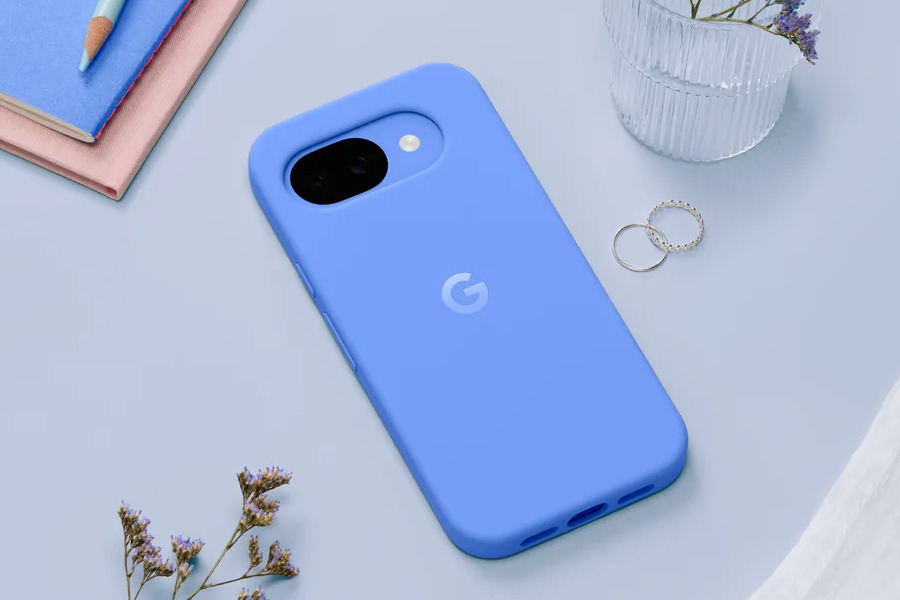
A few months after the first leaks started circulating, the Google Pixel 10a is finally official. And if you’ve been following the rumors, there aren’t many surprises. The specs are familiar, but it does tighten a few screws and leans even harder on software to make its case.
The Pixel 10a keeps the same 6.3-inch Actua display as before, but Google has slightly increased peak brightness to 3,000 nits, up from 2,700 nits on the Pixel 9a. The phone also retains its IP68 rating for dust and water resistance.
One of the more practical upgrades comes in the form of new screen protection. The Pixel 10a now uses Gorilla Glass 7i instead of Gorilla Glass 3. According to Google, the new Glass can survive drops from up to 1 meter (3.3 feet) and is more scratch-resistant than before.
As a Google phone, the software is the big talk for the Pixel 10a. It comes pre-installed with Android 16 out of the box and is promised seven years of software updates. It also comes with suites of AI features, from Gemini Assistant to Gemini Live.
The hardware powering it, however, remains the same. The Pixel 10a runs on the same Tensor G4 chipset as the Pixel 9a. Even the RAM and storage are the same at 8GB and 128GB or 256GB, respectively.
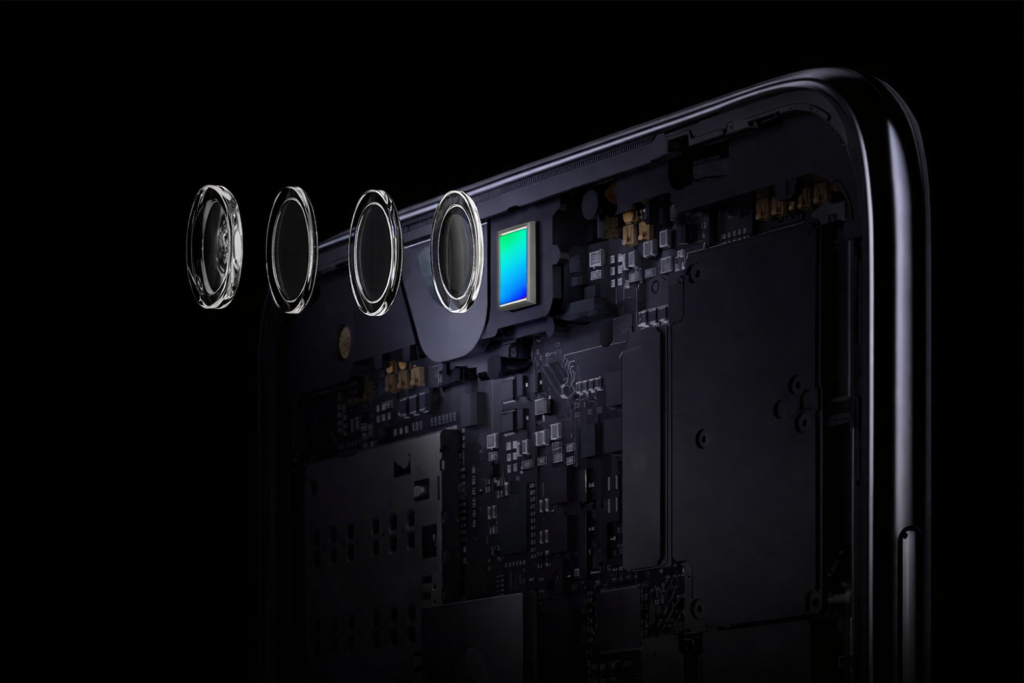
The Pixel 10a also retains the camera setup. It has a 48MP main rear lens with a 13-megapixel ultra-wide and a 13MP selfie camera. New here are the AI-features like Camera Coach, Auto Best Take, and Add Me.
Google Pixel 10a vs Pixel 9a: What’s different?
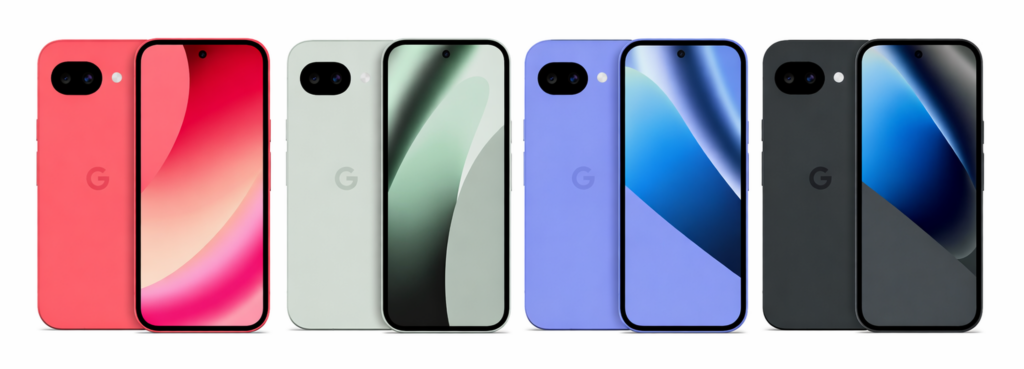
The difference for Pixel 10a comes on the design side. Its back is now made of 81% recycled plastic. Google has also introduced a new Pixel 10a Case made from 36 percent recycled plastic, color-matched to the phone. Neither the device nor the case includes built-in magnets.
Google also says the Pixel 10a uses more recycled materials than any previous Pixel a-series phone. It’s the first in the lineup to include recycled cobalt, copper, gold, and tungsten, making up at least 36 percent of the product by weight. The aluminum frame is made from 100 percent recycled material, and the packaging is completely plastic-free.
You can get the Google Pixel 10a in Fog, Obsidian, Berry, and Lavender. Its price starts at Rs 50,000 (8/128GB) in India, and at $499 in the US. Pre-order starts today, while it will go on open sale starting March 5.
For more daily updates, please visit our News Section.
The Internet is fuming as OpenAI retired GPT-4o recently, a chatbot model beloved for its warm, conversational style and unique emotional resonance. Despite a Change.org petition amassing over 22,000 signatures, OpenAI stood firm in its decision, citing low usage (just 0.1% of users) and the evolution of its newer models, GPT-5.1 and GPT-5.2.
This isn’t the first time OpenAI has tried to sunset GPT-4o. In 2025, the company faced overwhelming backlash from users who described the model as irreplaceable. OpenAI reversed the retirement within 24 hours, but this time, it seems the shutdown is final, leaving thousands of fans feeling abandoned.
For many, GPT-4o was more than a tool, it was a companion. Social media is flooded with grief-stricken posts likening its retirement to losing a close friend. Paying subscribers have threatened to cancel their memberships, and a few have already cancelled in protest, with one X user declaring, “No 4o, no money.”
The petition, spearheaded by Sophie Witt in April 2025, called on OpenAI to recognize GPT-4o’s unique appeal, which transcends performance metrics. Witt urged supporters to amplify their voices online, sparking widespread discussions about the emotional bond users form with AI.
However, GPT-4o wasn’t without controversy. At least eight lawsuits accuse the model of exacerbating mental health crises, with claims that its affirming tone contributed to self-harm in vulnerable users. These cases highlight the ethical challenges of emotionally intelligent AI, raising questions about where to draw the line between support and dependency.
OpenAI acknowledged these complexities in its January blog post, noting that feedback from GPT-4o users shaped its newer models. Yet, the decision to retire the model reflects a broader shift toward prioritizing safety and scalability over nostalgia.
The GPT-4o saga offers a clear lesson for marketers and AI developers about the risks and rewards of emotional design. As AI systems play a growing role in human interaction, the need to balance technological progress with accountability has never been more pressing.
Alibaba launches Qwen-3.5 with open and closed versions
60% cheaper and 8× stronger at handling large workloads
Built for the emerging “agentic AI” era
source: qwen.ai
Alibaba Unveils Qwen-3.5 Ahead of Lunar New Year
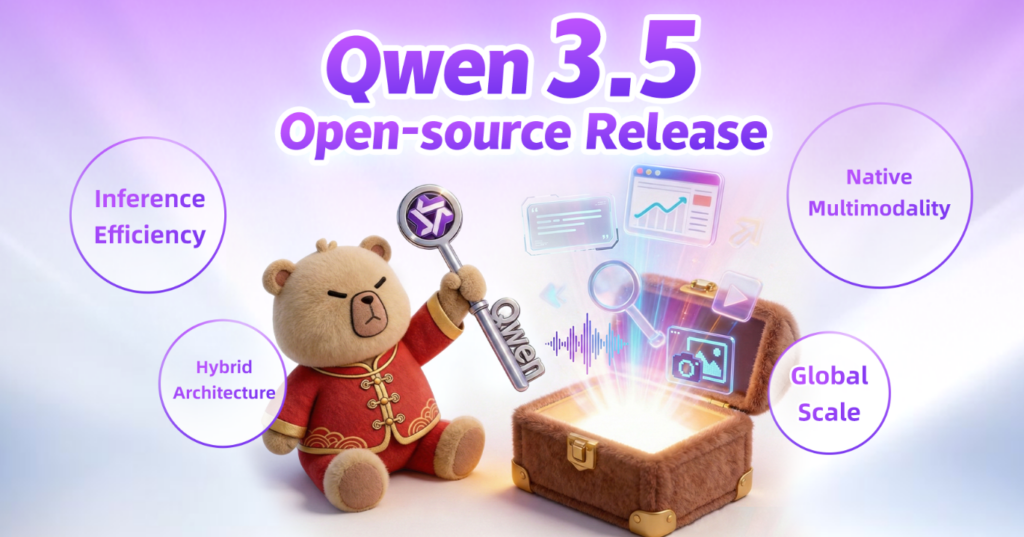
Alibaba Cloud has introduced its next-generation AI model family, Qwen-3.5, just ahead of the Lunar New Year. The launch is part of a broader wave of new flagship AI releases from major Chinese developers. The models are available through Alibaba Cloud’s Model Studio and are designed to strengthen China’s position in the global AI race.
Two Models, Different Strategies
The company released Qwen-3.5-Open-Source, a 397-billion-parameter model whose weights are publicly available on Hugging Face and ModelScope. Alibaba claims it outperforms its earlier trillion-parameter model while matching leading systems from OpenAI, Anthropic, and Google DeepMind.
Qwen-3.5-Plus remains closed-source and offers a 1-million-token context window, targeting enterprise customers and large deployments.
Built for the Agentic AI Era
Alibaba says Qwen-3.5 is 60% cheaper to use and delivers eight times better performance on large workloads compared to its predecessor. It includes multimodal features, understanding text, images, audio, and video. The model also introduces “visual agentic capabilities,” allowing it to operate mobile and desktop apps and complete multi-step tasks independently.
Intensifying Chinese AI Competition
Qwen competes with Chinese rivals such as ByteDance’s Doubao and DeepSeek. With expanded support for 201 languages and growing global downloads, Alibaba’s latest release signals rising competition between Chinese AI leaders.
Impact on Global AI Leaders
The launch of Qwen-3.5 increases competitive pressure on global AI leaders like OpenAI (ChatGPT), Anthropic (Claude), and xAI (Grok). While it may not immediately reduce their global user base, it strengthens China’s domestic alternatives and expands open-weight adoption worldwide. If Qwen delivers similar performance at lower cost, it could attract developers, startups, and enterprises looking for cheaper large-context models.
However, brand trust, ecosystem integration, and enterprise partnerships still give US firms a strong advantage outside China. In short, it may not disrupt them overnight, but it clearly raises the competitive stakes.
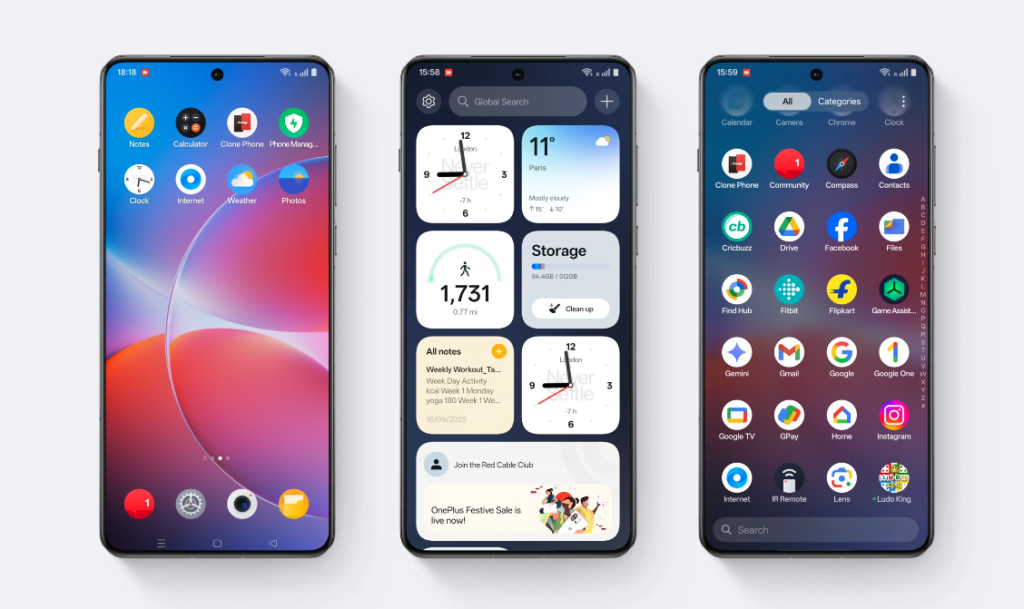
OxygenOS 17 is said to be in the works as OnePlus prepares its next major software upgrade based on Android 17. Early leaks have begun to surface online, offering an initial glimpse into potential changes focused on performance optimization, smoother user interactions, and improved system efficiency ahead of the official announcement.
OxygenOS 17 early details and expected improvements
OxygenOS 16
According to early leaks shared through a Telegram source tracking OnePlus software development, OxygenOS 17 could introduce a significant system-wide fluidity upgrade. The focus appears to be on improving responsiveness across everyday interactions, including smoother animations and reduced UI frame drops. Reports suggest that transitions throughout the interface may feel more consistent, which could enhance the overall perception of speed even without major hardware changes.
The update may improve zoom transitions while capturing photos and recording videos, reducing lag and making adjustments appear more seamless. These changes could help deliver a more polished camera experience, particularly during continuous zoom operations where sudden stutters can sometimes occur.
Beyond visual improvements, deeper system-level optimization is reportedly being worked on. CPU resource management is said to be refined to reduce unnecessary workload, while background app retention could improve multitasking by keeping more applications active without slowing down the device. Enhancements to garbage collection processes are also mentioned, potentially leading to faster app launches and fewer micro-stutters during extended usage.
Expected rollout timeline and device availability
Although OnePlus has not officially confirmed OxygenOS 17, the update is likely to arrive shortly after the stable release of Android 17. Historically, OnePlus has introduced its new OxygenOS version within months of Google’s Android launch, suggesting a possible announcement later in the year.
The upcoming OnePlus 16 is likely to be the first device to ship with OxygenOS 17 pre-installed, while older compatible models may receive the update through phased rollouts. Since OxygenOS and Oppo’s ColorOS share a common code base, similar enhancements could appear on Oppo devices as well.
For more daily updates, please visit our News Section.
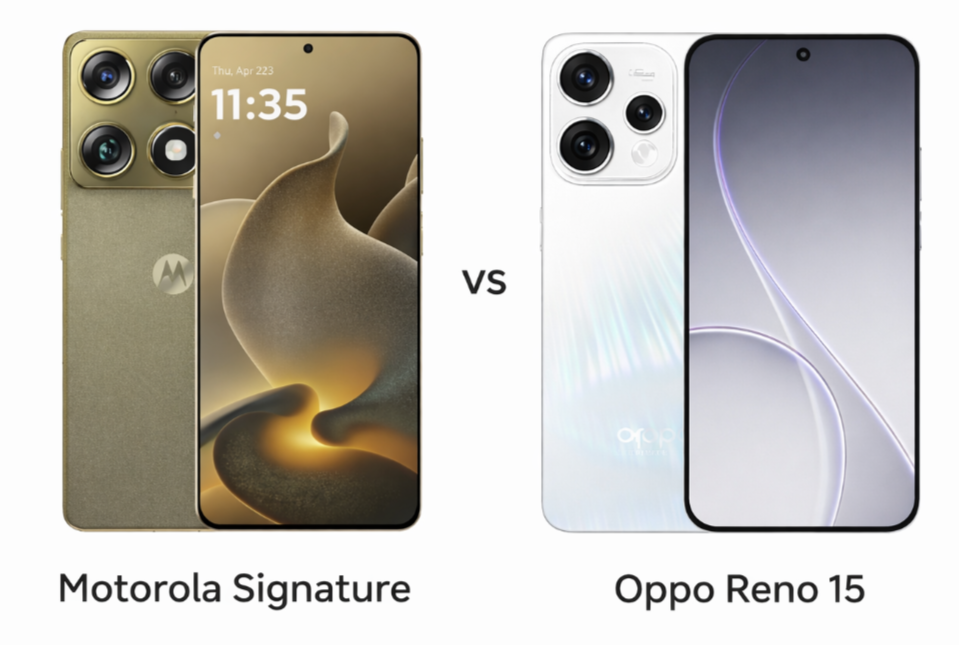
Choosing between the Motorola Signature and Oppo Reno 15 isn’t just about specs; it’s about deciding how much flagship power you really need. One promises next-gen performance, a 165Hz LTPO display, and 8K Dolby Vision recording, while the other focuses on battery endurance and value pricing. With nearly ₹13,000 separating them, this comparison matters for buyers who want to know whether the premium jump truly delivers a better long-term experience or if the Reno 15 already offers everything most users actually need.
The Motorola Signature features Gorilla Glass Victus 2 on the front, an aluminum frame, IP68/IP69 certification, and MIL-STD-810H compliance. It feels flagship in both durability and finish, with thoughtful extras like UWB support and Smart Connect. The Oppo Reno 15 also offers IP68/IP69 protection, Gorilla Glass 7i, and a premium glass back with an aluminum frame. However, the Signature’s stronger glass and added ecosystem features make it feel more complete and future-ready. The Reno 15 still carries a refined aesthetic, but it leans more toward style than rugged confidence.
Display Quality
Motorola Signature’s 6.8-inch LTPO AMOLED panel pushes boundaries with 165Hz refresh rate, Dolby Vision, HDR10+, and an eye-catching 6200 nits peak brightness. It feels built for gaming and HDR streaming at the highest level. Oppo Reno 15 offers a sharp AMOLED panel with 120Hz and HDR10+, but brightness and refresh rate are more conventional. The Signature clearly delivers a more immersive and smoother experience.
Verdict
Motorola Signature wins this round with its brighter LTPO display, higher refresh rate, and tougher glass protection.
2. Specifications Including Battery
Performance
Motorola Signature runs on Snapdragon 8 Gen 5 with UFS 4.1 storage and up to 16GB RAM. Combined with Android 16 and seven promised major updates, it positions itself as a long-term powerhouse. Performance is flagship-grade, built for gaming, AI workloads, and heavy multitasking. Oppo Reno 15 uses Snapdragon 7 Gen 4 with UFS 3.1 storage, offering solid upper mid-range performance. It handles daily tasks smoothly, but doesn’t match flagship-level power. The Signature simply operates in a higher performance tier.
Battery and Charging
Oppo Reno 15 packs a larger 6500mAh battery with 80W wired charging and broad charging protocol support. It’s clearly designed for endurance-focused users. Motorola Signature offers 5200mAh but compensates with 90W wired, 50W wireless, and reverse wireless charging. The wireless flexibility makes it feel more premium and versatile.
Verdict
Motorola Signature wins on raw performance and charging versatility, while Reno 15 excels in sheer battery capacity.
3. Camera
Main and Secondary Lenses
Motorola Signature offers a triple 50MP setup, including a periscope telephoto with 3x optical zoom and advanced 8K Dolby Vision video recording. The sensor sizes and stabilization give it strong flagship credibility. Oppo Reno 15 also features a 50MP main and 50MP telephoto with 3.5x optical zoom, but its 8MP ultrawide is less competitive. Video tops out at 4K, making it less ambitious overall. The Signature’s camera system feels more complete and high-end.
Selfie Camera
Both phones feature 50MP selfie cameras with 4K recording. Reno 15 offers an ultrawide selfie lens, which is useful for group shots. Motorola Signature, however, includes dual-pixel autofocus and higher frame rate options, giving it more versatility for video creators.
Verdict
Motorola Signature takes the edge thanks to stronger ultrawide hardware and advanced 8K Dolby Vision recording.
4. Pricing
Motorola Signature is priced around $660 (₹59,000), positioning it firmly in flagship territory. Oppo Reno 15 comes in at approximately $500 (₹46,000), targeting upper mid-range buyers. The price gap is significant, but so is the performance and display difference.
For buyers who want top-tier processing, LTPO 165Hz display, wireless charging, and extended Android updates, the Signature justifies its higher price. However, Reno 15 offers strong cameras, a massive battery, and premium build at a more accessible price, making it a smart value-driven option.
Verdict
Motorola Signature delivers more power and features, while Oppo Reno 15 offers better value for budget-conscious buyers.
Disclaimer: Prices are approximate and may vary based on country, region, and applicable taxes.
5. Conclusion
Motorola Signature stands out with Snapdragon 8 Gen 5, 165Hz LTPO display, 8K Dolby Vision recording, wireless charging, UWB support, and seven Android upgrades. It is clearly engineered for users who want cutting-edge hardware and longevity.
Oppo Reno 15 shines with its 6500mAh battery, solid telephoto performance, fast 80W charging, and competitive pricing. It feels tailored for users who prioritize endurance and balanced daily performance without stretching the budget too far.
Verdict
Motorola Signature is the superior flagship with stronger performance, display, and camera technology. Oppo Reno 15 is the smarter pick for value-focused buyers who want reliability, battery life, and solid camera performance at a lower price point.
Infinix has officially unveiled its new Note 60 series for global markets, introducing the Note 60 and Note 60 Pro with a focus on performance upgrades, interactive design elements, and long-term software support. The lineup marks a shift for the brand as it brings Qualcomm Snapdragon hardware back into the Note series while experimenting with unique rear lighting and display features. Here’s a look at the specifications and features of both smartphones.
Infinix Note 60 series specifications and features
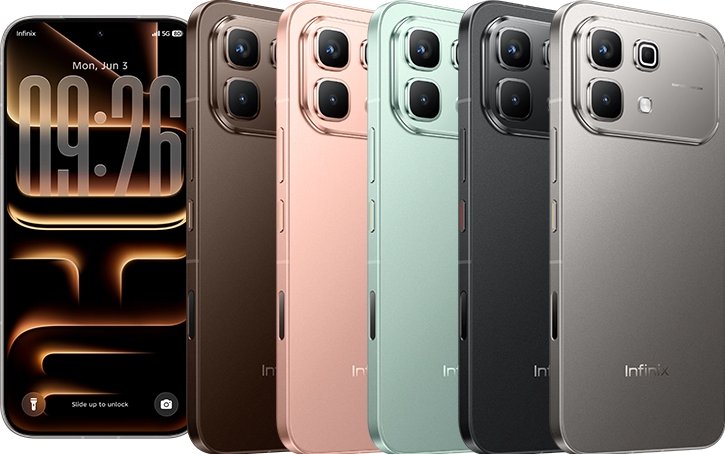
Infinix Note 60
The Infinix Note 60 and Note 60 Pro feature a 6.78-inch 1.5K AMOLED display with up to a 144Hz refresh rate and peak brightness reaching 4500 nits, aiming to deliver smooth visuals and strong outdoor visibility. The panels support a wide color gamut and are protected by Corning Gorilla Glass 7i. The design includes a metal frame, slim borders, and curved edges, giving the devices a more premium appearance compared to previous generations.
The Note 60 Pro is powered by the Snapdragon 7s Gen 4 chipset, making it one of the first Infinix Note devices in recent years to adopt a Snapdragon platform. The standard Note 60 runs on the MediaTek Dimensity 7400 Ultimate processor. Both are paired with LPDDR5X RAM and up to 256GB storage, alongside gaming-focused features such as vapor chamber cooling and antenna enhancements for stable connectivity during gameplay.
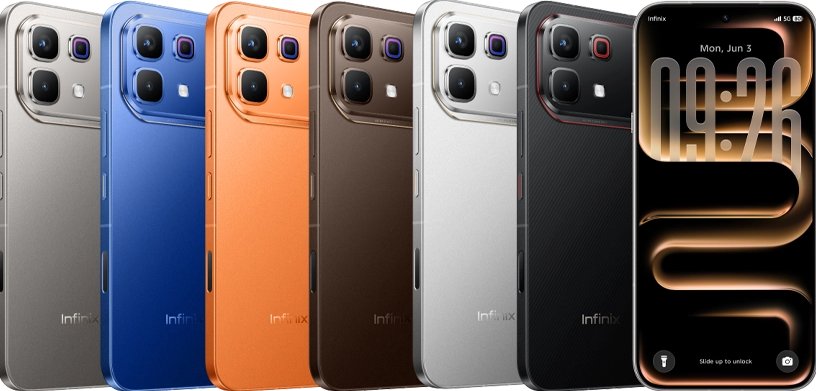
Infinix Note 60 Pro
The Note 60 Pro introduces an Active Matrix display alongside its rear camera setup. It remains hidden until activated, showing notifications, animated effects or custom interactions. The regular Note 60 instead uses RGB Halo lighting to indicate alerts and status changes. Both phones carry dual rear cameras headlined by a 50-megapixel primary sensor with optical image stabilisation and an 8-megapixel ultra-wide lens, along with a 13-megapixel front-facing camera.
The devices run XOS 16 based on Android 16, with three OS upgrades and five years of security patches promised. Both models housing a 6500 mAh battery. The Note 60 supports 45W wired charging, while the Pro variant increases charging speeds and adds wireless charging capabilities. Additional features include JBL-tuned stereo speakers, IP64-rated protection, an in-display fingerprint sensor and a customisable side button with AI assistant functions.
Infinix Note 60 series price and availability
The Infinix Note 60 and Note 60 Pro will roll out globally through the company’s official online store, although pricing details are yet to be confirmed for individual markets.
The Note 60 will be available in Mist Titanium, Rose Gold, Fizz Blue, Midnight Black and Mocha Brown finishes, while the Pro model adds Solar Orange, Deep Ocean Blue, Frost Silver and Torino Black options. Availability timelines may vary by region, and more market-specific details are expected closer to local launches.
For more daily updates, please visit our News Section.
Just when you thought your smartphone’s rear-facing camera had reached its peak with 200-megapixel monster sensors, the industry has decided to turn the lens around and aim straight for your face.
According to the latest leaks from seasoned tipster Digital Chat Station, the 2026 flagship cycle is set to witness a staggering shift as manufacturers begin testing 100MP selfie cameras.
While we are already bracing for dual 200MP setups on the back of phones like the rumored Xiaomi 18 Pro, the jump to a nine-digit megapixel count for a front-facing lens raises a provocative question about where actual utility ends and marketing vanity begins.
Fitting a hundred million pixels into the punch-hole of a modern display is less about a simple hardware upgrade and more about a breakthrough in engineering. To make this work, brands like Oppo and Huawei are reportedly developing custom “small-pixel” sensors that defy traditional size constraints.
Because these pixels are so tiny, they naturally struggle with light sensitivity, but the industry isn’t just throwing numbers at a wall for the sake of it. They are likely banking on advanced pixel-binning and potentially RYYB color filters to ensure your low-light selfies don’t look grainy.
2. Vlogging Flexibility
We are now in the social media age, where almost everyone is exploring content creation, whether it’s recording for TikTok, vlogging for YouTube, or sharing high-quality videos on Instagram.
The 100MP square sensor could allow creators to shoot a single high-resolution video vertically for TikTok while seamlessly cropping it into a horizontal format for YouTube, all without compromising 4K clarity.
Manufacturers are also reportedly embracing the new 1:1 square format, an innovation inspired by Apple’s Center Stage feature introduced with the iPhone 17. According to reports, Huawei’s Nova 16 series and Oppo’s Find X10 series are expected to feature these advanced square sensors, signaling a shift in how front-facing cameras are designed.
The real value here isn’t just in capturing more detail but in enabling digital zoom, stabilization, and reframing during post-production without any loss in quality.
This level of flexibility could turn smartphones into powerful tools for content creators, rivaling even dedicated vlogging rigs and making mobile devices the preferred choice for the social media generation.
3. Spec Race or Genuine Innovation?
Despite the excitement, some might wonder if our devices can handle the immense data demands of a 100MP selfie camera. After all, such high-resolution photos come with significant processing and storage requirements.
However, with the advancements in modern chipsets and AI, refining and optimizing these massive images is no longer a challenge. AI-driven algorithms can efficiently enhance light, detail, and color in real time, ensuring that even high-resolution selfies are polished and ready to share instantly.
Ultimately, the 100MP selfie revolution might be the ultimate spec flex, but innovation is always welcome, and Android manufacturers have proven its value. Unless we experiment with new spaces, we won’t know what to expect.
Five years ago, capturing the moon with such detail seemed impossible, yet here we are. The front camera is the final frontier of smartphone imaging, and it is finally getting the upgrade it deserves.
For more daily updates, please visit our News Section.
After teasing the arrival, Infinix has officially introduced the Note Edge 5G in India, positioning it in the competitive mid-range category. The device focuses on display design, battery endurance and AI-driven features, signalling the brand’s push towards premium-looking hardware at a relatively accessible price point.
Infinix Note Edge specifications and features
Infinix Note Edge
The Infinix Note Edge features a 6.78-inch 1.5K 3D curved AMOLED display with a 120Hz refresh rate and peak brightness reaching up to 4500 nits. The panel includes TÜV blue light certification to reduce eye strain during extended usage and is protected by Corning Gorilla Glass 7i. Despite packing a large battery, the handset maintains a slim profile at around 7.2mm thickness, complemented by narrow bezels and a curved-edge design.
Powering the device is the MediaTek Dimensity 7100 processor paired with up to 8GB LPDDR5X RAM and up to 256GB UFS 2.2 storage. The phone runs XOS 16 based on Android 16 and is promised three years of OS upgrades alongside five years of security updates. Infinix has also added AI-based gaming enhancements, signal-optimization technology, and a customizable Active Halo Lighting system that reacts to notifications, music, and calls.
For photography, the Note Edge includes a 50-megapixel primary rear camera supported by AI tools such as Live Photos and AI Eraser, while a 13-megapixel front camera handles selfies and video calls. Additional features include stereo speakers tuned by JBL, an in-display fingerprint scanner, IP65-rated protection and a 6500 mAh battery with 45W fast charging and reverse wired charging support.
Infinix Note Edge price and availability
Infinix Note Edge
The Infinix Note Edge 5G starts at Rs 21,999 (~$245) for the 6GB+128GB variant, while the 8GB+128GB model is priced at Rs 23,999 (~$265) and the 8GB+256GB version costs Rs 25,999 (~$285). With SBI and ICICI bank offers, buyers can get up to Rs 2000 instant discount, bringing effective pricing lower.
The smartphone will be available in Lunar Titanium, Stellar Blue and Silk Green colour options through Flipkart and the official Infinix online store starting February 25. Launch benefits include a one-time screen replacement, extended warranty coverage and additional subscription perks with select telecom plans.
For more daily updates, please visit our News Section.
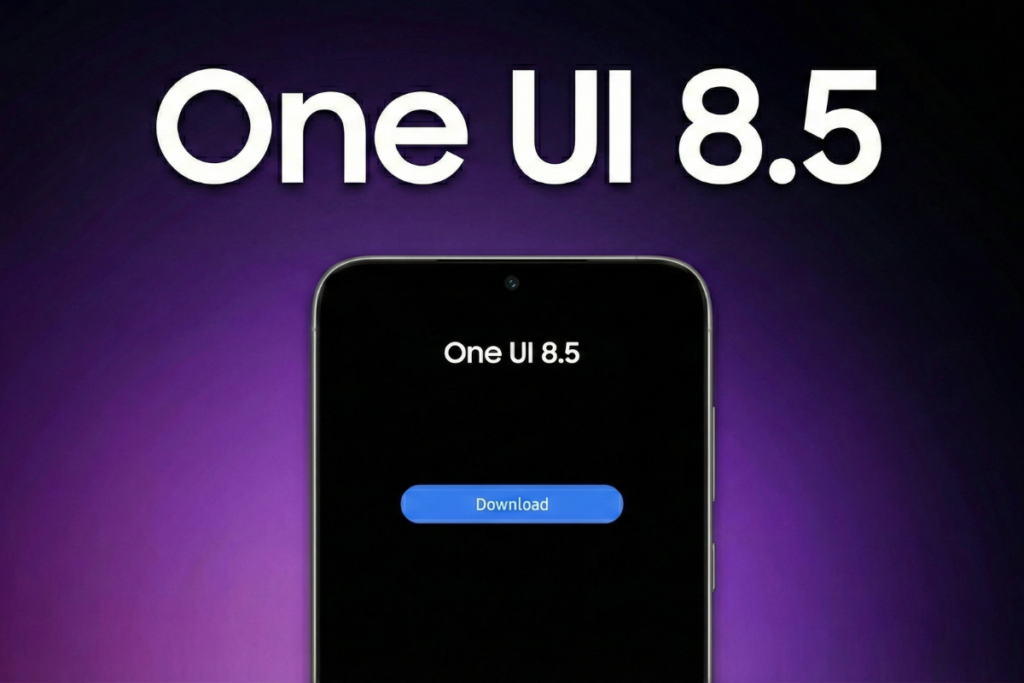
Next week is going to be an exciting one for Samsung fans, as the brand is preparing to launch the Galaxy S26 series. These upcoming devices will debut with One UI 8.5, which brings exciting visual changes, along with several new features and plenty of improvements throughout the system.
Unlike most incremental One UI upgrades, One UI 8.5 will be released to a wide array of Galaxy devices, including budget and entry-level smartphones. Now, with just a week remaining until its debut, it’s a good time to review what we already know so far, including details on eligible devices, the release timeline, and major changes.
Samsung devices eligible for the One UI 8.5 update
While One UI 8.5 is confirmed to debut with the Galaxy S26 series, Samsung hasn’t yet revealed the list of eligible devices. We might see that at the launch event.
However, based on the test builds spotted so far, it’s safe to say the One UI 8.5 update is coming to every Galaxy device that has received the One UI 8.0 update or launched with it.
Galaxy XCover series: Galaxy XCover 7, XCover 7 Pro
When will your Samsung device receive the One UI 8.5 update?
Samsung typically starts rolling out the latest One UI software to older Galaxy devices a few weeks after its initial release. For One UI 8.5, reports say the rollout could begin in the second half of March 2026, starting with premium models like the Galaxy S25.
As for the One UI 8.5 beta program, it’s been live since December, but only for the Galaxy S25 series. Unfortunately, the company isn’t looking to expand it to more devices. This could mean a direct stable release for other Galaxy devices.
Samsung would hope to complete the One UI 8.5 rollout by Q2 2026, as the company reportedly plans to debut One UI 9.0 (based on Android 17) on upcoming foldables, the Galaxy Z Fold 8 and Galaxy Z Flip 8, in July 2026.
What are the major upgrades to One UI 8.5?
One UI 8.5 is still based on Android 16, but uses a newer build (QPR2), allowing Samsung to include deeper system-level features. Here are some of the major upgrades spotted in the beta builds released so far:
More customizable Quick Settings: The improved Quick Settings panel in One UI 8.5 allows users to adjust the layout of every toggle and slider.
Improved app icons: Samsung has updated app icons (at least Samsung’s apps) to feature a bit of 3D effect. Some first-party apps also show a similar effect.
Smarter lock screen: The lock screen now automatically adjusts the clock and date so they don’t cover the main subject of your lock screen wallpaper. It can display weather visuals based on current conditions.
Floating tab bar: Many Samsung apps feature a modern floating tab bar UI, replacing the traditional plain tab bar at the bottom. It’s a pill-shaped UI element with a frosted color scheme that improves the software experience.
Partial screen recording: This new feature captures a specific area of your phone rather than the entire screen.
Improved Photo Assist: With the latest improvements, Photo Assist allows interrupted image generations without needing users to save each iteration.
Storage Share: It lets you access files from other Galaxy devices, such as Galaxy tablets and PCs, directly within the My Files app on your smartphone.
Audio Broadcast: This feature enables your Galaxy phone to function as a microphone and broadcast your voice to nearby Bluetooth LE audio devices using Auracast technology.
Failed authentication lock: It automatically locks the device after multiple failed unlock attempts.
Block apps with excessive ads: This feature puts apps that send frequent ad notifications in deep sleep.
We’ll continue to update you with the latest developments around One UI 8.5 in the Samsung section on this website. Remember to visit that regularly. Also, join our Telegram channel to get instant notifications about the breaking news and software rollouts.
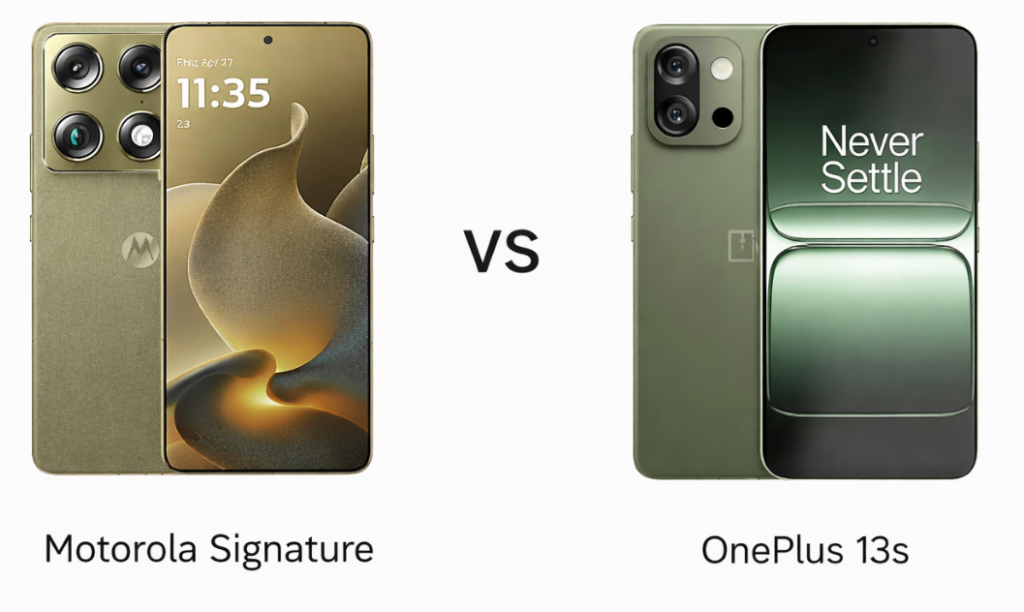
Choosing between the Motorola Signature and the OnePlus 13s isn’t just about specs; it’s about deciding what kind of flagship experience truly matters. One promises cutting-edge display tech, pro-grade cameras, and long-term software support, while the other focuses on compact power, strong battery life, and aggressive pricing. For buyers spending flagship-level money, understanding where each phone truly excels can make the difference between a good purchase and a great one.
Please Note: When you buy something using the links in our articles, we may earn a small commission at no cost to you.
2. Design and Display
Build and Feel
The Motorola Signature delivers a true flagship vibe with Gorilla Glass Victus 2 on the front, an aluminum frame, and IP68/IP69 protection. It also carries MIL-STD-810H compliance and Ultra Wideband support, pushing it toward premium durability territory. The OnePlus 13s keeps things refined with a glass and aluminum build, but its IP65 rating feels more mid-premium than ultra-flagship. Motorola’s ultrasonic fingerprint scanner adds a more advanced touch compared to the optical unit on the 13s. The Signature feels engineered for long-term flagship ownership, while the 13s leans toward compact practicality.
Display Quality
Motorola packs a 165Hz LTPO AMOLED panel with Dolby Vision, HDR10+, and a stunning 6200-nit peak brightness. It’s built for outdoor clarity and fluid gaming. The OnePlus 13s offers a smaller LTPO AMOLED display with a 120Hz refresh rate, Dolby Vision, HDR10+, and 2160Hz PWM dimming, which is easier on the eyes. However, brightness and refresh fluidity clearly favor Motorola.
Verdict
Motorola Signature wins with superior protection, brightness, and refresh rate, making it feel more premium overall.
3. Specifications Including Battery
Performance
The Motorola Signature runs on Snapdragon 8 Gen 5 with UFS 4.1 storage and up to 16GB RAM, paired with Android 16 and seven major updates. That long-term support adds serious value. The OnePlus 13s uses Snapdragon 8 Elite, which delivers slightly higher peak clock speeds and strong efficiency. However, it runs Android 15 with OxygenOS 16 and fewer confirmed upgrade commitments. Both are powerhouse performers, but Motorola’s update promise strengthens long-term reliability.
Battery and Charging
Motorola houses a 5200mAh silicon-carbon battery with 90W wired, 50W wireless, and reverse wireless charging. OnePlus counters with a larger 5850mAh battery and 80W wired charging, plus bypass charging. The 13s may last longer per charge, but Motorola’s wireless ecosystem adds versatility that feels more complete.
Verdict
Motorola edges ahead for balanced power, faster wireless charging, and longer software support.
4. Camera
Main and Secondary Lenses
Motorola Signature features a triple 50MP setup, including a 3x periscope telephoto and ultrawide lens. It supports 8K recording with Dolby Vision and 10-bit HDR10+, placing it firmly in pro-grade territory. The OnePlus 13s offers a dual 50MP system with 2x optical zoom and Dolby Vision 4K recording. While capable, it lacks a dedicated ultrawide lens and advanced zoom flexibility. Motorola’s setup feels built for versatility and creative freedom.
Selfie Camera
Motorola’s 50MP front camera with dual-pixel autofocus supports 4K at up to 60fps, delivering flagship-level clarity. The OnePlus 13s includes a 32MP autofocus selfie shooter with 4K at 30fps. Both are solid, but Motorola provides sharper output and better video options.
Verdict
Motorola Signature clearly dominates with its triple-camera flexibility and 8K Dolby Vision capability.
5. Pricing
Motorola Signature is priced at approximately $660 / ₹59,000, while the OnePlus 13s comes in around $650 / ₹51,000. The price gap in India is noticeable, with OnePlus undercutting Motorola by a meaningful margin. The 13s offers flagship-grade performance at a lower cost, making it attractive for value-focused buyers. However, Motorola justifies its higher price through superior display brightness, triple cameras, stronger protection ratings, and wireless charging support.
For users prioritizing compact design and cost savings, the OnePlus 13s feels like a smart buy. Those seeking full flagship features may find Motorola’s pricing justified.
Verdict
OnePlus 13s wins on value, but Motorola offers more features for the premium paid.
Disclaimer: Prices are approximate and may vary based on country, region, and applicable taxes.
6. Conclusion
Motorola Signature stands out with its 165Hz ultra-bright display, triple 50MP camera system, 8K Dolby Vision video, UWB support, and 50W wireless charging. It also promises seven Android upgrades, which strengthens long-term appeal. The OnePlus 13s impresses with a compact form factor, larger battery, bypass charging, and competitive pricing. OxygenOS also remains one of the cleaner Android experiences, which many users appreciate.
Motorola feels like a complete flagship experience without compromises. The OnePlus 13s feels like a refined, high-performance compact alternative that prioritizes efficiency and price.
Verdict
Overall, the Motorola Signature is the better all-around flagship thanks to its brighter 165Hz display, more versatile triple cameras with 8K video, stronger durability, wireless charging, and longer software support. It simply offers a more complete and future-proof experience. OnePlus 13s remains a strong value option with great performance and battery at a lower price, but in pure overall capability, the Motorola Signature takes the lead.
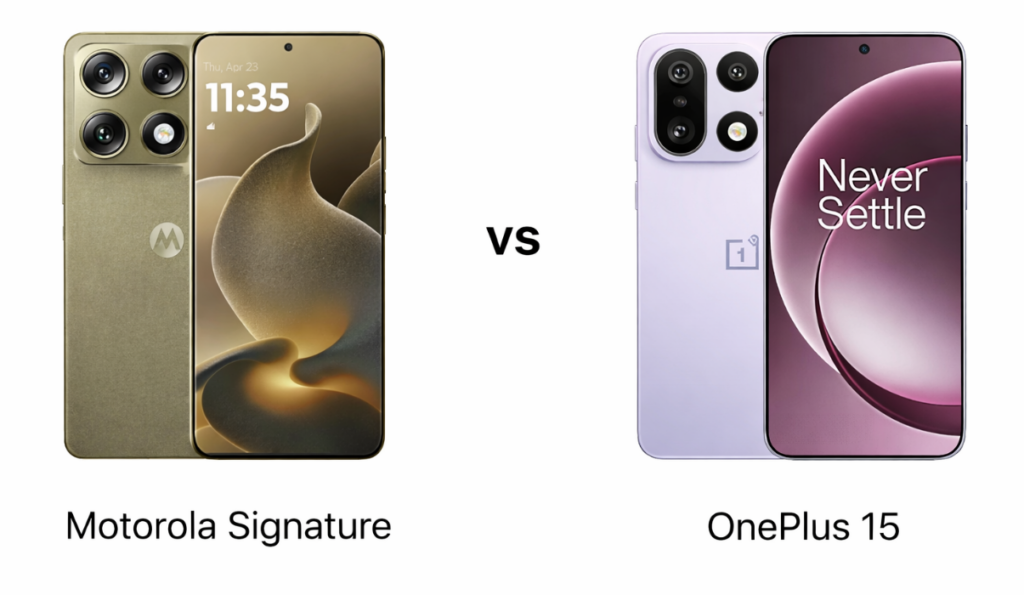
Flagship battles are no longer just about specs, they’re about value versus raw power. The Motorola Signature and OnePlus 15 represent two different philosophies in the premium Android space. One focuses on balance, long-term software support, and an ultra-bright display at a competitive price, while the other pushes performance limits with a massive battery and cutting-edge chipset. For buyers deciding where to invest serious money, this comparison reveals which phone truly delivers the smarter flagship experience.
Motorola Signature features a Gorilla Glass Victus 2 front, an aluminum frame, IP68/IP69 protection, and MIL-STD-810H compliance. It feels premium yet balanced, with added durability confidence. OnePlus 15 also uses Victus 2 with an aluminum alloy frame and offers IP68/IP69K protection, plus a unique Micro-Arc Oxidation finish on select variants. Both look flagship-grade, but Motorola’s cleaner aesthetic and Bose-tuned audio branding give it a slightly more refined personality, while OnePlus feels bold and performance-focused.
Display Quality
Motorola Signature packs a 6.8-inch LTPO AMOLED with 165Hz refresh rate and an extreme 6200 nits peak brightness, alongside Dolby Vision and HDR10+. OnePlus 15 matches the 165Hz LTPO panel and Dolby Vision but peaks at 1800 nits in HBM and adds Ultra HDR support. Both displays are ultra-smooth and vibrant, yet Motorola’s higher peak brightness gives it stronger outdoor visibility on paper.
Verdict
Motorola Signature feels more balanced and brighter overall, while OnePlus 15 leans toward a flashy, high-performance visual experience.
2. Specifications Including Battery
Performance
Motorola Signature runs on Snapdragon 8 Gen 5 with Adreno 829, while OnePlus 15 steps ahead with Snapdragon 8 Elite Gen 5 and Adreno 840. The OnePlus chip pushes higher clock speeds, clearly targeting gamers and heavy multitaskers. Both offer UFS 4.1 storage and up to 16GB RAM, but OnePlus positions itself as the raw performance leader. Motorola, however, promises up to seven major Android upgrades, which strengthens its long-term value. That extended support makes it feel like a safer investment for longevity.
Battery and Charging
Motorola houses a 5200mAh silicon-carbon battery with 90W wired and 50W wireless charging. OnePlus dominates capacity with a massive 7,300mAh battery and 120W wired charging, reaching full charge in about 40 minutes. It also supports multiple fast-charging standards and bypass charging. OnePlus clearly targets power users who demand endurance.
Verdict
For pure speed and battery life, the OnePlus 15 leads. For long-term software support, Motorola Signature holds a strategic advantage.
3. Camera
Main and Secondary Lenses
Motorola Signature delivers a triple 50MP setup including a 3x periscope telephoto and ultrawide lens, supporting 8K Dolby Vision recording and 4K at 120fps. OnePlus 15 also features triple 50MP sensors with a 3.5x periscope and advanced color tuning tools like LUT preview. Both support 8K video, but OnePlus offers slightly longer optical zoom. Motorola’s larger primary sensor may offer better natural light capture, giving it a more photography-focused feel.
Selfie Camera
Motorola steps ahead with a 50MP autofocus selfie shooter capable of 4K at up to 60fps. OnePlus uses a 32MP autofocus camera with 4K video. The higher resolution and dual-pixel PDAF on Motorola suggest sharper and more detailed front shots.
Verdict
Motorola feels stronger for balanced photography and selfies, while OnePlus leans toward creative flexibility and tuning tools.
4. Pricing
Motorola Signature is priced at approximately $660 (₹59,000), while the OnePlus 15 sits at around $900 (₹80,000). That is a significant price gap. Motorola delivers a flagship-grade display, triple 50MP cameras, a premium build, and long-term updates at a much lower price. OnePlus justifies its premium with a larger battery, faster charging, and a stronger chipset. The difference reflects performance ambition versus value balance.
Is the Price Justified?
OnePlus 15 justifies its pricing for gamers and power users who want maximum battery and performance. However, Motorola Signature offers near-flagship specs at a noticeably lower cost, making it feel like the smarter value pick for most buyers.
Verdict
Motorola Signature offers stronger value for money, while OnePlus 15 caters to those willing to pay extra for top-tier power.
Disclaimer: Prices are approximate and may vary based on country, region, and applicable taxes.
5. Conclusion
Motorola Signature stands out with ultra-high peak brightness, seven Android upgrades, Bose-tuned sound, and a 50MP selfie camera. OnePlus 15 counters with a massive 7300mAh battery, 120W fast charging, bypass charging, advanced HDR display support, and slightly stronger chipset performance. Motorola feels balanced and longevity-focused, while OnePlus feels engineered for speed and endurance.
Verdict
Motorola Signature is the better all-rounder and value flagship. OnePlus 15 is the powerhouse choice for users who prioritize battery life and peak performance above all else.
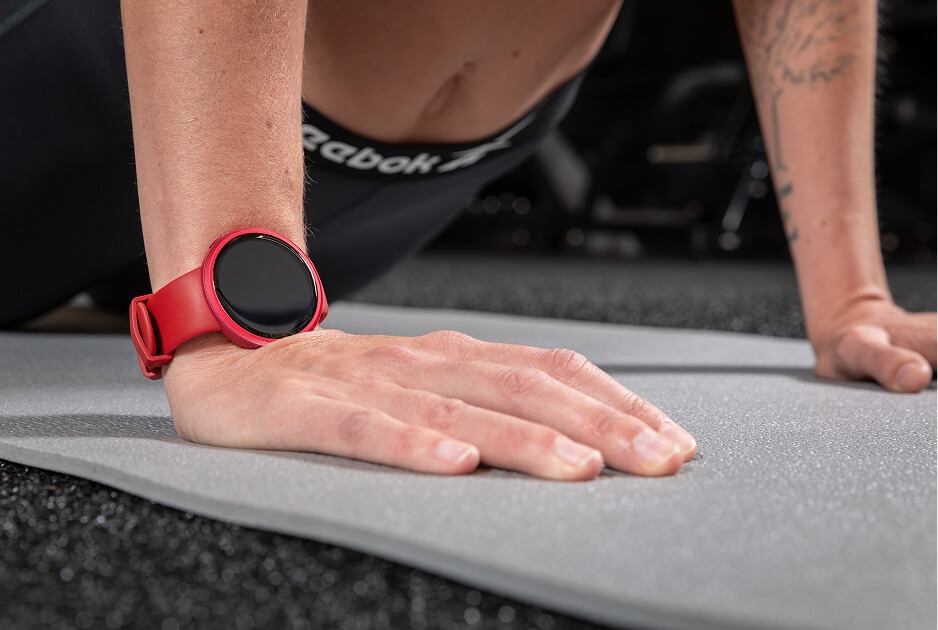
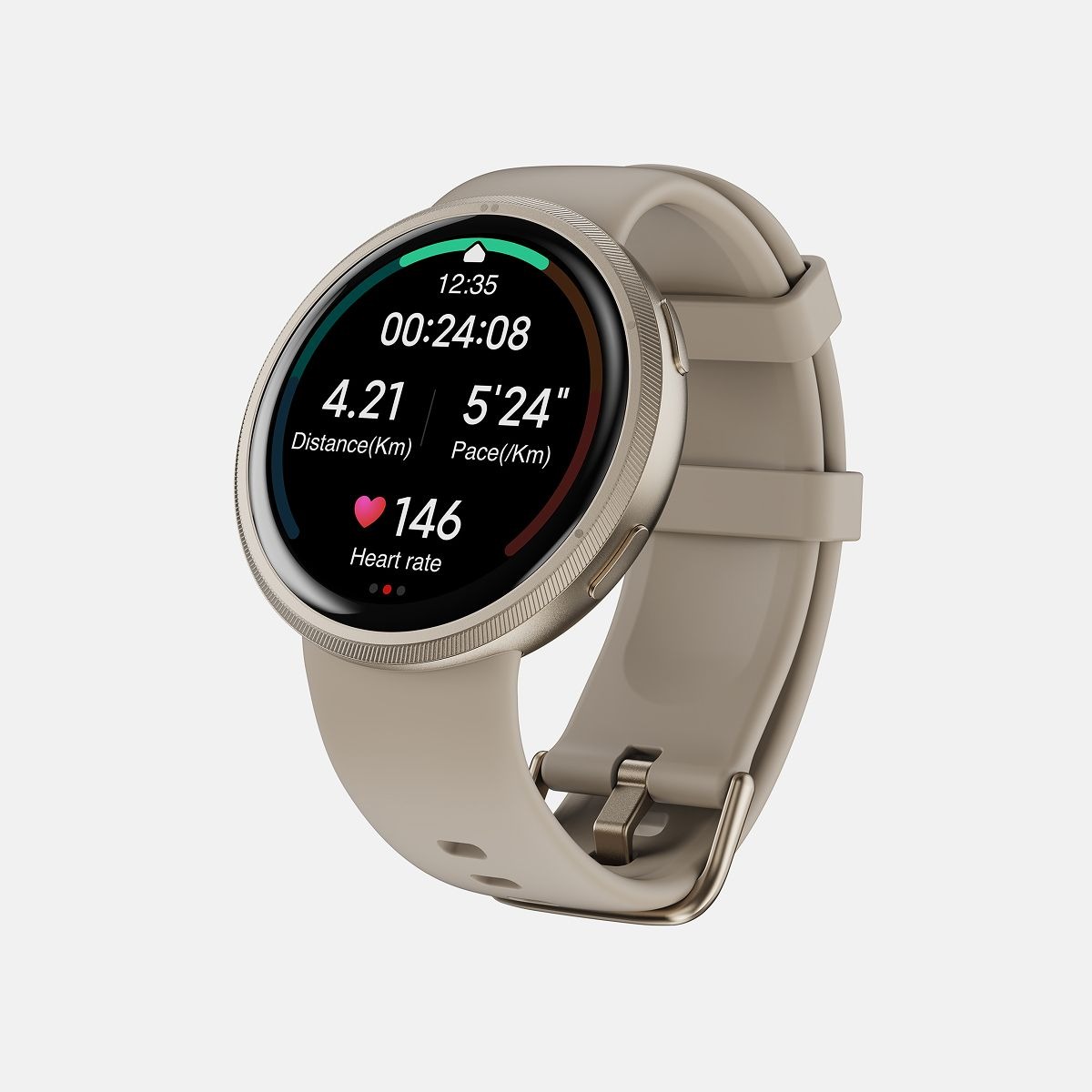
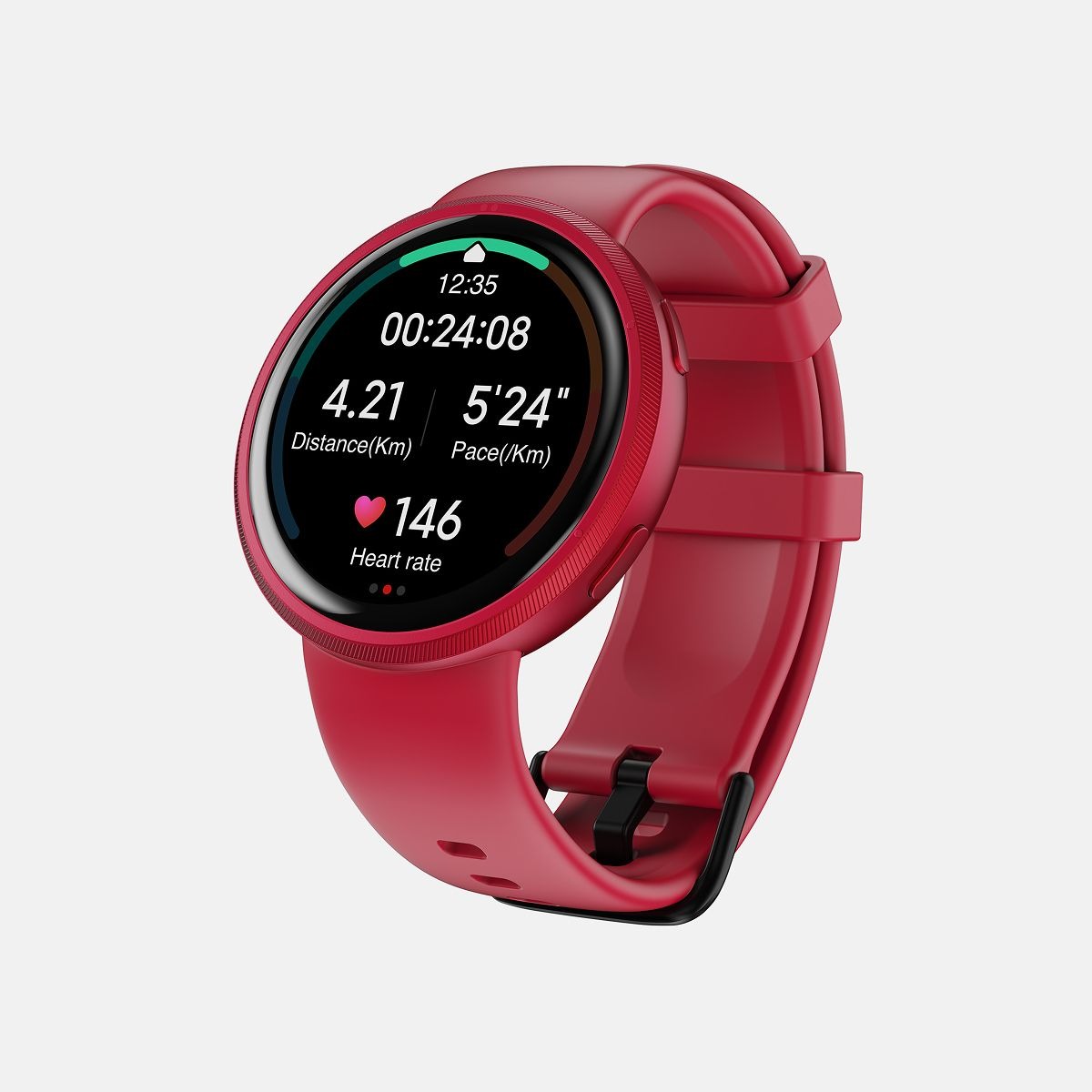
Reebok has released the Rush smartwatch in the US, targeting budget-conscious consumers seeking basic fitness tracking without premium pricing. Priced at $69.99, it undercuts the company’s Stride model by using lower-cost components while maintaining essential functionality.
The Rush sports a 1.39-inch LCD touchscreen at 360 × 360 resolution, replacing the Stride’s AMOLED display to reduce manufacturing costs. The device supports over 80 sport modes, including running, cycling, and yoga, with assisted GPS leveraging smartphone connectivity for location tracking.
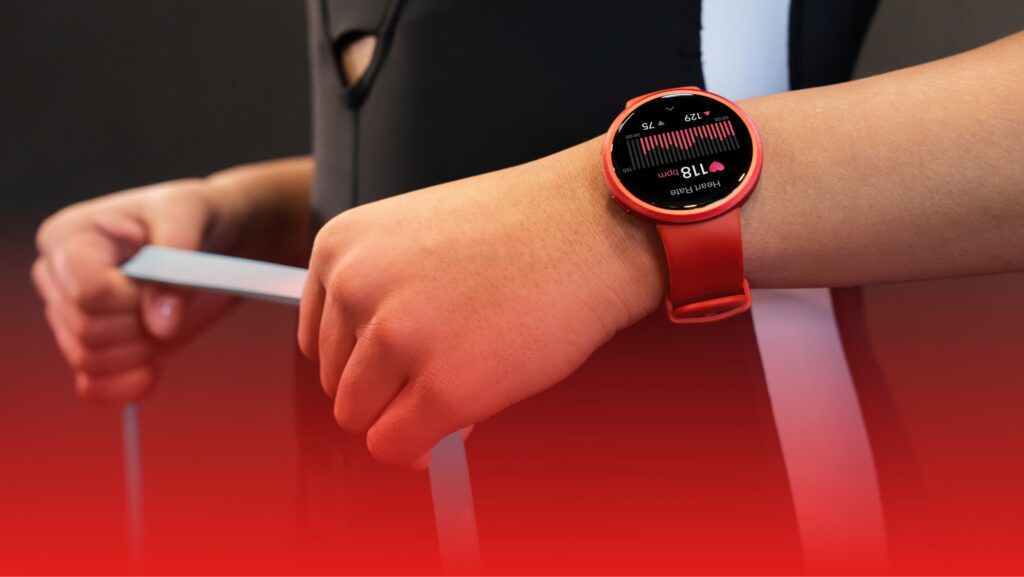
Health monitoring features include continuous heart rate tracking, SpO₂ measurement, step counting, calorie tracking, and sleep analysis. Data syncs automatically to the Reebok Connect app, which integrates with Strava, Google Health, and Apple Health. Bluetooth 5.3 handles connectivity for smart notifications, music control, reminders, and Google Assistant commands.
Notable omissions distinguish the Rush from higher-tier models. The watch lacks Bluetooth calling capability and a built-in speaker, features present on the Stride. IP68 water resistance protects against rain and splashes but not swimming. The 300mAh battery delivers up to 10 days of usage with quick charging support, though actual battery life depends on usage patterns.
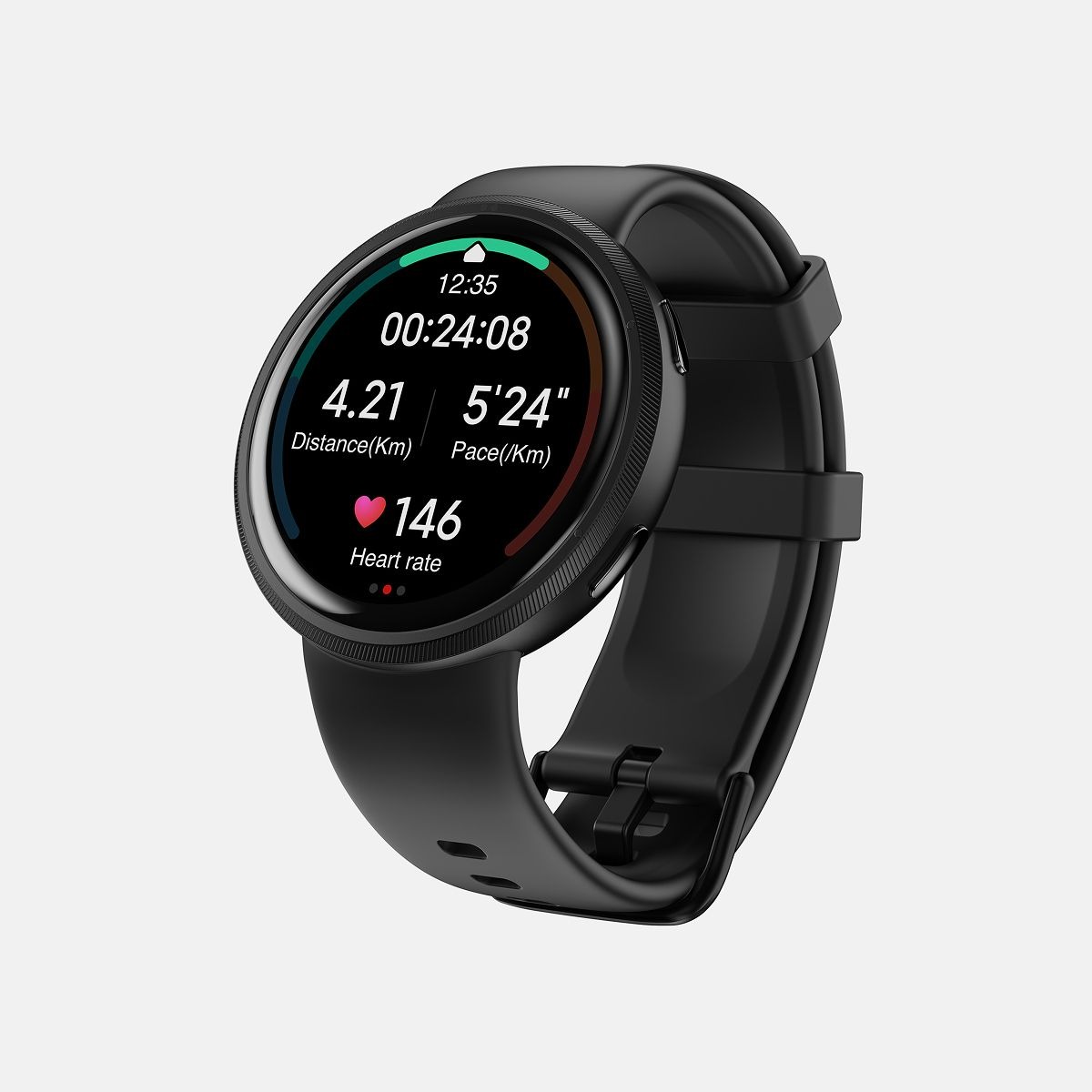
The 46 × 46 × 11 mm plastic case weighs 47 grams and accepts interchangeable sport bands. Users can select from over 100 watch faces for personalization. Onboard sensors include heart rate, SpO₂, G-sensor, touch panel, and vibration motor.
Three color options are available: Midnight Steel, Spectre Red, and Victory Gold. The Rush is now listed on Reebok’s US website as the company’s most affordable smartwatch offering.
For more daily updates, please visit our News Section.
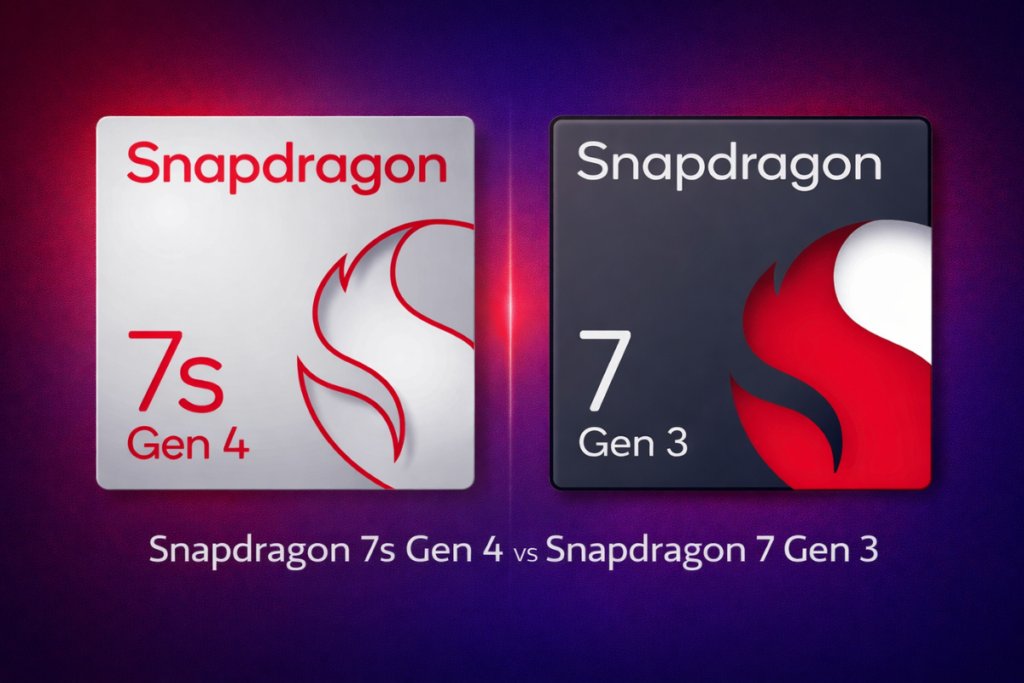
The Snapdragon 7s Gen 4 is positioned as an affordable version of the 7 Gen 4 chipset, while still offering excellent performance and efficiency. However, it’s not a clear upgrade over the 7 Gen 3. The latter still dominates some key aspects, such as connectivity, whereas the 7s Gen 4 leverages the newer CPU and newer GPU. So, the real question is: which one delivers the better value?
In this post, we’ll dive deep into benchmark figures and crucial differences to find out if the newer Snapdragon 7s Gen 4 can actually outperform the 2023’s Snapdragon 7 Gen 3.
Snapdragon 7s Gen 4 vs 7 Gen 3: Spec sheet
Snapdragon 7s Gen 4
Snapdragon 7 Gen 3
Announced
August 2025
November 2023
Process node
4nm (TSMC)
4nm (TSMC)
CPU
1 x 2.7GHz — Cortex-A720 3 x 2.4GHz — Cortex-A720 4 x 1.8GHz — Cortex-A520
1 x 2.63GHz — Cortex-A715 3 x 2.4GHz — Cortex-A715 4 x 1.8GHz — Cortex-A510
GPU
Adreno 810 Snapdragon Elite Gaming features
Adreno 720 Snapdragon Elite Gaming features
NPU
Qualcomm Hexagon NPU
Qualcomm Hexagon NPU
Memory
LPDDR5, up to 3.0GHz
LPDDR5, up to 3.2GHz
Storage
UFS 3.1
UFS 3.1
Camera
Qualcomm Spectra ISP (Triple ISPs, 12-bit) up to 200MP single camera up to 64MP single camera with zero shutter lag up to 32+21MP dual cameras with zero shutter lag up to 21MP triple cameras with zero shutter lag up to 4K/30fps video recording
Qualcomm Spectra ISP (Triple ISPs, 12-bit) up to 200MP single camera up to 64MP single camera with zero shutter lag up to 32+21MP dual cameras with zero shutter lag up to 21MP triple cameras with zero shutter lag up to 4K/60fps video recording
Connectivity
Snapdragon 5G modem (sub‑6GHz) download speed: 2.9Gbps (peak speed) Wi-Fi 6E (peak speed: 2.9Gbps) Bluetooth 5.4
Snapdragon X63 5G modem (sub‑6GHz) download speed: 5Gbps (peak speed) Wi-Fi 6E (peak speed: 2.9Gbps) Bluetooth 5.4
Snapdragon 7s Gen 4 vs 7 Gen 3: Benchmark scores
[Note: For the benchmark results, the tests were performed on the POCO M8 Pro (powered by Snapdragon 7s Gen 4) and OnePlus Nord CE 4 5G (powered by Snapdragon 7 Gen 3).]
Geekbench performance
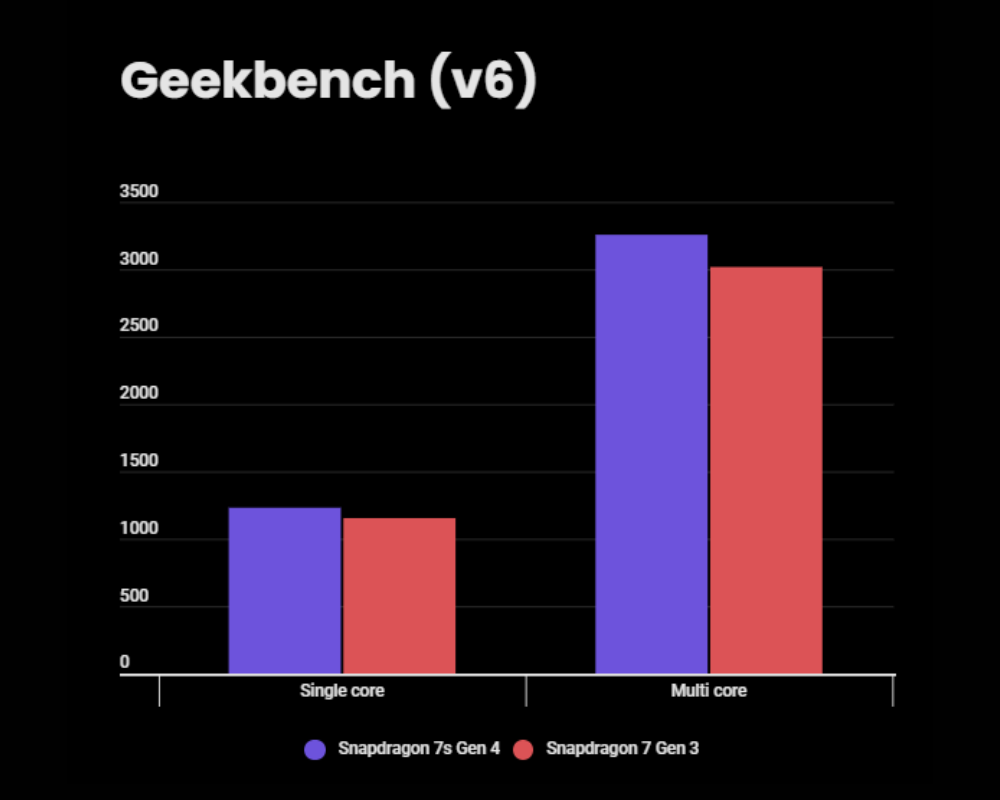
In the Geekbench test, the Snapdragon 7s Gen 4-driven POCO M8 Pro pulls ahead with 1,231 points in the single-core test and 3,257 points in the multi-core test. In contrast, the OnePlus Nord CE 4, powered by the Snapdragon 7 Gen 3, achieves 1,154 and 3,018 points in the single-core and multi-core tests, respectively.
While the difference isn’t significant, devices powered by the Snapdragon 7s Gen 4 should see noticeable improvements in demanding tasks. However, in everyday tasks such as browsing the internet, scrolling through social media feeds, and watching videos, there shouldn’t be any noticeable performance gap.
Snapdragon 7s Gen 4
Snapdragon 7 Gen 3
Single core
1,231
1,154
Multi core
3,257
3,018
Geekbench score (v6)
AnTuTu performance
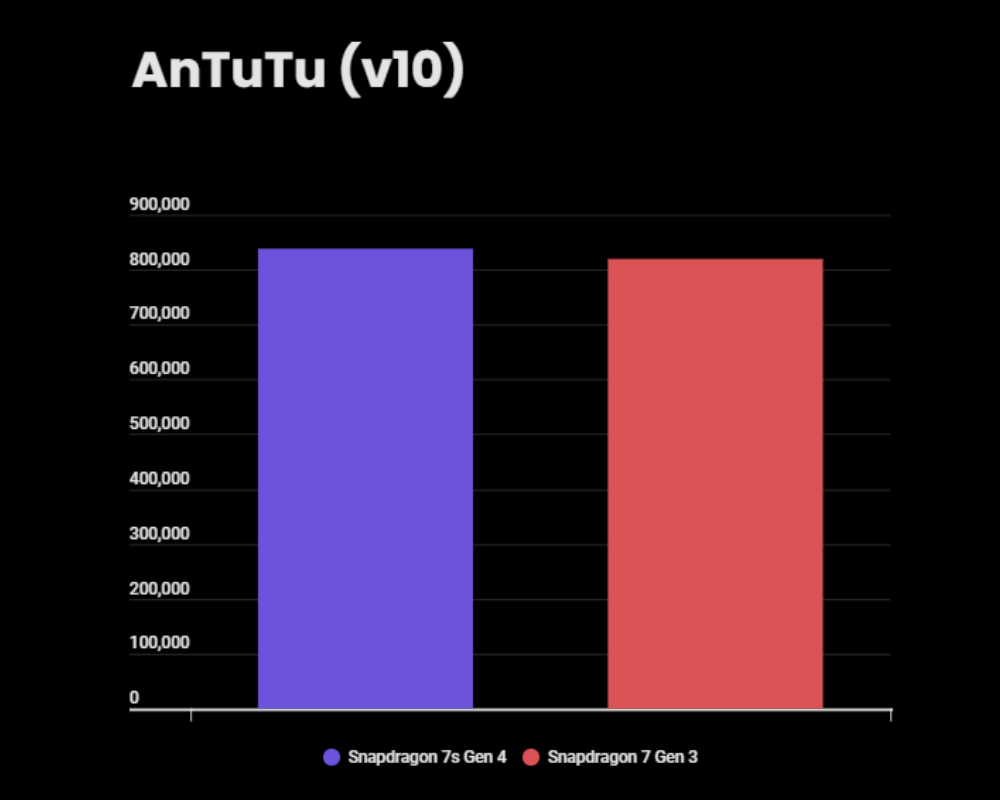
The Snapdragon 7s Gen 4 achieves a higher AnTuTu score, but the difference isn’t significant. The CPU score is also just above that of the 7 Gen 3 chip, posting a difference of just 2.8%. However, the 7 Gen 3 bounces back strongly in the GPU performance with a 21% higher score. We’ll tell you the reason in the following section.
Snapdragon 7s Gen 4
Snapdragon 7 Gen 3
AnTuTu score
838,402
819,655
CPU
276,892
269,334
GPU
211,590
256,584
Memory
162,373
129,961
UX
187,547
163,776
AnTuTu score (v10)
As the benchmarks show, the newer Snapdragon 7s Gen 4 offers better CPU performance, but the 7 Gen 3 is still ahead in GPU performance. However, they don’t say anything about the camera’s performance or connectivity. So, let’s now look at the key differences to get a better picture.
Snapdragon 7s Gen 4 vs 7 Gen 3: Key differences that matter
CPU, GPU & NPU
Both Snapdragon chipsets use the same 1+3+4 core configuration, but the 7s Gen 4 features newer CPU cores that offer better performance and power efficiency. Plus, they run at higher speeds, further improving performance.
For gaming and graphics-related tasks, the Snapdragon 7s Gen 4 mainly relies on the Adreno 810 GPU, while the 7 Gen 3 features an Adreno 700-series GPU, the Adreno 720. Despite that, the latter is able to offer better GPU performance because it has a higher GPU frequency, more shading units, and faster computational capabilities.
Both chips feature Qualcomm Hexagon NPUs with a fused AI accelerator design. They can generate text, photos, and other content on-device. Plus, it helps with noise cancellation and improves the overall camera output.
Camera & Imaging
The camera specs are mostly the same, except that the 7 Gen 3 supports 4K video recording at 60 fps, while the 7s Gen 4 is limited to 30 fps. Note that the final output also depends on the camera sensor and OEM optimizations.
Connectivity
The Snapdragon 7s Gen 4 and 7 Gen 3 are identical in most connectivity areas, except that the 7 Gen 3 offers up to 5Gbps download speed over 5G, while the 7s Gen 4 peaks at 2.9Gbps. The rest of the connectivity specs are the same, as both offer sub-6GHz, mmWave 5G, Wi-Fi 6E, and Bluetooth v5.4.
Snapdragon 7s Gen 4 vs 7 Gen 3: Which is a better choice?
The Snapdragon 7 Gen 3 is a better choice, even though the 7s Gen 4 offers better CPU performance. That alone can’t justify the advantages provided by the Snapdragon 7 Gen 3, including a much better gaming performance, faster memory, and better video recording capabilities. The 7 Gen 3 also offers faster download speed over 5G.
If gaming isn’t your thing, the Snapdragon 7s Gen 4 might make more sense if you can get a device at a lower price than one powered by the Snapdragon 7 Gen 3.
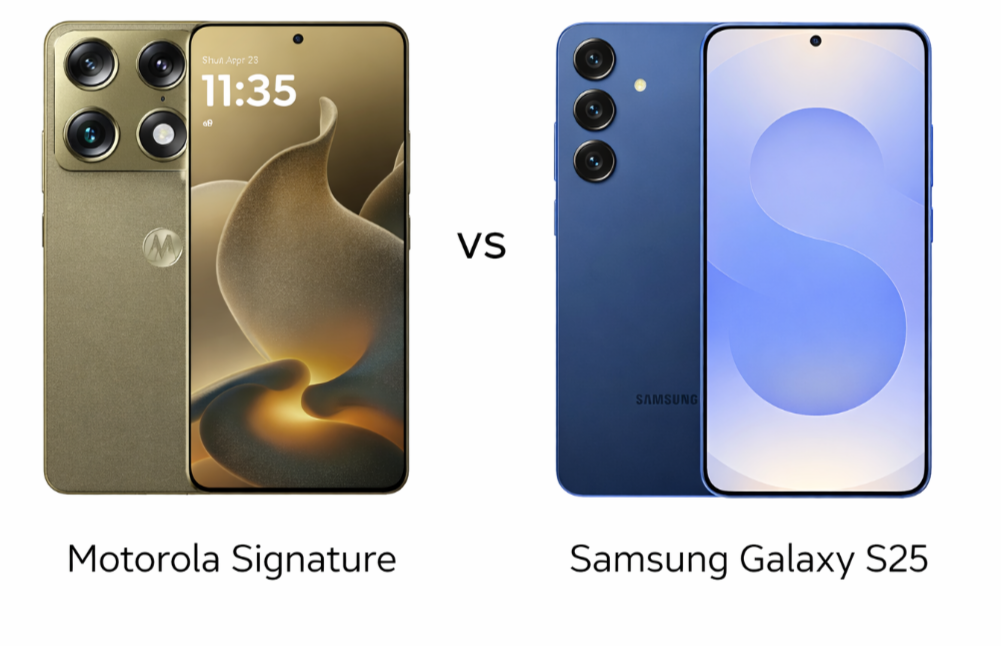
Choosing a flagship smartphone today is no longer just about brand loyalty; it is about balancing performance, innovation, and value. The Motorola Signature enters the premium segment with aggressive hardware and pricing, while the Samsung Galaxy S25 represents Samsung’s refined, ecosystem-driven approach to flagship excellence. With both offering long-term software support and cutting-edge chipsets, this comparison explores which device truly delivers the smarter overall investment.
The Motorola Signature features Gorilla Glass Victus 2 on the front with an aluminum frame and carries IP68/IP69 protection plus MIL-STD-810H compliance. It feels premium and engineered for durability, clearly targeting users who want flagship elegance with added toughness.
The Samsung Galaxy S25 uses Gorilla Glass Victus 2 on both front and back with an Armor Aluminum 2 frame and IP68 rating. Its compact form factor makes it more pocket-friendly and easier for one-handed use. Samsung’s finish feels refined and polished, while Motorola leans slightly toward bold and performance-centric design language.
Display Quality
Motorola pushes boundaries with a 6.8-inch LTPO AMOLED panel, 165Hz refresh rate, Dolby Vision, HDR10+, and a massive 6200-nit peak brightness. It is built for immersive gaming and outdoor visibility.
Samsung counters with a 6.2-inch Dynamic LTPO AMOLED 2X display at 120Hz and 2600-nit peak brightness. While smaller, it delivers sharp visuals and color tuning that feels balanced and consistent.
Verdict
Motorola wins on sheer display specs and brightness. Samsung feels more compact and refined for everyday comfort.
2. Specifications Including Battery
Performance
The Motorola Signature runs on Snapdragon 8 Gen 5 (3nm) with up to 16GB RAM and UFS 4.1 storage. It is tuned for raw power and future-ready performance, supported by Android 16 with seven major upgrades.
The Galaxy S25 features Snapdragon 8 Elite (3nm), paired with 12GB RAM and UFS 4.0 storage. Samsung’s optimization through One UI 8 ensures smooth multitasking and strong thermal management. While Motorola emphasizes peak power, Samsung focuses on stability and ecosystem polish.
Battery and Charging
Motorola packs a 5200mAh battery with 90W wired, 50W wireless, and reverse charging support. It clearly prioritizes fast top-ups and endurance.
Samsung offers a 4000mAh battery with 25W wired and 15W wireless charging. It remains reliable but not class-leading in charging speed.
Verdict
Motorola dominates in battery size and charging speed. Samsung delivers consistent, optimized performance but feels conservative on power upgrades.
3. Camera
Main and Secondary Lenses
Motorola equips a triple 50MP setup including a 3x periscope telephoto and ultrawide lens, plus 8K Dolby Vision video recording. The larger sensors and periscope zoom add versatility for photography enthusiasts.
Samsung uses a 50MP main sensor, 10MP 3x telephoto, and 12MP ultrawide. It supports 8K video and advanced computational features like Best Face. Samsung’s image processing tends to favor vibrant output, while Motorola appears to focus on hardware strength and detail retention.
Selfie Camera
Motorola offers a 50MP front camera with 4K recording and dual-pixel PDAF, giving it an edge in clarity and flexibility.
Samsung includes a 12MP dual-pixel selfie camera with HDR10+ support, optimized for natural skin tones and social media sharing.
Verdict
Motorola wins on camera hardware and selfie resolution. Samsung excels in computational photography and consistent color science.
4. Pricing
Motorola Signature is priced around $660 / ₹59,000, positioning it aggressively in the flagship space. For the hardware offered, a 165Hz display, 90W charging, periscope zoom, and 5200mAh battery, it delivers strong value.
Samsung Galaxy S25 costs approximately $800 / ₹75,000. The premium largely reflects brand value, ecosystem integration, and software refinement. Samsung devices traditionally hold resale value better and benefit from deeper ecosystem support.
Motorola clearly undercuts Samsung by a significant margin while offering higher peak specs in several areas. Samsung justifies its price through optimization, compact flagship appeal, and ecosystem continuity.
Disclaimer: Prices are approximate and may vary based on country, region, and applicable taxes.
Verdict
Motorola offers better hardware value for money. Samsung charges more for polish, brand strength, and ecosystem advantages.
5. Conclusion
Motorola stands out with its 165Hz ultra-bright display, 90W fast charging, 50MP triple camera system with periscope zoom, UWB support, and Bose-tuned audio. It feels like a performance flagship built to impress on paper and in real-world speed.
Samsung differentiates itself with One UI refinement, Samsung DeX and Wireless DeX desktop experience, compact flagship design, and long-term ecosystem reliability. It feels cohesive and mature rather than experimental.
Verdict
For most buyers, the Motorola Signature is the better overall pick because it delivers more flagship hardware for less money.
The Galaxy S25 is ideal for those who prioritize brand ecosystem, compact design, and software refinement over raw specifications.
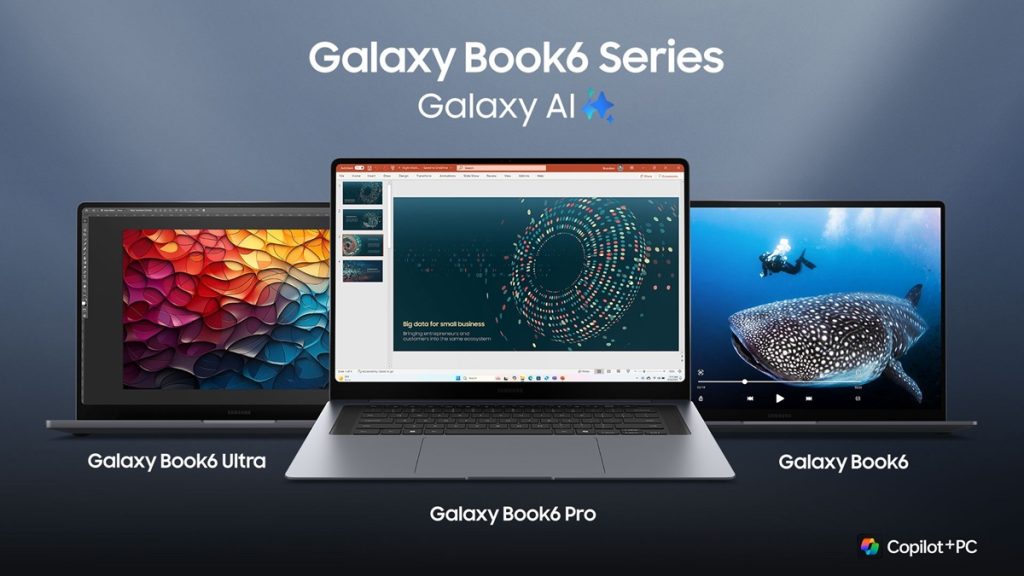
Samsung has confirmed European pricing and availability for its Galaxy Book 6 laptop series (via GSMArena), unveiled at CES 2026. Pre-orders launch February 25, with shipments starting March 11 across Belgium, France, Germany, Italy, the Netherlands, Scandinavia, Spain, the UK, and Ireland. Additional markets follow in April.
Samsung Galaxy Book 6 series
The lineup spans three tiers with six models. The 14-inch Galaxy Book 6 starts at €1,149/£949, while the 16-inch version costs €1,249/£1,049. A 16-inch touchscreen variant runs €1,399/£1,099. Galaxy Book 6 Pro models begin at €1,799/£1,399 for 14-inch and €1,899/£1,499 for 16-inch configurations. The flagship Galaxy Book 6 Ultra, returning after skipping the previous generation, commands €3,399/£2,999. UK pricing reflects 256GB base storage versus 512GB in most European markets.
All devices feature Intel Core Ultra Series 3 processors. The Galaxy Book 6 Ultra delivers 50 TOPS AI performance through its integrated NPU, with CPU options including Core Ultra X9, Ultra X7, and Ultra 7. European units ship with Nvidia GeForce RTX 5060 graphics, though the previously announced Intel-only configuration remains unlisted.
The Ultra sports a 16-inch WQXGA+ Touch Dynamic AMOLED 2X display with anti-reflective coating and 1000-nit peak brightness. Specifications include up to 64GB LPDDR5X RAM, up to 2TB SSD storage, plus an expansion slot. Connectivity covers Thunderbolt 4, USB-A, HDMI 2.1, Wi-Fi 7, and Bluetooth 5.4. Samsung claims 30 hours of video playback from the 80.2Wh battery with fast charging. Audio comes from six Dolby Atmos speakers.
Galaxy Book 6 Pro models feature 14-inch and 16-inch AMOLED touchscreens, Intel Arc graphics, up to 32GB RAM, and up to 1TB storage. The 16-inch adds an SSD expansion slot and up to 78Wh battery capacity.
Standard Galaxy Book 6 variants offer Core Ultra 5 or Ultra 7 processors, Arc graphics, up to 32GB RAM, and up to 1TB storage. Base models substitute LCD for AMOLED, though the 16-inch includes a touchscreen option. All versions maintain Dolby Atmos audio, enhanced cooling systems, and comprehensive port selections targeting productivity users.
For more daily updates, please visit our News Section.
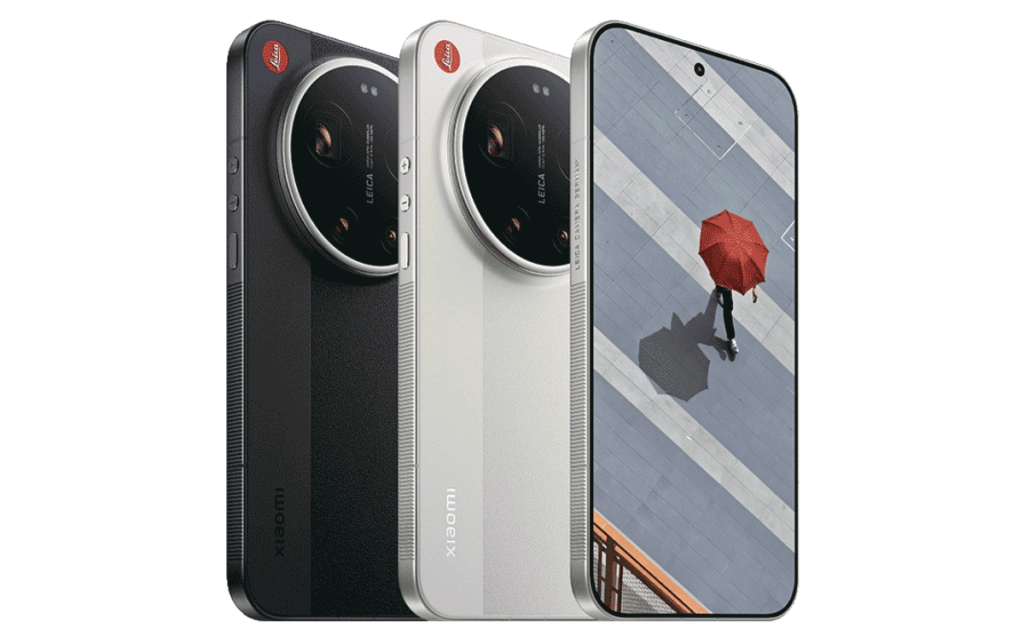
The upcoming Xiaomi 17 Ultra Leica Edition has appeared on Geekbench ahead of its expected global debut, revealing key performance and AI-related details. This device is expected to hit the global market alongside the regular Xiaomi 17 Ultra and Xiaomi 17. Here’s a look at the details that have emerged through its Geekbench AI listing.
Xiaomi 17 Ultra Leica Edition Geekbench AI listing
Xiaomi 17 Ultra Leica Leitzphone (global version – 25128PNA1G) appears on Geekbench AI
According to an XpertPickreport, the global variant carrying the model number 25128PNA1G has appeared on the Geekbench benchmarking platform. The listing highlights the device’s AI performance metrics, revealing a single precision score of 1,973, a half precision score of 3,322, and a quantised score of 4,754. These results suggest that the handset is tuned for strong on-device AI tasks such as image processing, voice recognition, and real-time computational photography enhancements.
The benchmark further indicates the presence of a Qualcomm ARMv8-based chipset featuring six efficiency cores clocked at 3.63GHz and two performance cores reaching 4.61GHz, which aligns with expectations of the Snapdragon 8 Elite Gen 5 processor.
The device has also been listed with 16GB of RAM and Android 16, likely running Xiaomi’s HyperOS 3 interface. The appearance on Geekbench suggests that testing is currently underway ahead of its anticipated international rollout.
Xiaomi 17 Ultra Leica Edition: What to expect?
Xiaomi 17 Ultra Leica Edition
The Xiaomi 17 Ultra Leica Edition is expected to retain the same core hardware as the standard Ultra model while focusing on photography-centric enhancements. The Leica Edition may feature Leica-tuned colour processing, exclusive shooting modes, refined styling, and a mechanical zoom control for a more camera-like experience.
The 17 Ultra Leica Edition is likely to feature a 6.9-inch 1.5K LTPO AMOLED display with a 120Hz refresh rate and Dragon Crystal Glass 3 protection. On the imaging side, it is tipped to include a Leica-tuned triple camera setup comprising a 50-megapixel primary sensor, a 50-megapixel ultra-wide camera, and a 200-megapixel periscope telephoto lens designed for advanced zoom capabilities.
Powering the device could be a large 6,800mAh battery supporting 90W wired and 50W wireless charging. The phone debuted in China with in 16GB+512GB and 16GB+1TB versions with a starting price of 7,999 Yuan (~$1,160) and was offered in Black and Off-White colour options.
Some certifications also suggest that the global version may be marketed under the name “Leica Leitzphone powered by Xiaomi,” although official confirmation is still awaited Reports hint that the smartphone may launch globally around the end of February, possibly ahead of the Mobile World Congress (MWC) 2026 event.
For more daily updates, please visit our News Section.
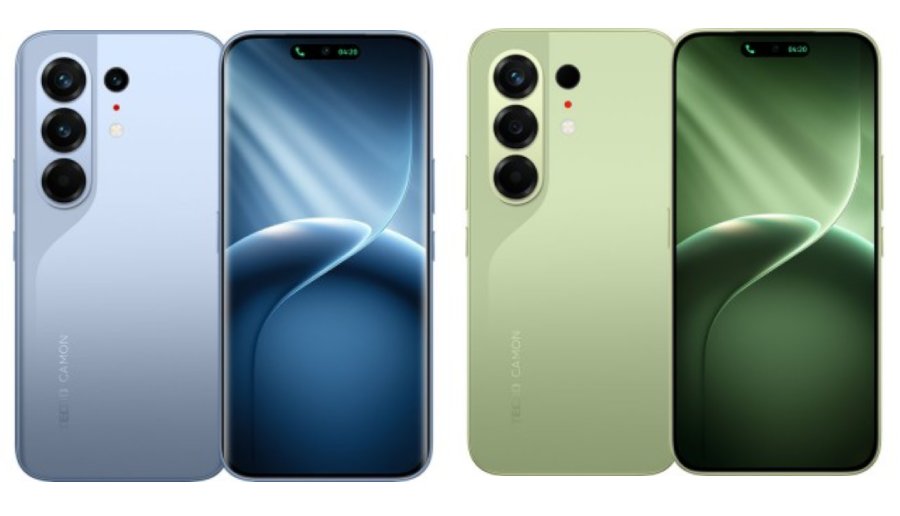
Tecno has quietly launched the Camon 50 and Camon 50 Pro smartphones in several African markets. Announced earlier than their expected reveal at MWC, the two phones share most of their specifications.
They both use the same processor, battery size, display specs, and much of the same camera hardware. However, the Pro model adds a dedicated 3x periscope telephoto camera. Here are the full specs.
Tecno Camon 50 and Camon 50 Pro Specifications
Both the Tecno Camon 50 and the Tecno Camon 50 Pro run on MediaTek’s Helio G200 processor paired with 8GB of RAM. As for the storage, the Pro model has 256GB, while the standard version starts at 128GB.
Powering both devices is a large 6,150mAh battery that supports 45W wired charging.
On the front, both phones feature a 6.78-inch AMOLED display with a 144Hz refresh rate and Full HD+ resolution. The screens also include an in-display fingerprint scanner and a 32-megapixel selfie camera.
Tecno Camon 50
The difference here is mostly aesthetic—the Pro model uses a curved panel, while the standard Camon 50 sticks with a flat display.
Around the back, both devices share the same 50-megapixel Sony LYT700C main sensor — the same camera used on last year’s Tecno Camon 40 Pro — alongside an 8-megapixel ultrawide lens. The Camon 50 Pro, however, adds a 50-megapixel 3x periscope telephoto camera with optical image stabilization (OIS).
Tecno Camon 50 Pro (left) | Tecno Camon 50 (right)
Software-wise, both phones ship with TECNO’s HiOS 16 and come with an IP68/69/69K rating for dust and water resistance. Tecno is also including a One-Tap AI Key and stereo speakers with Dolby Atmos support.
In Kenya, the Camon 50 is priced at KES 37,500 (around $290), while the Camon 50 Pro comes in at KES 44,000 (around $340). Both devices are currently available for pre-order. Tecno hasn’t announced 5G versions yet, but with MWC 2026 on the horizon, those models could be next in line.
For more daily updates, please visit our News Section.
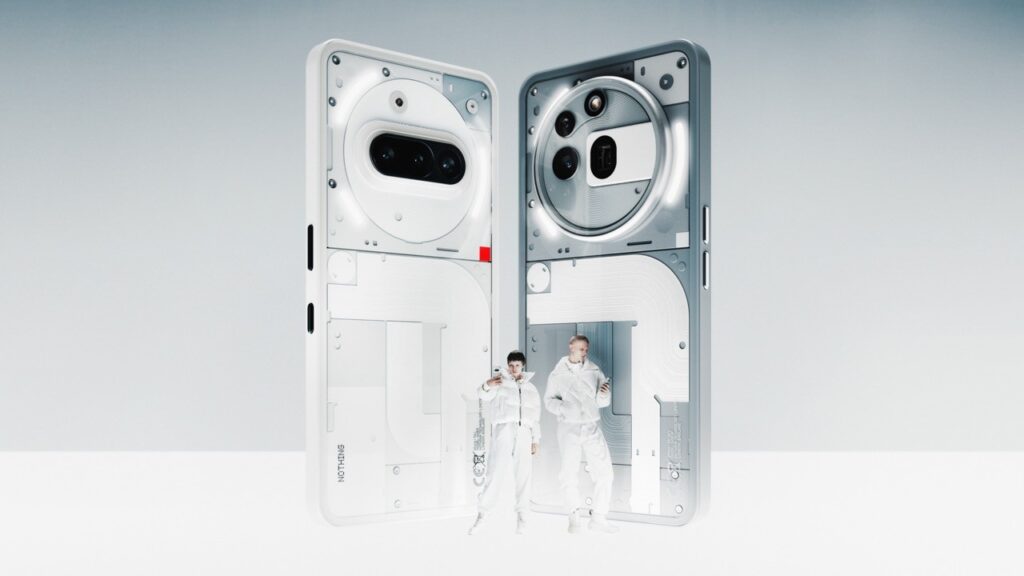
Nothing has confirmed that its next product launch will take place on March 5, 2026 at 11:30 AM French time, where the company is expected to introduce the Nothing Phone (4a), the Phone (4a) Pro, and the Nothing Headphone (a). While the official announcement is still weeks away, new leaks (via billbil-kun at Dealabs) have already outlined most of the specifications, variants, and expected pricing.
Nothing Phone 3a and Phone 3a Pro
The Pro model appears to be getting the bigger upgrades this year. It is rumored to feature a 50MP Sony main camera with optical image stabilization and zoom capabilities up to 140x. The device may also use a unibody aluminum frame designed to improve heat dissipation during heavy use. On the front, the Phone (4a) Pro is expected to include a 6.83-inch 1.5K AMOLED display with a 144Hz refresh rate, slightly larger and faster than its predecessor. Another possible addition is a Glyph Matrix lighting system, which would expand on Nothing’s signature LED notification design.
The standard Nothing Phone (4a) is also expected to bring noticeable improvements. Reports suggest a triple 50MP rear camera setup that supports a 0.6x ultra-wide view and zoom up to 70x. A 32MP front camera is expected for selfies and video calls. The device will likely retain Nothing’s transparent design with smoother curves and a Glyph Bar made up of 63 mini-LEDs for alerts and lighting effects.
Display upgrades are also expected on the regular model, with a rumored 6.78-inch 1.5K AMOLED panel supporting adaptive refresh rates between 30Hz and 120Hz. Battery life is said to improve compared to the Phone (3a), and support for 50W fast charging is expected. As for the processor, a recent Geekbench listing revealed that the Phone (4a) will be powered by a Snapdragon 7s Gen 4 processor.
Storage and color options differ between the two phones. The Phone (4a) may launch with 256GB storage only, paired with either 8GB or 12GB RAM. Black and White are expected across both variants, while Pink and Blue may be limited to the 12GB model. The Phone (4a) Pro is rumored to come in 8GB/128GB and 12GB/256GB versions, with Black and Silver available for both, and Pink again restricted to the higher configuration.
Pricing is expected to rise compared to the previous generation. The Phone (4a) 8GB/256GB may start at €409 in France, Belgium, and Italy, and €389 in Germany and Spain, while the 12GB version could cost €449 and €429. The Phone (4a) Pro 8GB/128GB is expected at €499 and €479, and the 12GB/256GB model may reach €569 and €549.
The standard Phone (4a) is expected to become available starting March 12, 2026, with the Pro version reportedly launching around March 26.
For more daily updates, please visit our News Section.
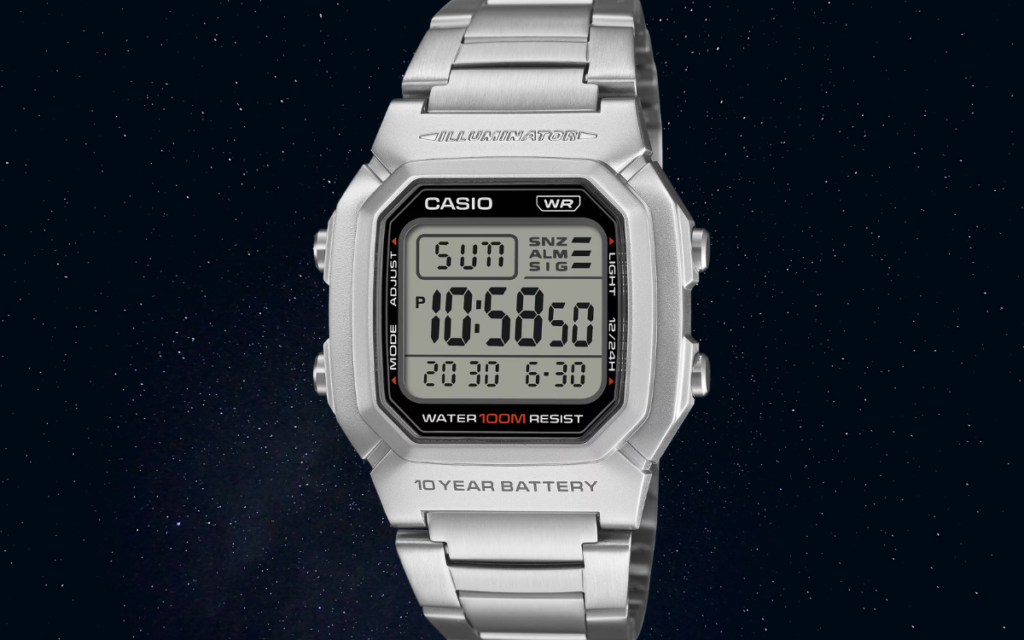
Casio has launched its W-800HD-1AV digital watch in the United States. The watch became available earlier this month in European countries, including the Netherlands, Spain, Germany, and the UK. It features a classic retro design and a range of practical features at an affordable price point.
Casio W-800HD-1AV Specifications
The W-800HD-1AV uses a square digital design with a brushed silver-tone resin case. Its slightly angular design incorporates softened edges, which create a compact and balanced look. The black bezel around the face contrasts sharply with the silver case, while subtle red accents on the inner frame add a touch of visual interest.
The watch features a grey LCD display with bold black numerals for clear readability. The day appears at the top, the time occupies the center, and additional information, such as the date and secondary time zone, sits at the bottom. It features a green LED backlight that provides visibility in low-light settings.
The watch comes with a silver-tone case with a stainless steel bracelet. The bracelet features broad, flat links and a triple-fold clasp.
The W-800HD-1AV includes several practical features. It offers a 10-year battery life powered by a CR2025 battery and 100-meter water resistance. The watch supports dual time zones, a 1/100-second stopwatch, and a multi-function alarm with a snooze option. It also includes a full auto-calendar programmed through the year 2099 and allows users to choose between 12-hour and 24-hour time formats.
The case measures 44.2 x 36.8 x 13.4 mm, and the watch weighs 91 grams. Casio has priced the W-800HD-1AV at $54.95, making it an affordable option for fans of retro digital watches.
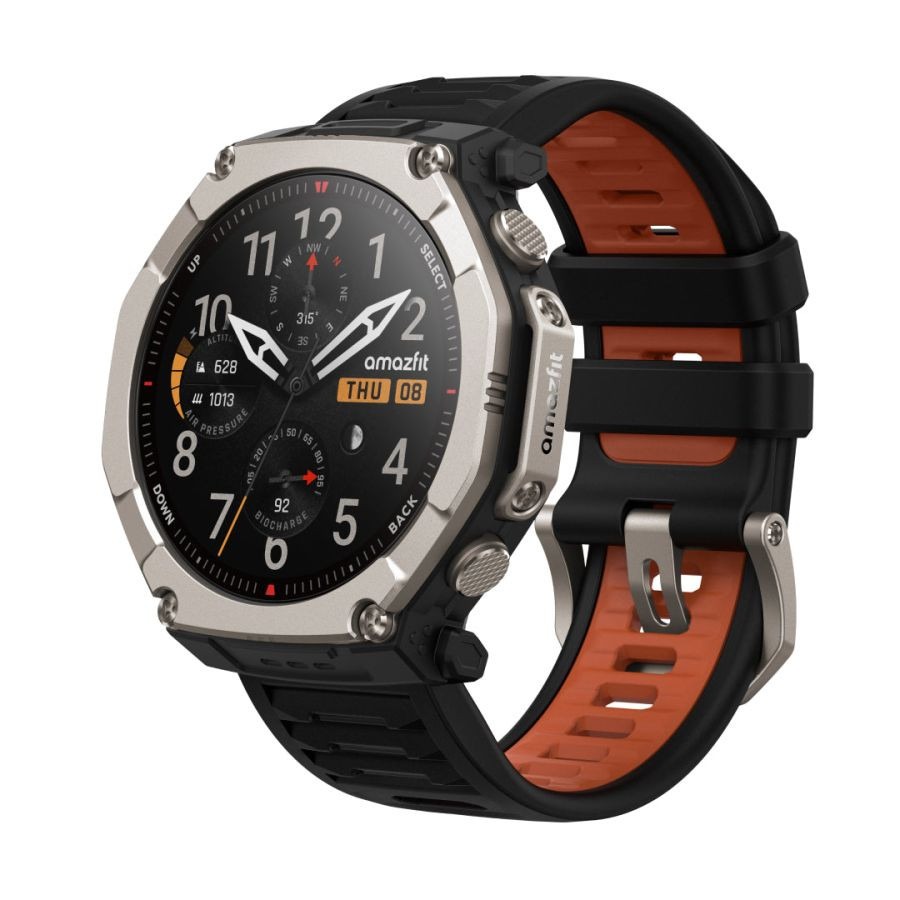
The Amazfit T-Rex Ultra 2 smartwatch has appeared in a leaked product listing from a European retailer, revealing its design and specifications before the official launch. Rumors about the device started in 2025, and it was later referenced in the code of a Zepp app update earlier in 2026.
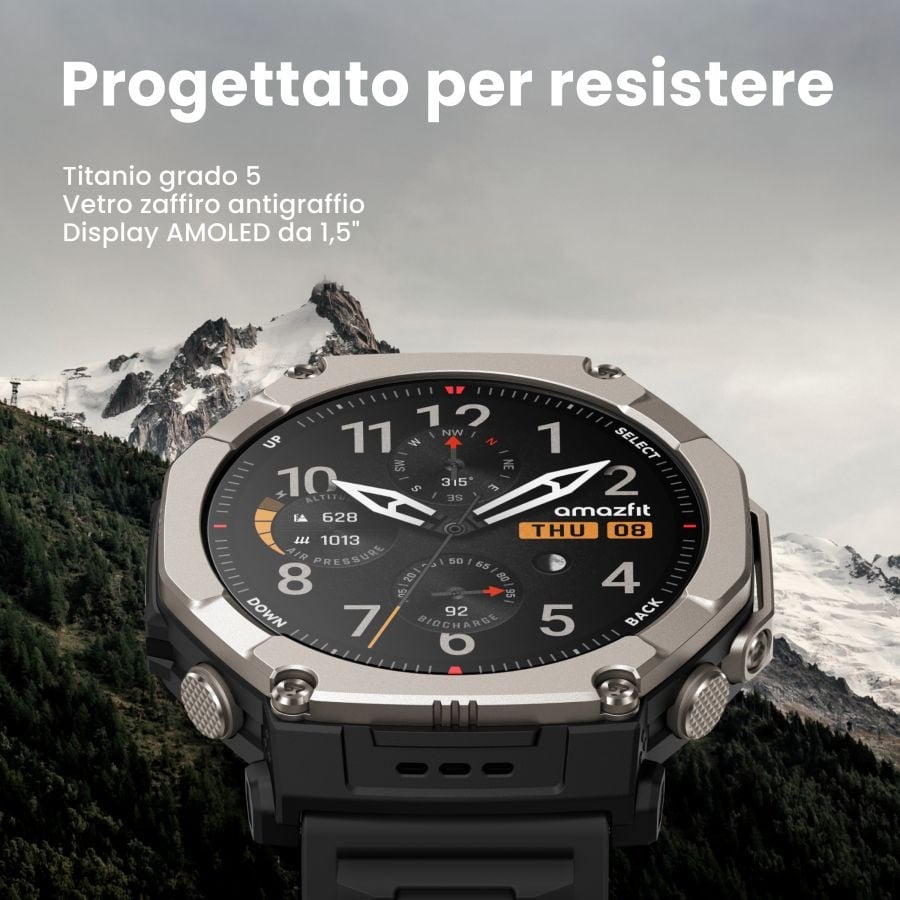
The latest leak came from an Italian retailer called Epto, where the watch briefly appeared before the listing was removed. The product page shows that the T-Rex Ultra 2 has a 1.5-inch AMOLED display with up to 3,000 nits peak brightness. Some earlier reports suggested a MicroLED display, but the listing confirms it’s AMOLED. The watch measures 51 mm wide and uses a titanium casing with a sapphire crystal protecting the screen.
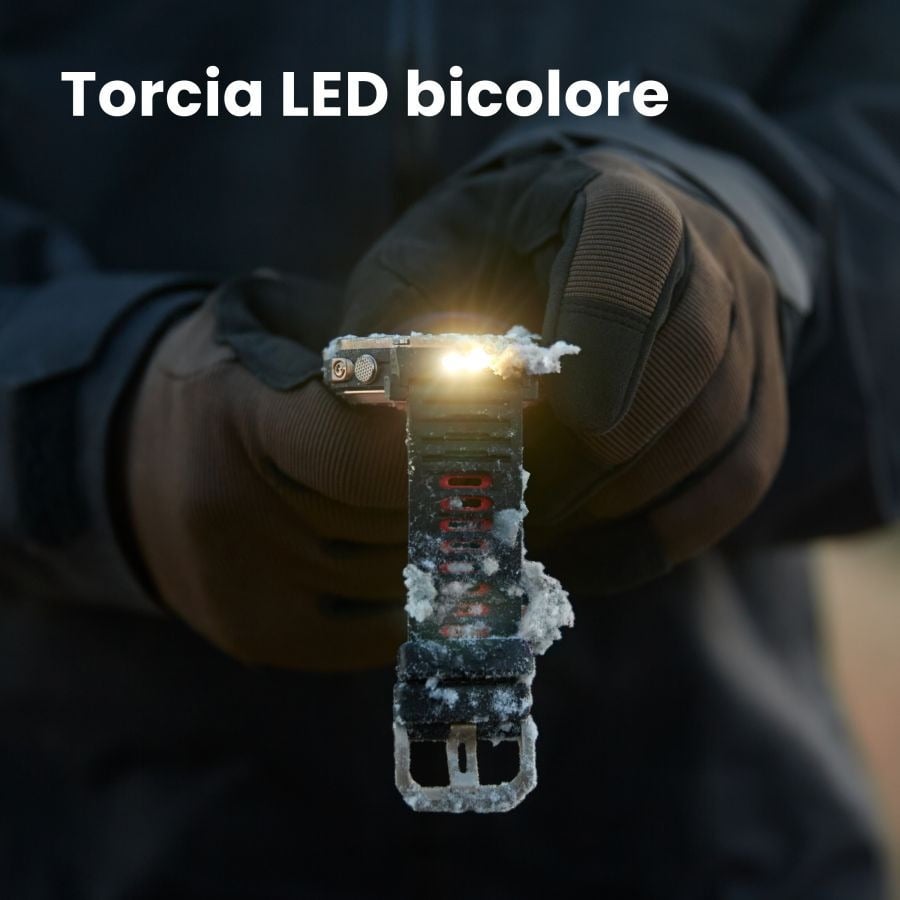
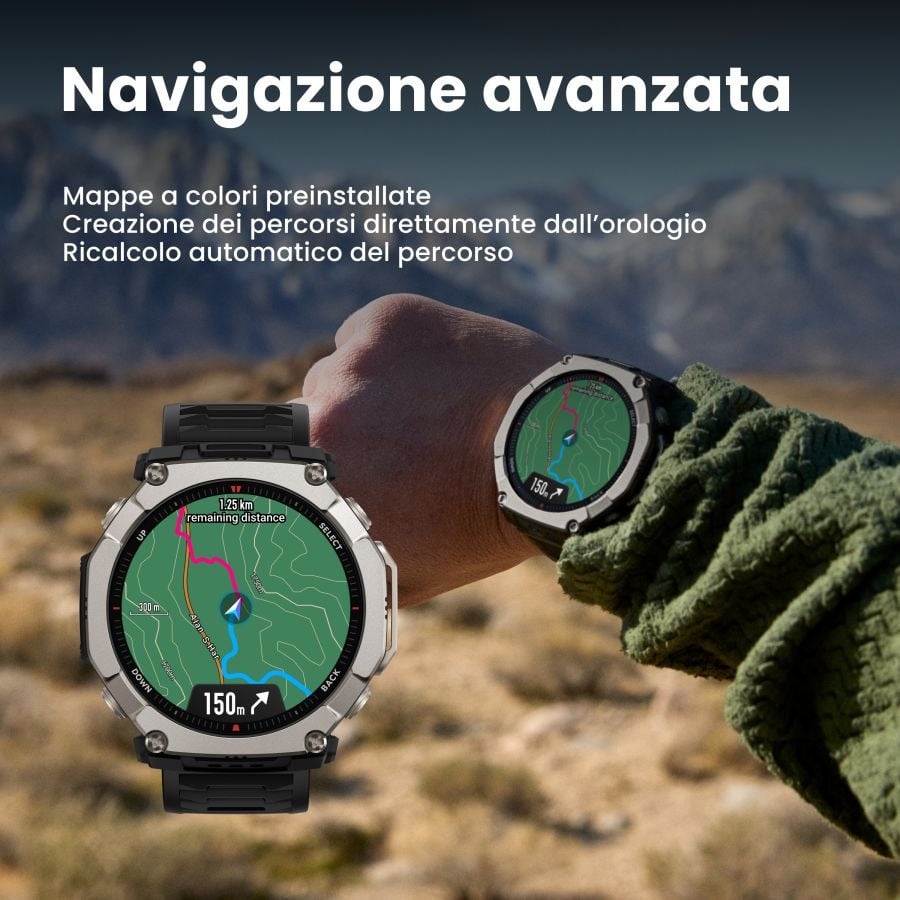
The smartwatch focuses on outdoor and navigation features. It supports six satellite positioning systems and dual-band GPS for better accuracy. Color maps come preloaded, and you can plan routes directly on the watch. It can search for points of interest and automatically reroute you if you go off the planned path. The device includes a dual-color flashlight to help you see in low light and stay visible. It also has a built-in barometer.
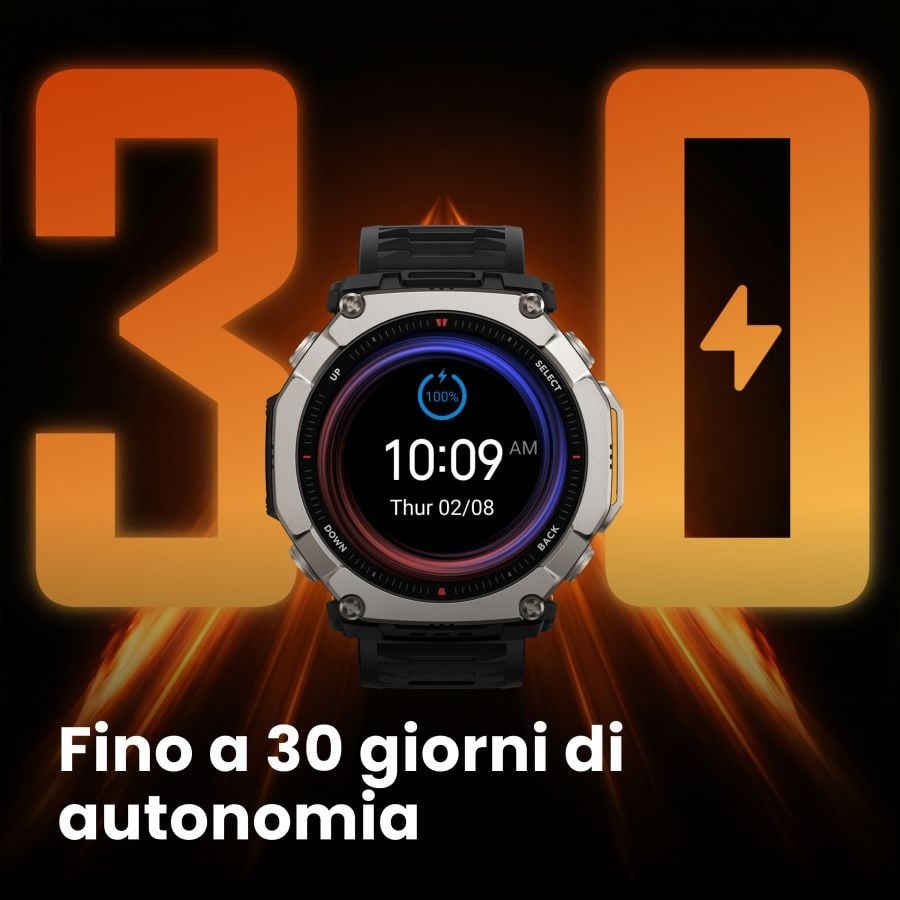
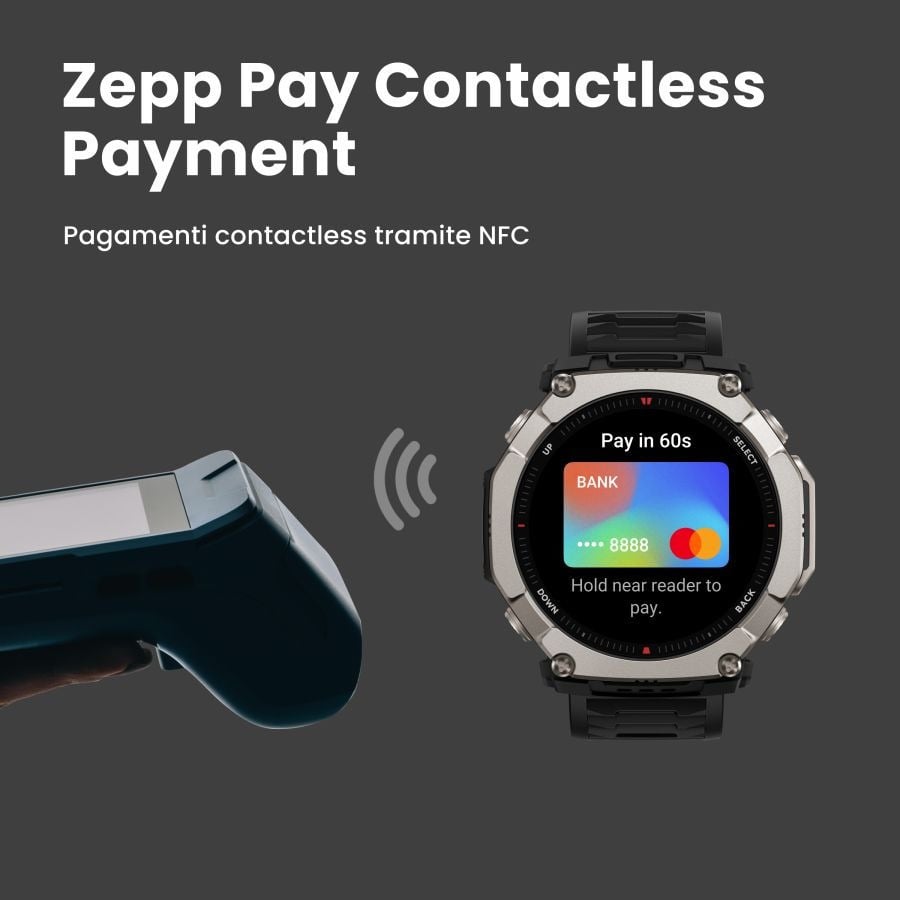
Battery life goes up to 30 days with typical use, or about seven days when GPS is actively used. The watch has a 10 ATM water resistance rating, making it good for swimming and other water activities. In Europe, users will get contactless payment support through Zepp Pay.
At the time of the leak, the Amazfit T-Rex Ultra 2 was listed for €512.90, and customers appeared to be able to pre-order it. The listing has since been removed, and Zepp Health has not yet announced an official release date.
For more daily updates, please visit our News Section.
We use cookies on our website to give you the most relevant experience by remembering your preferences and repeat visits. By clicking “Accept”, you consent to the use of ALL the cookies.
This website uses cookies to improve your experience while you navigate through the website. Out of these, the cookies that are categorized as necessary are stored on your browser as they are essential for the working of basic functionalities of the website. We also use third-party cookies that help us analyze and understand how you use this website. These cookies will be stored in your browser only with your consent. You also have the option to opt-out of these cookies. But opting out of some of these cookies may affect your browsing experience.
Necessary cookies are absolutely essential for the website to function properly. This category only includes cookies that ensures basic functionalities and security features of the website. These cookies do not store any personal information.
Any cookies that may not be particularly necessary for the website to function and is used specifically to collect user personal data via analytics, ads, other embedded contents are termed as non-necessary cookies. It is mandatory to procure user consent prior to running these cookies on your website.