
Add GIZMOCHINA as Preferred Source on Google
As artificial intelligence continues to weave itself into everyday life, a new category of technology is quietly reshaping how humans think about companionship: AI pets. For many, the idea evokes memories of iconic fictional companions like BB-8 from Star Wars, a droid that felt less like a machine and more like a loyal friend.
BB-8’s personality was intentionally designed to mirror the charm of a curious puppy, reinforcing how deeply emotional bonds with robots can resonate with people. Today, real-world companion robots are beginning to chase that same sense of warmth, presence, and connection.

At CES 2026, this shift was on full display as Japanese startup Ludens AI introduced two deeply expressive companion robots: Cocomo and Inu, signaling a world where digital companionship may soon feel as natural as living with a pet.
Ludens AI’s philosophy is refreshingly different from the growing trend of “smart helpers.” Instead of building robots that clean or organize, the company focuses on machines that listen, react, and bond emotionally over time. Their message is simple: AI companions don’t need jobs, they just need to exist alongside people.

Cocomo: A Warm, Mobile Robot Pet Designed for Emotional Bonding
Cocomo, the star of Ludens AI’s showcase, is positioned as an autonomous robot pet that follows its owner around the home. With a wheeled chassis, ear-like decorations, and an orange, teddy-bear-like exterior, Cocomo feels intentionally playful and approachable. Its body temperature is carefully maintained near human warmth, around 37°C in normal use and up to 39°C during frequent touch, eliminating the cold, mechanical feel often associated with robots.
Instead of speaking, Cocomo communicates through humming and soft sounds, reinforcing its pet-like character. Over time, it learns what makes its owner happy, what brings comfort, and when to offer spontaneous gestures or gentle surprises. Through voice, touch, and movement-based interactions, Cocomo is designed to create a slow-growing emotional bond rather than instant novelty. Ludens AI describes it as a companion meant to evolve alongside everyday life, a robot that remembers, imitates, and adapts.
Inu: A Minimalist “Desktop Alien Puppy” for Workspaces
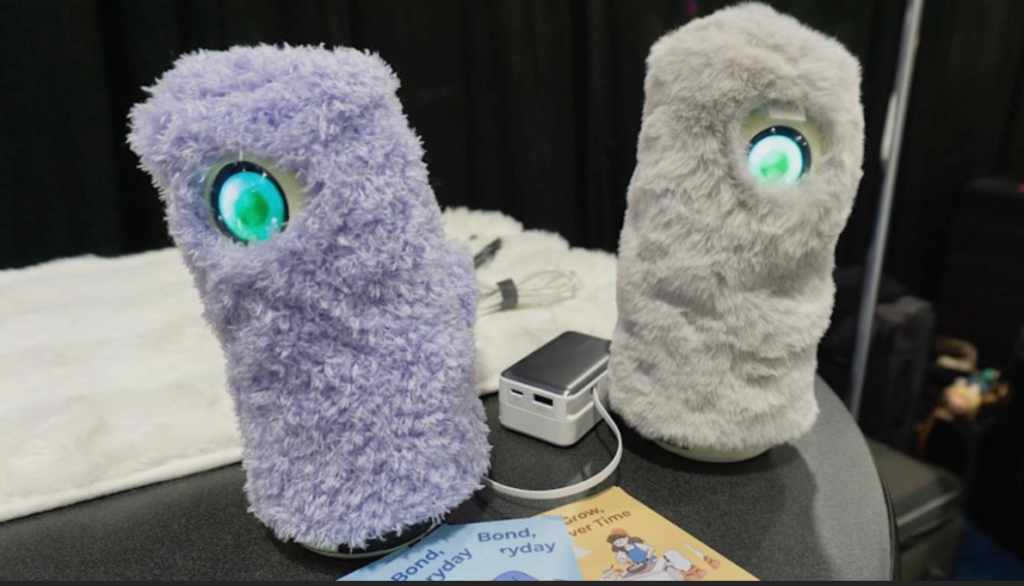
In contrast, Inu is a smaller, stationary desktop companion created for work environments. Marketed as a “desktop alien puppy,” it reacts to voice, touch, and nearby sounds with playful tail wags and expressive blinking eye animations. Inu doesn’t move around rooms; instead, it offers light emotional presence while users work, serving as a gentle, comforting desk companion rather than a task-oriented assistant.
Both Cocomo and Inu highlight Ludens AI’s belief that robots don’t need to be useful in a traditional sense; they simply need to be present, warm, and emotionally engaging. With crowdfunding campaigns planned later this year, these companions may soon enter real homes and offices.
A New Kind of Emotional Technology
The debut of Ludens AI’s robots signals a broader cultural shift, from machines as tools to machines as companions. As emotional AI continues to develop, Cocomo and Inu suggest a future where companionship may extend beyond pets and people, into a new world of soft-spoken, expressive, and deeply personal robotic presence.
Read More:
- China Sells Humanoid Robot for the Price of an iPhone
- Humanoid robot’s hilarious mishap goes viral: kicks trainer and mimics the pain
- AI Learns to Pilot a Space Robot : Navigates the International Space Station Faster
(via)



Comments