
Add GIZMOCHINA on Google:
Highlights:
- AI makes ISS robot navigation 50–60% faster, marking the first in-orbit demonstration of machine-learning-based motion control.
- The system handles the station’s cluttered, narrow interior, where traditional algorithms struggle due to limited onboard computing.
- NASA validates the technology at TRL-5, paving the way for autonomous robots on future Moon and Mars missions.
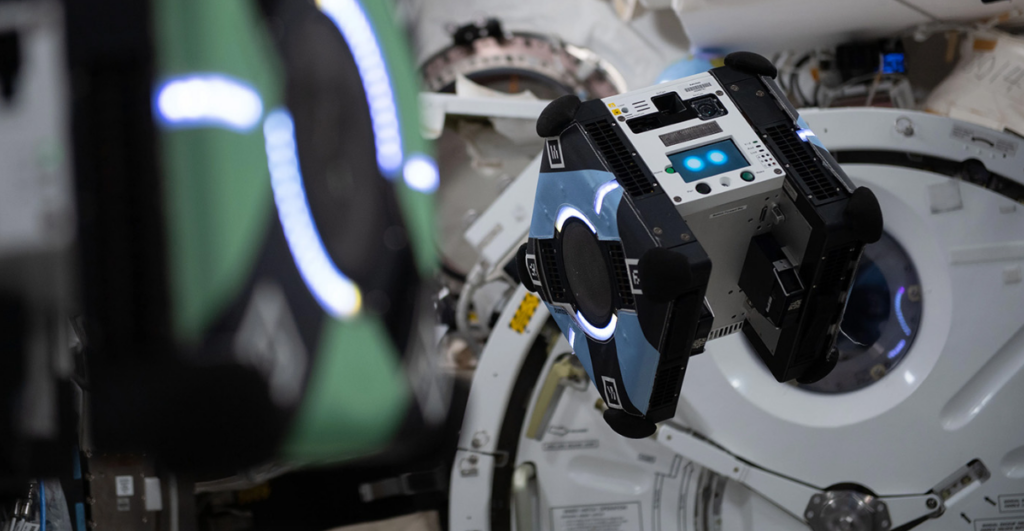
Autonomous Robotics in Space
Researchers at Stanford University have achieved a major milestone in space robotics by enabling a robot aboard the International Space Station (ISS) to navigate significantly faster using artificial intelligence.
The breakthrough, conducted with NASA’s Astrobee, marks the first-ever use of machine-learning-based motion control in orbit, demonstrating that robots can learn from past experience to move more safely and efficiently.
For astronauts who already rely on robots for routine tasks, this development signals a future where machines handle more operations independently, especially in environments too dangerous or complex for humans.
Why Navigation on the ISS Is So Difficult
The interior of the ISS is notoriously cluttered. Walls are lined with experiment racks, laptops, wiring bundles, cameras, and storage units. Imagine trying to guide a drone through a narrow corridor filled with shelves and cables, and now place that drone in microgravity. That’s the challenge Astrobee faces.
Traditional path-planning algorithms used on Earth require heavy computation, but space-qualified flight computers are far less powerful. Robots also face unexpected disturbances, such as airflow from vents or crew movement, making safe navigation even more complex.
How AI Made Navigation Faster
To solve this, the research team trained a machine-learning model on thousands of previously solved navigation paths inside the ISS. This allowed the system to generate a “warm start,” an educated guess of the robot’s path before running a full optimization algorithm.
This hybrid approach keeps all NASA safety constraints intact while dramatically speeding up planning. In the hardest navigation cases, such as tight passages or sequences requiring complex rotations, the AI-driven method delivered 50–60% faster performance.
- Without AI, Astrobee might slowly compute how to slip past two experiments mounted opposite each other in a narrow module. With AI, it starts with a rough idea based on similar past paths and finishes the calculation in nearly half the time.
Testing on Earth and in Orbit
Before flying to the ISS, the system was tested on a microgravity-simulating air table at NASA Ames. Once in space, astronauts, including Sunita Williams, assisted only with setup. The actual operations were run remotely from Earth, with commands flowing from Stanford to NASA Johnson Space Center and finally to the ISS. Each of the 18 test trajectories was executed twice: once with a traditional cold start and once with the AI warm start. The speed improvement was consistent and most notable in cluttered areas of the station.
NASA Approval and Future Applications
The technology has now reached Technology Readiness Level 5, meaning it has been validated in a real operational environment. This significantly reduces risk for future mission proposals that rely on autonomous robots.
Looking ahead, the team plans to integrate more advanced AI models, similar to those used in self-driving cars and large language models, to enable robots that can reason, plan, and explore with far greater independence.
For future Moon and Mars missions, where communication delays make remote control impractical, such autonomy will be essential. Robots may soon map caves, scout landing zones, or assist astronauts in habitats millions of miles from Earth, all using AI foundations proven today aboard the ISS.
Read More:
- Leaked Video Exposes Tesla’s Robot Secret: Was Optimus Being Remote-Controlled?
- TikTok’s Parent ByteDance is Now Making Phones and Challenging Industry Giants in AI
- ByteDance’s Agentic AI Phone Sparks Panic and Nationwide App Bans
(via)

Comments