
Add GIZMOCHINA as Preferred Source on Google
Key Highlights:
- ByteDance’s new agentic AI smartphone faces major pushback from major Chinese apps over security and fairness concerns.
- The company has restricted its AI agent, Doubao, after reports of blocked logins, account freezes, and privacy worries.
- The launch reveals both the promise and risks of fully autonomous AI systems that can control a device like a human.
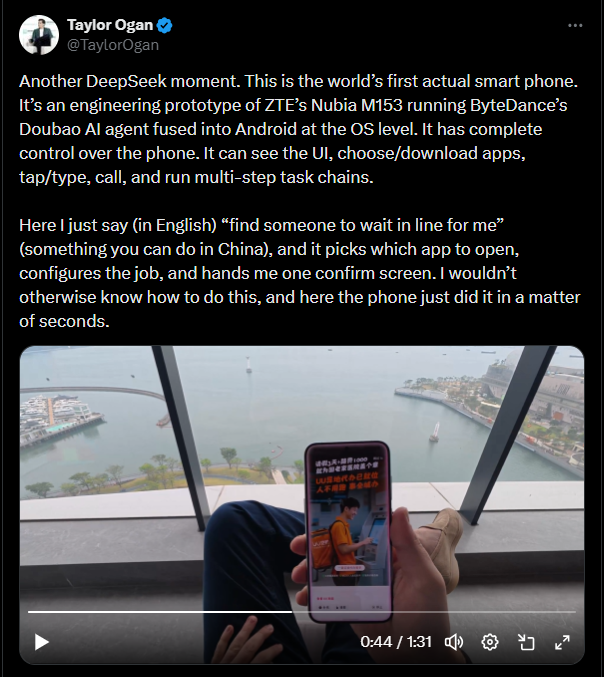
ByteDance’s Agentic AI Smartphone Faces Major Pushback Across China
ByteDance’s ambitious new AI smartphone, the Nubia M153, is drawing significant resistance from major Chinese platforms, prompting the company to roll back several of its most advanced features. Powered by Doubao, an agentic AI capable of operating the phone like a human, this device was meant to showcase the future of autonomous mobile computing. Instead, it has triggered a wave of concerns over security, fairness, and user privacy.
Major Chinese Apps Push Back
Leading platforms, including Alipay, Pinduoduo, and Taobao, have restricted or blocked Doubao’s automated operations. These companies cite issues such as unfair engagement, potential misuse, and risks to financial security. Some users reported that their accounts were frozen shortly after the AI performed tasks inside sensitive apps, even when they logged in manually.
Only a handful of major apps, including Meituan and ByteDance’s own Douyin, continue to work normally with the AI assistant.
ByteDance Restricts Doubao’s Powers
In response, ByteDance has scaled back Doubao’s capabilities. The AI can no longer interact with financial apps, claim user incentives, or operate competitive games where automated play could offer unfair advantages. The most significant restriction concerns WeChat: users experienced app crashes and suspensions, leading ByteDance to temporarily disable Doubao’s ability to control it.
The company says it is now working with developers to set clearer rules to avoid blanket bans.
Privacy Concerns Add to User Hesitation
ByteDance insists that the phone does not store screen data on its servers and that users’ activity is not used to train AI models. Still, many early adopters remain cautious. Doubao’s “global memory,” which allows it to remember tasks across apps, has heightened worries about device-level surveillance and unintended data exposure.
Real-World Challenges
The Nubia M153 made headlines after viral demos showed Doubao navigating apps visually, scrolling, typing, posting content, and completing multi-step tasks without step-by-step commands. The system’s full-stack control surpassed traditional assistants like Siri or Google Assistant, which rely on limited API calls.
But the same power that excited AI enthusiasts also alarmed regulators, app developers, and ordinary users.
Future Plans and Industry Impact
ByteDance stresses that the Nubia M153 is a “technology preview” priced at 3,499 yuan, mainly for industry professionals. The company plans to license Doubao to more smartphone brands after refining safety controls. The episode highlights a larger industry shift as tech companies worldwide, like Apple, Google, and OpenAI, race to build action-capable AI assistants.
For now, ByteDance’s phone demonstrates both the potential and the pitfalls of giving AI near-human control over a device. As the debate continues, the industry faces a defining question: how much autonomy should AI really have?
Read More:
- Leaked Video Exposes Tesla’s Robot Secret: Was Optimus Being Remote-Controlled?
- Say Goodbye to Driving: Rivian CEO Says Cars Will Soon Run Errands Without You
- Xiaomi’s AI Gamble Pays Off Big: Nobody Expected Returns This Fast
(via)


Comments