
Add GIZMOCHINA on Google:
Key Highlights:
- Xiaomi says its AI investments delivered returns in 2025 that “far exceeded expectations,” with major progress in embodied AI and EV technology.
- The company’s smart EV, AI, and new initiatives segment posted its first-ever quarterly profit in Q3 2025.
- Despite strong results, rising memory chip prices and weakening consumer sentiment pose challenges for 2026.
AI and Business Performance
Xiaomi reported that returns from its AI investments in 2025 “far exceeded expectations,” driven by rapid progress in both large AI models and real-world applications. The company’s smart EV, AI, and new business initiatives, grouped under its innovation segment, turned profitable for the first time in the third quarter. These new initiatives generated 29 billion yuan (US$4.1 billion) in revenue, a 199% year-on-year jump.
Overall, Xiaomi’s total Q3 revenue rose 22% YoY to 113.1 billion yuan, while adjusted net profit hit 11.3 billion yuan, up 81% from a year earlier.

Shift Toward Embodied AI
After years of investment in general AI, Xiaomi is now placing a stronger emphasis on embodied AI, technology that connects AI models with physical systems such as vehicles and robots. The company launched its first AI model, MiMo, in April and recently open-sourced MiMo-Embodied, which it claims delivers state-of-the-art performance in autonomous driving and robotics tasks.
This strategy mirrors approaches taken by Tesla, integrating AI deeply across EVs and humanoid robots. Xiaomi says embodied AI will be central to its next stage of innovation.
AI in EVs and Robotics
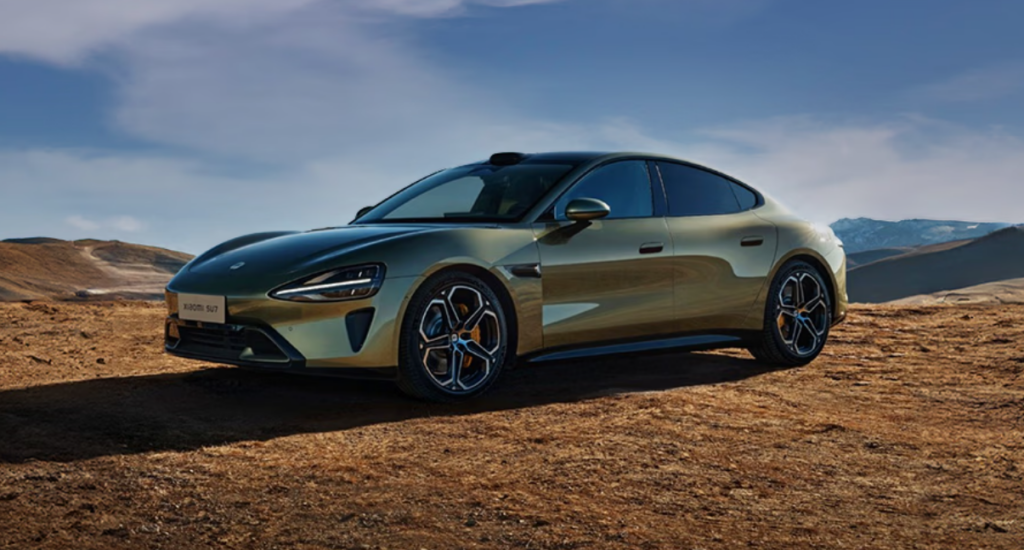
China’s EV sector is rapidly adopting AI, and Xiaomi aims to expand its presence in this space. It’s premium SU7 Ultra sedan, launched in February, uses the company’s Hyper-Autonomous Driving system. Xiaomi has also invested heavily in robotics, releasing a robot dog in 2021 and unveiling a humanoid robot prototype in 2022.
These efforts form part of Xiaomi’s long-term plan to merge AI with real-world hardware platforms.
Growing AI Talent and Leadership Vision
Xiaomi is accelerating AI recruitment and recently hired Luo Fuli, a former DeepSeek researcher who contributed to the company’s V2 model. Luo will lead the MiMo team and speak at the upcoming Xiaomi Developer Conference on December 17.
President Lu Weibing said the company’s AI performance exceeded internal forecasts and reaffirmed Xiaomi’s belief that embodied AI will define the next generation of intelligent technology.
Market Risks and Industry Outlook
Despite strong financial results, Xiaomi’s stock price has fallen more than 20% in the past six months. The company warned that rising memory chip prices, driven by demand for AI hardware, will create significant supply chain pressure in 2026, especially for smartphones.
Xiaomi also faces broader challenges, including aggressive price competition in China’s EV and smartphone markets and weak domestic consumer sentiment linked to economic uncertainty and the ongoing property-sector crisis. The company plans to balance innovation with cost management as it navigates a rapidly shifting technology landscape.
Read More:
- Leaked Video Exposes Tesla’s Robot Secret: Was Optimus Being Remote-Controlled?
- Say Goodbye to Driving: Rivian CEO Says Cars Will Soon Run Errands Without You
- AGIBOT Hits 5000-Unit Milestone, Fueling China’s Humanoid Robotics
(via)

Comments