Advertisement

Realme GT Explorer Master Edition has Snapdragon 870, officially confirmed

Realme is all set to announce the Realme GT Master Edition series on July 21 in China. Recent reports have revealed that the lineup will have two phones such as GT Master Edition and GT Explorer Master Edition. Today, the company confirmed that the latter will come equipped with the Snapdragon 870 chip.

China’s TENAA certification database has two new Realme phones such as Realme RMX3366 and RMX3361. A recent leak by OnLeaks revealed that the RMX3366 will be the GT Explorer Master Edition model, while the latter will be the GT Master Edition phone.

Realme GT Master Edition with Snapdragon 870Realme GT Master Edition with Snapdragon 870The RMX3366’s TENAA listing that was spotted last month revealed that it is equipped with a 3.2GHz octa-core processor. Later, multiple leaks claimed that the device could be equipped with the Snapdragon 870. Today, the company finally confirmed that the phone will indeed feature the SD870 chip. The image shared by the company shows the phone sporting a dual-curved edge display with a punch-hole design.

While it is not confirmed yet, the RMX3361 is likely to arrive as Realme’s first phone powered by the Snapdragon 778G chipset. The RMX3366 and RMX3366 are packed with different specs and there is some difference in the design of both devices as in can be seen below.

Realme RMX3366 vs RMX3361
Realme RMX3366 (left) and RMX3361 (right)

The Realme RMX3361 has a 6.43-inch AMOLED FHD+ display, an in-screen fingerprint sensor, a 32-megapixel front camera, a 64-megapixel triple camera unit, SD778G chip, and a 4,300mAh battery with 65W fast charging. The Explorer model (RMX3366) has a 6.55-inch AMOLED FHD+ screen, an in-display fingerprint sensor, a 32-megapixel selfie camera, a 50-megapixel triple camera unit, and a 4,500mAh battery with 65W charging support.

RELATED:

Xiaomi overtakes Apple to become the world’s second largest smartphone company

Xiaomi has become the world’s second-largest smartphone company in the second quarter of this year, overtaking the tech giant Apple. The report from Canalys Research says that the Chinese company saw a massive 83 percent jump in shipments.

This is the first time Xiaomi is breaking into the top two positions globally when it comes to smartphone shipments. For those who are unaware, the top two positions have historically been dominated by Samsung and Apple.

Xiaomi Logo

Huawei had briefly grabbed the second position, overthrowing Apple but soon after that, it started facing sanctions by the United States. The company eventually withdrew from the high-end premium phones market and Xiaomi rushed to fill the gap by launching smartphone switch top-of-the-line specifications and aggressive pricing.

According to Canalys Research, Samsung remained the leading smartphone brand globally with a 19 percent share in the second quarter of this year while Xiaomi managed to increase its market share to 17 percent in Q2 2021. Apple comes in third with 14 percent of the market share in terms of smartphone shipments. OPPO and Vivo are positioned fourth and fifth with a 10 percent market share each.

Canalys Research Q2 2021 Global Smartphone Shipments

Ben Stanton, Canalys Research Manager says that the average selling price for Xiaomi is around 40% and 75% cheaper when compared to Samsung and Apple respectively. So, the company managed to grow sales for its high-end devices, such as Mi 11 Ultra.

However, it remains to be seen if Xiaomi manages to keep its position from rivals like OPPO and Vivo which also have the same objective — offering high-end smartphones at an affordable price point. Another advantage that Vivo and OPPO have against Xiaomi is that they are spending a lot of capital on marketing efforts.

Canalys report adds that the Mi 11 series maker has managed to increase shipments by more than 300% in Latin America, 150% across Africa, and 50% in Western Europe.

RELATED: 

MediaTek announces Helio G96 and Helio G88 chips focusing on mobile photography

Last year, MediaTek had announced Helio G95 SoC featuring the company’s HyperEngine game technology for optimizing CPU, GPU, and RAM along with connectivity. Now, the company has launched its successor — MediaTek Helio G96.

Along with the Helio G96, the company has announced another G-series chipset, dubbed MediaTek Helio G88. Both the chips are designed with a focus on mobile photography.

MediaTek Helio G96 and MediaTek Helio G88

The MediaTek Helio G96 offers support for 120Hz displays with up to Full-HD+ screen resolution. It supports both LCD and AMOLED panels without limitation in DDIC supply, C-phy or D-phy interface. To take care of the gaming needs, the company has also added HyperEngine 2.0 Lite technology.

The chipset features two Arm Cortex-A76 CPUs operating at up to 2.05GHz. There’s also LPDDR4X memory and UFS 2.2 storage. It supports 108-megapixel cameras, fast Cat-13 4G LTE WorldMode modem integration, dual 4G SIM and VoLTE and ViLTE services, as well as the company’s Intelligent Resource Management Engine and Networking Engine.

On the other hand, the MediaTek Helio G88 supports Full HD+ screen resolution (1080p+) at a 90Hz refresh rate. It comes packed with an octa-core CPU that features two Arm Cortex-A75 CPUs operating at up to 2.0GHz and Mali-G52 MC2 GPU.

It has support for up to 64-megapixel main cameras, a hardware depth engine for dual-camera bokeh captures, a Camera Control Unit (CCU), Electronic Image Stabilization (EIS), and Rolling Shutter Compensation (RSC) technologies.

MediaTek hasn’t revealed anything about the pricing and availability for either of the chipsets and the upcoming devices powered by them. It seems like we will have to wait a bit longer to get information about the phones powered by these two chips.

RELATED: 

Honor Magic 3 specifications and render leaked

Honor will be launching the Honor Magic 3 series of smartphones on Aug. 12. A fresh leak by Digital Chat Station has revealed the key specs of the Magic3. In addition, a leaked render that is a glimpse of the Magic3’s rear design has also appeared.

The tipster revealed that the upcoming Magic 3 series of smartphones could be codenamed as Elizabeth. It appears that the ELZ-AN00, ELZ-AN10, and ELZ-AN20 phones that have emerged in the database of the TENAA certification platform belong to the Magic 3 family. Shown below is a rear render of the alleged Magic 3, which shows that a quad-camera setup is placed at the center of the top half of the phone’s back.

Honor Magic 3 render

The tipster claimed that the engineering prototype of the Magic3 features a 6.76-inch OLED waterfall screen that has extremely curved edges. The screen will feature a pill-shaped cutout, which indicates that it will come equipped with dual front-facing cameras. The screen is expected to offer a resolution of 2772 x 1344 pixels.

It could one of the first smartphones to feature the Snapdragon 888 Plus chipset, which is overclocked version of the Snapdragon 888 SoC. The standard model in the Magic 3 lineup may come with a 66W charger, whereas the higher model could be equipped with a 100W charger and 50W wireless charger.

Shown above is a designer and tipster Benjamin Geskin’s render of the Magic 3. It shows that the camera setup has a 48-megapixel camera with a 1/1.5-inch sensor and it carries support or 100x zoom.

RELATED:

OnePlus Buds Pro confirmed to come with adaptive noise cancellation

A few days ago, the OnePlus itself confirmed that the company will be launching its latest true wireless earphones — OnePlus Buds Pro on 22nd July along with OnePlus Nord 2 5G. It seems that the brand is looking to compete against the likes of Apple AirPods Pro with its upcoming earphones.

Now, the China-based company has revealed a new feature of the TWS earphones, confirming that it will come with “adaptive noise cancellation” technology support. The OnePlus Buds come with “environmental noise cancellation” but don’t offer active noise cancellation to compete against high-end offerings from other brands.

OnePlus Buds Pro

The company has confirmed that the Buds Pro will come with three microphones of their own to “monitor exterior noises” and “intelligently produce noise-canceling counter frequencies.” However, we will know about the actual performance of the earphones once they get officially launched.

Another major part OnePlus aims to address with the Buds Pro is the battery life. It has been announced that the battery has been upgraded and should offer an impressive battery life of no less than 38 hours (with ANC turned off). Further, a 10-minute wired recharge of the Buds Pro’s case will provide 10 hours of battery life.

In terms of design, It will reportedly come in matte black color with a glossy metallic covering on the steems to offer a better operating experience and resist sweat and dust. They are likely to be quite similar to the Apple AirPods Pro. Even the original Buds from the company look the same as Apple AirPods and the shipment of the same was seized by US Customs for being counterfeit AirPods.

When launched, the OnePlus Buds Pro will compete against the likes of Apple AirPods Pro and Galaxy Buds 2, among others. We expect the pricing to be under $150 but to know for sure, we will have to wait for the official launch.

OnePlus co-founder Carl Pei, who left the company earlier this year and founded a new brand named Noting is also set to launch its first-ever product, true wireless earphones called Nothing Ear (1) later this month, which will be priced at $99.

RELATED: 

Fresh Realme GT Master Edition Leaks trailer released, Two Versions spotted

After numerous leaks, we finally learned the launch date of the Realme GT Master Edition to be July 21st. Yesterday, the phone was seen in promo images along with a short teaser video. Today, the phone has appeared in a new trailer video that showcases the partnership between Realme and Naoto Fukasawa (Japan’s famous designer). It also reveals a new piece of information about the phone.

While the trailer video showcases the phone from all angles, the fresh teasers of the phone shared by Realme’s CMO look enticing. Surprisingly, both phones are said to be the upcoming Realme GT Master edition, but their rear camera islands have different designs.


According to the trailer video, the Realme GT Master Edition has a triple camera system along with a single LED flash. While the images shared by Realme’s CMO reveal that the phone has a pill-shaped LED flash and two separate LED units beneath the camera lenses.

While there’s no explanation on the same, it clearly hints at two versions of the smartphone. It is also worth noting that an unknown Realme phone with model number RMX3366 appeared in the leaks, and it could be the other version of the Realme GT Master Edition. It could be the Pro version that was tipped a few days back.

As of now, there’s nothing much to discuss other than the sturdy look of the phone. The smartphone has a taller form factor with a single-punch hole display at the front. It has horizontal bars at the back, which refers to a suitcase. It further suggests that the GT Master edition could be a good travel smartphone.

Realme GT Master Edition Specifications  

Other than this, the phone’s specs were previously leaked. It is expected to come with an AMOLED display featuring a 120Hz refresh rate and 360Hz touch sampling rate. It is said to boast a 32MP Sony IMX615 selfie camera and 64MP triple rear cameras.

Fresh Realme GT Master Edition Leaks reveal two versions

The smartphone will come powered by the Qualcomm Snapdragon 778G mid-range processor, paired with up to 8GB of RAM and 256GB of onboard storage. It is expected to house a 4,300mAh battery with support for 65W fast charging technology. The phone was recently seen in certifications running on Android 11 out of the box.

RELATED:

Samsung Galaxy Watch4’s new Exynos W920 chip and larger storage tipped

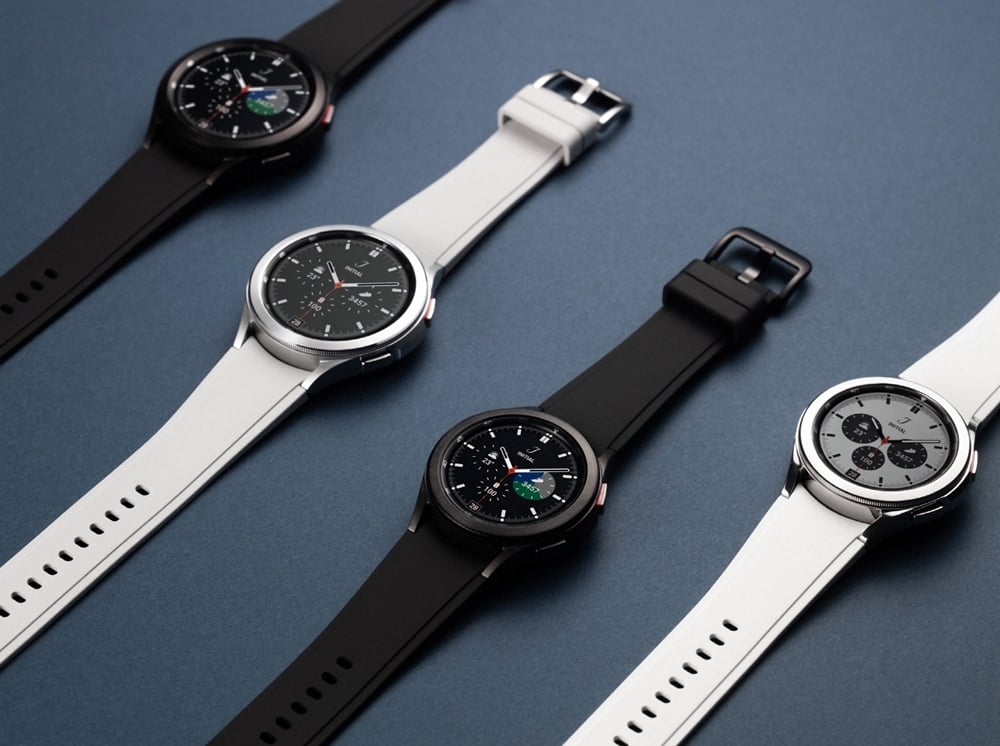
The Galaxy Watch4 and Galaxy Watch4 Classic are the next smartwatches from Samsung. All the predecessor models dating back to 2018 were fueled by the Exynos 9110 chip. According to Sammobile, the upcoming Galaxy Watch4 series will feature a new and more powerful chip. The publication also claimed that the Watch4 models will come with massive internal storage.

Predecessor models such as Galaxy Watch, Galaxy Watch Active, Galaxy Watch Active 2, and Galaxy Watch3 were powered by the Exynos 9110 chip. The 5nm Exynos W920 chip that will be available on the Galaxy Watch4 and Watch4 Classic will offer 1.25 times faster processing and 8.8 times smoother graphics performance than the Exynos 9110. In addition, the Watch4 duo will be equipped with 1.5 GB of RAM. To recollect, the Galaxy Watch3 came with 1 GB of RAM.

Another report reveals that the Galaxy Watch4 will be arriving with 16GB of internal storage. It is two times more than the built-in storage of the Watch3.

Samsung Galaxy Watch4 Classic renders
Samsung Galaxy Watch4 Classic renders by AndroidHaedlines

It is believed that Samsung is offering a more powerful processor and larger storage on the Galaxy Watch4 series because of the new One UI Watch, which the company has developed with Google as a customized version of the Wear OS.

One of the features of the One UI Watch is that it will let the Watch4 automatically download a smartwatch version of the app that is installed by the user on his/her phone. Hence, the 8 GB space that was made available on predecessor models will not be enough on the Watch4 lineup. The Exynos W920 chip will provide all the power that is needed to run such apps that users will get from the Play Store.

The Watch4 and Watch4 Classic are expected to debut along with Galaxy Z Fold3 and Galaxy Z Flip3, and Galaxy Buds2 on Aug. 11. The Galaxy Watch4 may start at 269 euros and the Watch4 Classic may start at 369 euros.

RELATED:

Valve’s Steam Deck is a handheld gaming PC priced at $399

The gaming handheld space just got a new member in form of Valve’s Steam Deck, a handheld console with specs that blow all the Nintendo Switch models out of the water.

Steam Deck front

With a starting price of $399, users get a device with a 7-inch 1280 x 720p touchscreen. The display is flanked on each side by two thumbsticks and two touchpads. There is also a D-pad next to the left joystick while ABXY action buttons are on the right. The device has two front-facing speakers, a Steam button, and a Quick Access button. Alongside two shoulder buttons on each side, you also get two back buttons on the back.

The Steam Deck has its volume buttons on top just like the Nintendo Switch Lite. There is also an audio jack a few millimeters from the buttons and not too far on the same side is the vent for the fan, a USB-C port, a status LED, and the power button.

Steam Deck buttons and ports

The console is powered by an AMD APU with a quad-core Zen 2 CPU with 8 threads and an 8 RDNA 2 CUs GPU. It has 16GB of LPDDR5 RAM and comes in three storage versions – 64GB eMMC (PCIe Gen 2 x1), 256GB NVMe SSD (PCIe Gen 3 x4), and 512GB NVMe SSD (PCIe Gen 3 x4). All variants have a MicroSD expansion slot.

The Steam Deck has support for Bluetooth 5.0, and unlike the Nintendo Switch, you can pair controllers, input devices, and audio accessories. It also has dual-band Wi-Fi and the USB-C port supports display output at 8K at 60Hz and 4K at 120Hz. There is an official dock that allows it to be connected to an external display. The dock has 2x USB-A 2.0 ports, 1x USB-A 3.1 port, a DisplayPort 1.4, an HDMI 2.0 port, a USB-C Power Delivery passthrough input port, and an ethernet port. There is also a 6” USB-C captive cable with a 90º connector that connects to the Steam Deck.

Steam Deck UI

Valve says there is a 40Whr battery inside the device and it will provide between 2 to 8 hours of gameplay depending on the games you play. It comes bundled with a  45W Power Delivery 3.0 charger.

The Steam Deck runs SteamOS 3.0 but because it is a PC, you can install third-party software and operating systems. Once you are logged in, your Steam Library appears. The Quick Access button brings up a dedicated space for your notifications, friends, important settings, and peripherals. Apart from being able to access the games from your library on your device, you will also be able to stream from your PC to the Steam Deck via Valve’s Remote Play feature.

Steam Deck rear

Reservation for the Steam Deck is already available for customers in Canada, European Union, U.S., and the U.K. and it will begin shipping in December. Valve says that once inventory is available, buyers will be notified in the order that they made their reservation. You will not be able to reserve more than one unit and you can’t change the model once you are able to purchase. There is a $5 reservation fee but it counts towards the final price you pay.

The Steam Deck is priced at $399 for the 64GB version, $529 for the 256GB version, and $649 for the 512GB version.


RELATED:

OPPO Reno6 Pro vs Vivo X60 Pro: Specs Comparison

The OPPO Reno6 Pro 5G finally hitten the global market with its high-end specifications offered at a pretty affordable price. But this year there is another Chinese device that can compete with the Reno series in the global market: the Vivo X60 Pro. It is the first flagship by Vivo to hit the European market and it will be joined by the OPPO Reno6 Pro 5G in Europe soon. Which of these devices should you buy and which offers the best features for the money asked? This comparison between their specifications will hopefully clear your ideas in regards.

OPPO Reno6 Pro vs Vivo X60 Pro

OPPO Reno6 Pro 5G Vivo X60 Pro
DIMENSIONS AND WEIGHT 160 x 73.1 x 7.6 mm, 177 g 158.6 x 73.2 x 7.6 mm, 179 g
DISPLAY  6.55 inches, 1080 x 2400p (Full HD+), AMOLED  6.56 inches, 1080 x 2376p (Full HD+), AMOLED
PROCESSOR Mediatek Dimensity 1200, octa-core 3 GHz Qualcomm Snapdragon 870, octa-core 3.2 GHz
MEMORY 8 GB RAM, 128 GB – 12 GB RAM, 256 GB 12 GB RAM, 256 GB
SOFTWARE  Android 11, ColorOS  Android 11, Funtouch OS
CONNECTIVITY  Wi-Fi 802.11 a/b/g/n/ac/ax, Bluetooth 5.2, GPS  Wi-Fi 802.11 a/b/g/n/ac, Bluetooth 5.1, GPS
CAMERA Quad 64 + 8 + 2 + 2 MP, f/1.7 + f/2.2 + f/2.4 + f/2.4
32 MP f/2.4 front camera
Triple 48 + 13 + 13 MP, f/1.5 + f/2.5 + f/2.2
32 MP f/2.5 front camera
BATTERY  4500 mAh, fast charging 65W  4200 mAh, fast charging 33W
ADDITIONAL FEATURES Dual SIM slot, 5G Dual SIM slot, 5G

Design

The Reno Glow finish which distinguishes the OPPO Reno6 Pro 5G from the other phones is simply amazing. The handset has an opaque rear side but it still shines thanks to a special finish which required a very long process for its production. On the other hand, the Vivo X60 Pro is more compact despite it has the same display size. Both the phones are built with premium materials including a glass back and both feature an elegantly curved screen at the sides, but the Vivo X60 Pro seems to have a more premium body with its aluminum frame and the Gorilla Glass 6 protection by Corning. Both are awesome phones in terms of aesthetics and both are very thin and lightweight, so whatever you choose, you will make a great choice.


Display

The OPPO Reno 6 Pro 5G and the Vivo X60 Pro are very close when it comes to the display. They both feature AMOLED panels with the HDR10+ certification, an in-display fingerprint reader, a Full HD+ resolution, a high brightness, and a high-end image quality. Even the size is almost the same: 6.55 inches and 6.56 inches, respectively. An important difference is the refresh rate: OPPO Reno6 Pro 5G has 90 Hz, while Vivo X60 Pro comes with a higher 120 Hz refresh rate.


Specs & Software

The Vivo X60 Pro wins the hardware comparison because it is powered by a stronger chipset: the Snapdragon 870 by Qualcomm. Despite the Dimensity 1200 by MediaTek is built with a better production process (6 nm), the Snapdragon 870 is actually more powerful and it is the chipset with the highest clock frequency in the Android world. The SoC is paired with 12 GB of RAM and 256 GB of UFS 3.1 internal storage and this is the only memory configuration of the Vivo X60 Pro. Note that, in China, the Vivo X60 Pro comes with a different processor: the Exynos 1080 by Samsung.


Camera

Besides having a superior chipset, the Vivo X60 Pro also comes with a better camera. The phone packs a triple camera including a 48 MP main sensor with gimbal stabilization, a 13 MP telephoto lens with 2x optical zoom, a 13 MP ultrawide sensor, and Carl Zeiss optics. Unfortunately, OPPO Reno6 Pro 5G lacks a telephoto sensor and it has inferior stabilization. The two handsets are both equipped with a 32 MP selfie camera, so you should not notice big differences when it comes to selfies quality.


Battery

An important advantage of the OPPO Reno6 Pro 5G is the presence of a bigger battery: 4500 mAh vs 4200 mAh. Alongside the 6 nm production process of its chipset, the bigger capacity allows the handset to provide a longer battery life. Further, the OPPO Reno6 Pro 5G has a faster charging technology with a power of 65W and it ships together with a compact 65W charger.


Price

The OPPO Reno6 Pro 5G is priced at Rs. 39,990 in India in the base configuration with 8 GB of RAM and 128 GB of storage, while Vivo X60 Pro costs Rs. 49,990 (€799 in the European market) in the configuration with 12 GB of RAM and 256 GB of storage. The Vivo X60 Pro is a superior phone because it packs better cameras and the amazing Snapdragon 870 chipset, but with the OPPO Reno6 Pro 5G, you can save money while getting a bigger battery and faster charging. If you do not need that awesome camera you can find on the Vivo X60 Pro, then OPPO Reno6 Pro 5G is a more intelligent choice for your needs and you should opt for it.


OPPO Reno6 Pro vs Vivo X60 Pro: PRO and CONS

OPPO Reno6 Pro 5G

PRO

  • Good price
  • Bigger battery
  • ColorOS 11.3
  • Faster charging

CONS

  • Inferior cameras


Vivo X60 Pro 5G

PRO

  • Better chipset
  • Superior cameras
  • More compact
  • Wider availability (for now)

CONS

  • Smaller battery

RELATED

Check the latest videos from our YouTube channel and subscribe:

Xiaomi is the biggest beneficiary of Huawei’s exit from the mid-range phone segment in Europe

Huawei endured a turbulent 2020 in Europe and the United States especially. The stringent sanction regime initiated by the US-led to similar restrictions across Europe, especially in the 5G segment, where the company had already established a seemingly unassailable lead. These moves significantly affected the company’s outlook, but recent research by Counterpoint Research has also shown that consumers in Europe may have also been hurt by the exit of the company, as mid-range 5G smartphones average prices from Europe reflected.

The European market did not have any mid-range 5G smartphones as of Q1 2020. Still, the scenario gradually changed so that, by the third quarter of 2020, 5G mid-rangers accounted for about 20% of the segment, and this has risen steeply to 50% of all smartphones sold in Europe at the end of the first quarter of 2021.

The price range considered by the researchers at Counterpoint Research was the $250-$500 range. Huawei enjoyed a great degree of prominence in the mid-range segment of Europe before the decline last year, with its market share virtually extinguished by Q1 2021. Of all the listed vendors, Xiaomi saw the biggest YoY growth in the mid-tier segment, obviously due to its robust offering and aggressive marketing.

Huawei’s loss also translated to growth for other Chinese brands like Oppo, who moved swiftly to bridge the gap resulting from Huawei’s exit. These brands have recorded massive improvements in their European operations. Xiaomi, Oppo, Vivo and other brands on the fringes of the 5G market in Europe are all pursuing robust strategies to break into the mid-range and premium segment of the 5G market in Europe with some flagship offerings.

However, Apple and Samsung remain the clear leaders across the 5G segments in Europe, although the Chinese contingent continues to pursue a share of the spoils in the highly lucrative market.

RELATED:


(source)


Samsung Galaxy Chromebook Go is now available for $299

Last month, the Galaxy Chromebook Go appeared on Samsung’s website as a new affordable Chromebook from the manufacturer. However, save for a few specs and images, there were still a lot of unknown details about the 14-inch device. Now, the notebook is official and available for purchase.

Galaxy Chromebook Go

The Galaxy Chromebook Go has a 14” LED screen with a 1366 x 768 resolution. The display brightness is on the low side at 220 nits and it doesn’t have a touchscreen, so don’t expect to use a USI stylus on this. However, it does have a 180° hinge allowing you to lay it flat.

Powering the Chromebook is an Intel Celeron N4500 and it is paired with 4GB of RAM and 32GB of eMMC storage. While 32GB is really small, there is a MicroSD card slot for additional storage.

For ports, the Galaxy Chromebook Go has two USB Type-C ports, a USB 3.0 port, and a headphone-out/microphone-in combo port. Samsung says the Chromebook has a military-grade design while being its lightest Chromebook yet at 3.2lbs (1.45kg). It can survive the occasional drops and the island-type keyboard is spillproof. There are two 1.5W speakers and you also get the much faster Wi-Fi 6.

While not as long as the 18 hours of battery life the Galaxy Book Go boasts, the Galaxy Chromebook Go still offers an impressive 12 hours of battery life on a single charge. It also charges faster at 45W and you get a charger in the box.

The Galaxy Chromebook Go is priced at $299 and is already available for purchase on Samsung’s website. If you have a device that can be traded in, you can pick it up for as low as $129.99. Samsung has revealed that an LTE version will be available soon.


RELATED:

TikTok emerges as the first non-Facebook app to hit 3 billion downloads

According to Sensor Tower data, TikTok has become the first non-Facebook application to reach 3 billion downloads on the global iOS and Android platforms. Sensor Tower Store Intelligence data shows that the app, including its Chinese iOS version called Douyin, was the world’s most downloaded and highest-paid non-gaming app in the first half of 2021, with 383 million first installs and consumer spending approximately $919.2 million U.S. dollars.

The data shows that the adoption rate of TikTok was on the increase in 2021. First downloads increased by 2% from the fourth quarter of 2020 to the first quarter of 2021, reaching 177.5 million, and increased by 16% from the first quarter to the second quarter of 2021. Reached 205.4 million. This is the largest increase the app has experienced since its start-up record quarter in 2020 when it had more than 315 million installations.

However, TikTok’s new downloads decreased by 38% year-on-year from nearly 619 million in the first half of 2020, but this was partly due to the removal of the app from the Indian app store. Even so, consumer spending on TikTok increased by 73% from the US$530.2 million in the same period last year.

The app has been installed more than 3 billion times, making it the fifth non-gaming app to achieve this goal. The other four apps with 3 billion installs are WhatsApp, Messenger, Facebook, and Instagram, all of which are owned by Facebook.

In the second quarter of 2021, TikTok’s consumer spending achieved the largest quarter-on-quarter growth since the second quarter of 2020, increasing from $384.7 million in the first quarter of 2021 to $534.6 million in the second quarter of 2021. 39%.

Globally, TikTok’s consumer spending has now exceeded $2.5 billion. Since 2014, only 16 non-gaming applications have accumulated more than US$1 billion in total revenue, and only Tinder, Netflix, YouTube, and Tencent Video have reached more than US$2.5 billion.

RELATED:


(source)

This is the Realme GT Explorer Master Edition

A few days ago, we reported that a source revealed that there will be two versions of the Realme GT Explorer Master Edition. We now know that alongside the Realme GT Master Edition, there will also be a Realme GT Explorer Master Edition, and here is our first look.

The Realme GT Explorer Master Edition (RMX3366) looks a lot like the Realme GT Master Edition (RMX3361), but unlike the latter which comes in only one color variant, the Explorer edition comes in two colorways as shown in the image below shared on Twitter by Steve Hemmerstoffer a.k.a. OnLeaks.

Realme GT Explorer Master Edition

The image shows the Realme GT Explorer Master Edition has a punch hole at the top left corner of the screen. The display has flat edges and curved corners. There are three cameras on the back that includes a 64MP main camera.

A TENAA listing of the Realme RMX3366 has revealed that the explorer edition will have a 6.55-inch FHD+ AMOLED display, a Snapdragon 870 processor, up to 12GB of RAM, and 512GB of storage. It will also run Android 11 out of the box and have support for 65W fast charging.

The Realme GT Master Edition will have a smaller 6.43-inch FHD AMOLED display, up to 12GB of RAM, and 256GB of storage. It has a 32MP front-facing camera and 64MP + 8MP + 2MP triple rear cameras. Rather than a Snapdragon 870 processor, it will have a Snapdragon 778G chipset. It too will have support for 65W fast charging.

The Realme GT Explorer Master Edition and Realme GT Master Edition will be announced on July 21.


RELATED:

Xiaomi’s 2020 Sustainability Report reflects the brand’s resolve to build a sustainable world

In 2020, Chinese tech powerhouse Xiaomi signed up for the United Nations Global Compact, thereby fully committing itself to the ten principles of corporate responsibility that will enhance sustainability practices across its business firmament. The company has continued to explore best practices that will engender sustainability since it was formed in 2010.

Xiaomi’s profile as a sustainability-oriented company has gotten a boost with the 2020 Sustainability Report. The Report provides a performance overview of the company across several sustainability metrics and components. These include environmental protection, corporate social responsibility (CSR), and supply chain management. The Report reflected Xiaomi’s strong commitment to data security, user privacy, and overall accessibility in China and other countries.

Innovation has been the driving force behind Xiaomi’s highly successful and expansive business strategy. It continues to churn out very impressive devices that appeal to the desires of its demographically diverse customer base globally. A noteworthy innovation is Xiaomi’s instant Earthquake notification mechanism in some of its current smart devices in China, which will subsequently be available globally. Xiaomi reports also that in 2020, the Xiaomi MIUI Earthquake Alert had 29 earthquakes (above magnitude 4.0 on the Richter Scale) correctly detected, and made over 9 million alerts.

Innovation is also reflected in its corporate social responsibility initiatives both within China and overseas. The Report reflected the magnitude of Xiaomi’s CSR global initiatives at the height of the coronavirus pandemic for the greater part of 2020 and how these attune with the company’s sustainability goals. The Report indicated that the overall size of Xiaomi’s COVID-19 CSR spending was about RMB 5.9 million ($854,000).

The 2020 Sustainability Report outlined a 60% reduction in the use of plastic packaging in the Mi 10T and Mi 10T Pro. This reflects steady progress in improving Xiaomi’s environmental rating with the substantial reduction in plastic usage. The company projects a higher decline by the year’s end. Xiaomi also says that the Report reflects its business strategy to produce energy-saving and environmentally-friendly consumer products across several segments, ensuring compliance with the relevant regulatory framework.

Xiaomi sees tremendous opportunities in its sustainability-oriented approach and will continue to pursue its operations along these lines.

RELATED:


(source)


Honor Magic 3 series global launch set for August 12

Honor has a global event scheduled for August 12, and while it didn’t say what it will be unveiling, we are expecting the launch of the Honor Magic3 phone. Today, the manufacturer has confirmed that the Magic3 series will indeed launch on that day.

Honor Magic 3 featured

A tweet by the Honor Global Twitter account has revealed that the Honor Magic3 Series 5G will be announced at the global event on August 12. Seeing as it used the word “series”, we should expect more than one model will be unveiled at the online event.

Earlier leaks have revealed that there will be more than one Magic phone this year including a foldable too. Several Chinese leakers have revealed that there are three models in the Magic3 series. The reliable leaker that goes by @RODENT950 on Twitter also disclosed in a tweet earlier this week that there are three models in the Magic3 series with model numbers ELZ-AN00, ELZ-AN10, ELZ-AN20, so we should expect a standard version as well as pro and pro+ variants. We believe the foldable Honor Magic isn’t among the aforementioned devices.

Honor Magic3 series invite

All three phones will be powered by the Snapdragon 888 Plus according to an official statement by Qualcomm last month.

The teaser image shows the main camera of one of the Honor Magic3 models, and while it is a close-up image, it does appear it will take up significant space on the device which means it is a large sensor.


RELATED:

Super Deal: Get FIMI X8SE 2020 Drone Quadcopter for $380 (Retail Price $480)

Fimi X8SE 2020 Drone Quadcopter which generally retails for $480 is now available at a massively discounted price of $379.99 only at Banggood. This flash deal ends in 4 days.

WHERE TO BUY
Fimi X8SE 2020 Drone Quadcopter at $379.99 @Banggood

Fimi X8SE 2020 Drone Quadcopter

FIMI X8SE 2020 Drone Quadcopter

Fimi X8SE 2020 Drone Quadcopter

Key Features:

  • 4K HDR videos and images
  • 3-Axis mechanical gimbal
  • Foldable and Portable design
  • Smart tracking and Smart Flight modes
  • Range: 8km
  • Flight Time: 35 mins
  • Precise Visual Positioning System
  • Rain Proof design
  • Fully adjustable camera settings
  • F-log Mode and DNG RAW
  • TDM HD real-time transmission
  • HEVC Codec
  • Multiple safety functions for a safe flight and return
  • Ergonomically designed remote controller

Fimi X8SE 2020 Drone Quadcopter

Generally retailing for $480, you can now buy Fimi X8SE 2020 Drone Quadcopter at a discounted price of $379.99 only at Banggood. Please note that this price is applicable to orders made from the CZ warehouse only. This flash deal ends in the next 4 days. So place your order asap.


For more information on such exciting deals and offers check out our deals hub.

* Please Note: When you buy something using the links in our articles, we may earn a small commission at no cost to you.

Vivo S10, Vivo S10 Pro launched in China with 44MP dual selfie cameras, Dimensity 1100, and 44W fast charging

Vivo on Thursday launched the all-new Vivo S10 series in the Chinese market featuring two smartphones – the vanilla Vivo S10 and the Vivo S10 Pro. The smartphones come with impressive specs like the Dimensity 1100 chipset and a whopping 108MP camera.

The Vivo S10 is priced at CNY 2,799(~$433) for the base 8GB RAM and 128GB storage variant and CNY 2,999(~$464) for the 12GB RAM and 256GB storage variant. On the other hand, the Vivo S10 Pro is priced at  CNY 3,399(~$526) for the 12GB RAM and 256GB storage variant.

Vivo S10, Vivo S10 Pro launched in China with 44MP dual selfie camera, Dimensity 1100, and 44W fast charging


The series will go on pre-orders starting from July 15 in China and will go on sale later on July 23. It will be available in four color options – Black, White, Lime, and Gradient.

Vivo S10 and Vivo S10 Pro Specifications

The Vivo S10 and the S10 Pro come in the same design featuring a 6.44-inch notch display. It is a SuperAMOLED panel with a Full-HD+ resolution and 90Hz high refresh rate. The series shares a common selfie camera sporting a 44MP + 8MP dual front camera system. Interestingly, the front camera has a dual-LED selfie flash on the top bezel.

Vivo S10 and Vivo S10 Pro launched in China with 44MP dual Selfie, Dimensity 1100, and 44W fast charging support

The only major thing where they both differ is in the rear camera setup. The S10 has a 64MP + 8MP + 2MP setup, whereas, the Pro boasts a 108MP + 8MP + 2MP selfie triple camera system. Just like the predecessor, the cameras on these phones are the major highlights.

Under the hood, the series is powered by the MediaTek Dimensity 1100 SoC paired with up to 12GB of RAM and 256GB of onboard storage. It has a 3,970mAh battery with support for 44W fast charging technology. The phones feature an under-display fingerprint scanner for extra security. Both phones run on OriginOS based on Android 11 out of the box.

RELATED:

Amazon plans to launch a wearable for kids in partnership with Disney

Amazon makes a handful of hardware products for kids such as a kids version of its Fire Tablet, Echo Dot Kids Edition, and the Echo Show 5 Kids. Now it has plans to launch a wearable in partnership with Disney. It has also been revealed that Amazon was planning to launch an Alexa-powered wearable for kids last year but that didn’t happen.

Amazon Logo Dark

The new wearable will launch as the Magic Band and it is scheduled to arrive this year. Details of the wearable are unknown but there is a possibility that it is related to the Magic wristband that Disney gives guests at its parks and hotels.

The more interesting news is the wearable that was supposed to launch last year. Bloomberg revealed the wearable was codenamed “Seeker” and was targeted at kids between the ages of 4 and 12. The wearable could be worn on the wrist, or used as a keychain or clip.

The device would have support for Alexa, built-in GPS, provide access to kid-tailored content, and allow parents to communicate with and monitor their kids. With a price tag of $99, Amazon would also offer free 1-year access to FreeTime Unlimited a.k.a. Kids+.

Seeker was supposed to launch last year but it was never announced. Unfortunately, it is not known if it has been canceled or postponed. While there isn’t a shortage of smartwatches/trackers for kids from manufacturers such as Xiaomi, Huawei, and TCL, we don’t think Amazon has given up on making a wearable for kids.


RELATED:

Deal: Get Flydigi Trigger 2 Gaming Button for $24 (Retail Price $30)

Flydigi Trigger 2 Gaming Button which generally retails for $30 is now available at a discounted price of $23.90 only at AliExpress. This deal ends in the next 15 hours. 

WHERE TO BUY
Flydigi Trigger 2 Gaming Button at $23.90 @AliExpress

Flydigi Trigger 2 Gaming Button 

Flydigi Trigger 2 Gaming Button 

Key Features:

  • Stinger 2 Mobile Game Buttons
  • CapAir Mapping 2 Technology: Extra sensitive trigger with record click frequency 
  • Removable design of main and auxiliary keys
  • Ergonomic body design: Organic curved surface makes it comfortable to hold for a long time
  • Customize the keys as per your game to enhance your performance
  • Full micro mechanical button
  • Full finger support and steady handgun
  • Universal compatibility: iOS, Android smartphones: Max 10.5mm thick and 87mm wide

Flydigi Trigger 2 Gaming Button 

Generally retailing for $30, you can now buy Flydigi Trigger 2 Gaming Button at a discounted price of $23.90 only at AliExpress. Please note that this deal ends in the next 15 hours. So place your order asap. 


For more information on such exciting deals and offers check out our deals hub.

* Please Note: When you buy something using the links in our articles, we may earn a small commission at no cost to you.

OnePlus TV Y1, U1S series price in India hiked by up to ₹7,000

At the end of last month, a report revealed that Xiaomi would be incrementing the price of its smart TVs in India and the company did as well. It appears OnePlus had also hiked the price of its television models in the country a few days later. Let’s take a look at how much they cost now.

OnePlus TV U1S Series Featured A
OnePlus TV U1S Series

OnePlus has jacked up the price of its TVs by up to a whopping ₹7,000 in India. The 50-inch variant of the newly launched OnePlus TV U1S series has received the maximum price hike.

The brand has only incremented the price of two lineups, namely the OnePlus TV Y1 series and the OnePlus TV U1S series. This is how much they retail for in India right now.

Model

Old Price

Price Hike

New Price

OnePlus TV 32Y1

₹16,499 ₹2,500 ₹18,999

OnePlus TV40Y1

₹23,999 ₹2,500 ₹26,499

OnePlus TV43Y1

₹26,999 ₹2,500

₹29,499

Oneplus TV 50U1S ₹39,999 ₹7,000

₹46,999

OnePlus TV 55U1S ₹47,999 ₹5,000

₹52,999

OnePlus TV 65U1s ₹62,999 ₹6,000

₹68,999

As you can see from the table above, the entire OnePlus TV Y1 series gets a ₹2,500 price hike. Whereas, the increase in price is different for each size variant of the OnePlus TV U1S series.

That said, the continued smart TV price hike in India is due to the prolonged global shortage of ‘Open Cell’ (panel), which makes up almost 70% of the cost of a television. TV manufacturers in India import panels from China and Vietnam.


RELATED: