Advertisement

Samsung to maintain Global Smartphone Market lead in 2020: Report

Samsung is expected to maintain its position as the lead in the global smartphone market, as per a PulseNews report. The company will likely strengthen its global efforts even further next year and will capitalize on the situation surrounding its rival, Huawei.
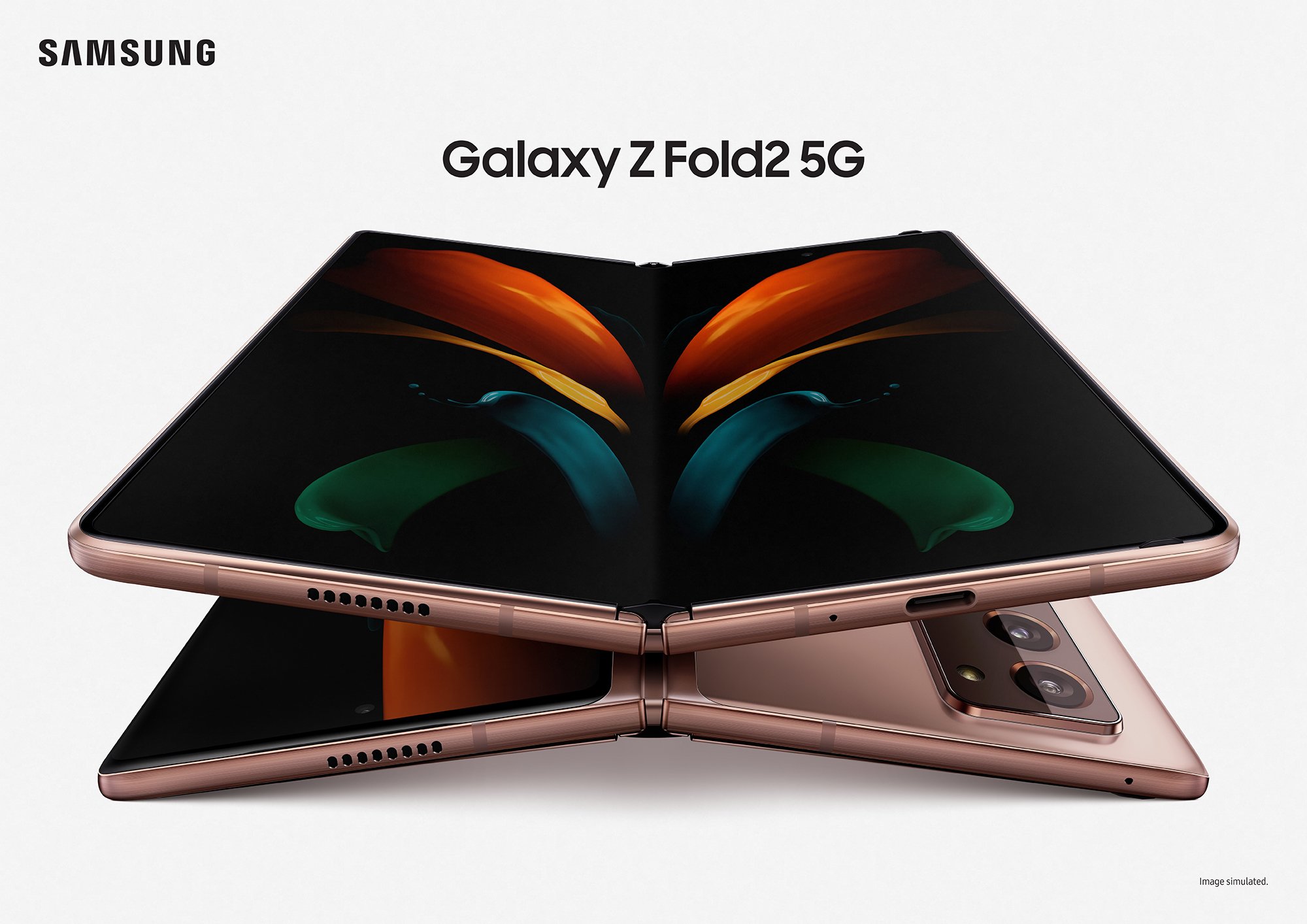
Samsung Galaxy Z Fold2 5G Mystic Bronze

According to Strategy Analytics, the global smartphone shipments are expected to fall by about 11 percent to 1.26 billion units this year. This revised figure arrives after the original projection of 15.6 percent. The analytics based firm further stated that the new estimation reflects a faster recovery rate in various markets including, the US, Europe, and India, amid a new market growth on the back of growing trends like work from home and learning at home.

Furthermore, the economic recovery in 2021 and more widened adoption of 5G networking and foldable smartphones will lead to overall market growth of 9 percent in 2021, with a 2019 level of shipments (1.41 billion units) being reached again by 2022. In the rankings, Samsung is expected to maintain its lead with 265 million units being shipped or 21 percent market share, followed by Apple with 192 million units shipped and a market share of 15.3 percent.
Samsung

Similarly, Huawei rounds up the third spot with both Samsung and Apple gaining 0.1 percent and 1.3 percent of the market share respectively as the Chinese tech giant loses chunks of its market share next year, when its chip inventory runs out. The South Korean tech giant and Cupertino based giant could also soon replace Huawei in the premium flagship market in China as per the report.


Huawei is making constant changes in its products due to US Ban: Founder

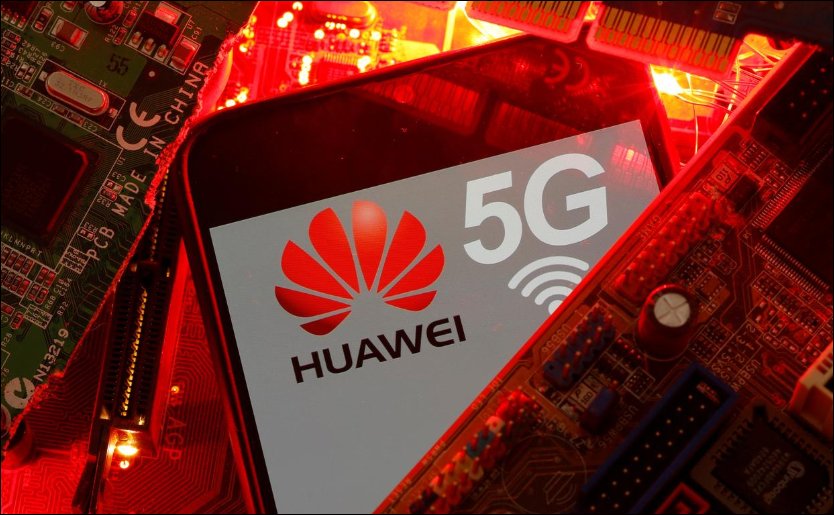
Ren Zhengfei, the Founder of Huawei Technologies recently stated that the company has had to make multiple tweaks to various aspects of its product offerings, to cope with the increasing pressure from the US and its restrictions.

Zhengfei Ren, Huawei founder and CEO

According to the senior official when addressing new employees, “We have had to modify thousands of electronic boards, replace parts, and algorithms to cope with … (the ban) from the US.” As per the South China Morning Post report, the US is cracking down hard on the Chinese tech giant. After losing its chip supply from TSMC, the Trump administration made supplying even more difficult for the company by reinforcing laws that regulate Huawei from receiving supplies from any company that uses American technology.

This has greatly affected the company’s supply chain. Thus, in the Ren Zhengfei stated that Huawei makes constant changes to multiple parts and components in their products while also tweaking its algorithms as well, to better evolve against the US sanctions that seek to remove technology originating from the US. The founder even acknowledged the company’s dire situations at the moment.

huawei

He said that Huawei’s 90,000 members of the research and development team wouldn’t need to be so large if the company had access to “high-quality resources like Western companies.” While Huawei has recovered from the initial chip supply blow, the recent regulations have plunged the company back into survival mode to best endure its current situation.


Xiaomi Mi 10 Ultra will remotely control car thousands of miles away using 5G

Xiaomi recently launched the Mi 10 Ultra flagship smartphone to commemorate the company’s 10-year anniversary. While the phone is quite powerful, the company is all set to demonstrate how it can be used to remotely control a car.

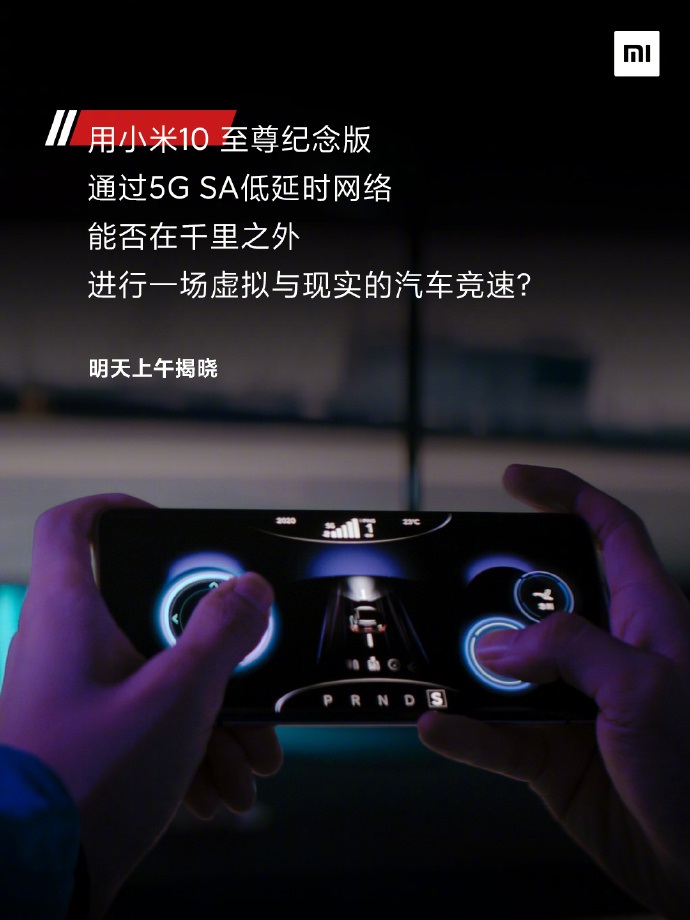
The company has shared a teaser poster and video on Weibo which reveals that Xiaomi is set to demonstrate how it can use Mi 10 Ultra smartphone to remotely control a car that is thousands of miles away, using 5G connectivity. It is not yet known which model of the car was used by Xiaomi for the demonstrations.

Xiaomi Mi 10 Ultra Remote Car Control using 5G

The Xiaomi Mi 10 Ultra comes with a 6.67-inch Full HD+ display that offers 2340 x 1080 pixels screen resolution, along with a 120Hz refresh rate, 240Hz touch sampling rate, support for HDR10+, a peak brightness of 1120 nits, and up to 1.07 billion colors. The display is TÜV Rheinland certification and is protected by Gorilla Glass 5.

The smartphone also features an in-display fingerprint scanner. Under the hood, the device is powered by the Qualcomm Snapdragon 865 processor — the same chipset that is powering the Mi 10 and Mi 10 Pro smartphones launched earlier this year.

EDITOR’S PICK: Xiaomi Mi 10 Ultra Review – 120W Charging, 120X Zoom, & 120Hz Display equals 120% Flagship experience

It packs up to 16GB of LPDDR5 RAM and offers 512GB of UFS 3.1 internal storage. It has a quad-camera setup that includes a 48MP primary sensor, 48 MP ultra-telephoto lens, a 12MP telephoto sensor, and a 20MP ultrawide sensor. On the front, there’s a 20MP snapper for taking selfies and video calling.

The device is running the company’s own MIUI 12 which is based on Android. It is powered by a 4,500mAh battery — which has a combination of two 2250mAh butterfly-designed graphene-based lithium-ion batteries. The phone supports 120W wired fast charging, 50W wireless charging, and 10W reverse wireless charging.


Huawei FreeBuds Pro TWS earphones teased ahead of launch this week

A few days ago, Huawei confirmed that the company will be hosting a launch event on 10th September in China where it will launch a few of its products. At the same event, the company is set to debut its FreeBuds Pro TWS earphones.

Today, Huawei has released a new teaser video for the upcoming FreeBuds Pro headset. It reveals that the product features dynamic noise reduction technology. The teaser also indicates that the TWS earphones look similar to the letter “P.”

The company has already launched a few models in the series and now it seems that Huawei has ditched the number-based naming for the “Pro” suffix. Some of the details related to the true wireless earphones have been leaked online.

It is said that the upcoming TWS earphones from Huawei are similar in design to Apple AirPods Pro with silicone tips. It will be powered by the company’s in-house HiSilicon Kirin A1 chipset, which powers most of Huawei’s wearable devices.

EDITOR’S PICK: After Huawei, China’s largest chipset maker SMIC could get blacklisted by the United States

They are expected to feature Bluetooth 5.2 connectivity and ANC (Active Noise Cancellation). While the size of drivers remains unknown, it is said that each bud will feature a total of three microphones and a 52.5mAh battery.

As for the pricing, the Huawei FreeBuds Pro will start at €150 in Europe and will be available for purchase from early October. However, it seems like the product will first go on sale in the company’s home market China.


Honor Watch GS Pro and Honor Watch ES are now up for pre-booking in China

At the IFA 2020 in Berlin a few days ago, Huawei sub-brand Honor had announced two new wearable devices — Honor Watch GS Pro and Honor Watch ES. Now, both of them have been listed on JD.com and are available for pre-booking.

While both the smartwatches have been listed online in China, pricing details for the Chinese market still remains unknown. The company will be officially launching both the devices in China through a launch event on 16th September.

Honor Watch GS Pro

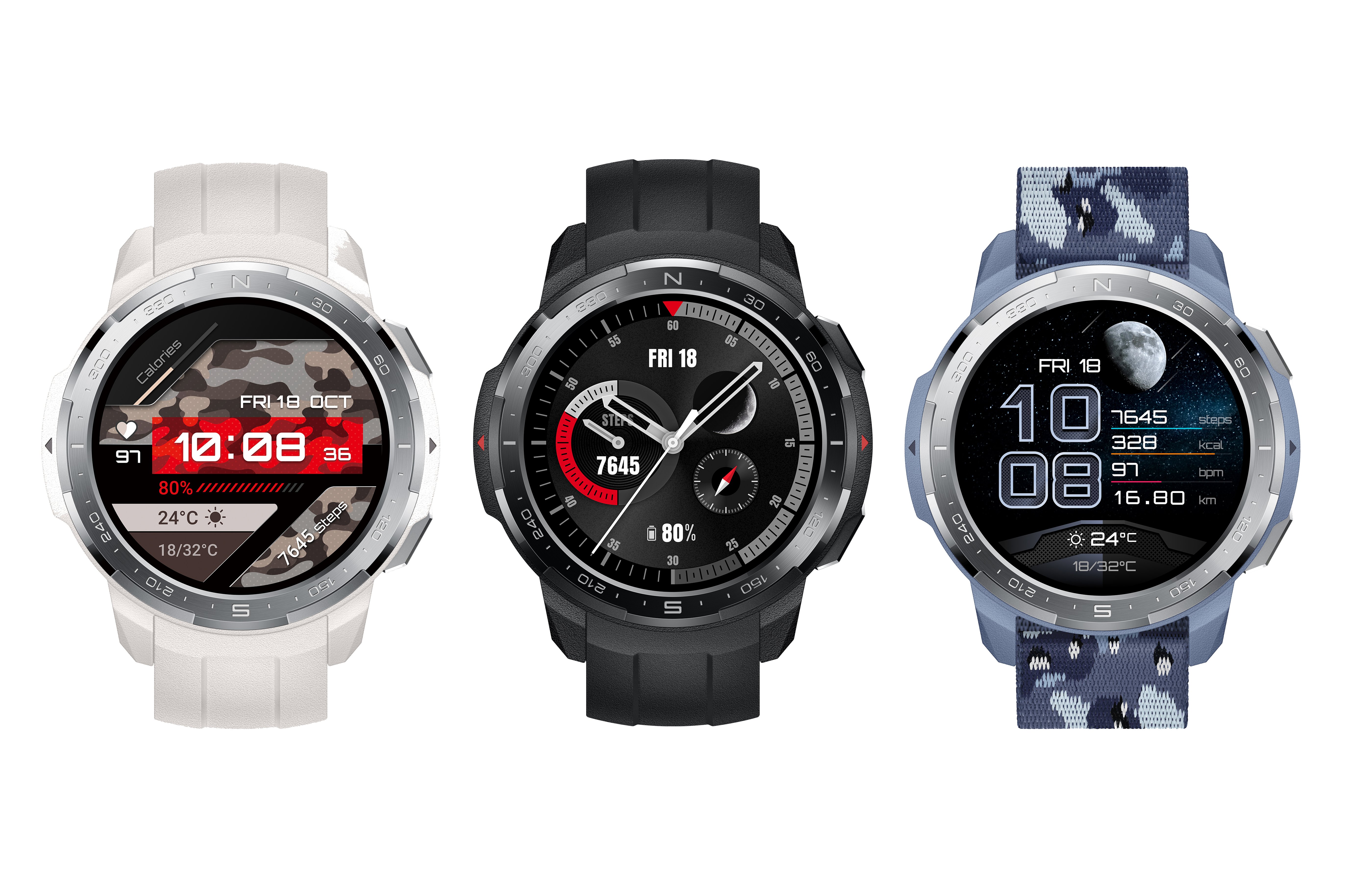
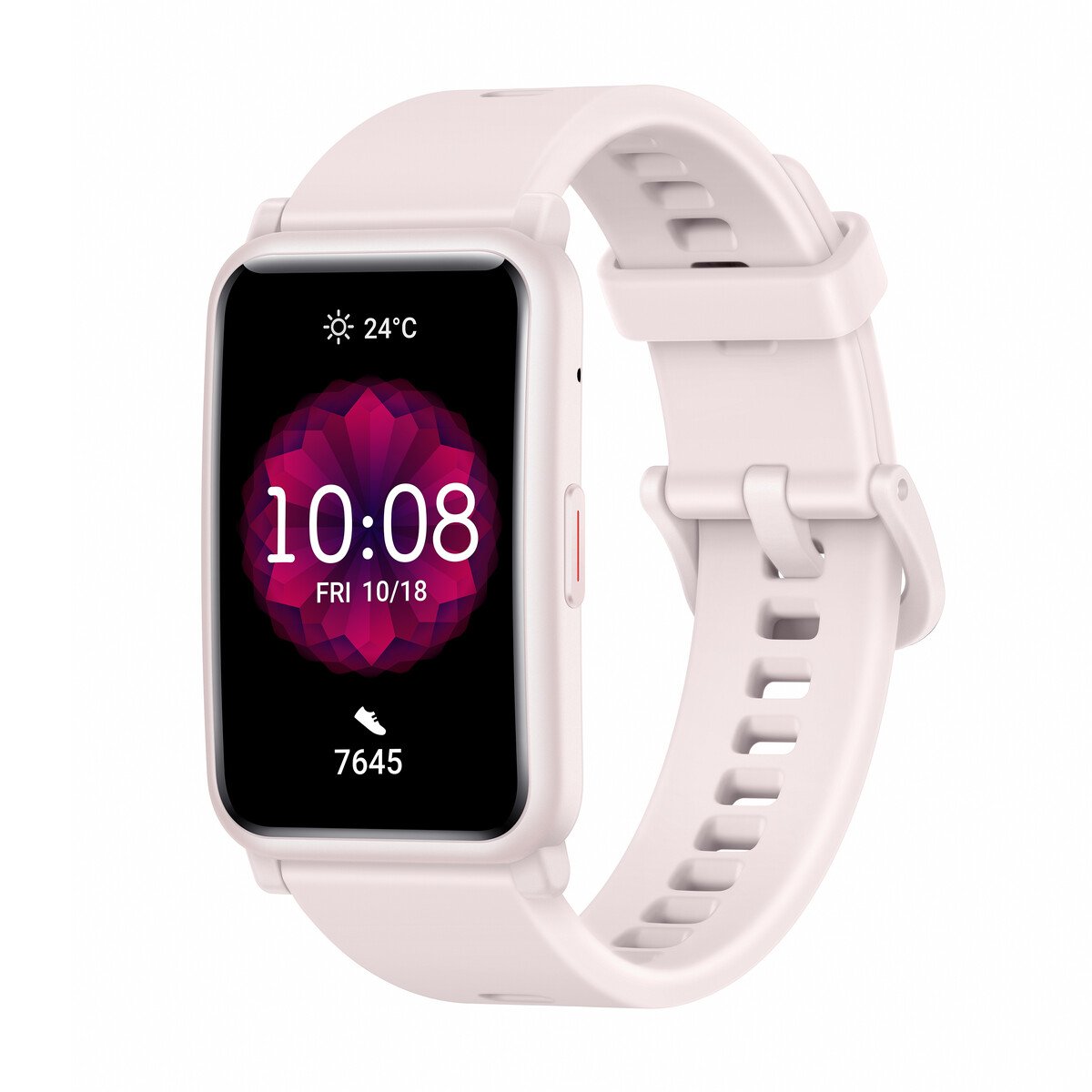
HONOR Watch GS Pro Colors Charcoal Black Marl White and Camo Blue

The Honor Watch GS Pro is the company’s first rugged smartwatch. It comes with MIL-STD-810G certification and features a massive 790mAh battery that is claimed to offer a maximum 25-day battery life.

The device supports over 100 workout modes including skiing, snowboarding, hiking, and others. It comes with a circular AMOLED display, measuring 1.39-inch with a screen resolution of 454 x 454 pixels and 326ppi pixel density.

There’s also an optical heart rate sensor, SpO2 sensor, accelerometer, gyro, barometer, compass, and ambient light sensor along with built-in GPS. It is powered by the Kirin A1 SoC and runs LiteOS.

As for the build, the casing is made of stainless steel and reinforced polycarbonate. It comes in three colors namely Charcoal Black, Marl White, and Camo Blue. It is priced at €249.99 for the EU nations and £249.99 in the UK.

EDITOR’S PICK: Exclusive – We’ve got POCO X3’s camera specs and other details

Honor Watch ES

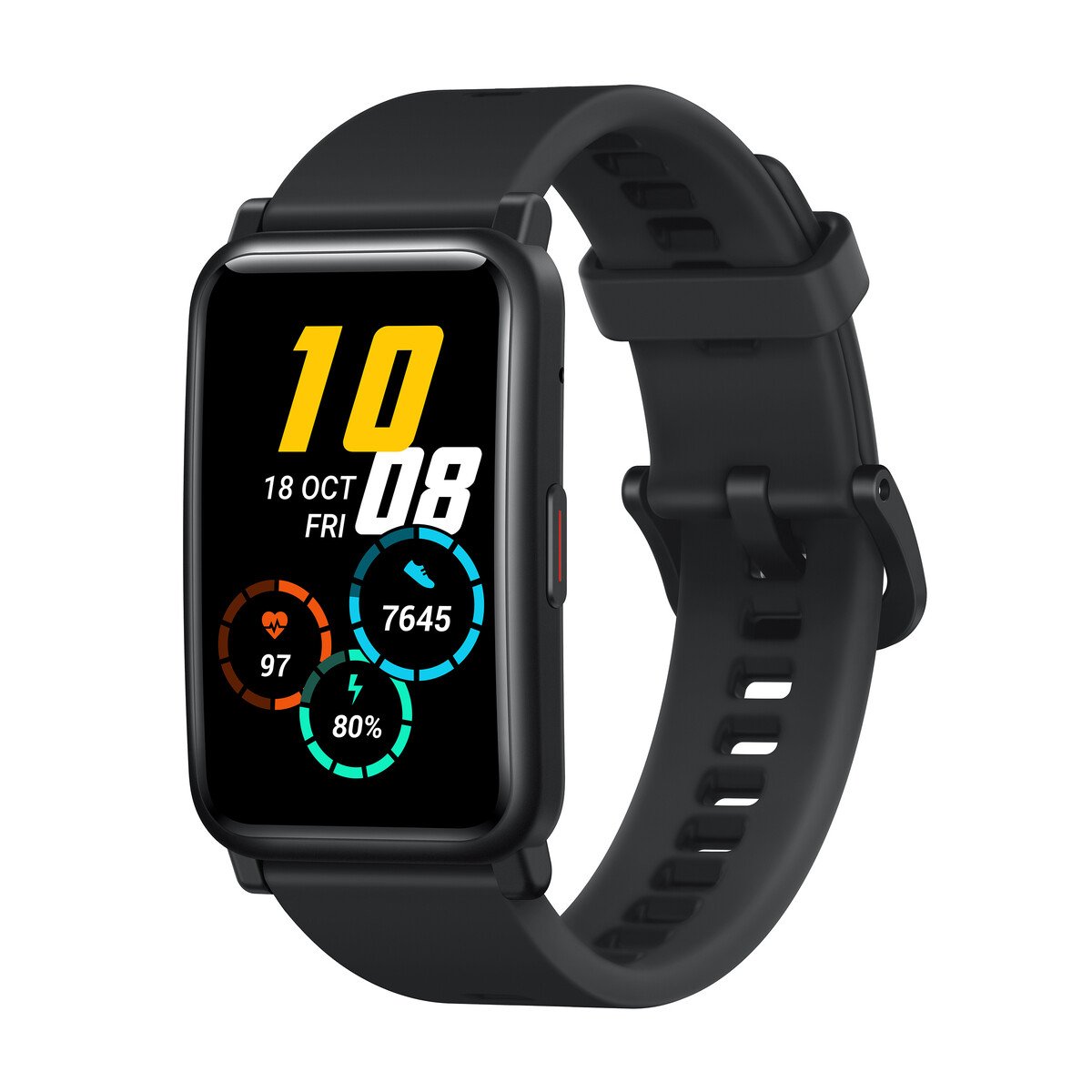
With the Honor Wach ES, the company is targeting fashionable consumers. The device comes with a 1.64-inch rectangular AMOLED display with 456 x 280 pixels screen resolution, 326ppi pixel density, and 70% screen-to-body ratio.

This one is also powered by HiSilicon Kirin A1 and runs the company’s own LiteOS. There’s support for 95 workout modes and 12 animated workout courses. It also packs an optical heart-rate sensor, SpO2 sensor, accelerometer, gyroscope, and ambient light sensor.

It is water-resistant up to 5ATM pressures and offers basic smartwatch features such as app notifications, alerts for calls & messages, sleep tracking, stress-level tracking, menstrual cycle tracking, and more.

The company claims that the Honor Watch ES could offer a 10-day battery life. It comes in three colors – Meteorite Black, Coral Pink, and Icelandic White. It costs €99.99 in the European market and £99.99 in the UK.


Apple could announce its iPhone 12 launch event in the coming days

Apple usually launches its new iPhone series in the initial weeks of September, however, the company is behind schedule this year, most likely because of the disruption caused by the COVID-19 pandemic.

The company has already confirmed that the iPhone 12 models launching this year will be “available a few weeks later.” Now, as per the report from Mark Gurman of Bloomberg, Apple could be making an announcement of its upcoming launch event this week.

Previously, it was reported by Jon Prosser that Apple has scheduled a press release for 8th September at 9:00 PM ET. Prior to that, he had said that the company will be launching a new iPad and Apple Watch models in the week of 7th September.

However, the new report from Mark Gurman claims that Apple won’t be announcing any hardware product but instead, it will just reveal the launch date through the press release. To know for sure, we’ll have to wait for a few more hours.

Given that the company holds the launch event roughly two weeks after sending out the invites, Apple could be hosting the iPhone 12 launch event on 22nd September if it sends out invites on 8th September.

EDITOR’S PICK: HongMeng OS-powered high-end tablets could come this year while the first smartphone is set to arriving next year

Although the phones could get announced in the coming weeks, it seems that the date of availability has been pushed. It is being reported that pre-booking will start around mid-October and shipments of the base model beginning a week after that.

But not all the models will go on sale together. As per the report, the iPhone 12 will be available for purchase in October itself, while other models in the lineup, including the iPhone 12 Pro, will go on sale in November.

At the launch event, along with the four iPhone 12 models, the tech giant is also expected to announce a few more products, including Apple Watch Series 6, a new iPad, new Apple TV, smaller HomePod, AirTags, and over-ear headphones.


China’s largest chipset maker SMIC could get blacklisted by the United States

The Trump administration in the United States has started a US-China trade war and has been adding sanctions on Huawei. Now, as per the report, the United States is planning to ban China’s largest semiconductor manufacturer SMIC.

SMIC relies on American chipmaking equipment. If the company gets added to the Entity List, that could make it more difficult to obtain the components needed to develop its capabilities and hurt the production of chipsets.

SMIC Logo

The ban on SMIC could badly hurt Huawei given that the company is manufacturing budget HiSilicon Kirin chipsets. As of now, SMIC is the only option left for Huawei given that it has been banned from using chipsets or its related technology by any American company.

The US Department of Defence is considering whether the chipmaker aids China’s military and defense apparatus. It alleges that SMIC worked with a large Chinese defense company and that university researchers linked to the military have tailored their work to fit SMIC’s technology. However, the company has denied those accusations.

EDITOR’S PICK: Rollme Hero Pro Is World’s First Smartwatch to pack Qualcomm Snapdragon Wear 4100+ chip

Semiconductor Manufacturing International Corporation (SMIC), based in Shanghai, was founded in 20000. It recently raised around $7.8 billion in a secondary listing on the Star Market in July, making it the biggest public offering in China in a decade. For this, the company withdrew its listing from the New York Stock Exchange.

Although the company ranks among the top five semiconductor manufacturers in the world, it is far behind its competitors in terms of technology. While the likes of TSMC and Samsung have started manufacturing 5nm chipsets, SMIC is still using the 14nm process for manufacturing smartphone chips.


Realme 7, 7i launch on September 17 confirmed; Realme 7i full specifications and renders leaked

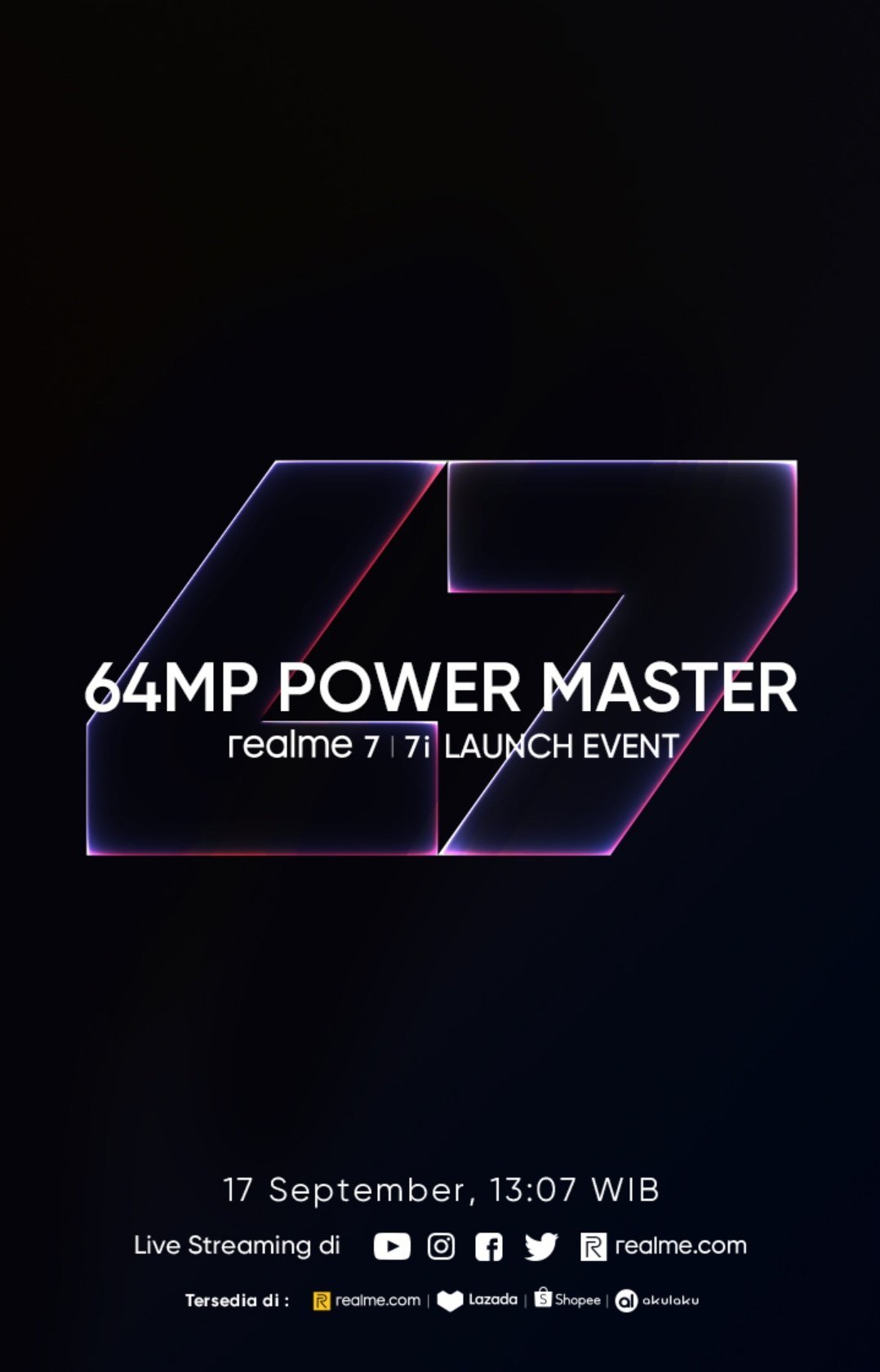
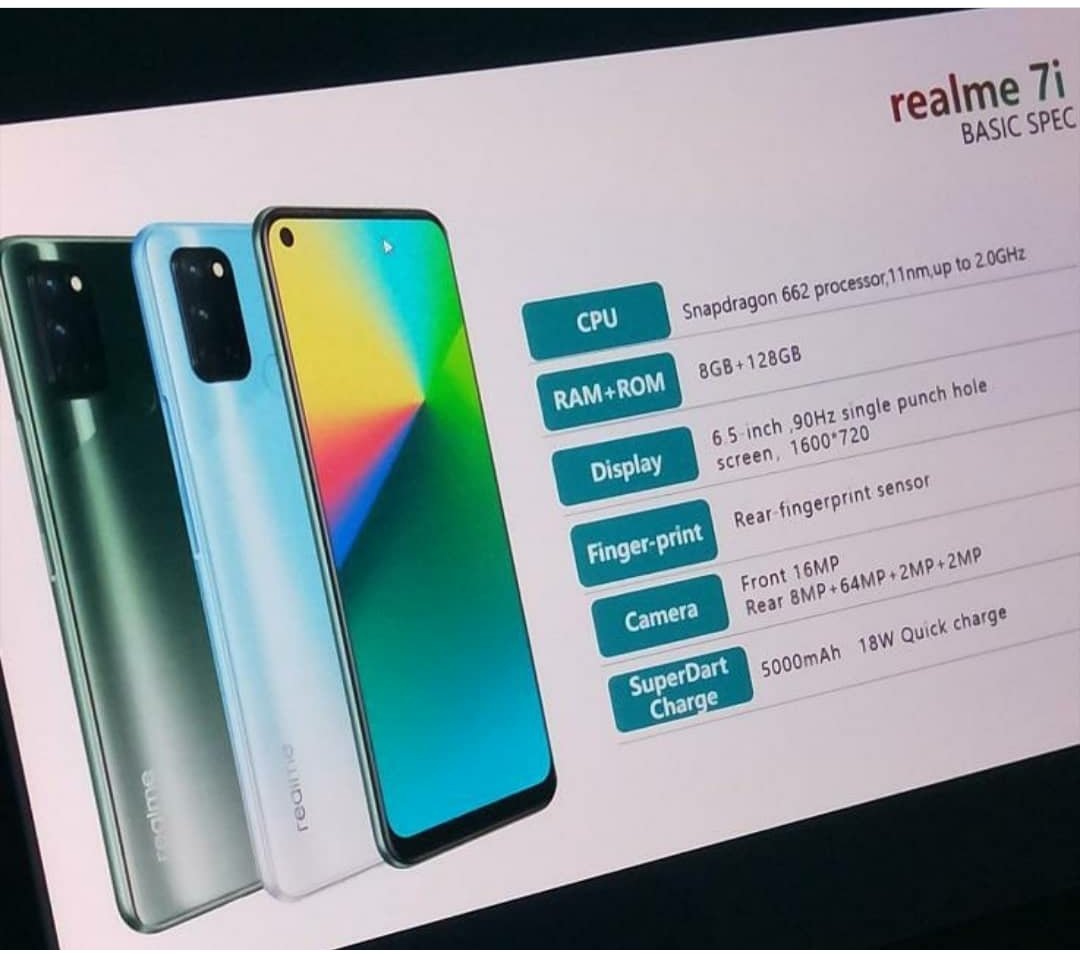
Last week, Realme launched the Realme 7 and Realme 7 Pro smartphones in India. Today, the Chinese firm confirmed that it will be announcing the Realme 7 and the all-new Realme 7i smartphone on Sept. 17 in Indonesia. There is a possibility that the Realme 7 that went official in India could be the same device that will go official on Sept. 17 in Indonesia. As far as Realme 7i, the posters released by the company have revealed a few pieces of information on its design and main specs. The Gadgetfight.id Instagram account has shared a snapshot of a promo material of the Realme 7i. The image has revealed the entire specs of the device.

Realme 7i launch date

Realme 7i specifications (Rumored)

The Realme 7i has a punch-hole LCD panel that produces an HD+ resolution of 720 x 1600 pixels. Like the Realme 7, the Realme 7i supports a 90Hz refresh rate. The leaked shot reveals that the phone will be available in green and light blue colors. The backside of the phone has a rectangle-shaped camera housing and a fingerprint scanner.

The 11nm Snapdragon 662 mobile platform that clocks at 2.0GHz is present under the hood of the Realme 7i. The SoC is coupled with 8 GB of RAM. The phone will offer internal storage of 128 GB.

Realme 7i leaked specs

It has a front camera of 16-megapixel. Its rear camera setup features a 64-megapixel main camera, an 8-megapixel lens which could be a superwide sensor and a pair of 2-megapixel lenses which could be a macro shooter and a depth sensor. For capturing selfie shots, the handset possesses a 16-megapixel front camera.

The Realme 7i has a 5,000mAh battery and it will come with support for 18W charging. In comparison, the Realme 7 is equipped with 30W fast charging technology. At present, there is no word on its pricing.


(via)

[Update] Exclusive: We’ve got POCO X3’s camera specs and other details

UPDATE: It turns out our source got the camera specs wrong today. We apologize for the mix-up. The fact that the same source also had the phone with him made us believe he was 100% correct. But sadly, for some reason, our source mixed up the specs.
Anyway, we have updated this story with the correct camera specs now.
Our review team has also got hold of the Poco X3 NFC and our hands-on article will be live very soon. So stay tuned.

Original story continues…

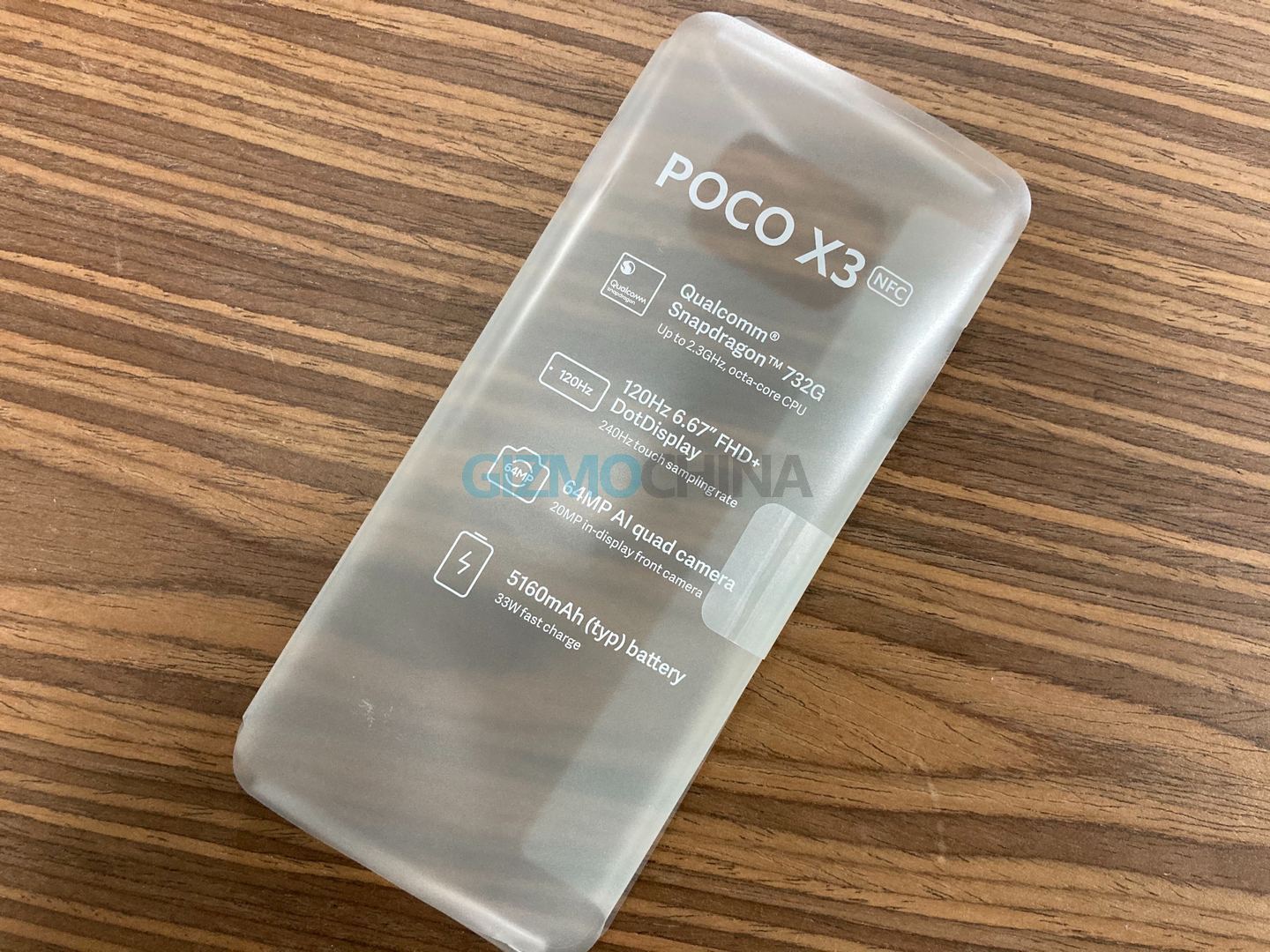
The global launch of the POCO X3 NFC smartphone will be held at 8 PM (GMT+8) today. It will be the first-ever smartphone to feature the recently unveiled Snapdragon 732G processor. Several details of the phone have appeared through its FCC certification, Geekbench listing, and other leaks. Today, we at GizmoChina bring you an exclusive shot of the protective sleeve designed for the POCO X3 NFC. The main specifications of the smartphone are mentioned on the sleeve. Moreover, we also obtained exclusive information on the cameras of the POCO X3 NFC.

It is mentioned on the POCO X3 NFC’s protective sleeve that it is driven by a 2.3GHz SD732G chipset. The smartphone has a 6.67-inch DotDisplay that produces Full HD+ resolution. We can confirm that the POCO X3 NFC has an LCD panel like the predecessor POCO X2 smartphone. The screen supports a 120Hz refresh rate and a 240Hz touch sampling rate.

Poco X3 NFC Specs

The rear side of the POCO X3 NFC features an AI-powered 64-megapixel quad camera. For selfies, the handset has a 20-megapixel camera housed inside the top-center positioned punch-hole on the screen. The handset has a 5,160mAh battery that supports 33W fast charging. The handset retains the side-facing fingerprint sensor.

None of the POCO X3 leaks have revealed the exact details of its rear cameras. However, a few hours ahead of the launch, GizmoChina has acquired exclusive information on the camera configurations of the POCO X3 NFC. Our source has confirmed that it will be retaining the Sony IMX686 64-megapixel main camera that was made available on the POCO X2.

The quad-camera system of the predecessor, the Poco X2, comprised of a 64-megapixel Sony IMX686 main camera, an 8-megapixel ultrawide shooter, a 2-megapixel macro lens, and a 2-megapixel depth sensor. But we have learned from our source that the POCO X3’s rear camera setup has an 8-megapixel ultrawide lens, a 5-megapixel depth sensor, and a 2-megapixel macro lens apart from the main Sony IM686 camera. The leaked renders of the phone that have appeared in the recent past have revealed that the company has adopted a different design from the rear cameras system as compared to the POCO X2.

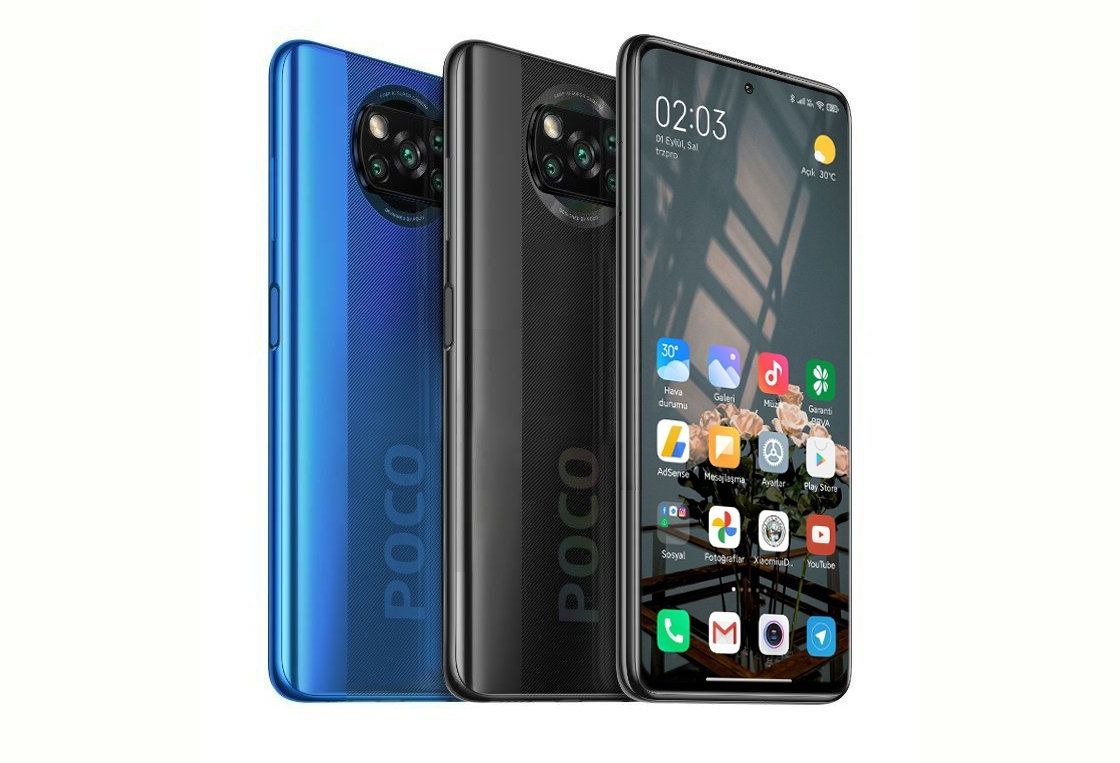
POCO X3 renders
POCO X3 NFC

The POCO X3 NFC will come preinstalled with MIUI 12 based Android 10 OS. Like the POCO X2, the successor model is expected to arrive with up 8 GB of RAM and up to 256 GB of internal storage. Just like the X2, the new Poco X3 NFC will also be priced very aggressively.


POCO phone with 48MP dual cameras in development

The POCO X3 NFC launches later today, and while the phone will feature a rear design we have not seen on any phone till date, it won’t be the only POCO phone to have such a look.

Apparently, the manufacturer has another phone in development with a similar rear design but this unnamed phone has two rear cameras, unlike the POCO X3 that packs four sensors. The info comes from  Digital Chat Station.

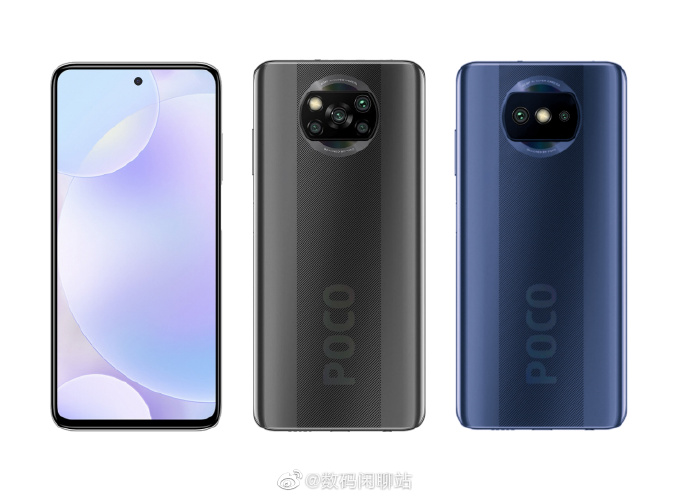
The Chinese leaker revealed on Weibo that he came across two prototype POCO phones. One of the phones is the POCO X3 which has 64MP quad rear cameras and a Qualcomm processor inside it while the other phone has 48MP dual-cameras. Both devices have a similar rear design as shown in the render.

POCO phone with dual camera

While the name of the phone is not known, it should be more affordable than any of the manufacturer’s current offering. The render, while not official, shows the phone doesn’t have a rear-mounted fingerprint scanner. It also appears to have a centered hole in its screen just like that of the POCO X3.

Other than the POCO X3 NFC launch today, there is also the POCO M2 launch scheduled for tomorrow, September 8 in India. With two phones in the first week of the month, we shouldn’t expect this dual-camera phone until much later or the end of September at the earliest. Nevertheless, more details should surface before it launches.


HongMeng OS high-end tablets coming this year? First phone arriving next year

Huawei’s Developer Conference will begin on September 10 and we expect big announcements from the manufacturer with a focus on software. While we are still a few days away from the event, some interesting details have surfaced in a new leak.

According to the leaker Teme (@RODENT950) who is known for his Huawei-related leaks, folks will be able to “try HongMeng OS high-end tablets this year”. Based on the phrasing, it appears users will just be able to run and test the new operating system on these select tablets and not that they will actually run it out of the box.

The tweet also revealed that the design for this year’s (high-end) tablets, which are most likely the successors to the MatePad Pro and MatePad Pro 5G, will ditch the punch-hole design of the last generation but will still boast ultra-narrow bezels.

In another tweet, the leaker stated that HongMengOS 3.0 is “mobile-ready” and the first phone powered by the operating system will be announced in the second half of next year.

Huawei has confirmed it will announce HarmonyOS 2.0 (HongMengOS 2.0) at its developer conference this week. So it means that next year’s version will be 3.0 and will be the mobile-ready version that will appear in phones. The time frame is the second half of next year and our guess is that it will be announced at or after the 2021 Huawei Developer Conference.

We are excited to see what new features HongMengOS 2.0 will bring as they should provide hints as to what to expect when version 3.0 arrives next year.


Realme X7 Pro vs Redmi K30 Ultra vs ZTE Axon 20 5G: Specs Comparison

Realme X7 Pro went official as one of the most affordable flagship killers of 2020. The handset packs one of the most powerful chipsets of the year but it is not made by Qualcomm: we are talking about the Dimensity 1000+ which allowed Realme to set a very affordable price for this handset. But the Realme X7 Pro is not the only phone with this SoC launched this year: there is Redmi K30 Ultra as well, in the same price range. That is why we decided to make a comparison between them and, for those who still do not trust MediaTek’s new flagship chipsets, we also brought the latest device launched with a Qualcomm SoC in the same price range: the ZTE Axon 20 5G.

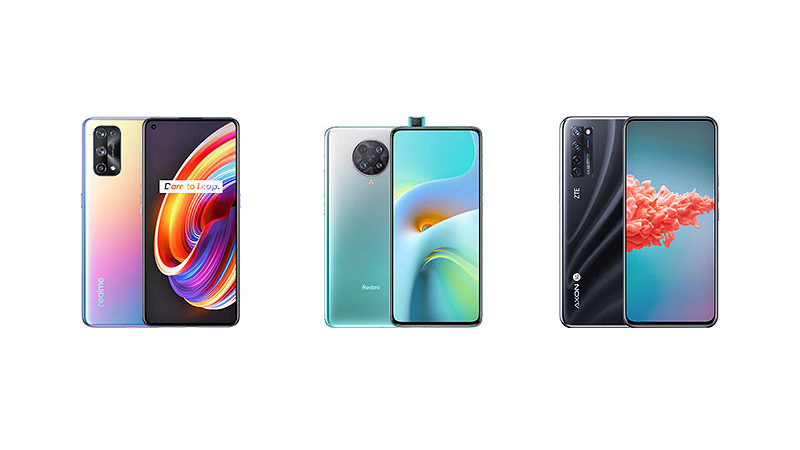
Realme X7 Pro vs Xiaomi Redmi K30 Ultra vs ZTE Axon 20 5G

Realme X7 Pro Xiaomi Redmi K30 Ultra ZTE Axon 20 5G
DIMENSIONS AND WEIGHT 160.8 x 75.1 x 8.5 mm, 184 g 163.3 x 75.4 x 9.1 mm, 213 grams 172.1 x 77.9 x 8 mm, 198 g
DISPLAY  6.55 inches, 1080 x 2400p (Full HD+), Super AMOLED 6.67 inches, 1080 x 2400p (Full HD+), 395 ppi, AMOLED  6.92 inches, 1080 x 2460p (Full HD+), OLED
PROCESSOR MediaTek Dimensity 1000+, octa-core 2.6 GHz MediaTek Dimensity 1000+, octa-core 2.6 GHz Qualcomm Snapdragon 765G, octa-core 2.4 GHz
MEMORY  6 GB RAM, 128 GB –  8 GB RAM, 128 GB – 8 GB RAM, 256 GB  6 GB RAM, 128 GB – 8 GB RAM, 128 GB – 8 GB RAM, 256 GB – 8 GB RAM, 512 GB  6 GB RAM, 128 GB – 8 GB RAM, 256 GB – micro SD slot
SOFTWARE  Android 10, Realme UI Android 10, MIUI  Android 10, Mi Favor
CONNECTIVITY  Wi-Fi 802.11 a/b/g/n/ac/6, Bluetooth 5, GPS  Wi-Fi 802.11 a/b/g/n/ac/ax, Bluetooth 5.1, GPS  Wi-Fi 802.11 a/b/g/n/ac, Bluetooth 5.1, GPS
CAMERA  Quad 64 + 8 + 2 + 2 MP  camera, f/1.8 + f/2.3 + f/2.4 + f/2.4
32 MP f/2.5 front camera
Quad 64 + 13 + 5 + 2 MP f/1.8, f/2.4, f/2.2 and f/2.4
20 MP front camera
 Quad 64 + 8 + 2 + 2 MP  camera, f/1.8 + f/2.2 + f/2.4 + f/2.4
32 MP f/2.0 front camera
BATTERY  4500 mAh, fast charging 65W 4500 mAh, fast charging 33W  4220 mAh, fast charging 30W
ADDITIONAL FEATURES Dual SIM slot, 5G Dual SIM slot, 5G Dual SIM slot, 5G, in-display camera

Design

ZTE Axon 20 5G is a very innovative device and it is the first smartphone to offer a full-screen experience while still including a selfie camera on the front panel. Indeed, the ZTE Axon 20 5G is the first phone with an under-display camera: a technology which is still not perfect on this device, but it provides a full-screen display while keeping a very thin body. The handset is also built with premium materials, including a glass back and an aluminum frame. The Redmi K30 Ultra has a full-screen display too, but it sports a motorized pop-up camera. The Realme X7 Pro has a punch-hole design.


Display

On the paper, the most convincing display belongs to the Redmi K30 Ultra which is equipped with an AMOLED panel sporting a 120 Hz refresh rate and the HDR10+ certification. Right after, we got the Realme X7 Pro which has a 120 Hz AMOLED display as well. but the ZTE Axon 20 5G offers an important advantage besides the under-display front camera: it has one of the widest panels ever seen on a phone, with a 6.92-inch diagonal. All of the devices feature a Full HD+ resolution.


Specs & Software

Realme X7 Pro and Redmi K30 Ultra are both equipped with the flagship-class Dimensity 1000+ chipset: in order to give you an idea, AnTuTu places this SoC in the middle between Snapdragon 855+ and Snapdragon 865. You probably understood that it is a more powerful chipset than the Snapdragon 765G found on the ZTE Axon 20 5G. And, obviously, it supports 5G networks. Redmi K30 Ultra and Realme X7 Pro feature up to 8 GB of RAM, but the former has up to 512 GB of native storage, while Realme X7 Pro stops at 256 GB. With the ZTE Axon 20 5G you get max 256 GB, but it is the only one with a micro SD slot. Android 10 is installed out of the box and customized by custom UIs.


Camera

The Redmi K30 Ultra looks like the device with the best rear camera capabilities because it has better secondary sensors on the rear side. We are talking about a 13 MP ultrawide lens and a 5 MP telephoto macro sensor. But when it comes to the front camera, ZTE Axon 20 5G (and Realme X7 Pro) are definitely better. Realme X7 Pro and ZTE Axon 20 5G have a very similar rear camera department, with just the ultrawide sensor being slightly different.


Battery

Realme X7 Pro and Redmi K30 Ultra have a bigger 4500 mAh battery than the ZTE Axon 20 5G. Given that they have the same chipset and the same refresh rate, it is hard to understand which one will last more on a single charge without testing them thoroughly. But note that Realme X7 Pro has a faster charging technology with a 65W power.


Price

Realme X7 Pro and ZTE Axon 20 5G are both priced about €270/$320 in China, while Redmi K30 Ultra starts from €329/$389. The differences between Realme X7 Pro and Redmi K30 Ultra are so marginal that it is not worth spending €50/$70 more for the Redmi K30 Ultra. The Redmi K30 Ultra has the best secondary rear cameras and HDR10+, but Realme X7 Pro has faster charging and a better front camera, as well as a sleeker design, imho. With those price tags, unless the design is your main concern, I think there is actually no reason to go for the ZTE Axon 20 5G.


Realme X7 Pro vs Xiaomi Redmi K30 Ultra vs ZTE Axon 20 5G: PRO and CONS

Realme X7 Pro

PROS

  • 120 Hz AMOLED display
  • Stereo speakers
  • Very fast charging
  • More compact

CONS

  • Nothing particular


ZTE Axon 20 5G

PROS

  • Great materials
  • Under-display front camera
  • Very wide display
  • Micro SD slot

CONS

  • Inferior hardware


Xiaomi Redmi K30 Ultra

PROS

  • AMOLED 120 Hz display
  • Good rear cameras
  • Nice materials
  • Stereo speakers

CONS

  • Inferior front camera

Huawei’s CEO says the challenges facing the tech giant will help forge “heroes”

Huawei’s founder and CEO Ren Zhengfei has stated that the challenges facing the embattled Chinese company will help forge “heroes,” an indication that the company may be down but definitely not out. Huawei store logo official

The tech mogul stated this while addressing strategy experts and new recruits at an internal forum Thursday. The Huawei Technologies Co. Ltd. CEO and founder said that while the firm was operating in unprecedented and troubling times, talented staff were being cultivated across the board.

The company’s R&D system alone comprises 90,000 employees, far more than one would see in a “Western” tech company, he said, which may be able to function at a high level with fewer people and more resources, but without Huawei’s tribulations would raise fewer “heroes”.

Earlier this month, the U.S. Department of Commerce further tightened rules restricting the sale of microchips and other technology to Huawei, which effectively banned any company, anywhere in the world, from supplying it with chips unless approved by the U.S.

Regarding the latest round of U.S. hostility towards the Chinese tech company, which the Trump administration has said is based on unspecified security threats and Huawei’s alleged links with the Chinese military, Ren said, “It takes one U.S. government directive, and we have to change thousands of circuit boards, parts, and algorithms. Once we’ve made the changes, we have to do it all again… We end up making changes to our circuit boards on repeat.”


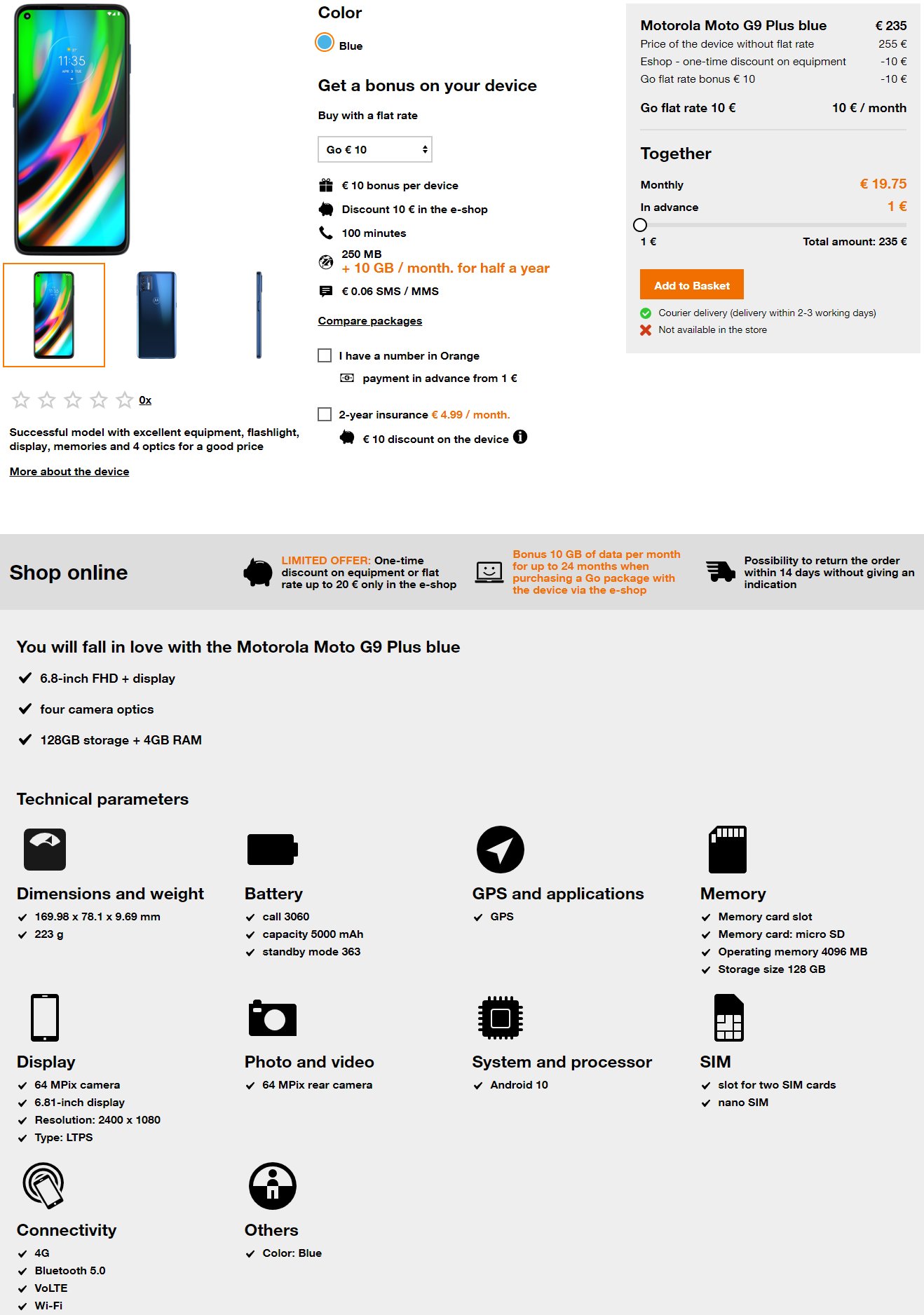
Motorola Moto G9 Plus specs and price revealed by European operator

Motorola has already announced the Moto G9 in India. The phone arrived in Europe the next day as the Moto G9 Play. Now, it appears the Moto G9 Plus is almost here as a listing for the device was seen on the site of a European operator.

The page has now been pulled down by the network operator which is Orange Slovakia, but a screenshot was taken by Roland Quandt (@rquandt).

Moto G9 Plus spec sheet

The Moto G9 Plus has a 6.81-inch FHD+ display according to the listing. The resolution is 2400 x 1080 and at the top left corner of the screen is a hole in the screen for a single selfie camera.

There is 4GB of RAM onboard along with 128GB of expandable storage. Thre is no mention of the processor but it will draw juice from a 5000mAh battery. A TUV Rheinland certificate already revealed the device has support for 30W fast charging. The Moto G9 Plus also has quad rear cameras including a 64MP main sensor.

Other features mentioned are Bluetooth 5.0, VoLTE, Wi-Fi, dual SIM support (nano-only), and Android 10 out of the box. It will be available in Blue, weigh 223 grams, and measure 169.98 x 78.1 x 9.69 millimeters and will sell for €235.

There is a possibility the Moto G9 Plus will arrive in the next few days or few weeks. It should launch in Europe first before making its way to India and the US.


More details of the Vivo Watch surfaces; may launch next quarter

It is no longer news that Vivo is developing its own smartwatch. The watch was certified by the Chinese Communications Commission back in June and has also received its Bluetooth certification too. More details of the watch have now surfaced in a leak.

A post on Weibo by the Chinese leaker Digital Chat Station, says the Vivo Watch will be available in two months, which means it should arrive next quarter. He stated he has seen the “male” version of the watch and it has a 46mm dial that houses a color OLED display.

Vivo Watch

The post also revealed the Vivo Watch has NFC, a heart rate monitor, a blood oxygen monitor, and other standard features we expect in a smartwatch.

Based on the above info, the Vivo Watch will be available in two sizes – a 46mm version and a version with a smaller dial, probably 42mm. The watch will support payments via NFC, so owners can use it for bus payments which is a pretty popular feature in China.

There is still no info with respect to battery life and the OS it will run. Vivo’s sister company, OPPO, launched its own smartwatch a couple of months ago and it runs ColorOS in China while the international variant runs WearOS. Vivo may follow a similar path for its own watch too.

Apart from details about the watch, the leaker revealed Vivo has also begun working on its own line of flat-screen TVs. It appears it will be joining OnePlus in the TV business soon. OPPO is also expected to announce its own smart TVs too as two models with 55-inch and 65-inch screens have been certified in China while their remotes have received Bluetooth certificates.


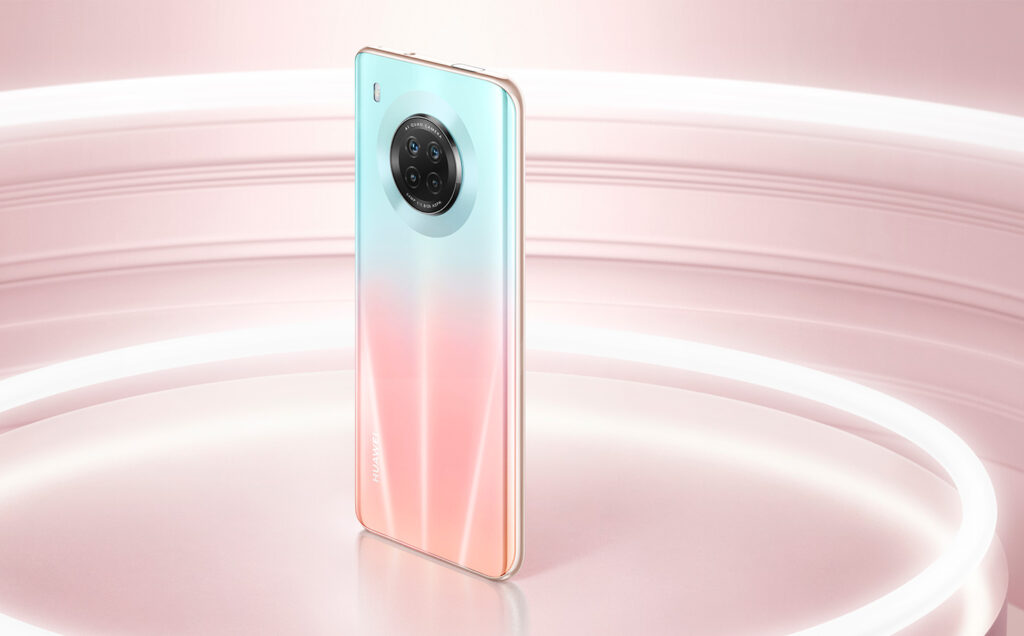
HUAWEI Y9a announced with MediaTek helio G80, 64MP quad-camera, and 40W fast charging

Huawei did not launch any new products at IFA 2020 like its sub-brand Honor. However, the company does have a few products up in its sleeve waiting to go official for global markets. One of them, HUAWEI Y9a, has now been announced quietly as a tweaked version of HUAWEI Enjoy 20 Plus that was launched in China recently.

It is worth noting that this is not the first time we are hearing about this phone as its name was already mentioned in two separate lists of upcoming Huawei devices and even its promotional poster leaked last week.

HUAWEI Y9a Sakura Pink

HUAWEI Y9a Specifications

The newly announced HUAWEI Y9a sports a 6.63-inch FHD+ (2400 x 1080 pixels) IPS LCD panel on the front with a 92% screen-to-body ratio lacking any notch or punch-hole. That’s because the phone’s 16MP selfie camera sits in a pop-up module.

Unlike the Enjoy 20 Plus which is a 5G smartphone powered by MediaTek Dimensity 720, this one comes with MediaTek G80 SoC paired with 6GB/8GB LPDDR4x RAM and 128GB UFS 2.1 storage based on regions it is sold. If needed, the storage can be further expanded via Huawei’s proprietary NM SD card.


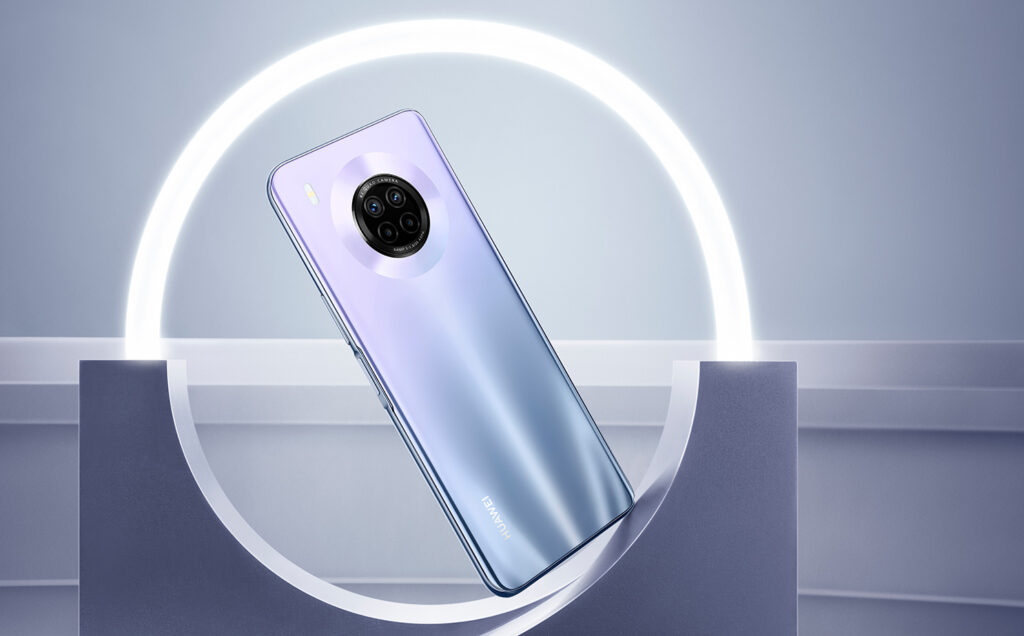
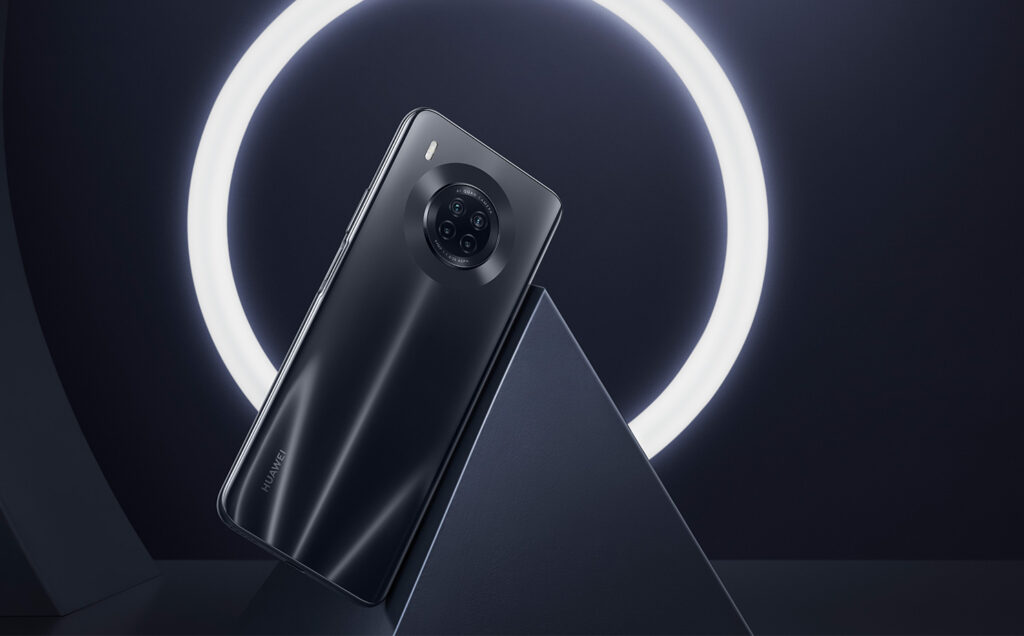
The back of the device features the circular design from HUAWEI Mate30 Pro for the camera arrangement but the sensors are different. Because it comes equipped with a 64MP primary snapper paired with an 8MP 120° ultra-wide unit, a 2MP depth sensor, and a 2MP macro shooter. On the other hand, the Enjoy 20 Plus features a 48MP + 8MP (ultra-wide) + 2MP (macro) triple camera setup.

HUAWEI Y9a Space Silver

The phone runs EMUI 10.1 based on Android 10 with HMS (Huawei Mobile Services). It includes all the necessary sensors such as gyroscope, compass, gravity sensor, ambient light sensor, and a side-mounted fingerprint sensor.

As for connectivity and ports, it supports 4G LTE, dual-band WiFi 5, Bluetooth 5.1, GPS, 3.5mm headphone jack, and USB Type-C. Further, the device will be backed by a 4,200mAh battery with support for 40W fast charging in the Middle East, Africa, and some countries in Middle Asia. Whereas, in other regions, it will feature a 4,200mAh battery and will only support 22.5W fast charging.

HUAWEI Y9a Midnight Black

Talking about size and weight, the HUAWEI Y9a measures 163.5 x 76.5 x 8.95mm in dimensions and weighs 197g. Last but not least, It will be available in three colors namely Space Silver, Sakura Pink, and Midnight Bllack.


Rollme Hero Pro Is World’s First Smartwatch to pack Qualcomm Snapdragon Wear 4100+ chip

Recently we had reported of Rollme Hero which is claimed to be the world’s first full-screen display smartwatch. The official renders indeed elevated the curiosity as none has so far achieved frameless display on a smartwatch. Now it seems, the Rollme Hero, or at least the Rollme Hero Pro is going to be the first to be powered by Snapdragon Wear 4100+ SoC – the new processor for wearables by Qualcomm.

rollme hero

The Rollme Hero Series release should be around the corner as we’ve been seeing a lot of tidbits nowadays. While the real-life product may differ, the renders depict literally no visible frame on the smartwatch making it one of the best looking smartwatches out there.

Snapdragon Wear 4100+ – An Efficient Engine for Smartwatches

If you missed it, the Wear 4100+ is a next-generation connected smartwatch platform based on Qualcomm’s ultra-low-power hybrid architecture. Based on the 12nm manufacturing process, the platform was officially announced in July 2020.

snapdragon wear 4100

As per Qualcomm, the Wear 4100+ platform comprises of a powerful applications processor and ultralow-power co-processor, which extends its hybrid architecture. It is designed to deliver super-fast performance, and connectivity, a smarter Always-On experience, and extended battery life for next-generation connected smartwatches.

The quad-core Wear 4100+ SoC peaks at 1.7GHz. Perhaps the fastest clock speed ever achieved by a Wear platform by Qualcomm. So apart from the guaranteed efficiency, the SoC should offer the best performance that you can imagine on a smartwatch.

So far, the Rollme Hero packs a bunch to lure the consumers. If the pricing is done on the mark, we could see a lot of users going for it without any second thoughts. What do you guys think?

Related: Rollme to roll-out the first-ever ‘bezel-less’ smartwatch

Realme 6 Pro’s latest update brings smooth scrolling and super power saving mode

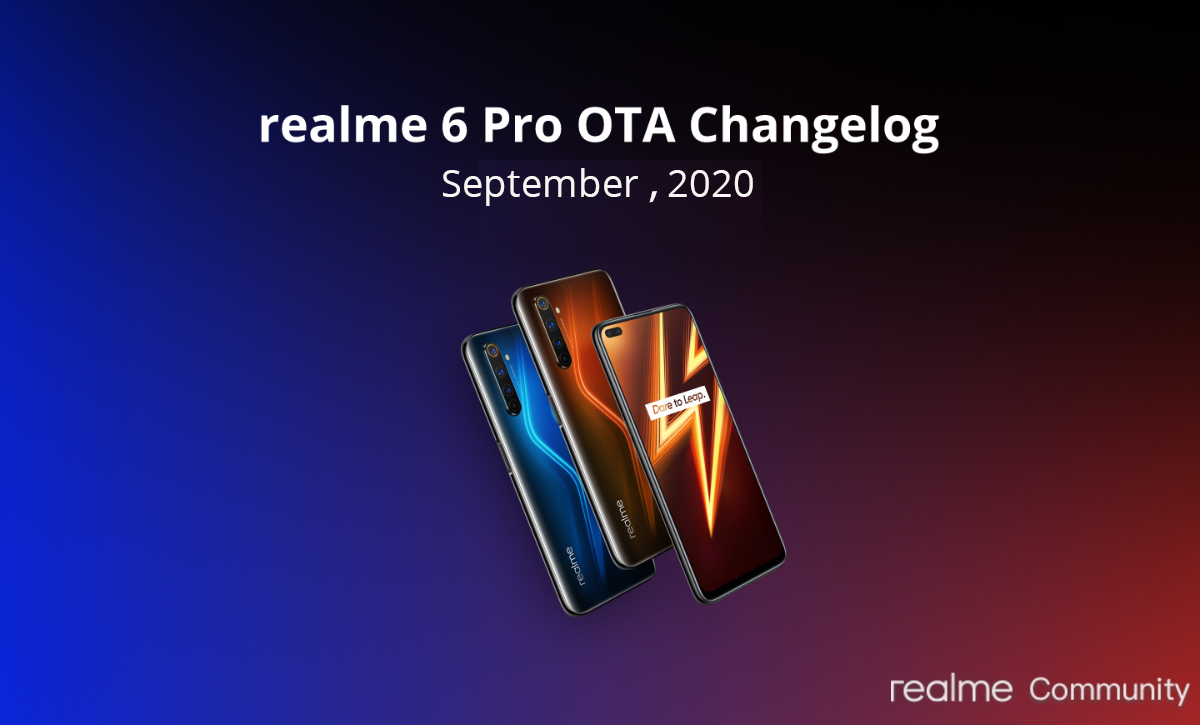
Last week, Realme released new software updates for the Realme 6 and 6i. The updates made available the Smooth Scrolling feature to both smartphones. The tech giant has now released a similar update for the premium Realme 6 Pro. Apart from the Smooth Scrolling feature, the phone also gets the Super Power Saving Mode which was first introduced with the Realme C12 and Realme C15. Realme 6 Pro

The new update, sporting version number RMX2061_11.A.31, is rolling out over the air in India to a limited number of users, and a broader rollout will commence in a few days if no major bugs are found.

Additionally, the new build comes with the Super Nighttime Standby feature and bumps up the Android security patch level from July 2020 to August 2020. You can find the complete changelog below:

Security

● Android Security Patch: August 2020

Settings

● Added the Super nighttime standby feature

● Added the smooth scrolling feature

Settings

● Added Super Power Saving Mode

● Added long press to copy IMEI in the status information interface

● Added Deep cleanup feature in Process Manager

● Added Icon Pull-down gesture feature in launcher settings

Status Bar

● Added OTG Switch toggle to notification panel

● Added independent Switch toggles of focus mode

● Optimized “Mute-Bell-Vibrate” icon state

● Optimized viewing for system update prompt pop-up window

● Optimized flight mode, Bluetooth status will not be affected after flight mode is turned on

● Optimized Russian translation issue of the carrier in the status bar

Calculator

● Optimized the Russian translation issue of the calculator

Lock screen

● Fixed font display issue of charging animation

Camera

● Fixed the probabilistic lagging issue of video recording after blurring the background


Sony Xperia 5 II promo video leaks ahead of September 17th launch

Sony is expected to announce the Xperia 5 II flagship phone on September 17.  Ahead of the launch, the rumour mill has been agog with leaks surrounding the specifications and renders of the Xperia 5 II.Sony Xperia 5 II black and gray

Reliable tipster Evan Blass has leaked an official promotional video of the device. The video clip centres on the handset’s multimedia and gaming capabilities. The phone is touted to allow you to enjoy your favourite movies and music and can also handle pretty much everything you throw at it. It is shown to feature a 120Hz screen refresh rate as well as 240Hz touch response time. The Xperia 5 II will also pack dual front-facing stereo speakers and gaming enhancement software that gives you absolute control over the handset during gaming. There is also a 3.5mm audio jack onboard.

The video also flaunts the photography and videography capabilities of the device. The Xperia 5 II can shoot slow-motion 4K videos in 120fps, offers burst shooting with AF at up to 20 frames per second and you can edit videos on the color-accurate OLED screen.


Leaked video of a possible Mi 10 Ultra prototype shows an under-display cam

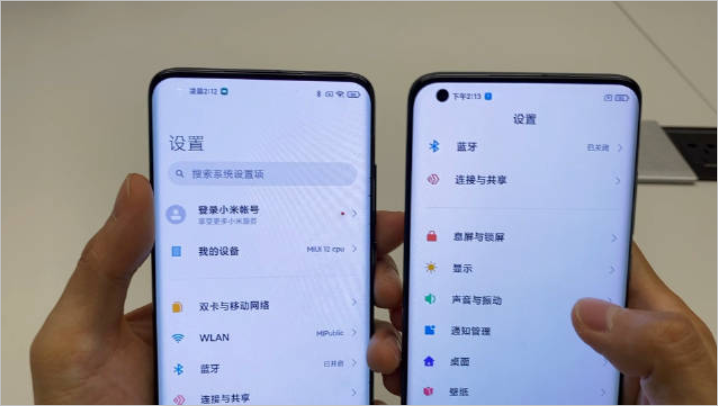
It is already known that Xiaomi has got an under-screen camera phone in the works. The company’s CEO Lei Jun recently released a demo video showing the firm’s perfected third-generation under-screen display in action. Right now, a video of the Mi 10 Ultra having an under-display selfie camera has appeared online.Mi 10 Ultra

The video was shared on Weibo with what appears to be a Xiaomi Mi 10 Ultra packing an under-display camera (UDC) being compared with a couple of other Xiaomi devices. Xiaomi released the Mi 10 Ultra recently in China to mark its 10th anniversary and the device didn’t feature an under-display selfie camera. The unit in this video which clearly is a Mi 10 Ultra considering the rear camera design may likely be an early prototype that ended up not being mass-produced.

However, there are speculations that Xiaomi may possibly launch this under-display version of the Mi 10 Ultra in October or November. There are also speculations that the Chinese tech giant may alternatively only showcase the model just like the Mi Mix before mass-production commences next year. The source clearly indicated that this is a prototype and won’t be released until next year. Xiaomi also stated earlier that it aims to bring this technology to the mass market next year” (2021.

The industry saw its first commercially launched under-display camera-packing phone in the Axon 20 5G recently. The device was a mid-range model and the samples shot on the selfie camera wasn’t that great. Since it is a mid-range model that doesn’t cost so much, the negative reviews won’t be high. We can’t say the same thing about the Mi 10 Ultra which from all intents and purposes is a flagship model. Xiaomi won’t want to test the waters with an expensive machine. Well, except it is sure that the camera quality is devoid of glare and the output is of flagship quality.