Advertisement

100 Million Android users are affected by this Chinese Spyware App

In recent Android builds, the operating system has offered its users an improved degree of control over what resources or areas an application has access to. However, this system is still abused by many applications that do not require many of the permissions they require to operate. Now, a Chinese developer’s apps have been labeled as ‘Spyware’ from a research team that suspects that 100 million Android users have already been affected.

Chinese developer

The research team is from VPNpro that claimed that the developer behind the app also has at least 50 million installs and its apps request “dangerous permissions.” Notably, VPNpro also claimed that one of their apps also has a malicious remote access trojan hidden within it. These applications were found in Google’s Play Store and were made from a Chinese developer and its local subsidiaries. Reportedly, this practice has been seen before with developers hiding behind a network of different subsidiaries.

The Chinese developer behind the abuse was the Hangzhou-based QuVideo Inc. It is best known for its popular video editing app, VivaVideo. This application is extremely popular since it offers its services for free, with the Play Store showing 100 million installs. VivaVideo is also one of the 40 Chinese apps that have been listed as ‘malicious-ware’ or ‘spyware’ by the Indian government back in 2017.

The apps from QuVideo are available on Apple’s iOS as well. However, due to the permissions system and boundaries being different, the abuse of a similar nature isn’t present on that platform. So, those that have these applications are warned to check what permissions you are granting the app.


(Via)

Motorola One Vision Plus Geekbench listing reveals Snapdragon 665 and 4 GB RAM specs

Last year in May, Motorola unveiled the Exynos 9609 powered Motorola One Vision Android One smartphone. Recently, its enhanced edition dubbed as Motorola One Vision Plus was found listed at the Android Enterprise Recommended page. It appears that the company is planning to launch the phone soon as it has appeared on Geekbench benchmarks. Probably, the company could be testing its performance before making it official.

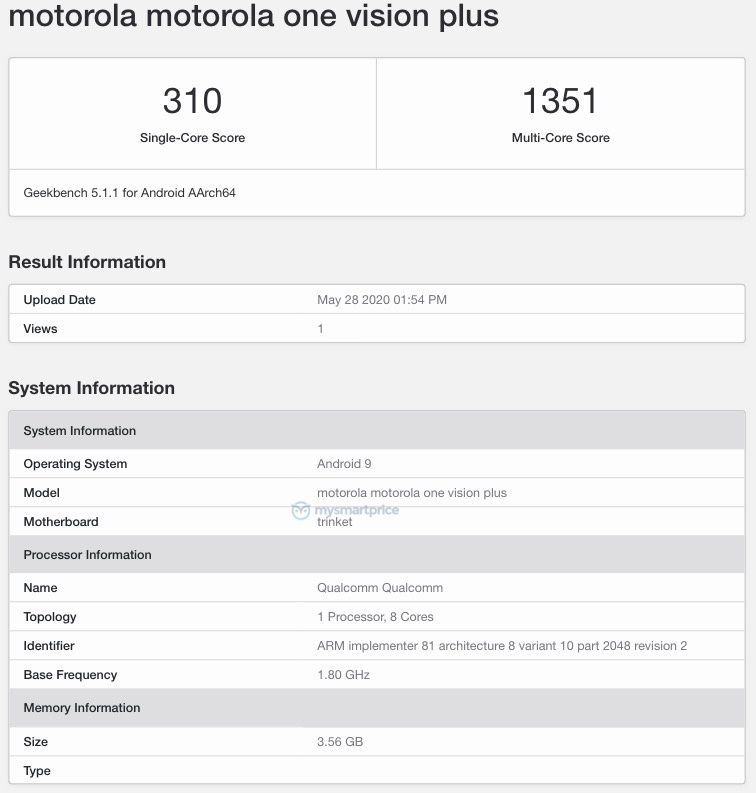
The Motorola One Vision Plus Geekbench 5 appearance states that it scored 310 in the single-core test and 1351 in the multi-core test. The “trinket” text mentioned in the motherboard field is the internal name for the mid-range Snapdragon 665 SoC from Qualcomm. It has a base frequency of 1.80GHz.

The SoC is coupled with 4 GB of RAM and the phone boots to Android 9 Pie OS. The same RAM capacity and Android version was found at the Android Enterprise listing of the smartphone. The listing had further revealed that it has a 6.3-inch display and has an internal storage of 64 GB. The presence of fingerprint reader and support for NFC was also revealed through Android Enterprise appearance.

Motorola-One-Vision-Plus-listing-on-Geekbench

Motorola is yet to confirm the launch of the existence of the Motorola One Vision Plus. Probably, the smartphone may break cover before the end of the first half of the year.

The Motorola One Vision from last year featured a 6.3-inch IPS LCD punch-hole display with support for 21:9 aspect ratio and full HD+ resolution. The SoC was coupled with 4 GB of RAM and it came with 128 GB of UFS 2.1 storage. The Android One featured a front camera of 25-megapixel and a 48-megapixel + 5-megapixel dual camera setup on its back. Its 3,500mAh battery came with support for 15W fast charging.


(source)

[UPDATE: Launch Postponed, Limited Rollout]Android 11 Beta launch event will be live streamed on June 3rd

UPDATE:

While the launch event is officially postponed, the Android 11 Beta update is available for several Pixel devices today.


Original Story.

Google I/O, the technology giant’s annual developers conference, has been canceled this year because of the on-going COVID-19 pandemic. Thus, the company has decided to have an exclusive launch event for the upcoming major Android version — Android 11.

The company will be hosting a launch event on 3rd June for the Android 11 Beta which will be live-streamed. The event’s live stream will start at 15:00 PM UTC (08:30 PM IST) and will last for about an hour.

Android 11 Developer Preview Logo

For those who are unaware, Google was supposed to release the Android 11 Beta version this month but it pushed the update to 1st June and instead released the Android 11 Developer Preview 4 (DP4) version.

Coming back to the launch event, it will include the features packed inside the new Android 11 along with updates for developers. This will be followed by a live Q&A session in which anybody can participate using #AskAndroid hashtag.

Along with this, the company will also make available 12 talks which were scheduled for the Google I/O 2020. Here’s the list of those talks.

  1. What’s new in Android
  2. What’s new in System UI
  3. All things privacy in Android 11
  4. Storage access with Android 11
  5. The state of Kotlin on Android
  6. Get Composed
  7. What’s new in Android Jetpack
  8. What’s new in Android Development Tools
  9. What’s new in Design Tools
  10. What’s new in Google Play
  11. What’s new in Play Commerce
  12. Screens – large, small and foldable

The company was earlier rumored to announce the Pixel 4a smartphone at this same event but as per the latest reports, the launch event for the Google Pixel 4a has been delayed till mid-July and the sale for the same is expected to talk place in August.

You can find out the list of all the exciting features of Android 11 here. You can watch the live stream on YouTube as well as Twitter.


OnePlus and Fortnite collaborate to bring new game modes in Creative Island

Fortnite, one of the most popular games in the market, is partnering with the known smartphone vendor OnePlus. The collaboration will bring a new game mode to Epic Game‘s battle royale.

OnePlus

The new Creative Island is a part of Fortnite’s in-game Creative mode. The new game mode within the game will allow players to test their skills in a series of mini-games. Dubbed as “90”, the new Creative Island will have 5 unique mini-games. Each of these games will last for about 90 seconds, with the focus on the player’s speed and adaptability.

For example, the Color Dash mini-game will test players’ abilities to color as many times as possible within a fixed time frame, with gravitational effects also coming into play. Another one is Skydrive Shootout, where players are pitted against one another, testing their capabilities against one another while skydiving. The announcement that unveiled the new Creative Island arrives just after OnePlus and Fortnite brought 90fps streaming to OnePlus phones.

OnePlus 8 series Fortnite
OnePlus 8 series can stream Fortnite at 90fps

For those unaware, OnePlus smartphones are capable of streaming Fortnite at 90fps, offering both a better visual experience thanks to the smoothness and improved gameplay due to better responsiveness. Notably, OnePlus has been an active figure in the entire gaming industry, it is a known partner of popular esports organizations like Fnatic and even sponsors popular streamers like Shroud. So, it comes as no surprise that it is actively collaborating with gaming studios.


(Via)

Meizu dual-screen smartphone leak shows rounded secondary screen and Samsung chipset

Meizu, which recently launched its flagship Meizu 17th smartphone in its home country China. The company has worked on some interesting smartphone designs and now a smartphone with dual display setup has been leaked online.

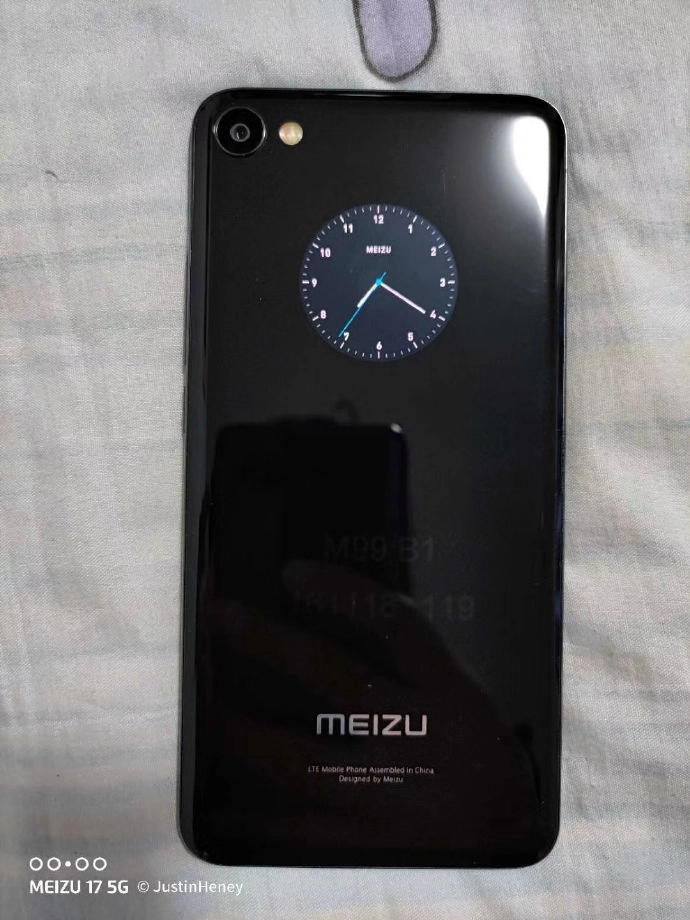
The leaked image shows that the phone has a secondary screen on the back panel. It also shows that the device is powered by the Samsung Exynos 8890 chipset and features a single rear camera sensor.

Meizu Dual Screen Smartphone Leak

While nothing much is known about this smartphone, the report claims that the device in question could have been named Meizu Pro X. Given the smartphone’s design and the chipset used, it seems that the company was working on it around 2006 but the device never made it commercially.

However, the company did come up with a dual-screen smartphone when it finally launched Meizu Pro7 and Pro7 Plus. The smartphones come with a small 1.9-inch AMOLED screen on the top-left corner on the phone’s back.

The company’s latest flagship smartphones — the Meizu 17 series went official earlier this month and a couple of weeks back, the phones were up for sale in China for the first time and got sold out in under a minute.

Meizu 17 has a starting price of 3,699 Yuan which is about $522 whereas the Meizu 17 Pro begins at 4,299 Yuan which roughly converts to $607. The Meizu 17 comes in Mint, Black, and White colors while the Pro model is offered in Green, Gray, and Aurora White colors.

Recently, Meizu joined the P2P File Transfer Alliance along with OenPlus, Realme, and Black Shark. The alliance, which already has Xiaomi, OPPO, and Vivo as members, enables cross-device file transfer protocol at high-speed without the need for third-party apps.

(Via)

Redmi K30 Pro price slashed by 400 Yuan (~$56) for 618 sales in China

Apart from November 11 (also known as Double 11), China is known for organizing 618 shopping festival from June 1 to June 18 each year. With June 1 fast approaching, Chinese smartphone brands are coming up with exciting offers for the forthcoming 618 sales. Redmi today confirmed that it will be offering up to 400 Yuan discount for the buyers of Redmi K30 Pro 5G phone between June 1 and June 3.

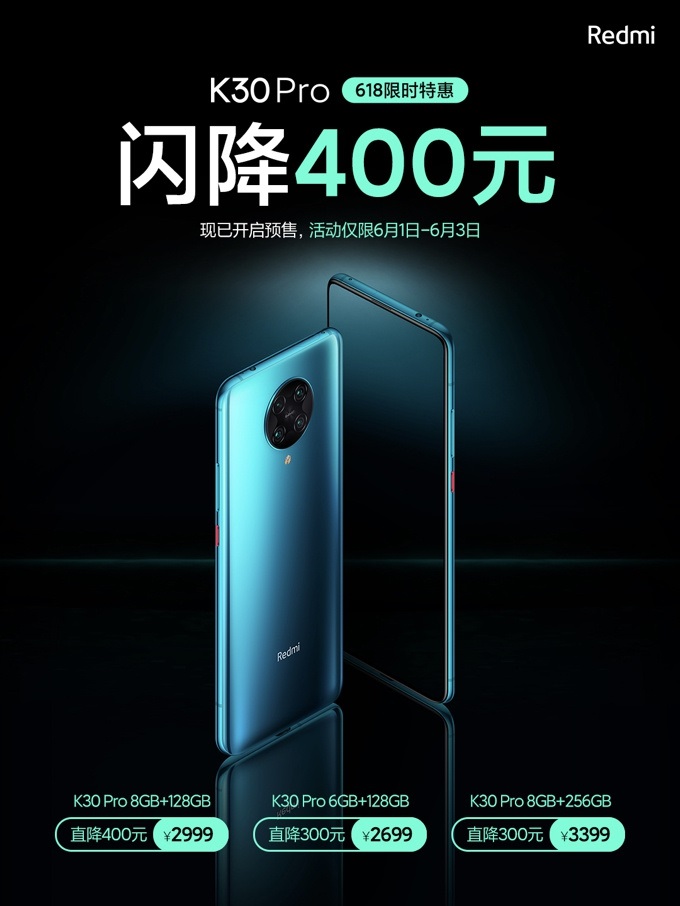
The above poster shows that the Redmi K30 Pro 5G’s 8 GB RAM + 128 GB storage variant will be available with 400 Yuan (~$56) discount. The discount effectively brings down the price of the variant to 2,999 Yuan (~$414).

Redmi K30 Pro discount for 618 sales

The Redmi K30 Pro’s 6 GB RAM + 128 Gb storage and 8 GB RAM + 256 GB storage models will come with 300 Yuan (~$42) price cut. These models can be purchased with revised pricing of 2,699 Yuan (~$377) and 3,399 Yuan (~$475) during the first three days of June month in China.

Redmi K30 Pro 5G specifications

The Redmi K30 Pro 5G has a 6.67-inch notch-less AMOLED display that supports full HD+ resolution. It has an in-screen fingerprint reader. The Snapdragon 865 mobile platform powers the device with LPDDR5 and UFS 3.1 storage. It lacks a microSD card slot and comes preinstalled with MIUI 11 based Android 10 OS.

The 4,700mA battery of the Redmi K30 Pro 5G supports 30W fast charging. It has a pop-up selfie camera of 20-megapixel. The rear shell of the phone features a quad camera system that includes a 64-megapixel Sony IMX686 main lens, a 5-megapixel telephoto macro shooter, a 13-megapixel ultrawide lens and a 2-megapixel depth sensor.


Qualcomm FastConnect 6900 and 6700 announced with Wi-Fi 6E and Bluetooth 5.2

Qualcomm has announced a flagship portfolio of mobile connectivity systems — Qualcomm FastConnect 6900 and 6700. The new offerings come with support for the latest wireless communications standards and the company says that they are built from scratch.

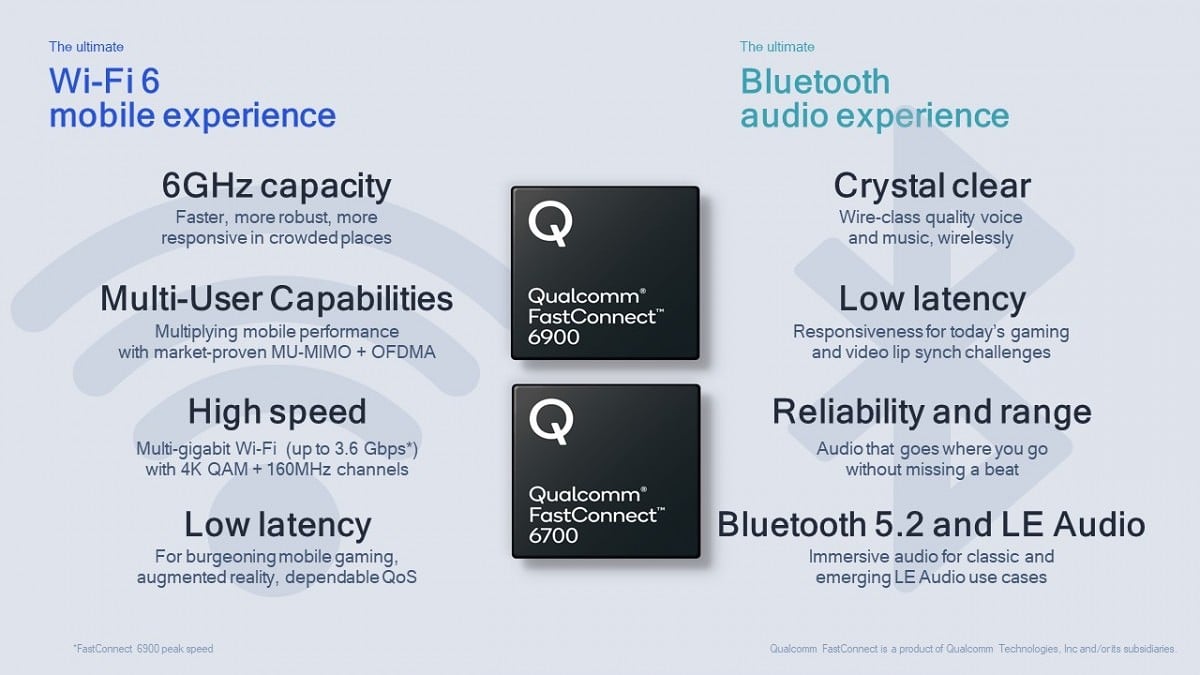
Both, the Qualcomm FastConnect 6900 and Qualcomm FastConnect 6700  supports Wi-Fi 6 which is the fastest available Wi-Fi speeds in the industry (up to 3.6 Gbps), along with VR-class low latency and Bluetooth advancements for immersive audio experiences.

Qualcomm FastConnect 6900 and 6700

With the Wi-Fi 6E-enabled chipset, devices will be able to use the 6GHz frequency when other frequencies are being used by other devices. Now combine that with Bluetooth 5.2 and you get lower latency on peripherals, as close to a wired connection as possible.

Notably, FastConnect 6900 offers the fastest available Wi-Fi 6 speed, up to 3.6 Gbps while the FastConnect 6700 offers peak speeds of 3 Gbps. This is because 6900 has an extra boost of performance through additional implementation of 4-stream Dual Band Simultaneous (DBS) with multi-band (including 6GHz) capabilities.

The Bluetooth 5.2 implementation includes a second Bluetooth antenna with intelligent switching capabilities to overcome common signal shadowing issues for unparalleled Bluetooth reliability and range.  It is engineered to be ready to address emerging LE Audio experiences such as multi-point audio sharing and broadcast audio, enabling multiple audio connections simultaneously.

Features for the next-generation Wi-Fi 6E technology offered includes the following:

  • It dramatically expands Wi-Fi capacity by adding up to 1200MHz of additional spectrum, more than doubling the number of pathways currently available for sending and receiving data.
  • Dual-band 160MHz supports up to seven additional non-overlapping channels in the 6GHz band, in addition to 160MHz channels available in the 5 GHz band.
  • Deploys high-performance Uplink / Downlink MU-MIMO and OFDMA mobile technologies across all available bands.
  • New Wi-Fi 6 Uplink MU-MIMO capability increases network capacity by more than 2.5x.


OnePlus 8 5G special sale in India at 12 PM today

The OnePlus 8 series of flagship phones were made official in April. While the OnePlus 8 5G and OnePlus 8 Pro 5G have been available for purchase in some markets across the globe, India is one of the major regions where the sales of these phones have not started yet. The Chinese firm had planned to carry out the first sale of the OnePlus 8 series in India on May 29. However, it recently confirmed that the OP8 series first sale for India has been postponed due to a temporary halt in its production last week. Still, as promised, the company will be conducting a special sale of the OnePlus 8 5G smartphone in India at 12 PM (local time).

The OnePlus 8 5G comes in three choices such as 6 GB RAM + 128 GB storage, 8 GB RAM + 128 GB storage and 12 GB RAM + 256 GB storage. They are priced at Rs. 41,999 (~$555), Rs. 44,999 (~$594) and Rs. 49,999 (~$661). Onyx Black, Glacial Green, and Interstellar Glow are three color variants of the smartphone. SBI cardholders can take advantage of Rs. 2,000 discount on the purchase of OnePlus 8 5G. Customers can also take advantage of no-cost EMI for up to 12 months while availing the handset.

OnePlus 8

OnePlus 8 5G specifications

The OnePlus 8 5G has a 6.55-inch Fluid AMOLED full HD+ display with support for a 90Hz refresh rate. The Snapdragon 865 SoC fuels the device with LPDDR5 RAM and UFS 3.0 storage. The Android 10 OS with OxygenOS 10 comes preinstalled on the phone. It has a 48-megapixel + 16-megapixel (ultrawide) + 2-megapixel (macro) triple camera system on its rear and it has a front camera of 16-megapixel. The device houses a 4,300mAh battery with 30W fast charging support.

On May 18, it had made the OnePlus 8 5G available through an early bird sale for its fans. The smartphone was sold out in a few seconds. Today too, the handset is expected to receive similar response from buyers.


OPPO Reno4, 4 Pro to launch on June 5; Live shots appear

OPPO’s upcoming Reno4 series was recently spotted on TENAA with full specifications. Multiple leaks have revealed the appearance of the Reno4 5G and Reno4 Pro 5G smartphones. Today, the Chinese firm confirmed through Weibo that the Reno4 series will be announced on June 5 in China.

The OPPO Reno4 series launch event will be held at 19:30 PM (local time) on June 5. The video released by the company highlights the brilliant design of the Reno4 series phone. The handset shown in the video is the Rneo4 Pro.

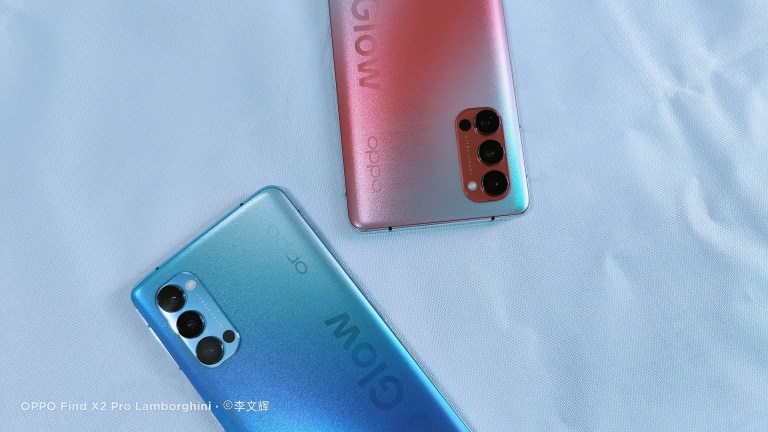
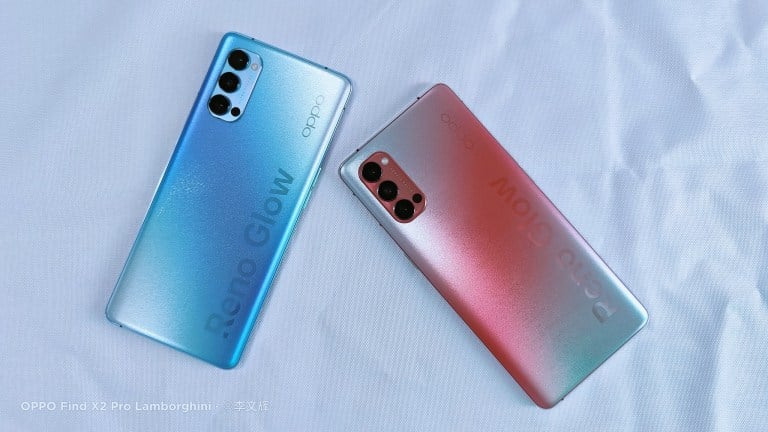
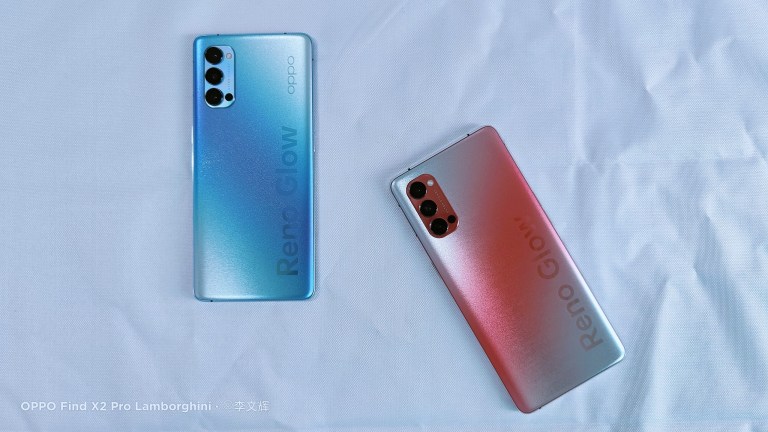
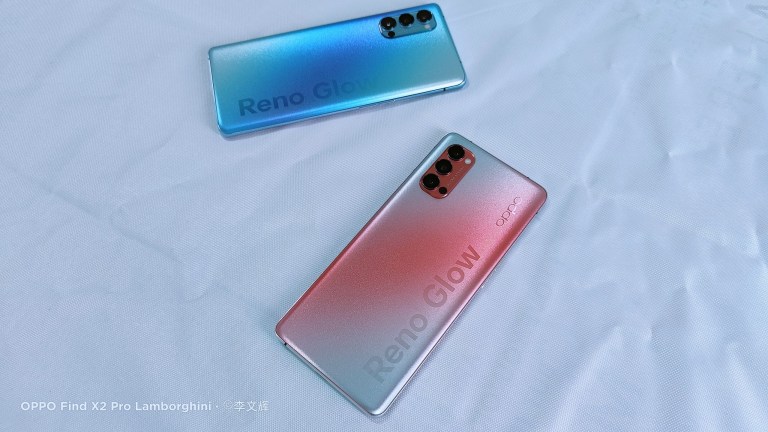
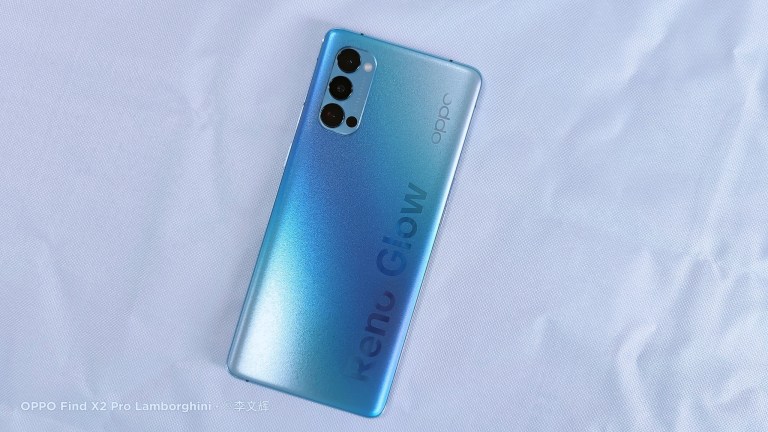
The OPPO Reno4 Pro 5G has a full HD+ 6.5-inch display with curved edges and a punch-hole at the upper-left corner. It supports full HD+ resolution and is said to support the 90Hz refresh rate. The glass rear of the smartphone has the ‘Reno Glow” text imprinted on it and it has a triple camera system assisted by an LED flash and laser autofocus unit.

The Reno4 Pro’s triple camera system is said to feature an OIS-ready 48-megapixel lens, a 12-megapixel ultrawide lens, and a 13-megapixel telephoto sensor. It has a front camera of 32-megapixel. The bottom edge of the phone is populated with a SIM slot, a USB-C port, and a speaker grille and it lacks a 3.5mm headphone slot. The handset is shown in blue and orange colors.

Shown above are a couple of live shots of the Reno4 Pro handset. The tipster who shared the real-life images on Weibo claims that the handset is built with the crystal drill process. The wear-resistant rear of the device does not fingerprint marks.

The OPPO Reno4 5G has a Full HD+ 6.43-inch S-AMOLED display with a pill-shaped punch-hole for 32-megapixel + 2-megapixel dual selfie setup. It has a 48-megapixel + 8-megapixel (ultrawide) + 2-megapixel (depth) triple camera system. Both phones are rumored to be fueled by Snapdragon 765G. They have 4,000mAh batteries with 65W fast charging support.


(via)

Redmi 10X 5G vs Redmi K30i vs Xiaomi Mi 10 Youth: Specs Comparison

Xiaomi is one of the company with the best portfolio of affordable 5G phones in 2020. In the last few months, the company released a lot of 5G mid-rangers in China. The latest ones are Redmi 10X 5G, Redmi K30i and Xiaomi Mi 10 Youth. The first is a device from a brand new lineup, the second is an affordable variant of the K30 5G also known in India as the POCO X2, and the third was also launched in the global market under the Xiaomi Mi 10 Lite 5G moniker. If you live in China and you are looking for a very affordable 5G phone but you do not know which one should you choose, you are in the right place. Here is a specs comparison between Redmi 10X 5G, Redmi K30i and Xiaomi Mi 10 Youth.

Xiaomi Redmi 10X 5G vs Xiaomi Redmi K30i vs Xiaomi Mi 10 Youth

Xiaomi Mi 10 Youth Xiaomi Redmi K30i Xiaomi Redmi 10X 5G
DIMENSIONS AND WEIGHT 164 x 74.8 x 7.9 mm, 192 g 165.3 x 76.6 x 8.8 mm, 208 grams 164.2 x 75.8 x 9 mm, 205 grams
DISPLAY  6.57 inches, 1080 x 2400p (Full HD+), Super AMOLED 6.67 inches, 1080 x 2400p (Full HD+), IPS LCD 6.57 inches, 1080 x 2400p (Full HD+), AMOLED
PROCESSOR Qualcomm Snapdragon 765G, octa-core 2.4 GHz Qualcomm Snapdragon 765G, octa-core 2.4 GHz MediaTek Dimensity 800, octa-core 2.6 GHz
MEMORY  6 GB RAM, 64 GB – 6 GB RAM, 128 GB – 8 GB RAM, 128 GB – 8 GB RAM, 256 GB 6 GB RAM, 128 GB 6 GB RAM, 64 GB – 6 GB RAM, 128 GB – 8 GB RAM, 128 GB – 8 GB RAM, 256 GB
SOFTWARE  Android 10, MIUI Android 10, MIUI Android 10, MIUI
CONNECTIVITY  Wi-Fi 802.11 a/b/g/n/ac, Bluetooth 5.1, GPS Wi-Fi 802.11 a/b/g/n/ac, Bluetooth 5.1, GPS Wi-Fi 802.11 a/b/g/n/ac, Bluetooth 5.1, GPS
CAMERA  Quad 48 + 8 + 5 + 2 MP, f/1.8 + f/2.2 + f/2.4 + f/2.4
16 MP f/2.5 front camera
 Quad 48 + 8 MP + 2 + 2 MP f/1.8, f/2.2, f/2.4 and f/2.4
Dual 20 + 2 MP f/2.2 + f/2.4 front camera
Triple 48 + 8 + 2 MP f/1.8, f/2.2 and f/2.4
16 MP f/2.3 front camera
BATTERY  4160 mAh, fast charging 20W  4500 mAh
Fast charging 30W
4520 mAh, Fast charging 22.5W
ADDITIONAL FEATURES Dual SIM slot, 5G Dual SIM slot, 5G Dual SIM slot, 5G

Design

With its very attractive dual punch-hole display and its premium materials, I think Redmi K30i deserves the design award. It is the only not coming with a waterdrop notch, it has a smaller camera module on the rear side and it has both a glass back and an aluminum frame, just like flagships. On the other hand, Redmi 10X 5G and Xiaomi Mi 10 Youth offer more compact bodies, despite their notches. Redmi 10X 5G is even splash resistant, while its internal rivals do not offer any protection against water.


Display

If you love having the most impressive display quality, then you might prefer the AMOLED display found on both Redmi 10X and Xiaomi Mi 10 Youth, which also comes with the HDR10+ certification. But if you are a gamer, for you it might be better to go for the Redmi K30i because, despite its IPS display, it comes with a 120 Hz refresh rate. With a so high refresh rate, you get a very smooth viewing experience, that is amazing during gaming sessions.


Hardware/Software

The key feature of Xiaomi Mi 10 Youth, Redmi K30i, and Redmi 10X 5G is the presence of 5G connectivity thanks to a 5G integrated modem. It is actually very rare to find it at a so affordable price. Xiaomi Mi 10 Youth and Redmi K30i come with a more powerful chipset: the octa-core Snapdragon 765G. Redmi 10X 5G has a Dimensity 800 by MediaTek, not as amazing as the Snapdragon 765G but still a very nice processor. Note that with the Redmi K30i you only get 6 gigs of RAM and 128 GB of native storage, while Xiaomi Mi 10 Youth goes up to 8 GB paired with 256 GB of internal storage. Android 10 is out of the box on all of these devices with the same MIUI 11 customization.


Camera

The most awesome rear cameras are mounted on the Xiaomi Mi 10 Youth. It has the same 48 MP main sensor as the Redmi K30i and Redmi 10X 5G, but it includes an 8 MP periscope sensor with 5x optical zoom, unlike its two opponents which do not even feature a telephoto lens. Redmi K30i is superior when it comes to rear cameras, thanks to its dual 20 + 2 MP selfie camera. Redmi 10X 5G is the most disappointing one as it lacks both a telephoto lens and a macro camera.


Battery

On 5G phones battery life is more important compared to 4G phones, that is why battery capacities increased on 2020 devices. With the Redmi 10X 5G, you will most likely achieve a longer battery life in most of the scenarios since it has the biggest battery and the most efficient components. Redmi K30i has a similar battery capacity, but its wider IPS display with a higher refresh rate will likely be more energy-demanding and it will have higher consumption.


Price

You need just €200/$220 to grab a unit of the Redmi 10X 5G, Redmi K30i costs €250/$275 and Xiaomi Mi 10 Youth starts from €265/$295. The Xiaomi Mi 10 Youth wins the comparison thanks to its better cameras, the best hardware, and a very nice display, but just by a low margin. Also, note that Xiaomi Mi 10 Youth has a way smaller battery than its rivals. You should go for the Redmi K30i if you do not care about having the best optical zoom and the best image quality, while there is no valid reason to choose the Redmi 10X 5G unless you want a Xiaomi Mi 10 Youth with worse cameras and a bigger battery.


Xiaomi Redmi 10X 5G vs Xiaomi Redmi K30i vs Xiaomi Mi 10 Youth: PRO and CONS

Xiaomi Mi 10 Youth

PROS

  • Better hardware
  • HDR10+ display
  • AMOLED display with in-display fingerprint scanner
  • Slimmer design

CONS

  • Nothing particular


Xiaomi Redmi 10X 5G

PROS

  • AMOLED display with in-display fingerprint scanner
  • HDR10+ display
  • Great battery life
  • Splash resistant

CONS

  • Less impressive cameras


Xiaomi Redmi K30i

PROS

  • Wider display
  • Great cameras
  • 120 Hz display
  • Faster charging

CONS

  • IPS display

HMD Global announces Nokia C5 Endi, Nokia C2 Tava, and Nokia C2 Tennen for Cricket Wireless

HMD Global announced three new smartphones today in partnership with Cricket Wireless. The phones which are members of the C-series are the Nokia C5 Endi, Nokia C2 Tava, and Nokia C2 Tennen.

Nokia C5 Endi
Nokia C5 Endi
Nokia C5 Endi

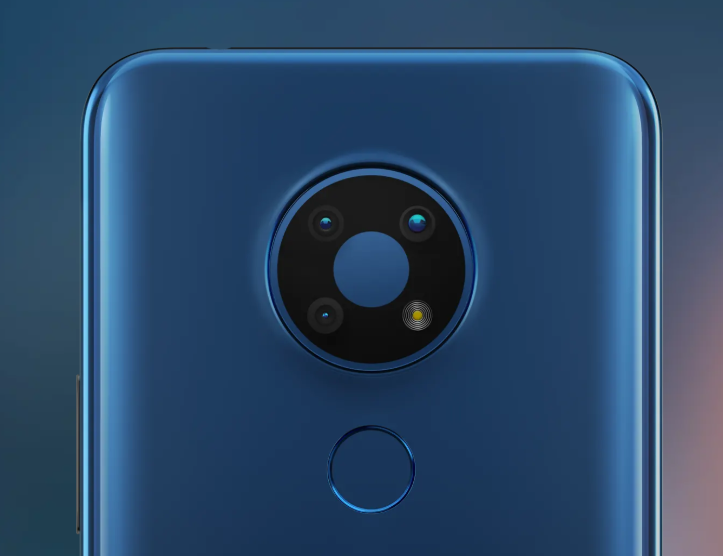
The Nokia C5 Endi looks like the Nokia 7.2 and Nokia 6.2 with its waterdrop notch and its cookie-shaped triple rear cameras. However, it is not a rebadge of any of the aforementioned phones.

The phone has a 6.517-inch HD+ screen (720 x 1600) with a pretty thick lower bezel. The body of the phone is made from high-tech polycarbonate that HMD Global claims is light but solid and has “a rigid unibody structure designed to take on the everyday knocks of life”.

It is powered by a MediaTek Helio P22 processor with 3GB of RAM and 64GB of storage that can be expanded via a MicroSD card slot.

Nokia C5 Endi cameras

The triple rear cameras are a 13MP primary sensor, a 5MP ultrawide angle camera, and a 2MP depth sensor. The camera app comes with features such as AI scene detection, Recommended Shot, Low-light photography, and Portrait mode. The selfie camera is an 8MP sensor.

The Nokia C5 Endi has a rear-mounted fingerprint scanner and underneath the polycarbonate body is a 4000mAh battery with support for 10W charging (5W charger included in the box). It has Bluetooth 5.0, an audio jack, FM radio, a dedicated Google Assistant button, and a single nano-SIM slot. HMD Global ships the phone with Android 10 out of the box

The Nokia C5 Endi will be available for purchase from Cricket Wireless beginning June 5, 2020, for $169.99. It will come in a single color variant called Midnight Blue.


Nokia C2 Tava and Nokia C2 Tennen

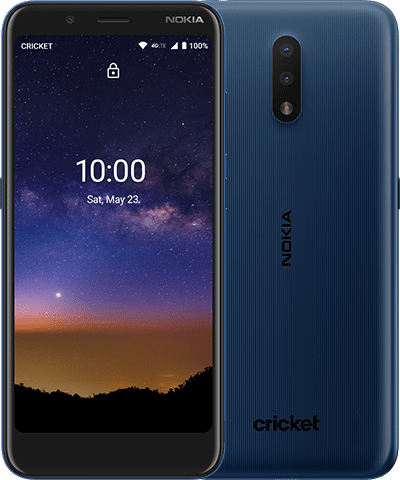
Both phones share the same specs all through but sell for different prices. They do look like the Nokia 2.3 but are actually much smaller.

Nokia C2 Tava

The two phones have a 5.45-inch HD+ display with thick bezels at the top and bottom of the screen. There is MediaTek’s Helio A22 chipset under the hood along with 2GB of RAM and 32GB of expandable storage.

Users will get two rear cameras – an 8MP primary camera and a 2MP secondary camera. There is also a 5MP camera in front for selfies and it has its own flash.

There is no fingerprint scanner but you get advanced AI Face Unlock which the Nokia C5 Endi also has. You also get a dedicated Google Assistant button, an audio jack, a USB Type-C port, Bluetooth 4.2, and an FM radio.

Nokia C2 Tennen

The two phones ship with 3000mAh batteries with support for 10W charging, however, you only get a 5V 1A charger in the box. Android 10 comes pre-installed with both phones.

The Nokia C2 Tava is priced at $109.99 and will be available in Tempered Blue at Cricket Wireless retail stores and on the Cricket Wireless website beginning May 29, 2020.

The Nokia C2 Tennen will sell for $69.99 and will be available in Steel at select National retail stores beginning June 15, 2020.

HMD Global may still launch these phones under different names in other markets.


Leak suggests Samsung may be planning a return to removable batteries

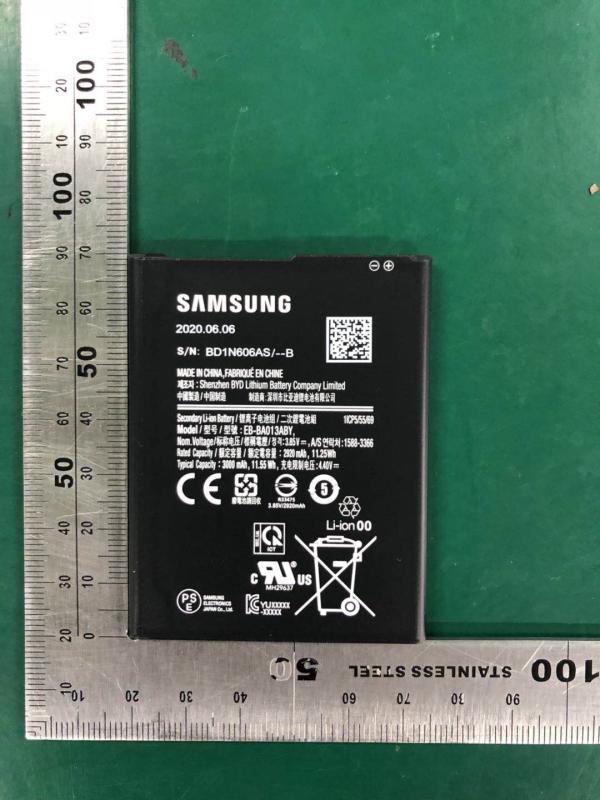
One of the biggest regrets regarding the technological (and aesthetic) renewal process of today’s smartphones concerns the abandonment of the much appreciated removable batteries. The convenience of being able to easily replace a battery at the end of its life with a new one is a feature that most of us won’t mind having back on smartphones. But there is a manufacturer that could retrace its steps and bring this feature back to life, at least on low-end models.Samsung SM-A013F


That manufacturer is Samsung, which according to a recent leak could be thinking of equipping a future entry-level device with a removable battery. As can be seen from the photo in the gallery, the model in question is identified with the model number SM-A013F. It is believed that the model may launch as Galaxy A01e.

Samsung used to release its phones with a removable battery. Even when other OEMs had switched to non-removable cells, Samsung’s entry-level models were still shipping with removable batteries. We recall the Tizen-powered Samsung Z series were all launched with removable batteries. However, there isn’t a recent release with such feature but with this leak, there’s is the possibility of a return of removable battery soon.

Going to the bottom, in fact, it was discovered that the SM-A013F code is a model in development, with a 3,000mAh battery and 16/32 GB of internal memory. Perhaps, Samsung is listening to the yearnings of its fans with this discovery. We expect the release of this model to trigger a chain reaction among phone manufacturers. It would be fun to have such design on low-end and even mid-range models which usually don’t have IP ratings.

Would you like to see a return of removable battery on phones? Let us know what you think in the comments section.


(source)


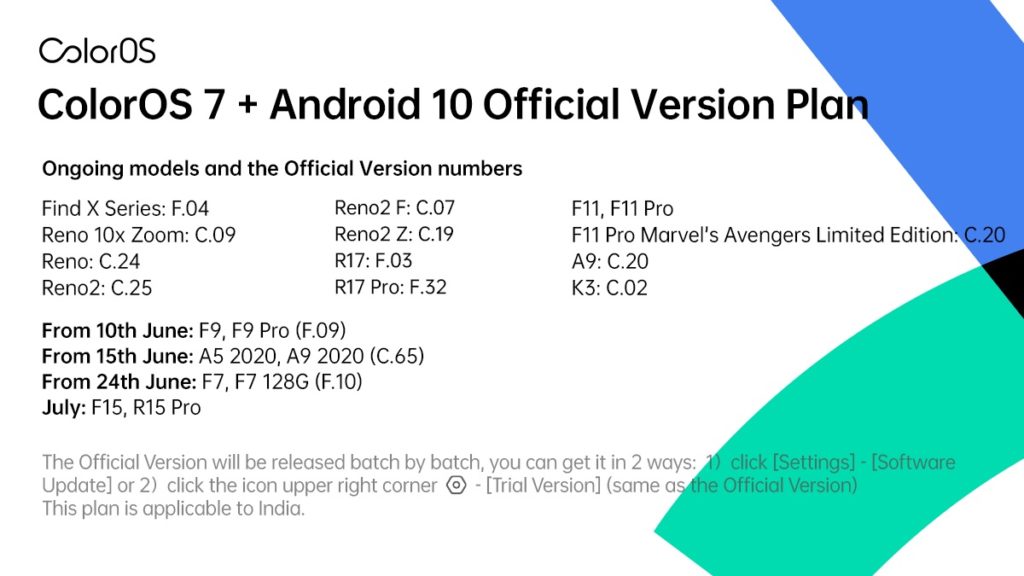
Oppo releases ColorOS 7 stable update timeline for India

Oppo announced ColorOS 7 back in November 2019 but the company is yet to update its devices. In fact, it only started releasing stable updates in early April for the first batch of handsets in China. Since then, the brand has been seeding out updates to various phones across different regions. Now, it also shares the stable update timeline for India.

Oppo ColorOS 7 Stable Update Timeline India

Last, when we covered ColorOS 7, Oppo had released stable update timeline for Europe and Australia. Now, we are back with the same for India.

So far, the company has updated the following smartphones to ColorOS 7 in India.

  • Oppo Find X Series
  • Oppo Reno 10X Zoom Editon
  • Oppo Reno
  • Oppo Reno 2
  • Oppo Reno 2 F
  • Oppo Reno 2 Z
  • Oppo R17
  • Oppo R17 Pro
  • Oppo F11
  • Oppo F11 Pro
  • Oppo F11 Po Marvel’s Avengers Limited Edition
  • Oppo A9
  • Oppo K3

The above-mentioned devices are currently receiving the update in batches. Users can check for the update by navigating to Settings -> Software Update -> Gear Icon -> Trial Version. The company says the trial version is nothing but a stable build.

Further, the brand also announced the ColorOS 7 stable update timeline for smartphones that are yet to receive in India.

  • From June 10
    • Oppo F9
    • Oppo F9 Pro
  • From June 15
    • Oppo A5 2020
    • Oppo A9 2020
  • From June 24
    • Oppo F7
    • Oppo F7 128GB
  • In July
    • Oppo R15
    • Oppo R15 Pro

If you happen to own an Oppo smartphone that has received ColorOS 7 stable update in India, then do share your experience in the comment section below.


(Via)

ZTE Axon 11 SE TMall & JD listings confirm previously leaked specs

ZTE is set to launch its next smartphone in a few days. The device will be called Axon 11 SE and will be the first handset to support 5G on all four carriers in China. Unlike other brands, ZTE is not teasing the features of its upcoming phone. But thanks to TENAA and now TMall and JD listings, we know most of the specs of this device.

ZTE Axon 11 SE Specs Render Leak

The TMall and JD listings of ZTE Axon 11 SE do not have the renders of the device except for the above low-quality one but they do reveal some of the primary specs of the handset.

According to them, the upcoming 5G phone from ZTE will sport a 6.53-inch FHD+ LCD screen. It will be powered by MediaTek Dimensity 800 SoC paired with 6GB / 8GB RAM and 128GB / 256GB internal storage.

Further, it will feature a quad-camera setup consisting of a 48MP primary sensor, an 8MP ultra-wide shooter, and two 2MP snappers (likely macro and depth). As for selfie, it will come with a single 16MP camera at the front.

As per TENAA listing, the handset will run Android 10 and will be backed by a 4,000 mAh battery. Other features of the ZTE Axon 11 SE includes USB Type-C, 3.5mm headphone jack, and a rear-mounted fingerprint sensor.

The phone will be officially announced on June 1 and as far as pricing is concerned, it is expected to cost under 2,000 Yuan ($280).


(Via)

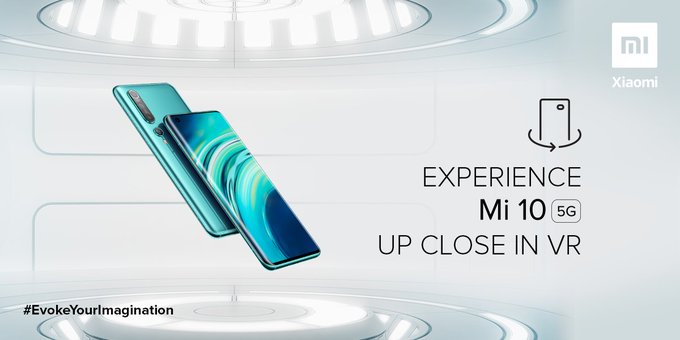
Xiaomi Mi 10 5G gets VR hands-on experience too

Do you remember the Mi 10 Youth Edition virtual unboxing from exactly a month ago? The Mi 10 5G has gotten a similar treatment (there is no unboxing). This means you can get a virtual “hands-on” experience of Xiaomi’s flagship phone.

The VR experience allows you to see what the phone looks like to the tiniest detail. You can even switch between the two color variants available which are Twilight Grey and Coral Green.

Mi 10 5G VR


The Mi 10 5G was announced back in February in China before making its way to other markets and then India early this month.

The phone has a 6.67-inch FHD+ screen with a punch-hole at the top left corner. It is powered by a Snapdragon 865 processor with up to 12GB of RAM and 256GB of storage.

The Mi 10 5G has a 108MP quad-camera setup on the back. The other three sensors are a 13MP ultrawide camera, a 2MP macro camera, and a 2MP depth sensor. There is also a 20MP camera in front for selfies.

Xiaomi ships the phone with a 4780mAh battery with support for 30W fast wired and 30W fast wireless charging. It also supports 5W reverse wireless charging. The phone has an in-display fingerprint scanner, NFC, an IR blaster, stereo speakers, and runs Android 10 out of the box.

You can check out the phone in VR here.

(Source)


Samsung Galaxy Fold 2 components have reportedly entered mass production

Rumours have been rife about Samsung‘s next-generation Galaxy Fold model. The Galaxy Fold 2 is expected to be launched around August 2020. It is already over a year since the company unveiled the first-gen Fold but the tech giant kept fans busy with an impressive Galaxy Z Flip foldable model which was unveiled in February this year.

Samsung-Galaxy-Fold-2-Render--Benjanim Geskin
Samsung Galaxy Fold 2 render by Benjamin Geskin

The company has now reportedly commenced mass production of the Galaxy Fold 2 smartphone parts through major partners. Based on recent report details about Galaxy Fold 2 is expected as early as June. The company will use UTG (ultra-thin glass) used in the Galaxy Z Flip in the Fold 2. UTG is considered to be superior to CPI (transparent polyimide) present in Galaxy Fold.

The Galaxy Fold 2 is rumoured to house a larger outer Dynamic AMOLED LTPS display of 6.23 inches. The 60Hz panel that will also feature a punch-hole cutout is said to support 819 x 2267 pixels. In comparison, the original Galaxy Fold has a 4.6-inch outer screen and an inner flexible display of 7.3 inches. The outer display of Fold 2 may have the punch-hole at the top-centre position. The phone will be available in 4G and 5G variants, both powered by Qualcomm’s Snapdragon 865 SoC.

There are rumours that the Fold 2 will be unveiled alongside the Galaxy Note 20 and Galaxy Note 20+ at its Unpacked event sometime in August.


(source)


Amazfit T-Rex is coming to India too next month

Huami’s Amazfit line of smartwatches is sold in key markets including India. A few days ago it was reported that the Amazfit Bip S will be announced in India on June 3. Today, it has been confirmed that the rugged smartwatch, the Amazfit T-Rex, will also make its way to the country.

Amazfit T-Rex India

Just like the Amazfit Bip S, the Amazfit T-Rex will be sold by Amazon when it launches in the second week of June. There is even a promotional page already live on the site.

The Amazfit was announced earlier this year at CES 2020 with a price tag of ¥799 (~$111). Available in five colors, the Amazfit T-Rex is Huami’s most durable watch. It has a rugged design and boasts 12 military certifications.

The watch packs a 1.3-inch AMOLED display with several watchfaces to choose from. There is a high-precision GPS chip from Sony inside. The Amazfit T-Rex has 14 sports modes including elliptical training, hiking, climbing, and trail running. It is also water-resistant up to 50 meters.

Other features include 24-hour heart rate monitoring, call reminder, app notification support, and more. Its battery life is put at 20 days and it goes up to 66 days in basic watch mode.

We have no idea how much it will cost in India but Huami should price it competitively. You can sign up to be notified about its availability here.


DxOMark announces best smartphones for camera, selfie, & audio, Huawei P40 Pro wins big time

DxOMark has been existing for over a decade but it came into light after the company started reviewing smartphone cameras. The original Google Pixel was one of the first phones to be advertised with the DxOMark score. Last year, the company even began to review audio performance of handsets. Having said that, it has now released the list of best camera, selfie, and audio smartphones.

DxOMark Best Smartphone Camera Selfie Audio
Image Source: DxOMark

DxOMark Camera and DxOMark Audio teams review smartphones on a regular basis when new devices hit the markets. They never publish stories on best smartphones for camera, selfie, and audio since it can be easily known from the website’s homepage. 

Surprisingly, they did publish them now and here we are doing a PSA. The company has posted three different posts for each category and listed the best device along with runner-ups. That being said, let us take a look at the winners.

DxOMark Best Smartphone Cameras

DxOMark has divided this category into 6 sub-categories and the Huawei P40 Pro wins 4 of them since it is still the unbeatable king with an overall camera score of 128.

 Anyway, here are the winners and runner-ups of DxOMark best smartphone cameras.

Best for Photo

Winner
Runner-ups

Huawei P40 Pro

Honor 30 Pro Plus

Huawei Mate 30 Pro 5G


Best for Video

Winner
Runner-ups

Huawei P40 Pro

Honor 30 Pro Plus

Xiaomi Mi 10 Pro


Best for Wide

Winner
Runner-ups
Samsung Galaxy S20 Ultra

Samsung Galaxy S20 Plus

Samsung Galaxy Note 10 Plus


Best for Night

Winner
Runner-ups
Huawei P40 Pro

Honor V30 Pro

Honor 30 Pro Plus


Best for Zoom

Winner
Runner-up

Huawei P40 Pro

Xiaomi Mi 10 Pro


Best for Bokeh

Winner
Runner-ups
Samsung Galaxy Note 10+ 5G

Honor V30 Pro

Samsung Galaxy S20 Ultra

DxOMark Best Smartphone Selfie Cameras

This category includes two sub-categories and they are selfie photo and selfie video respectively. Unsurprisingly, Huawei P40 Pro wins in both with some Samsung Galaxies as runner-ups.

Best for Selfie Photo

Winner
Runner-ups

Huawei P40 Pro

Huawei Nova 6 5G

Samsung Galaxy S20 Ultra


Best for Selfie Video

Winner
Runner-ups

Huawei P40 Pro

Samsung Galaxy S20 Ultra

Samsung Galaxy Note 10+ 5G

DxOMark Best Smartphones For Audio

This is the only category in which the Huawei P40 Pro neither wins or nor gets a runner-up tag. The Xiaomi Mi 10 Pro wins in this category for audio playback, whereas the Honor V30 Pro performs well in audio recording.

Best for Audio Playback

Winner
Runner-ups

Xiaomi Mi 10 Pro

Huawei Mate 20 X

Oppo Find X2 Pro


Best for Audio Recording 

Winner
Runner-ups

Honor V30 Pro

Huawei Mate 30 Pro 4G / 5G

Xiaomi Mi 10 Pro

The Huawei P40 Pro excels in the camera department unlike any other smartphone released so far as per DxOMark. Unfortunately, this handset is hard to recommend due to the lack of GMS (Google Mobile Services) and other crucial daily used apps.


(Source 1, 2, 3)

OPPO is reportedly poaching MediaTek & UNISOC engineers for its own chip

OPPO was first rumoured to be working on its own chipset called OPPO M1 in November 2019. The company indeed confirmed this in January 2020 but is yet to share further details. Apparently, the Chinese tech giant is still recruiting experts for the project.OPPO Find X2 Pro Bamboo Green

A new report claims the BBK subsidiary is poaching MediaTek and UNISOC engineers in its bid to woo them over. Jeffery Ju, MediaTek’s former co-chief operating officer is reported to have been hired. While Ju left MediaTek in 2017, OPPO is also looking to hire another top executive from MediaTek’s 5G smartphone chip development in a couple of months. The report also tips OPPO as spreading its tentacles to pick up executives from Qualcomm and Huawei’s HiSilicon unit, adds the report.

OPPO’s effort to commence chip manufacture isn’t unrelated to Huawei’s predicament even though the company believes owning the chip design capability will give it more control over its supply chain, according to sources. The path to outputting a workable chipset isn’t a rapid one, though. It might take up to a year before a chipset is born. The success of such chipset against those from Qualcomm and Mediatek looks bleak. Recall Xiaomi made a similar effort with the Surge S1 but since then nothing as heard about the self-developed chip. We hope to get more details of the OPPO chipset in the coming months.


(source)


Google’s new Scam Spotter program will help you spot and prevent internet fraud

Internet fraud is as old as the internet itself but in recent times, it has gained widespread notoriety as scammers are more active these days than before. The prevailing COVID-19 pandemic is being exploited as a large number of persons are still relying on the internet for almost everything ranging from work or school classes to socializing and shopping.

Google has now unveiled a program which is aimed at helping internet users spot scams and stop scammers from having a filled day going forward. In a blog post, Google’s VP and Chief Internet Evangelist Vint Cerf noted that there have indeed been record-high scam reports in recent months, and according to the Federal Trade Commission (FTC), $1.9 billion were lost to scams just in 2019. Several scams revolving around COVID-19 are said to have seen victims lose more than $40 million to fraudsters. In addition, highly plausible scams about overdue payments or bogus contest winnings are reportedly causing trusting internet users to lose over $3,600 every minute.

The search giant is thus launching the Scam Spotter program to educate internet users on identifying and preventing scams. All details of the program can be found at ScamSpotter.org. The Google VP advises that we all share the website with friends and family members, especially with seniors who research have shown lose the most from scams.

The program’s teachings revolve around three simple rules to consider when dealing with a suspicious email, phone call or message:

  • Slow it down: Are they telling you it’s urgent? Take your time and ask questions to avoid being rushed into a bad situation.
  • Spot check: Are they claiming to be from a specific institution? Do your own research to double-check the details you’re getting.
  • Stop! Don’t send: Are they asking you to go to the store and get gift cards? If you think a payment feels fishy, it probably is.


(source)