Advertisement

Honor 30, Honor 30 Pro, & Pro+ launched with Kirin 990, 40W Charging & Periscope Cameras

Honor has officially announced three new models in China today – the Honor 30, the Honor 30 Pro, and the Honor 30 Pro+. So it looks like the company is committed to the Pro+ moniker this year, making it the second such device after Huawei launched the Pro+ model in its P40 series last month. All three new Honor models feature a similar design which includes an OLED display, a punch-hole camera up front, and a rectangular camera setup at the back.

Honor 30

Just like the OnePlus 8 that was announced yesterday, Honor is marketing the Honor 30 as a compact 5G flagship. It weighs just 185 grams and measures 8.1mm in thickness. On the other hand, the Honor 30 Pro and Pro+ models have an 8.38mm body and weigh 186 grams and 190 grams respectively. So all the three models are pretty lightweight. The company has used a 3D curved back on all three models giving them better ergonomics.

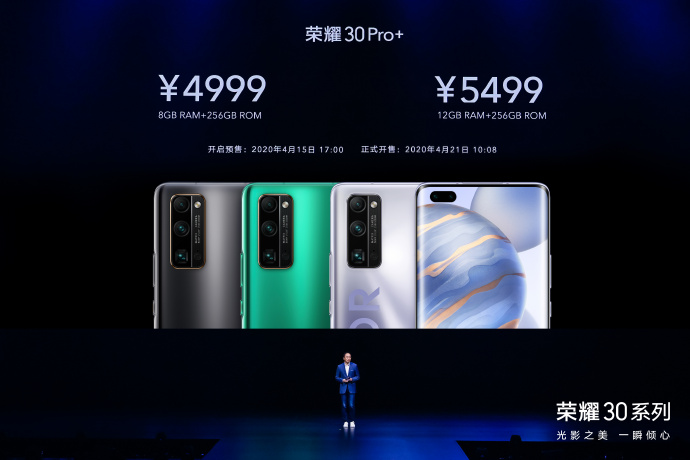
The Honor 30 and 30 Pro comes in four colors – Neon Purple, Black, Green, and Silver. The Honor 30 Pro+ has just three colors, Black, Silver, and Green. Interestingly, the Honor logo takes up nearly half of the back on all the three models.


Honor 30, 30 Pro, 30 Pro+ Cameras

The camera setup is the biggest highlight of all the three Honor 30 models. In fact, the Honor 30 Pro+ scored 125 on DxOMark, which is just shy of the top score of 128 by the Huawei P40 Pro.

Honor 30 Pro

So what’s so special about their cameras? The Pro+ shares the same primary camera as the P40 Pro and features a 50x telephoto periscope lens too!

Honor 30 Pro+ camera specs – Triple Cameras 

  • 50MP RYYB IMX700 sensor – same as the P40 Pro – large 1/1.28-inch sensor and 2.44um pixels
  • Periscope Telephoto Lens with 50x digital zoom, 10x hybrid zoom, and 5x optical zoom + Dual OIS
  • 16MP Ultra wide-angle lens with 17mm focal length and support for 2.5cm macro shots

Honor 30 Pro camera specs -Triple Cameras

  • 40MP RYYB IMX600 1/1.7″ sensor
  • Periscope Telephoto Lens with 50x digital zoom, 10x hybrid zoom, and 5x optical zoom + Dual OIS
  • 16MP Ultra wide-angle lens with 17mm focal length

Honor 30 camera specs – Quad Cameras

  • 40MP RYYB IMX600 sensor
  • 8MP Ultra Wide Angle Lens
  • Persicope Telephoto lens with 50x optical zoom and 10x hybrid zoom
  • 2MP Macro Lens

The Honor 30 comes with a single 32MP punch hole camera while the Pro models have a 32MP + 8MP (wide angle) dual front camera solution.


Honor 30, 30 Pro, 30 Pro+ Specs

The Honor 30 comes with a flat 6.53-inch OLED display with 1080p FHD+ resolution. The screen is a regular 60Hz refresh rate panel and features a single punch-hole camera on the top left corner.  The Honor 30 Pro and Pro+ models feature a 6.57-inch curved OLED panel up front with dual punch-hole cameras. The resolution is 1080p FHD+ on both the models but the Pro+ comes with a higher 90Hz refresh rate panel and 180Hz touch sampling rate. All three models have in-display fingerprint sensors.

Honor 30 Pro

As for the hardware, the Honor 30 comes with the new octa-core Kirin 985 chipset with Mali-G76 GPU. The Kirin 985 is a slightly toned-down version of the Kirin 990 chip that powers the Honor 30 Pro and Pro+ models. Both the Pro variants have Mali-G77 GPU inside. The Honor 30 comes in 6GB RAM and 8GB RAM with 128GB and 256GB ROM options. The Honor 30 Pro has 8GB and 128GB /256GB ROM variants while the Pro+ comes in 8GB / 12GB RAM and 256GB ROM variants.

All three Honor 30 models support dual-mode 5G and NFC. The Honor 30 has Wi-Fi 6 while the 30 Pro and Pro+ have Wi-Fi 6+ support. The Pro models also come with VC cooling to ensure better heat dissipation even during long hours of gameplay. The Pro variants also have stereo speakers with Histen sound effects for an immersive entertainment experience.

All three models feature a 4000mAh battery with 40W fast wired charging. However, the Honor 30 Pro+ adds support for 27W fast wireless charging as well. They run on Android 10 based Magic UI 3.1.1.


Honor 30, Honor 30 Pro, Pro+ Pricing & Availability

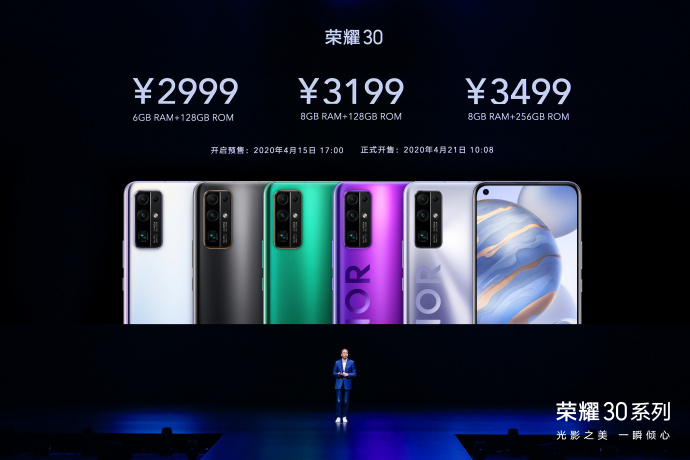
The Honor 30 starts at 2999 yuan ($425) for the 6GB RAM + 128GB ROM model and goes up to 3199 yuan ($453) and 3499 yuan ($495) for the 8GB RAM + 128GB ROM and 8GB RAM + 256GB ROM models respectively.
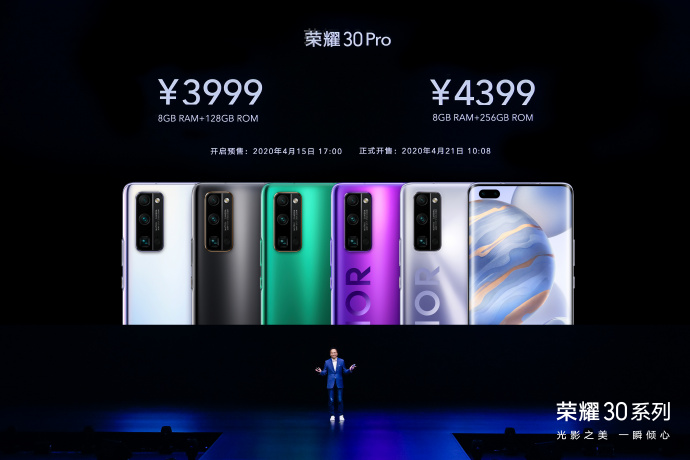
The Honor 30 Pro starts at 3999 yuan ($566) for the 8GB RAM + 128GB ROM model and goes up to 4399 yuan ($623) for the 8GB RAM + 256GB ROM variant.

Finally, the Honor 30 Pro+ starts at 4999 yuan ($708) for the 8GB RAM + 256GB ROM model and goes up to 5499 yuan ($778) for the 12GB RAM + 256GB ROM variant.

All the three models are up for pre-orders in China and will go on sale for the first time on April 21 at 10:08 AM.
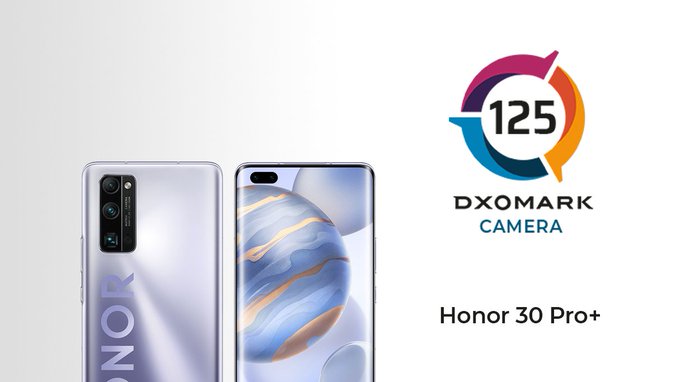


Honor 30 Pro+ achieves the second highest DxOMark camera rating, Scores 125 points

Honor, the Huawei subsidiary, had recently unveiled its flagship Honor 30 series. Now, the Chinese company’s high end Honor 30 Pro+ has received the second-highest DxOMark rating by scoring 125 points, which is just slightly below the Huawei P40 Pro.

For those unaware, DxOMark is a renowned benchmarking and rating platform that generally reviews professional-grade or digital camera, and recently, smartphones as well. They use various tests in different conditions and environments to get the clearest possible results and have become a standard for ratings in the smartphone industry in recent years.

Honor

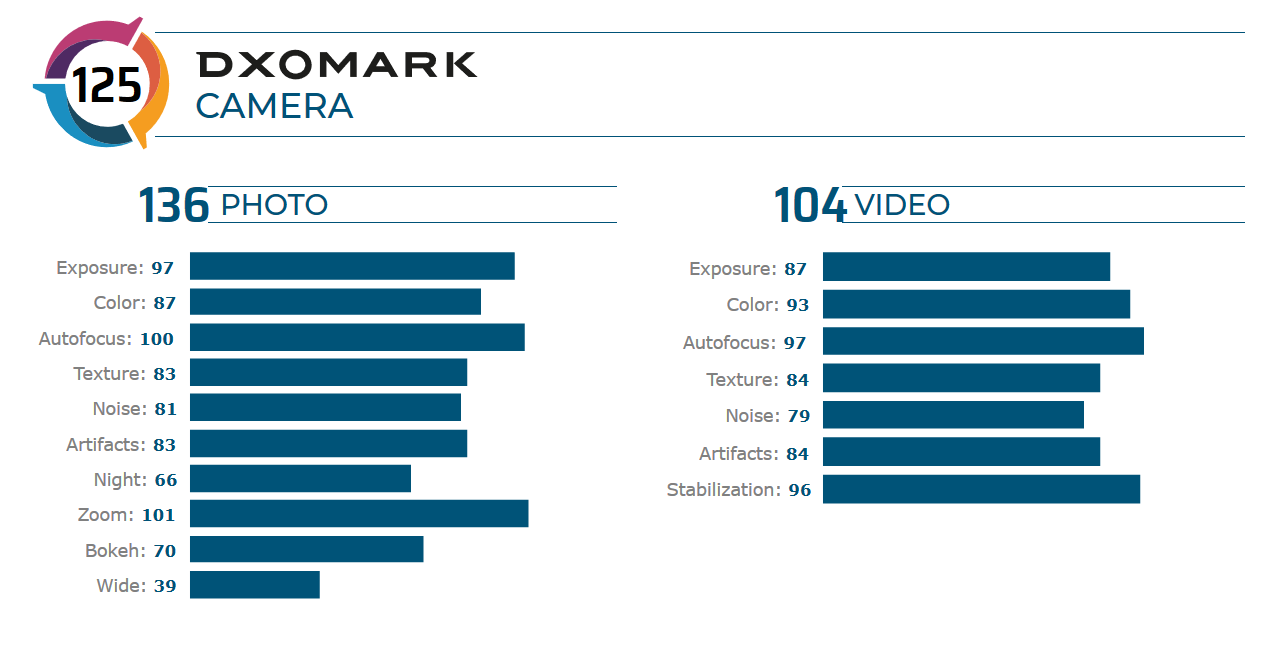
Arriving at the score, the Honor 30 Pro+ scored a total of 125 points, which includes 136 points for photography and 104 points for videography. Starting with the former, the premium flagship received an impressive score. The device’s zoom capabilities were specifically praised, while the autofocus, exposure, and color also achieved high ratings. The Honor 30 Pro+ features a 50 megapixel primary sensor alongside a 16 megapixel ultra wide lens and 8 megapixel telephoto lens.

Arriving at the video scores, aspects like exposure, colors, and autofocus again received impressive ratings while the overall stabilization was one of the key highlights in this area. Videos were found to have detailed textures with natural colors. Notably, the smartphone is also capable of 4K (2160p) recording at 60fps, which is the current standard in flagship smartphones.

Honor

Overall, the Honor 30 Pro+ featured good dynamic range, textures, fast autofocus, and good stabilization. However, it did suffer from low saturations during low light scenarios and a loss of sharpness in a few pictures that were zoomed in. White balance was also an issue when capturing videoes, but the handset is still one of the best smartphones DxOMark has ever rated.


(Source)

Magic UI 3.1 Closed Beta Update is now rolling out to Honor 20, Honor V20, and Honor V30 series

Huawei introduced EMUI 10.1 alongside the P40 series last month. Since then, the company has announced a list of eligible devices and even updated some of them with a closed beta build in China. As for Honor devices, the new EMUI iteration is known as Magic UI 3.1 and only one device has received it so far. But now, the brand has started rolling out the update to more devices such as Honor 20 series, Honor V30 series, and Honor V20. 

Honor V30 Pro 5G

Huawei has been seeding out EMUI 10.1 closed beta updates to multiple devices over the past few days. The first batch of devices included the P30 Series and Mate 30 series, which was later followed by Nova 5 series and Honor 20S (Magic UI 3.1). Recently, even the company’s first 5G smartphone, the Mate 20X 5G also got the update.

With that being said, the new set of Honor smartphones that are currently receiving the Magic UI 3.1 closed beta update in China are as listed below.

The Magic UI 3.1 closed beta update for Honor 20 (YAL-Al00, YAL-TL00), Honor 20 Pro (YAL-AL10), and Honor V20 (PCT-AL10, PCT-TL10) comes with build number Magic UI 10.1.0.116.

Whereas, the update for Honor V30 ( OXF-AN00) and Honor V30 Pro (OXF-AN10) bear the build number Magic UI 3.1.0.75.


Master Lu: Smartphone brand market share in Q1 2020 (China)

Master Lu, the Chinese benchmarking platform, has just released a data report regarding the market share of smartphone brands in Q1 of 2020 in China. The rankings feature major brands and also lists rankings for other categories as well.

Master Lu

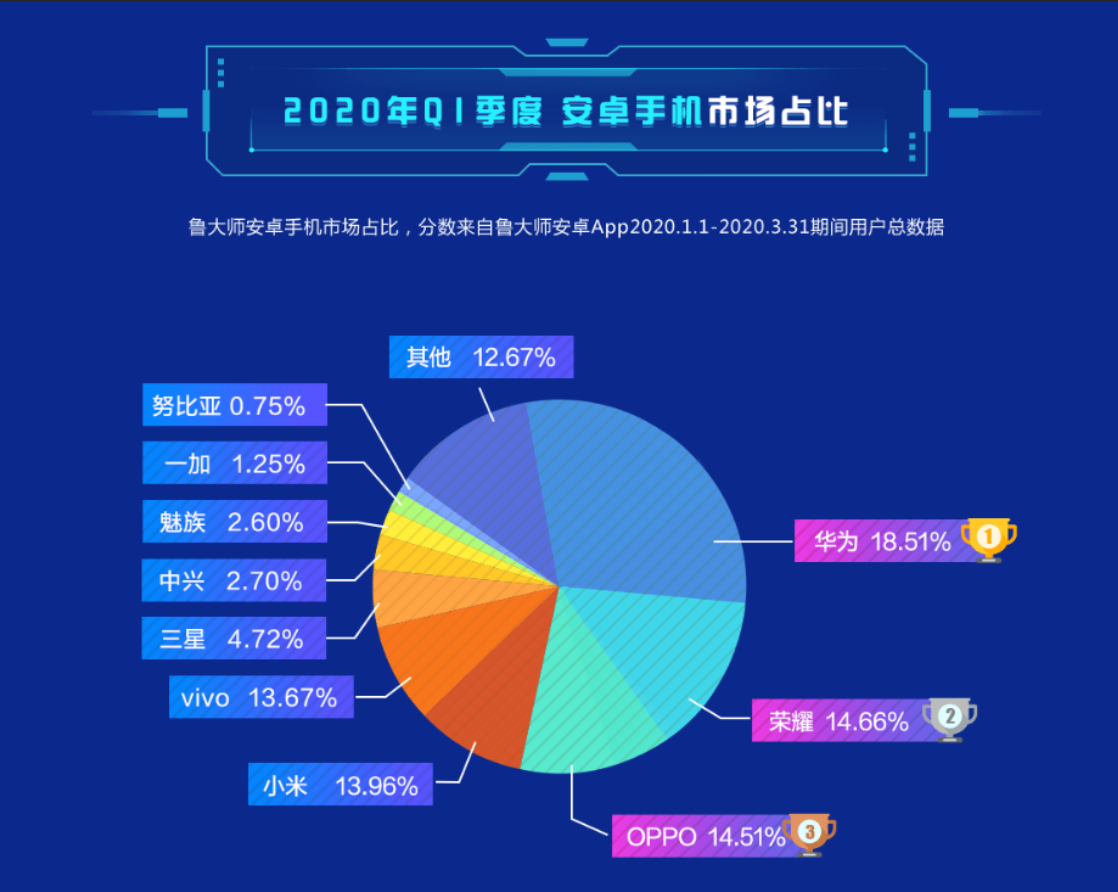
According to Master Lu, Huawei ranked first with a market share of 18.51 percent, which was closely followed by its subsidiary Honor that arrives second with 14.66 percent. In other words, the group took a total of 33.17 percent market share alone. In the first quarter of 2020, Oppo surpassed Xiaomi, ranking third with a market share of 14.51 percent.

On the other hand, Xiaomi had a market share of 13.9, with Vivo just behind it with a market share of 13.67 percent. Other smartphone brands like Samsung (4.72%), ZTE (2.7%), Meizu (2.6%), OnePlus (1.25%) and Nubia (0.75%). Keep in mind, that the figures shared above are just for the first quarter of 2020, and only serve as a reference at this period of time and are also heavily influenced by the ongoing Coronavirus pandemic.

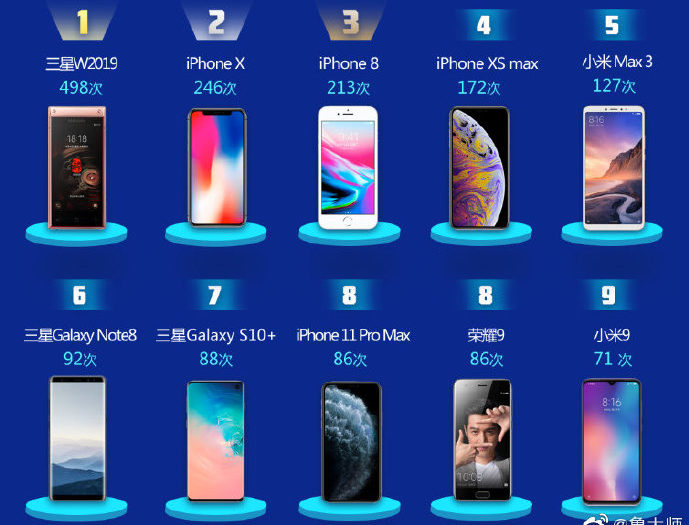
Master Lu Top 10 most-faked smartphones

Notably, Master Lu had also recently published a report regarding the most commonly faked smartphone brands as well, which we had previously covered. Furthermore, the firm also publishes rankings for software UI, chipset rankings, smartphone performances and more. So stay tuned for updates regarding these as well.


(Via)

No! McDonald’s didnt release a 5G phone – it’s a new Fried Chicken

Earlier this week, we had reported on bizarre news that had pointed at McDonald’s, the popular fast food franchise, launching a 5G smart product. The company had released various teaser poster images that depicted a device with thin bezels, but all of those have turned out to be untrue. What McDonald’s actually released is a new fried chicken.

McDonald's

This was move was obviously done in a humorous manner and also involved jumping on the 5G bandwagon that the smartphone industry is on. McDonald’s is well known for its famous McNuggets, and this crispy fried chicken is also in line with the same. It will be available in China and has been made with special sauces and spices, according to official notes.

Although McDonald’s didn’t actually end up launching a 5G product, but it was a hilarious campaign. To begin with, the company isn’t based around or related to technology, but boasts of launching a 5G smart product without any pre announced partnership with any electronics company.


(Via)

OnePlus 8 Pro undergoes a Durability, Scratch and Bend test

OnePlus had just officially announced the OnePlus 8 series yesterday (14th April 2020). The Chinese company unveiled the OnePlus 8 and 8 Pro, which are also one of the most expensive handsets the company has launched to date. And now, popular content creators have already started uploading there videoes regarding the device, including JerryRigEverything that has made the flagship go through a durability test.

OnePlus smartphones have typically passed the durability test set by JerryRigEverything, and so did the OnePlus 8 Pro. In the video, he can be seen scratching the device in different areas like the screen, metal frame, rear camera module and even the cover. Similar to most phones with Gorilla Glass protection, the screen passed the scratch test until level 6 and managed to still retain functionality.

Although, it was impressive that the soft metal cover on the rear held up quite well, being wear resistant. The OnePlus 8 Pro was also subjected to a burn test that had the device survive again, but with a small white spot where it was directly subjected to the high temperatures. Notably, this also marks the first time an OnePlus device has been rated IP68 for water and dust resistance officially.

OnePlus

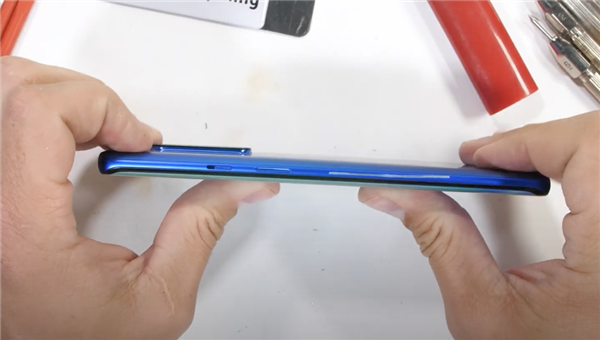
The final hurdle the premium grade flagship had to pass was the bend test, which it survived once again. For a high price tag starting from 899 US Dollars for the OnePlus 8 Pro, decent build quality and endurance is to be expected.


Realme LED TV variants and remote control spotted at Bluetooth SIG; Likely to launch soon

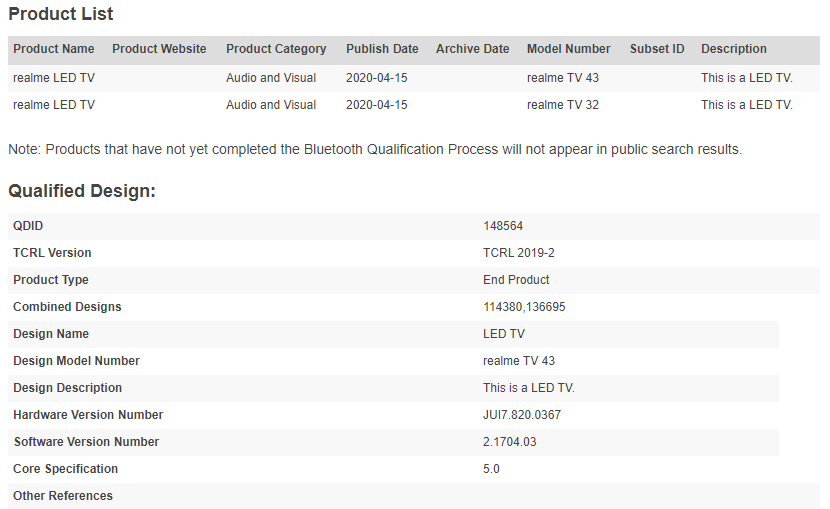
At the beginning of this year, Realme had confirmed that it will be launching its first smart TV this year. The company hasn’t yet confirmed a specific timeframe for Realme TV’s arrival. Two variants of the Realme TV have surfaced on the database of Bluetooth SIG certification body. The Realme remote control was approved by the certification platform earlier this month. These approvals suggest that the Realme TV launch date may not be far away.

Realme LED TV Bluetooth SIG

The Bluetooth SIG certification has revealed that the first TVs from Realme may arrive in the market as “Realme LED TV.” The listing reveals that it will be arriving in the market in 43-inch and 32-inch screen sizes. Both will carry support for Bluetooth 5.0 connectivity. The 43-inch model was recently spotted at the database of Bureau of Indian Standards (BIS) earlier this month.

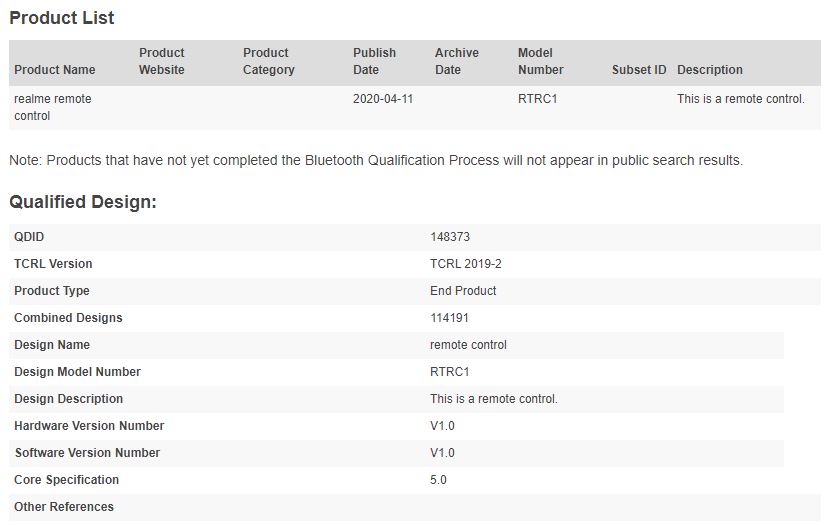
Realme remote control Bluetooth SIG

The remote control for Realme LED TV’s Bluetooth certification reveals that is enabled with Bluetooth 5.0. Products are known to go official around a month after their Bluetooth SIG certification. Hence, there is a possibility that the Realme LED TV may debut in May. There is no information available on the specifications of the Realme LED TV.

Rumors surrounding the Realme TV suggest that there could be a larger and premium TV with a 55-inch QLED display. It was approved by BIS authority in February. The Realme 55-inch QLED TV is expected to rival with QLED TVs from other brands like Samsung and OnePlus. The BIS approvals suggest that 43-inch and 55-inch Realme TVs will be heading to India.


(source 1, 2)

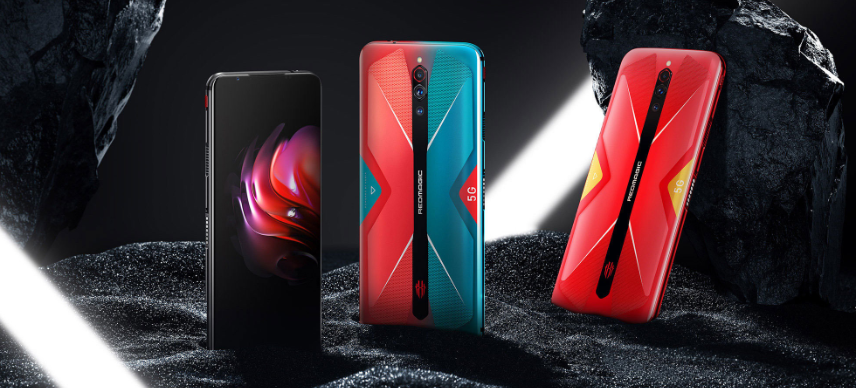
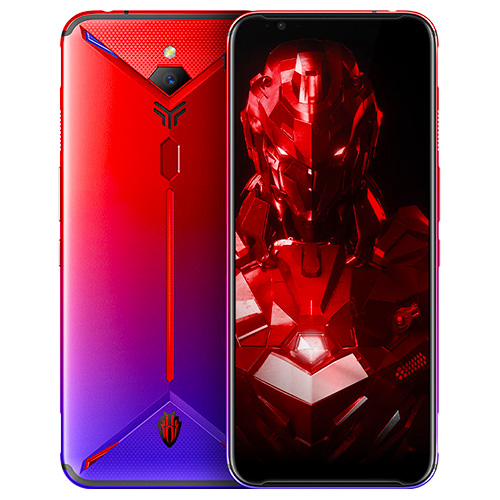
Nubia Red Magic 5G smartphone is now available for purchase globally

A couple of months ago, in March this year, Nubia launched its latest gaming smartphone named Nubia Red Magic 5G in its home market China. Now, the same device is getting launched globally.

While the phone comes in four different memory configuration in China, the overseas market gets only two variants — 8GB RAM with 128GB internal storage and 12GB RAM model that packs 256GB storage.

The 8GB RAM model comes in Eclipse Black and Hot Rod Red colors for a price of $579/€579/£539 while the 12GB RAM model is priced at $649/€649/£599 and comes in just one color — Pulse Neon.

The Nubia Red Magic 5G comes with 6.65-inch AMOLED display with 2340 x 1080 pixels screen resolution and 144Hz refresh rate, making it the first smartphone in the world to offer such high refresh rate. It also offers an in-display fingerprint sensor.

Under the hood, the device is powered by the Qualcomm Snapdragon 865 processor, coupled with Adreno 650 GPU to provide the best mobile gaming experience. While the phone comes with up to 16GB LPDDR5 RAM, the global variant is limited to 12GB.

ZTE nubia Red Magic 5G

As for the camera department, the phone features a triple-camera setup on the back that consists of a 64MP Sony IMX686 primary camera sensor, an 8MP ultrawide angle camera lens, and a 2MP macro sensor. On the front side, the device comes with an 8MP snapper for taking selfies and video calling.

The company has added a set of seven contact pins on the left side of the phone. These pins are for a dock which when connected allows you to charge, connect earphones and also connect a network cable all at the same time.

The 5G smartphone comes with dual cooling technology that is termed ICE 3.0 and is a combination of air cooling and liquid cooling. The device is powered by a 4,500mAh battery which comes with support for 55W (10A high-current) air-cooled turbo fast charging as well as PPS fast charging, Quick Charge 4.0 and Power Delivery 3.0.


Nokia 7.3 may arrive with 48MP or 64MP quad camera system

A recent report hd revealed that HMD Global may announce the Nokia 9.3 PureView flagship phone along with the Nokia 7.3 upper mid-range phone in Q3 this year. The Nokia 7.2 smartphone that went official in September 2019 was equipped with a 48-megapixel triple camera system. A new report on Nokia Power User states that the Nokia 7.3 will be arriving with an enhanced quad camera system.

The publication has learnt from its sources that the Nokia 7.3 will be arriving with much-improved camera capabilities than the predecessor phone. It is rumored to arrive with a quad camera system. Considering that the Nokia 8.3 5G and Nokia 5.3 are equipped with round-shaped camera module, the four cameras of the Nokia 7.3 could be arranged in circular camera setup.

NPU has said that the final camera configurations of the Nokia 7.3 are not available yet. One prototype of the smartphone reportedly features a Zeiss optics 48-megapixel sensor. There is a possibility that it may feature a 64-megapixel main lens. The other camera sensors of the Nokia 7.3’s quad camera system may comprise of a depth sensor, a macro shooter and a ultrawide lens.

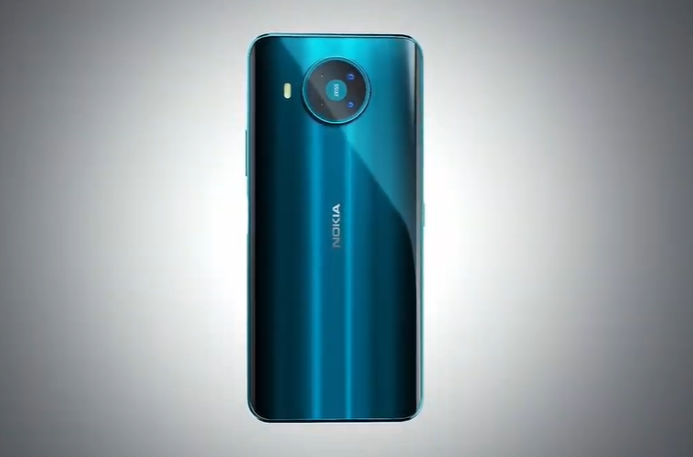
Nokia 8.3 5G
Nokia 8.3 5G

The Nokia 7.3 may sport a selfie camera of 24-megapixel or 32-megapixel. The predecessor phone has a 24-megapixel selfie camera and the newly introduced Nokia 8.3 5G is also fitted with a 24-megapixel. It remains to be seen whether the company settles for a selfie camera with a higher megapixel count on the Nokia 7.3.

The Snapdragon 660 chipset fueled the Nokia 7.2. There is a possibility that the company may use a Snapdragon 7-series to power the Nokia 7.3. There is a speculation that the handset could be available in 4G and 5G versions.


(source)

Samsung demos ‘full potential’ of 5G mmWave with speeds of 8.5Gbps

Samsung has announced that the company has achieved the industry’s fastest 5G speeds in a lab demonstration that combined 800MHz of mmWave spectrum with MU-MIMO technology, running on Samsung 5G mmWave Access Unit.

The company said that it pushed a total of 8.5Gbps to a pair of mobile phones in a lab test that used 800MHz of millimetre wave (mmWave) spectrum and carrier aggregations to deliver approximately 4.3Gbps to each of the devices.

Samsung

Samsung said the test showed mmWave was capable of delivering multi-gigabit speeds that lower spectrum bands were incapable of. Millimetre wave radios are already setting cellular speed records, and now Samsung is showing how new small cells will be accelerating downloads on multiple devices.

The company says that the wide bandwidth from mmWave spectrum enables mobile operators to provide multi-gigabit speeds that lower band spectrums for transformational 5G mobile services. It adds that mobile operators will be able to deliver new and rich services such as 8K video streaming, AR remote learning and holistic VR teleconferencing as well as new use cases.

Several countries, including Japan, South Korea, and the United States of America have already assigned 5G mmWave spectrum, and two of them have already launched their commercial 5G services using the spectrum. Samsung says more than 15 nations are expected to join the 5G mmWave club in the coming years.


Qualcomm and BOE partners to make Flexible Displays with 3D Sonic Sensors

Qualcomm has announced that it has partnered with BOE Technology Group, one of the leading player in the displays market, to produce new flexible displays that feature the 3D Sonic ultrasonic fingerprint sensors.

The company has also begun working on incorporating its security feature into BOE’s flexible OLED panels. Qualcomm says that this partnership is intended to provide a more streamlined solution to OEMs.

Qualcomm Logo

Roawen Chen, senior vice president and chief operations officer, QCT, Qualcomm Technologies, Inc, said: “Qualcomm Technologies continuously strives to improve our collaboration in China, and collaboration with BOE will be another example of the dedication and our long-term commitment to driving innovations in this vibrant ecosystem.

He adds that the collaboration will offer more opportunities to design cutting-edge products that feature OLED displays made with the Qualcomm 3D Sonic fingerprint sensor technology, in the areas like 5G, XR and IoT.

Qualcomm also believes that this partnership will result in a streamlined supply chain and reduced bill of materials (BoM) and research and development expenses. Based on the collaboration, BOE will offer integrated displays with Qualcomm 3D Sonic fingerprint sensors to its customers. It further adds that commercial devices featuring this integrated solution are expected to be available in the second half of 2020.

(Source)

Nokia 9.3 PureView likely to come with 120Hz display

If recent reports are to be believed, HMD Global is repeatedly delaying the arrival of the Nokia 9.3 PureView flagship phone. It is speculated to break cover in the second half of the year. A recent report had claimed that the Finnish firm will hold an unveil event in Q3 to announce the Nokia 9.3 PureView and Nokia 7.3 smartphones.  The probable reason behind the delay of the Nokia 9.3 PureView is that the company could be working on adding features that will allow it to rival with other flagship phones. The handset is now rumored to arrive with a high refresh rate display.

According to Nokia_anew that is known for its credible leaks on the upcoming Nokia phones, the Nokia 9.3 PureView will be equipped with a 120Hz refresh rate display. If this rumor turns out to be true, the Nokia 9.3 PureView will be able to rival with the likes of Samsung Galaxy S20 and OnePlus 8 Pro.

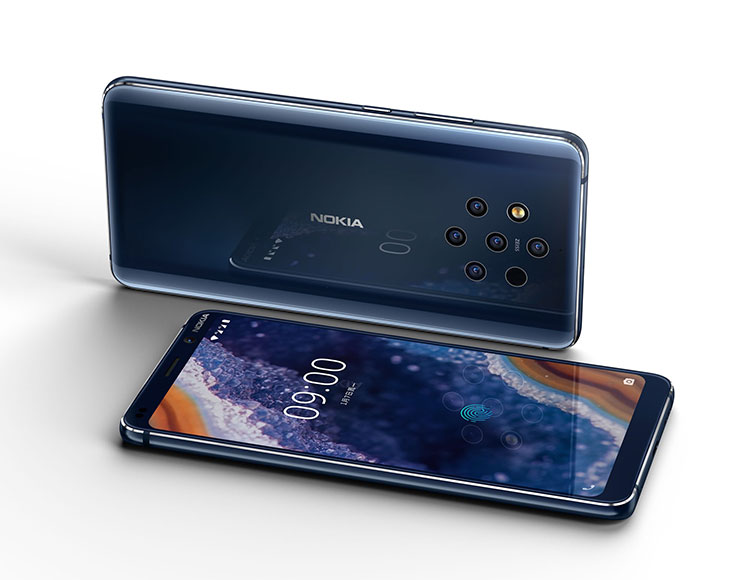
Nokia 9 Pureview
Nokia 9 Pureview

There is no information available on the display design of the Nokia flagship. It would be good if the company offers a curved display on the Nokia 9.3 PureView.

The Snapdragon 865 mobile platform is expected to fuel the device. Being a part of the Android One program, the smartphone may run on the stock version of Android 10 OS. After the recently announced Nokia 8.3 5G, it will be the second phone to arrive with 5G support.

The Nokia 9.3 PureView is expected to sport a penta-lens setup like the predecessor model. Nokia_anew has also claimed that the smartphone may either feature a Samsung made 64-megapixel or 108-megapixel primary lens. The setup may include a telephoto lens, a depth sensor, a macro shooter. The company is also expected to add support for OIS for photography. It may flaunt a 48-megapixel front camera. Some reports have claimed that it may sport an under-display camera.


(source)

Nubia Play 5G smartphone confirmed to launch in China on April 21

Days after unveiling its new logo and brand vision, ZTE-backed Nubia has today confirmed that it will be holding an online launch event on 21st April to launch its new device named Nubia Play which will have 5G connectivity support.

The company has not yet revealed anything related to this upcoming smartphone but going by the name, it seems likely that the Nubia Play will be a gaming smartphone. However, Nubia already has a gaming lineup under the Red Magic series.

Nubia Play Poster

So, we expect the upcoming Nubia Play smartphone to be a youth centric device and a mid-range gaming device, since the brand’s Red Magic lineup already covers the premium gaming market.

Interestingly, the company had also launched a smartphone series named Nubia M2 Play back in 2017. So, this could a part of that lineup and the company may have decided to ditch the ‘M2’ branding. To know for sure, we’ll have to wait for a few more days.

Recently, a Nubia smartphone with model number NX651J was spotted on 3C certification website which could be the upcoming Nubia Play 5G smartphone. The listing shows that the phone could have 30W fast charging support and is compatible with Quick Charge, PD, PPS and other charging protocols.

This will also mark the first device getting launch after the company unveiled its new logo, which has ditched the red dot design and has adopted a typography-based modern and bright red-colored branding.


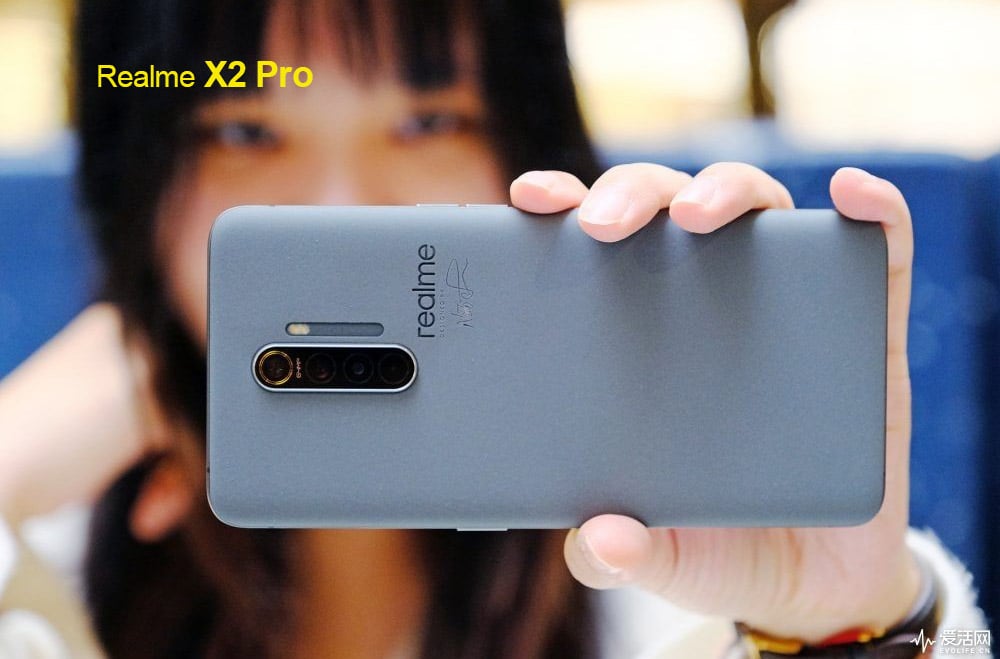
Buy Realme X2 Pro Global Version for $399 from Giztop [$20 Off Coupon]

In Oct. 2019, Realme announced its first flagship phone in China and Europe. Dubbed as the Realme X2 Pro, the Chinese smartphone manufacturer’s latest handset was made available in the Indian market in November last year.

realme x2 pro

Marketed as the ‘Full Speed Flagship,’ the Realme X2 Pro has a global version that you can buy from Giztop. The Realme X2 Pro Global Version ships with 8GB of RAM and offers a hefty 128GB of internal storage space for you to save your favorite content.

The aforesaid model would normally set you back $419, but Giztop is giving you a chance to save a considerable amount of money even before you place your order. You can apply coupon code RealmeX2Pro20 to save $20 at the time of checking out.

In other words, you can bring the already reasonable asking price of the Realme X2 Pro further down to just $399 simply by applying the aforesaid coupon code. An absolute steal at this price, the X2 Pro Global Version sports a 6.5-inch Super AMOLED full HD+ display with a refresh rate of 90Hz.
Realme X2 Pro Global Version

Moreover, it is powered by a Snapdragon 855 Plus 2.96GHz Octa-core processor and packs a highly competent Adreno 640 GPU under the hood. In the optics department, the X2 Pro Global Version features a quad-camera set up at the back comprising a Samsung GW1 64MP, 13MP, an 8MP, and a 2MP camera. Upfront, it houses a 16MP selfie camera.

The Realme X2 Pro Global Version is backed by a 4000mAh battery that supports 50W SuperVOOC flash charge and USB-PD and 18W rapid charging. Aside from that, it runs ColorOS 6.1 Realme Edition based on Android 9.0 Pie OS and even supports dual-frequency GPS, and NFC.

You can head straight to this link to check out more details about the Realme X2 Pro Global Version and take advantage of the $20 Off Coupon before it expires.

The Gizmochina Coupons is a community that finds, reports and evaluates deals and coupons of Chinese products from online shops. Please visit it here to find more coupons to save money on mobiles and smart gadgets.

Oppo Enco W31 True-Wireless Earphones now available on Giztop for Just $56.99

On Apr. 13, Oppo gave us a brief glimpse of its new earbuds dubbed Enco W31 TWS earbuds via various videos. The latest entrant in the Enco series, the Enco W31 is a Bluetooth earphone that offers one of the lowest delays in audio, coupled with 94ms latency.

Oppo Enco W31

The recently unveiled earbuds have gone up for sale bearing an unbeatable price via Giztop, one of China’s most reliable e-tailers. Carrying a $56.99 price tag, the Oppo Enco W31 earbuds come in three eye-catching color options including white, pink and black.

These Oppo-branded true-wireless earphones sport an open-fit design and come with silicone in-ear tips to ensure a better fit for a longer duration. Featuring a smooth matte surface, the charging case also serves as a wireless charger for the earphones.

The USB-C port can be used to recharge both the case, as well as the buds. Moreover, the Enco W31 uses Bluetooth low-latency dual transmission for a faster connection experience. On top of that, there is a noteworthy improvement in Bluetooth anti-interference ability.
OPPO Enco W31

The Enco W31 offers the bass mode and the balanced mode, and you can simply double-click the left bud to switch between the modes. Moreover, the earbuds draw their juices from a robust battery that lasts 3-5 hours, and 15 hours with the charging case, which is backed by a 350mAh battery.

The earbuds have passed through IP54 dustproof and waterproof and the professional structure design certification. You can enjoy your favorite music for 1 hour after charging for only 10 minutes and don’t even need to worry about sweat and accidental splashes whether in the gym or on the go.

Integrated with dual microphone beamforming technology, the Enco W31 has a wind noise-proof cavity design, and supports the ENC noise reduction algorithm, allowing you to make clear calls even in noisy settings. You can follow this link to know more about these amazing earbuds from Oppo and place your order.

Motorola Edge Geekbench listing appears ahead of April 22 launch

Motorola will be holding an unveil event on April 22 to announce the new Edge series of smartphones. The Lenovo-owned company is expected to announce Motorola Edge and Edge+ smartphones. The latter is a 5G flagship phone powered by Snapdragon 865 mobile platform whereas the former is an upper mid-range phone with 5G capabilities. Ahead of the April 22 launch, the Motorola Edge has been spotted on Geekbench benchmarking platform.

The Motorola Edge+ was spotted on Geekbench 5 at the beginning of this year. Now the vanilla Edge phone has surfaced on Weibo with Qualcomm’s octa-core chipset that has a base frequency of 1.8GHz. Based on the reports surrounding the Motorola Edge, it can be said that the Qualcomm SoC that powers it is the Snapdragon 765.

The Geekbench 5 listing of the Motorola Edge reveals its “racer” codename and further states that it is equipped with 6 GB of RAM and Android 10 OS. It recorded a single-core score of 505 and a multi-core score of 1410.

Motorola Edge specifications (Rumored)

The specifications of the Motorola Edge phone are no secret as they had emerged in the previous month. The handset will be flaunting a waterfall OLED panel of 6.67 inches with extremely curved edges. It will be a punch-hole screen that will offer full HD+ resolution and a refresh rate of 90Hz. The display cutout will be housing a selfie camera of 25-megapixel.

The back panel of the phone will be fitted with a triple camera system that will comprise of a 64-megapixel primary shooter, a 16-megapixel ultrawide lens and an 8-megapixel telephoto sensor.

The Motorola Edge may draw power from a 4,500mAh battery. Some of the other features that are expected to be available on the Edge include fast charging support, in-display fingerprint reader, dual speakers, NFC, 3.5mm audio jack and USB-C. There is no word on its pricing.


(via)

iQOO Neo3 with punch-hole display appears in teaser video

iQOO has recently confirmed that it will be unveiling the Snapdragon 865 mobile platform powered iQOO Neo3 phone on April 23. The company has also confirmed that it will be arriving with a 144Hz refresh rate supporting display. A new video teaser released by the company on Weibo reveals the front design of the iQOO Neo3.

Past reports have revealed that the iQOO Neo3 will be arriving with a punch-hole display. It is now officially confirmed through the video teaser that the Neo3 will indeed house a display that features a punch-hole at the top-right corner like the iQOO 3 5G. However, unlike the iQOO 3 5G that has an AMOLED panel, the Neo3 is rumored to be equipped with an LCD screen. The exact size of the iQOO Neo3 phone is not known yet.

iQOO Neo3 in teaser video

So far, the company has confirmed that the iQOO Neo3 features Snapdragon 865 SoC and UFS 3.1 storage. Recent reports have revealed that the base model of the phone will be equipped with 6 GB of RAM and 128 GB of built-in storage. The FunTouch OS 10 based Android 10 OS will come preloaded on the device.

Some other rumors surrounding the smartphone have claimed that it is equipped with a 48-megapixel quad camera setup on its back. The device may house a 4,500mAh battery along with support for 44W fast charging. The model number of the iQOO Neo3 is V1981A. The handset is yet to appear at the databases of 3C and TENAA regulatory bodies of China.

With a price tag of 2,999 Yuan (~$425), the Redmi K30 Pro is available in China as the most affordable Snapdragon 865 powered phone. It is speculated that the iQOO Neo3 may bag the title of the cheapest SD865 phone by arriving with a starting price of 2,998 Yuan.


Meizu 17 Pro 3C certification hints 40W rapid charging support

Yesterday, Meizu took to Weibo to confirm that it will be announcing some vital information on the upcoming Meizu 17 smartphone on April 17. The machine translated text of the forthcoming event describes it is as “Meizu 17 mSmart 5G fast and stable technology sharing meeting.” Hence, it appears that it may not be a launch event, but some sort of a platform to share the 5G-related innovations that could available on the Meizu 17.  Rumors surrounding the Meizu 17 have revealed that it could be accompanied by a more advanced model called the Meizu 17 Pro. The Pro variant seems to have received approval from the 3C authority of China.

A new 5G-enabled Meizu phone with model number M091Q has been spotted at 3C. The listing reveals that the phone could be arriving with a UP2018 charger that supports up to 20V/2A charging speeds.

Meizu 17 and Meizu 17 Pro 3C certification

Earlier this month, the Meizu 17 that has a model number of M081Q had bagged 3C certification. It had reveled that the phone may ship with a 30W fast charger. Hence, it appears that the M091Q phone could be the rumored Meizu 17 Pro handset that may arrive with 40W rapid charging technology.

The Snapdragon 855+ powered Meizu 16s Pro flagship phone from last year had arrived with 24W mCharge technology. Various Chinese smartphone OEMs are offering phones with faster charging capabilities. The new 3C listings reveal that Meizu too will offer enhanced charging speeds on the upcoming Meizu 17 5G series.

Meizu is yet to reveal the specifications of the Meizu 17 5G series. Both phones are expected to be powered by the Snapdragon 865 mobile platform and punch-hole display. At present, there is no information available on how the Meizu 17 Pro phone will differ from the Meizu 17 handset. It is speculated that the Chinese firm may also announce Meizu 17 Audio Special Edition smartphone alongside the Meizu 17 and 17 Pro.


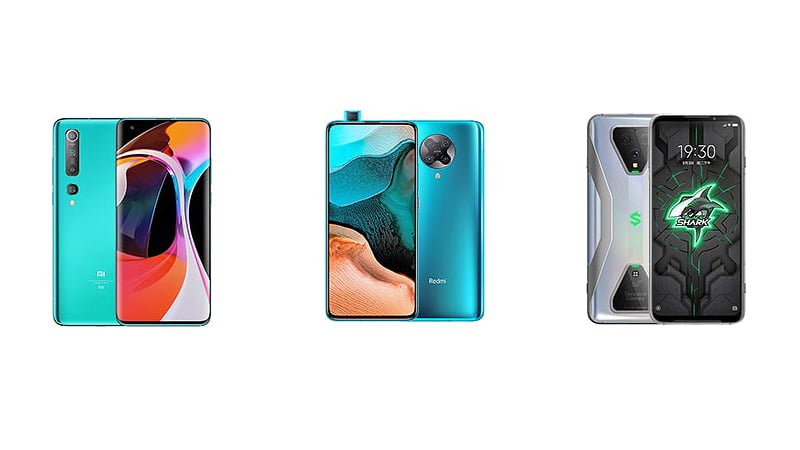
Xiaomi Mi 10 vs Redmi K30 Pro Zoom vs Black Shark 3: Specs Comparison

Until now, Xiaomi and brands connected to the company launched three affordable flagship smartphones series in 2020. We decided to compare them in order to clear all the doubts regarding their specifications and tell you which one is worth buying. One is Xiaomi Mi 10, which is the vanilla version of the main Xiaomi’s flagship lineup. Then we saw the Redmi K30 Pro series and for this comparison, we chose the Redmi K30 Pro Zoom that is the most advanced version of the K30 lineup. Last but not least, the gaming phone Black Shark 3. Here you will learn the differences between these handsets as well as their strong and weak points.

Xiaomi Mi 10 vs Xiaomi Redmi K30 Pro Zoom vs Xiaomi Black Shark 3

Xiaomi Mi 10 Xiaomi Black Shark 3 Xiaomi Redmi K30 Pro Zoom
DIMENSIONS AND WEIGHT 162.6 x 74.8 x 9 mm, 208 g 168.7 x 77.3 x 10.4 mm, 222 g 163.3 x 75.4 x 8.9 mm, 218 g
DISPLAY  6.67 inches, 1080 x 2340p (Full HD+), Super AMOLED 6.67 inches, 1080 x 2400p (Full HD+), AMOLED 6.67 inches, 1080 x 2400p (Full HD+), Super AMOLED
PROCESSOR Qualcomm Snapdragon 865, octa-core 2.84 GHz Qualcomm Snapdragon 865, octa-core 2.84 GHz Qualcomm Snapdragon 865, octa-core 2.84 GHz
MEMORY  8 GB RAM, 128 GB – 8 GB RAM, 256 GB – 12 GB RAM, 512 GB 8 GB RAM, 128 GB – 12 GB RAM, 128 GB – 12 GB RAM, 256 GB 6 GB RAM, 128 GB – 8 GB RAM, 128 GB – 8 GB RAM, 256 GB
SOFTWARE  Android 10, MIUI Android 10, MIUI Android 10, MIUI
CONNECTIVITY  Wi-Fi 802.11 a/b/g/n/ac/ax, Bluetooth 5.1, GPS  Wi-Fi 802.11 a/b/g/n/ac/ax, Bluetooth 5.0, GPS Wi-Fi 802.11 a/b/g/n/ac/ax, Bluetooth 5.1, GPS
CAMERA  Quad 108 + 13 + 2 + 2 MP, f/1.7 + f/2.4 + f/2.4 + f/2.4
20 MP f/2.0 front camera
Triple 64 + 13 + 5 MP, f/1.8 + f/2.3 + f/2.2
20 MP f/2.2 front camera
Quad 64  + 8 + 13 + 2 MP
20 MP front camera
BATTERY  4780 mAh, fast charging 30W, Fast wireless charging 30W 4720 mAh, fast charging 65W 4700 mAh, fast charging 33W
ADDITIONAL FEATURES Dual SIM slot, reverse wireless charging 10W, 5G Dual SIM slot, 5G, magnetic charging 18W, LED lights, shoulder buttons Dual SIM slot, 5G

Design

Xiaomi Mi 10 and Redmi K30 Pro Zoom come with very elegant and premium designs. The former sports a punch-hole display, while the latter has a notch-less and holeless screen thanks to the presence of a pop-up selfie camera. Both come with a glass back and an aluminum frame. But I personally prefer the Xiaomi Mi 10 due to its amazing curved display, its very high screen-to-body ratio and its very minimal glass back sporting a smaller camera module. Black Shark 3 is a gaming-centric device with a gaming-centric design, so its aesthetics are specifically targeted to gamers, who get useful shoulder buttons and LED lights.


Display

Xiaomi Mi 10 and Black Shark 3 are equipped with more advanced displays compared to the Redmi K30 Pro. The two flagships have two displays with the same specifications, including HDR10+ and a smooth 90 Hz refresh rate, as well as the Super AMOLED technology and a Full HD+ resolution. Redmi K30 Pro Zoom has HDR10+ as well, but unfortunately, it lacks a high refresh rate.


Hardware/Software

With all of these devices, you get the amazing Snapdragon 865 chipset by Qualcomm, despite their price is not excessive. On the paper, Redmi K30 Pro Zoom looks better since it sports UFS 3.1 native storage and up to 512 GB of internal storage. But the advanced cooling system of the Black Shark 3 and its gaming-centric features make it more interesting for power users. However, there will be only marginal differences in the performances of these three handsets. Android 10 and MIUI 11 are installed out of the box on all of these flagships.


Camera

If you need the most advanced camera, just do not go for the Black Shark 3. It lacks a high-end main camera and a telephoto sensor, so it simply not an impressive camera phone. Xiaomi Mi 10 has the most awesome main sensor with a 108 MP resolution, but the OIS-enabled 64 MP sensor found on the Redmi K30 Pro is supported by a better secondary sensor: we are talking about a telephoto lens with OIS and 3x optical zoom (absent on the Mi 10).


Battery

With the Xiaomi Mi 10, you get a bigger battery, but we suppose that Redmi K30 Pro Zoom will last more since it lacks a 90 Hz refresh rate. However, we still recommend the Xiaomi Mi 10 because of the marginal difference and the support to both wireless charging and reverse wireless charging. Black Shark 3 does not support wireless charging, but it has the fastest wired charging technology and it supports magnetic charging, which is very comfortable during gaming sessions.


Price

We will refer to the Chinese prices since China is the only country in which all of these phones are available. Redmi K30 Pro Zoom base is CNY 3,799 ($535), Xiaomi Mi 10 starts at 4299 Yuan ($610), and Black Shark 3 is priced at CNY 3,499 ($496) for the base variant. There is not a definitive winner of this comparison. As a casual user, I would go for the Xiaomi Mi 10 since it offers a better display than Redmi K30 Pro Zoom, a better camera than Black Shark 3 and wireless charging which is not present on both its rivals. But for gamers who do not care about high photo quality, Black Shark 3 is actually a better option. More or less, Redmi K30 Pro can be considered a Xiaomi Mi 10 with an inferior display and more interesting cameras.


Xiaomi Mi 10 vs Xiaomi Redmi K30 Pro Zoom vs Xiaomi Black Shark 3: PRO and CONS

Redmi K30 Pro Zoom

PROS

  • Nice cameras
  • UFS 3.1 storage
  • Holeless display
  • Up to 512 GB internal storage

CONS

  • Nothing particular


Xiaomi Mi 10 

PROS

  • Great design
  • Biggest battery
  • Wireless charging
  • Stereo speakers

CONS

  • Nothing particular


Xiaomi Black Shark 3

PROS

  • Gaming-centric
  • Stereo speakers
  • Magnetic charging
  • Good price

CONS

  • Design is not for all

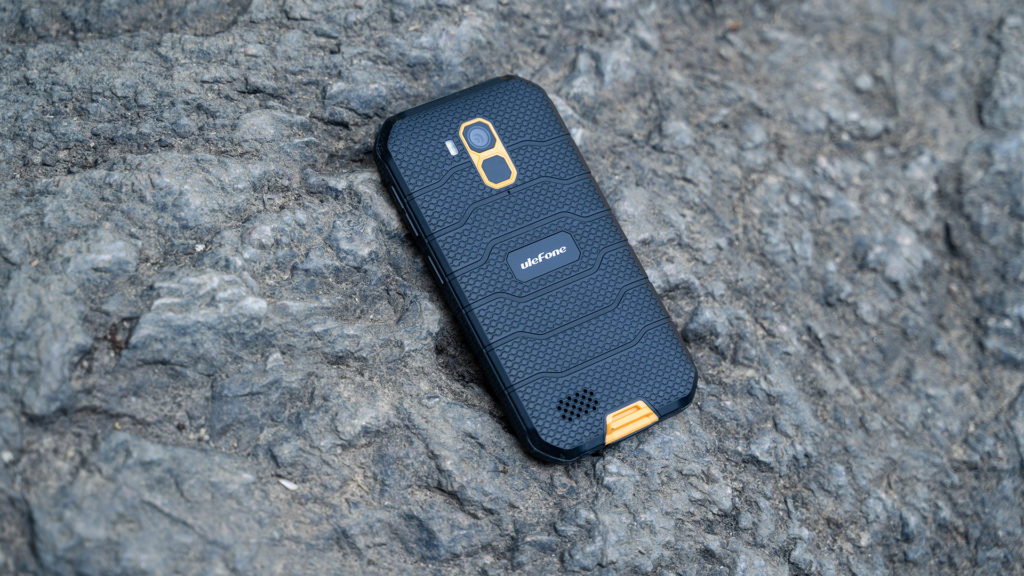
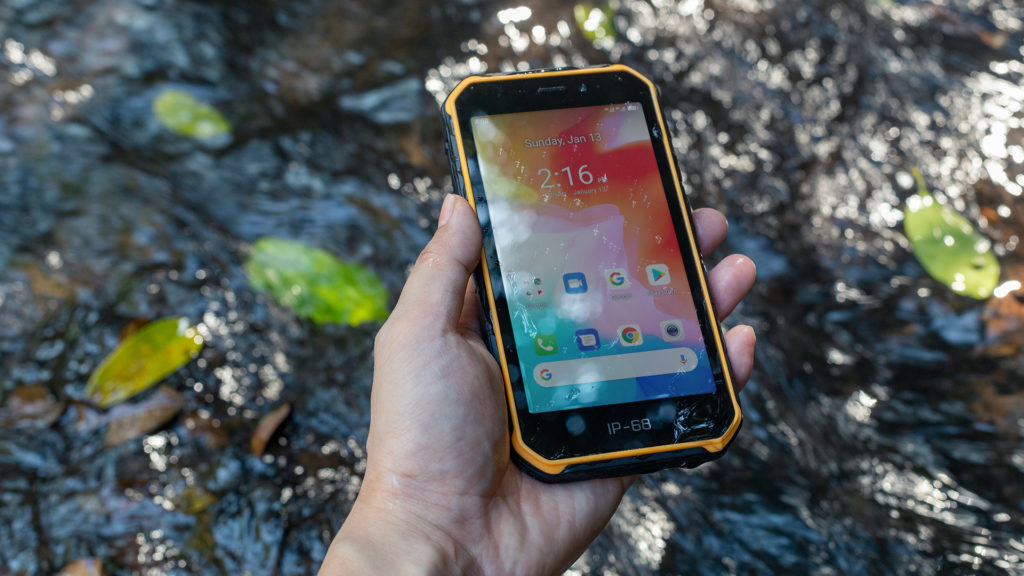
Ulefone Armor X7 passes with flying colors in screen rigidity test

Ulefone Armor X7 is an entry-level rugged smartphone that has gone through durability and various other tests to prove its metal. However, a new screen rigidity test has surfaced on YouTube showing the toughness of the screen. Ulefone Armor series is built to keep running amid any type of condition or situation. The Ulefone Armor X7 test video is showcased below:

Ulefone Armor X7 has gone through several tests in the video to confirm that the device sports a solid display. It has gone through a test cutting a cucumber or a piece of paper using a sharp knife on it. It is even tested using an electric drill, cracking walnuts, hammering nails to wood. The tester even pounded a concrete block and a hammer to hit against the display. After such torture, the Ulefone Armor X7 display remains intact without any sign of a tear.

ulefone armor x7

Ulefone Armor X7 sports a 5-inch LCD display with an IPS technology featuring 1280 x 720 pixels resolution and 294 PPI. In the camera department, there’s a 13-megapixel rear camera with video recording support of up to 1920 x 1080 pixels. On the front, there’s a 5-megapixel selfie camera with f/2.2 large aperture.

Ulefone Armor X7 supports 4000 mAh battery with built-in lithium-ion polymer battery while supporting 5W charging. There’s a fingerprint unlock touch sensor for fast authentication. In the connectivity, the smartphone will get GPS, GLONASS, Galileo, and digital compass. In sensors, there’s an acceleration sensor, p-sensor, l-sensor, m-sensor, e-compass, and fingerprint.

ulefone armor x7

Ulefone Armor X7 retails for $79.99 on Aliexpress. You can know more about the device, by heading over to the official website.